
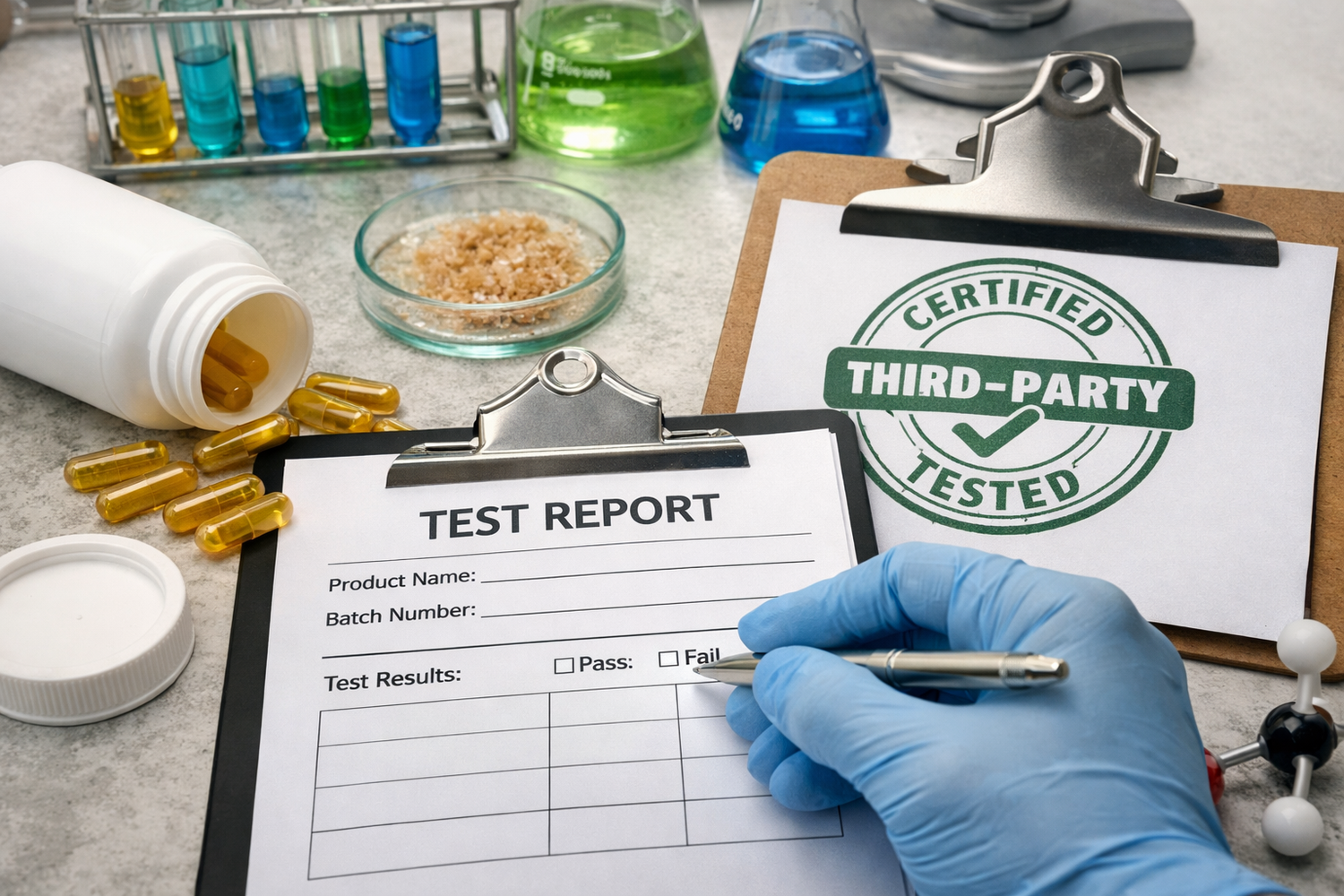
Introduction
Walk into any supplement aisle and it looks like every bottle is backed by hard science. The labels sound precise, the claims sound confident, and the branding feels medical. Yet for most dietary supplements, the FDA does not test products for safety or effectiveness before they reach those shelves. That gap is exactly where Third-Party Testing has to live.
In this kind of market, almost any company can promise more energy, sharper focus, or faster recovery. The label might list impressive ingredients, but there is no built-in referee confirming that the powder or capsule actually matches that list. Doses can drift, contaminants can sneak in, and shortcuts in raw materials are invisible to the naked eye. Marketing is loud; real verification is quiet.
Third-Party Testing is the scientific filter that cuts through that noise. An independent laboratory, with no stake in whether a product sells, analyzes the formula for identity, purity, potency, and unwanted contaminants. Instead of asking people to trust a promise, it produces hard numbers. For anyone serious about performance, longevity, or daily energy, or daily energy, those numbers matter more than the slogan on the front of the bottle.
This guide walks through what Third-Party Testing actually involves, not just what brands say on their websites. By the end, it will be clear how to read labels, how to spot real independent testing, and how to avoid products that only pretend to be verified. It will also show how Synchronicity Health applies this science to physician-formulated, at-home stacks like NAD+ nasal sprays. The goal is simple and practical: choosing supplements that are proven on paper before they ever reach your body.
“In God we trust; all others must bring data.” — W. Edwards Deming
Key Takeaways
-
Third-Party Testing uses a fully independent lab. The lab does not make or sell supplements. Its only job is objective measurement.
-
These tests check identity, dose, and hidden contaminants. They look for microbes, heavy metals, and leftover solvents. Clean results mean the product matches the promise.
-
Certification seals and Certificates of Analysis (COAs) are the clearest proof of Third-Party Testing. They show which tests were run and the numbers. Vague claims about testing without data are a warning.
-
Most brands test occasionally or only part of a formula. Batch-by-batch Third-Party Testing is far rarer and far safer. Synchronicity Health builds every product around this higher bar.
What Is Third-Party Testing

When a brand says its supplement uses Third-Party Testing, it means an outside laboratory checks the product against clear standards. The lab does not work for the manufacturer or the store that sells the bottle. In simple terms, the first party is the company that makes the product, and the second party is the person who buys it. The third party is the independent lab that judges whether the product matches the claims on the label.
The defining feature of real Third-Party Testing is the absence of a conflict of interest. The lab is paid to test, not to pass, a product. Its reputation depends on accurate measurements, repeatable methods, and honest reporting. If a result fails, a serious lab records that failure rather than smoothing it away.
That is very different from in-house, or first-party, testing. Brands do need internal quality checks, but they also have a direct financial stake in seeing their own products pass. An in-house team may:
-
Skip costly tests that require advanced instruments
-
Overlook borderline results that would slow down a launch
-
Lack methods sensitive enough to spot low-level contaminants
Third-Party Testing brings in specialists whose only focus is precise analysis.
It is also not a single quick test. True Third-Party Testing is a package of checks that cover identity, dose, microbes, heavy metals, and more from raw material through final capsule, powder, or spray. For dietary supplements, which do not go through pre-market FDA approval the way prescription drugs do, this outside review is the closest thing to an audit.
Think of it the way you would think about a financial audit: you would not ask a company to audit its own books, so it makes just as little sense to let a supplement company be the only one to judge its own product.
“Good quality control is boring on purpose. If the numbers always look clean, the products rarely cause surprises.” — Quality-control saying used in many labs
Why Third-Party Testing Is Non-Negotiable In The Supplement Industry
The supplement aisle looks scientific, but the rules behind it are looser than most people assume. The FDA expects companies to follow good manufacturing practice and to tell the truth on labels, yet it does not test most formulas before they go on sale. Action usually happens only after problems surface, such as contamination reports or clusters of side effects.
Dietary supplements are regulated more like food than like pharmaceuticals. That means much of the responsibility for safety, quality, and label accuracy falls on the manufacturer. Without independent testing, it is very hard for a customer to know who is careful and who cuts corners.
In that gap, cutting corners is easy unless real Third-Party Testing steps in. Some issues simply waste money because a weak product never reaches an effective dose. Others raise safety concerns for people who take the same supplement every day for months or years. The most common problems fall into a few clear patterns:
-
Inaccurate dosing is one of the most common findings when labs check supplements. Underfilled capsules do not deliver enough active ingredient to move the needle on energy, focus, or blood markers. Overfilled ones can push fat-soluble vitamins, stimulants, or strong plant extracts into ranges that strain organs instead of supporting them. In fields like hormone support or NAD+ metabolism, dose errors can be the difference between benefit and side effects.
-
Contamination covers several hidden threats in a single word. Raw materials can bring in heavy metals, microbes, pesticides, or residual solvents from farming and processing. Third-Party Testing screens for each of these so that lead, arsenic, mold, or leftover chemicals do not ride along with your NAD+ or B12. Even small amounts can build up when a product is taken daily.
-
Undeclared drugs show up most often in sports, sexual function, and weight loss products. Lab tests have found pharmaceutical stimulants and hormones that never appear on the label, and that can trigger a failed doping test or unexpected side effects. For athletes and professionals in tested roles, Third-Party Testing with banned-substance panels acts as basic protection.
-
Ingredient substitution and fillers can quietly swap in cheaper, weaker materials. An herbal extract might be diluted with ordinary plant powder, or a branded ingredient might be replaced with a generic version that has different effects. Only identity and potency testing can catch that kind of swap.
For biohackers, performance-driven professionals, and adults in the 35 to 55 range, those risks are not abstract. Stacks built around NAD+ support, metabolic health, or cognition only work when every layer is precisely what it claims to be. Third-Party Testing is the tool that turns those claims from guesswork into data and gives serious users a way to separate real science from marketing spin.
What Gets Tested And A Complete Breakdown Of The Analyses That Matter

When you send a supplement to an independent lab, Third-Party Testing follows a structured plan rather than a single quick check. The lab chooses methods that fit the ingredient type, the delivery form, and any claims on the label. For a serious brand, the testing plan covers identity, strength, and safety from several angles. Each part answers a different question about what is really in the bottle.
For most supplements, a Third-Party Testing panel will include:
-
Identity testing
Identity testing answers a simple question: is each ingredient what it says it is? This is especially important for herbs, mushrooms, and specialty compounds, where cheaper look‑alike materials are common. Labs may use:-
Chemical “fingerprints” that match known reference patterns
-
Microscopy to confirm the right plant species or tissue
-
Reference standards to verify the correct molecule or salt form
-
-
Potency testing
Potency testing measures how much of that active is present in each serving, so a capsule labeled with 500 milligrams does not quietly deliver 200 or 900 instead. For ingredients like NAD+ precursors, berberine, or methylcobalamin (B12), hitting the intended dose is central to real-world results. -
Purity and contaminant testing
Purity and contaminant testing cover the things no one wants to see on a label:-
Heavy metal panels look for lead, mercury, arsenic, and cadmium, often with tools such as ICP‑MS that detect these elements at tiny levels.
-
Microbiological tests search for harmful bacteria, yeast, and mold that can grow during storage.
-
Pesticide screens check for residues on plant-based ingredients.
-
Residual solvent testing looks for chemicals left over from extraction or purification steps.
-
-
Other quality checks
Depending on the product, a lab may also run:-
Stability tests to see how potency holds up over time
-
Allergen testing for gluten, dairy, soy, or peanuts
-
Banned-substance panels for sports-focused products
-
The starting quality of ingredients sets the ceiling for any product, even before Third-Party Testing starts. Pharmaceutical-grade actives follow tighter identity and purity standards than typical supplement-grade powders. They have narrower limits for unknown impurities and more consistent particle size and stability. When a brand like Synchronicity Health chooses this higher tier, the lab can confirm that clean profile rather than trying to clean up a weak supply chain.
All of these results flow into a document called a Certificate of Analysis (COA). A true third-party COA lists each test, the method, the target range, and the actual measured value, along with a clear pass or fail line. Lot-specific COAs, tied to a batch number printed on the bottle, give you information about the exact product in your hand. Generic COAs with no date or lot number are far less meaningful and may be left over from early pilot runs.
Another key detail is how often a company uses Third-Party Testing — a concern validated by government research on the Effectiveness of Third Party testing programs, which found that frequency and rigor of independent review significantly impacts product reliability. Some brands test once during product development and then rely on that data for years. Others test only a few lots per year, which leaves space for variation to sneak through. Batch-by-batch testing, where every production run goes through the lab before release, is the standard that performance-focused consumers should look for.
How To Identify A Legitimately Third-Party Tested Product

It is one thing to know that Third-Party Testing matters and another to spot it in the wild. The supplement aisle, and many websites, are full of trust badges and scientific language that may or may not mean anything. With a few simple habits, it becomes far easier to see which products are backed by real data. Think of these steps as a quick field guide for building a safer, more effective stack.
-
Look for trusted seals on the label.
Check for seals from groups such as NSF International, USP, or ConsumerLab. Their programs verify identity, potency, and contamination while also auditing the manufacturing site. NSF Certified for Sport adds screening for hundreds of banned substances, which matters for tested athletes. A product with no recognizable seal can still be good, but a seal makes the claim easier to check. When in doubt, visit the certifier’s website and confirm that the product or brand is listed. -
Visit the brand website and find the testing or quality page.
The best companies link batch-specific COAs that match the lot numbers on your bottle, sometimes through a QR code on the label. If only a single old COA appears, or nothing at all, that gap tells its own story. Brands proud of their Third-Party Testing make the data easy to find and easy to download. -
If you cannot find the COA, ask for it.
A quick email or chat message that requests the lab report for a specific product should get a prompt, specific answer. When a company dodges the question or sends a vague marketing sheet instead of a lab report, treat that as a red flag. A real COA from a third-party lab is straightforward to share and should show clear test results, not just generic claims. -
Read what the testing actually covers.
Some brands only do identity checks, while others include potency, heavy metals, microbes, residual solvents, and sometimes allergens or banned substances. Ask how often panels are run and whether every batch is tested before release. The deeper and more frequent the Third-Party Testing, the more consistent the real-world product will be. -
Check claims about pharmaceutical-grade ingredients and production standards.
Serious brands will mention cGMP-compliant facilities, recognized test methods, and specific lab partners rather than vague phrases. Remember that cGMP compliance means the facility follows quality rules; it does not, by itself, prove that this batch was third-party tested. When higher-grade inputs and Third-Party Testing show up together, that points to a supply chain designed for athletes, biohackers, and health professionals, not just for low-cost retail shelves. That is the kind of pattern worth rewarding with your dollars and your trust. -
Watch for plain-language explanations.
When a brand can explain its testing program in clear, simple terms—what is tested, how often, and where—that is a good sign. Overly vague wording or buzzwords with no specifics should make you pause.
How Synchronicity Health Sets The Gold Standard In Third-Party Testing

Everything at Synchronicity Health starts before Third-Party Testing, with in-house formulation by a Yale-trained physician. Instead of handing a vague idea to a contract manufacturer, the brand designs every product from scratch around clear clinical goals. Ingredient forms, doses, and delivery methods are chosen with published research and real patients in mind. That medical lens guides what the lab is later asked to confirm.
Once a formula is set, every ingredient and every production batch goes to an independent lab. Panels cover identity, purity, potency, heavy metals, microbes, and residual solvents, not just a token test or two. Batch-by-batch Third-Party Testing means the NAD+ Nasal Spray, B12 nasal sprays, Glutathione Nasal Spray, and Berberine Blend in your cabinet match the same standard as the ones that went through development. Precision does not stop after the first successful run.
Synchronicity Health also insists on pharmaceutical-grade active ingredients and cGMP-compliant manufacturing facilities. This tighter standard narrows the range of impurities and helps keep every lot consistent in strength and performance. Third-Party Testing then confirms that this higher starting quality shows up in the finished bottle. For customers, that means less guesswork and more repeatable results over months and years of use.
Transparency ties the whole system together. Synchronicity Health makes Certificates of Analysis available so customers, clinicians, and coaches can review the actual data behind each product. That open window reflects a simple principle often used in medicine and engineering: trust, but verify. In a supplement market full of bold promises, the brand invites people to read the lab reports themselves and ask questions.
This matters most in high-impact products such as the Sync Stack system for at-home NAD+ support, or nasal sprays that deliver B12 and glutathione quickly to the bloodstream. These are not casual gummies meant to sit in a kitchen drawer. They are tools for serious energy, focus, and longevity work, often used as alternatives to expensive IV clinic protocols. Third-Party Testing is what lets them match clinic-level intent while staying accessible and convenient.
Conclusion

In a field where claims are cheap and rules are light, Third-Party Testing is the strongest filter a person can use. It turns a glossy label into a set of numbers that either support or contradict the story. When identity, potency, and safety all pass independent review, a supplement moves from marketing pitch to reliable tool.
You now know what to look for: seals from respected programs, lot-specific COAs, batch-by-batch testing, and pharmaceutical-grade inputs. You also know that Synchronicity Health has built those pieces into every product, from NAD+ Nasal Spray to the wider Sync Stack system. The brand pairs physician-guided design with aggressive Third-Party Testing so serious users can build protocols on solid ground.
Use these checks like a quick checklist any time you consider adding a new supplement to your routine.
Do not settle for a supplement that asks you to take its word for it. Look for the data. Demand the COA. Choose the brand that can show you the science.
To see how that looks in practice, explore the Synchronicity Health lineup and review the COAs that sit behind each stack.
FAQs
What Is The Difference Between Third Party Tested And Third Party Certified?
Third party tested means an independent lab has run assays on a product and reported the numbers back to the brand. There may or may not be a public standard involved, and the company decides how to share the data. Third party certified means a group such as NSF, USP, or ConsumerLab compares results to its own published limits and grants a seal only if all tests pass.
In short:
-
Third party tested: lab data exists, but standards and disclosure are set by the brand.
-
Third party certified: lab data is compared against outside standards, and passing earns a certification mark you can verify publicly.
Does Third-Party Testing Guarantee A Supplement Is Effective?
Third-Party Testing confirms that the label matches what is inside the bottle and that safety limits are respected. That is a basic requirement for any supplement to work, because a product cannot help if it is weak, contaminated, or fake. Actual effects still depend on how strong the scientific research is for each ingredient, whether the dose matches that research, and how an individual body responds.
Think of Third-Party Testing as quality control for the product, not proof for the health claim. It sets the stage so that research and good clinical judgment can do their work.
How Often Should A Supplement Company Conduct Third-Party Testing?
At the bare minimum, a company should test during product launch and any time it changes a formula or raw material source. Better brands also run periodic panels on existing products to catch drift in the supply chain. The highest bar is batch-by-batch Third-Party Testing, where every production run is checked before it ships.
For products used daily or aimed at sensitive groups—such as athletes in tested sports, older adults, or people stacking multiple formulas—frequent testing is especially important.
What Is A Certificate Of Analysis And How Do I Read One?
A Certificate of Analysis (COA) is the formal report a lab issues after Third-Party Testing. It lists each test, the method, the target range, and the result for a specific lot number.
A simple way to read a COA is to focus on:
|
COA Field |
What It Tells You |
|---|---|
|
Product name & lot |
Confirms the report matches the bottle in your hand |
|
Test name / parameter |
What was measured (e.g., NAD+ potency, lead, E. coli) |
|
Method |
How it was measured (e.g., HPLC, ICP‑MS, microbiological culture) |
|
Specification / limit |
The acceptable range or maximum level allowed |
|
Result |
The actual number the lab found |
|
Pass / fail |
Whether the result met the specification |
When reading one, focus on potency results near the labeled amount and on contaminants marked as not detected or well below safety limits. Clear pass or fail lines make interpretation much easier and show that the lab treated the product like a real test, not a formality.


Leave a comment
All comments are moderated before being published.
This site is protected by hCaptcha and the hCaptcha Privacy Policy and Terms of Service apply.