

Introduction
Walk into any supplement aisle and the shelves tell a clear story. In the United States alone, dietary supplements bring in tens of billions of dollars every year. People spend real money on capsules, powders, and sprays for better energy, sharper focus, and longer health span, yet most still trust the front of the bottle more than the Supplement Facts panel on the back.
That gap has a cost. Maybe there is a cabinet at home filled with half-empty bottles that never seemed to do anything. Many formulas are under-dosed, use poor ingredient forms, or hide behind fillers and flavors, and the label actually revealed that the whole time. The missing piece was knowing how to read a supplement label with the same focus a scientist brings to a lab report.
The good news is that this is a skill, not a gift. In this guide, the steps to read a supplement label like a scientist are laid out: how to use the Supplement Facts panel, how to judge serving size and dose, how to spot real quality markers, and how delivery method changes what the body really gets. Think of it as consumer self-defense for anyone who cares about performance, longevity, and getting full value from every bottle.
“In God we trust; all others must bring data.” (W. Edwards Deming)
Learning to read labels is how you “bring data” to your supplement choices.
Key Takeaways
- The Supplement Facts panel follows a standard format, so once someone learns how to read a supplement label there, the same method works on almost any product. Serving size and amount per serving form the base for all numbers on the panel. Always compare those amounts with doses used in human studies, not just what the front label promises.
- Proprietary blends and fancy names often hide very small amounts of expensive ingredients, so clear individual doses are far better for science-based decisions. Standardized herbal extracts, named plant parts, and exact species tell you that the maker cares about consistent potency. When those details are missing, real effect is hard to predict.
- Quality seals and third-party lab reports give extra assurance that what is on the label matches what is in the bottle and that it is free from unsafe contaminants. Delivery method can matter as much as dose, because it controls how much of each ingredient reaches the bloodstream. A nasal spray, for example, is absorbed through the lining of the nose instead of being swallowed.

Featured in this article
NAD+ Nasal SpraySupports cellular energy, focus and healthy aging. A needle-free alternative to NAD+ IV.
Shop NAD+ Nasal SprayThird-party tested ingredients. Vegan, non-GMO, made in the USA.
Reading The Supplement Facts Panel: Serving Size, Dosage, And Daily Values
Flip any bottle from the front label to the back and the first thing that matters is the Supplement Facts panel. This box follows a standard format set by regulators, and research on Nutrition facts labels: who is actually reading them confirms that understanding this panel is key to meeting intake recommendations. Read it as the lab report for that supplement, not as fine print.
Serving Size sits at the top of the panel and sets the base for every number that follows. If the serving size is one capsule, all listed amounts and Daily Values apply to that single capsule. If a person takes two, every number on the panel doubles, including helpful nutrients and anything that should be limited, such as sodium or added sugar.
Right under serving size is Servings Per Container, which tells how many full servings the bottle holds. To compare products, divide the price of the bottle by that number to get cost per serving. A large bottle with a big sticker price can be better value than a smaller one, but only if the number of servings and the dose per serving make sense.
The Amount Per Serving column shows the exact quantity of each vitamin, mineral, or other active compound, usually in milligrams or micrograms. This is where a scientific mind goes to work. The key question is whether that amount matches ranges used in peer-reviewed human research. For instance, if studies on a nutrient show benefits at around eight hundred milligrams per day, a formula that gives one hundred milligrams per serving is not likely to move the needle.
Next to each nutrient, the Percent Daily Value (percent DV) puts that amount in context for an average adult eating a two thousand calorie diet. A value near five percent DV or less means the product is low in that nutrient, while values around twenty percent DV or more mean it is high. Aim for higher numbers on helpful items like vitamin D or potassium and lower numbers on things that should stay in check, such as sodium or added sugars in flavored powders and gummies.
Some lines appear on the panel without a percent DV at all. This can happen with trans fat, total sugars, and often protein, either because experts have not agreed on a safe upper limit, or because most people already get enough from food. Lack of a DV here is not a mistake, but it does mean a person has to think about the full diet and other products, not just that single bottle.
To make this faster when you pick up a new product, you can walk through a simple mental checklist:
- Check serving size. How many capsules, scoops, or sprays count as one serving?
- Look at amount per serving. Does the dose match what human studies used?
- Scan percent DV. Is the product very low or very high in any nutrient?
- Consider the full day. Add this product to what you already get from food and other supplements.
“The dose makes the poison.” (Paracelsus)
That same idea applies the other way around: dose also makes the benefit. Labels tell you where a product sits on that spectrum.
To see how label numbers can differ from research use, consider these simplified examples.
|
Nutrient |
Common Amount On Labels |
Common Research Dose Range |
Quick Note |
|---|---|---|---|
|
Vitamin D3 |
400 IU per serving |
1,000 to 4,000 IU per day |
Blood tests and medical guidance help set an appropriate personal dose. |
|
Magnesium (as glycinate or citrate) |
50 to 100 mg per serving |
200 to 400 mg per day |
Gentler forms such as glycinate are often better tolerated than oxide. |
|
Berberine |
200 to 300 mg per serving |
900 to 1,500 mg per day split in doses |
Often used for metabolic support, so low doses may not show clear effects. |
Proprietary Blends, Ingredient Forms, And Why They Matter
Once the basics of serving size and Daily Values make sense, the next level is understanding how to read a supplement label for the story behind the numbers. Two labels can show the same nutrient names yet behave very differently in the body. That difference comes from how clearly each ingredient dose is listed and which chemical or plant form the formulator chose. This is where careful label reading separates evidence-based formulas from pure marketing gloss.
Proprietary Blends: A Transparency Problem
A proprietary blend is a group of ingredients listed under a single name with only one combined weight for the whole mix. The label might say one thousand milligrams of a focus blend, followed by a long list of herbs and amino acids. The law requires that those items appear in order from highest to lowest by weight, yet the exact amount of each one stays hidden. Without those numbers, no one outside the company can tell whether the strongest research-backed ingredient is present at an effective level or just sprinkled in.
This lack of clarity makes it impossible to compare brands or to match what is on the label with doses used in human trials. It also raises safety questions when someone takes several products that share the same ingredients, since there is no way to know the total daily intake.
In practice, proprietary blends often:
- Load up low-cost ingredients at the top of the list
- Use tiny amounts of premium ingredients mainly for marketing
- Make dose comparisons with clinical research nearly impossible
A simple rule is to favor companies that show the exact dose of every active ingredient, because hiding numbers is a sign of marketing first and science second.
Ingredient Forms And Standardized Extracts: Potency Is In The Details
To read a label like a scientist, you also need to care about the form of each ingredient, not just the name. Vitamin B12 is a clear example. Cyanocobalamin is a low-cost synthetic form that the body has to convert, while methylcobalamin is already in the active shape cells use. Synchronicity Health designs its Methyl B12 Nasal Spray around that active form so that the listed micrograms on the label line up with what the nervous system and blood cells can actually use.
Herbal products bring another layer of detail. A strong label tells which part of the plant is present, such as root or leaf, and often lists a standardization number that shows the percentage of key active compounds. A line that reads turmeric extract standardized to ninety five percent curcuminoids signals far more predictable strength than a vague turmeric powder entry. Serious brands also give the full Latin species name, so a person knows they are getting Rhodiola rosea, the species used in most research, instead of a lower-cost close relative.
Minerals vary as well. Magnesium oxide may look impressive on paper because the milligram number seems high, yet it absorbs poorly and often upsets the stomach. Forms such as magnesium glycinate or magnesium citrate tend to enter the bloodstream more easily and feel gentler for many people. When you compare products, match both the dose and the form to what clinical papers used, and choose brands, like Synchronicity Health, that explain plainly why each form appears on the label.
For one example of how ingredient forms compare, see our guide to methylcobalamin vs cyanocobalamin.
The "Other Ingredients" Section, Allergens, And Certifications
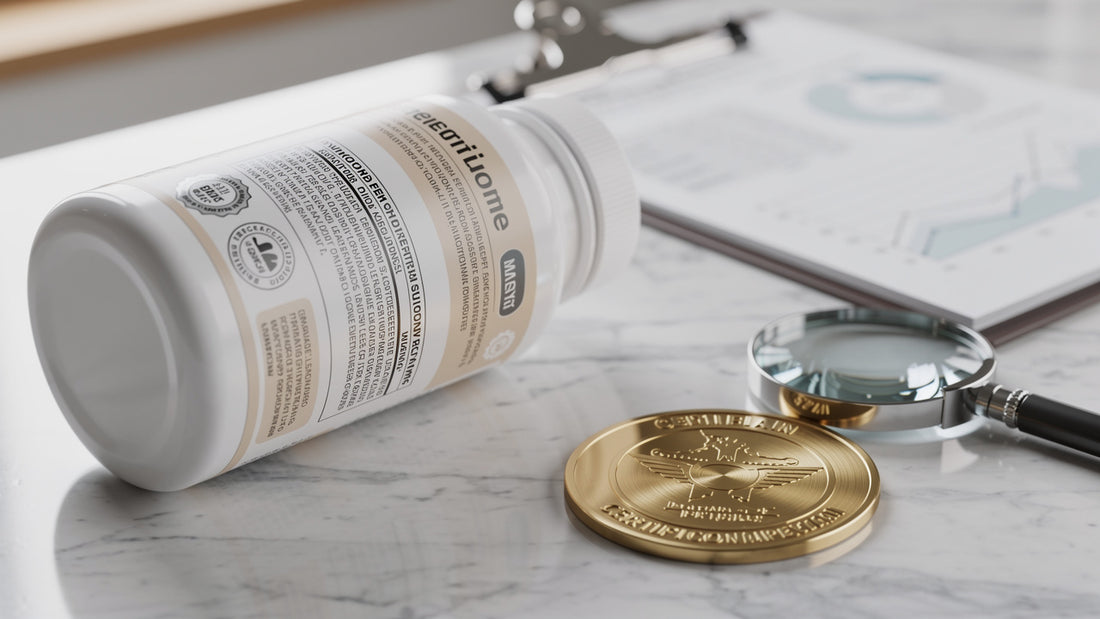
Most eyes jump straight from the Supplement Facts box to the price, skipping the small type below. That lower section often tells just as much about real-world quality as the main panel does. It lists the extra substances that help shape the capsule or tablet, sets out allergen warnings, and may show seals from independent groups.
The line labeled Other Ingredients lists excipients, the inactive helpers that let factories produce stable tablets and capsules. Binders hold powders together, fillers add volume so each capsule is consistent, and flow agents keep machinery from clogging. Common examples include:
- Magnesium stearate
- Silicon dioxide
- Capsule shells, such as gelatin or plant-based materials like hypromellose
Many people do fine with these, but some prefer to avoid artificial colors, heavy sweeteners, or large amounts of low-cost filler. Synchronicity Health keeps this list intentionally short so that most of what a person swallows is the active compound, not extra fluff.
Allergen statements are non-negotiable for anyone with food sensitivities. By law, major food allergens such as milk, eggs, fish, shellfish, tree nuts, peanuts, wheat, soy, and sesame must appear clearly on the label if they are present. Many companies also note if a product is made in a facility that processes these foods, which matters for people who react to even small traces. It is wise to scan both the ingredient list and the bold allergen warning every time, even with brands you know well.
Quality seals and badges can help, but only if a person understands what each one actually checks. The table below summarizes some of the most common marks.
|
Seal |
What It Verifies |
|---|---|
|
USDA Organic |
Plant ingredients grown without synthetic pesticides or genetic modification and with strict farming rules |
|
Non-GMO Project Verified |
Product reviewed and monitored by an independent group to meet non-GMO standards |
|
Vegan Certified |
No animal ingredients or animal based process aids are used |
|
Kosher / Halal |
Production follows the preparation rules of Jewish or Islamic dietary law |
|
Clinically Studied |
Formula or key ingredients have data from human trials, not just cell or animal work |
Seals talk about how a product should be made, but a third-party Certificate of Analysis (COA) shows what actually came out of the production line for that batch. A COA lists lab results for identity, potency, and unwanted contaminants such as heavy metals, microbes, or pesticide residues. Synchronicity Health makes its products with third-party tested ingredients and lists the amount of each one plainly on the label. An honest expiration or best by date belongs in the same group, since it means the maker tested how long the formula stays within its claimed strength under normal storage conditions.
The Factor Most Labels Don't Tell You, Bioavailability And Delivery Method

A label can show a perfect list of ingredients and doses, yet that still does not guarantee results. The missing piece is bioavailability, which means the share of an ingredient that actually reaches the bloodstream in active form. Two products can list the same amount of NAD+ or vitamin B12, but if one delivers far more of that dose into circulation, that one wins for real-world effect.
Classic oral capsules and tablets face several hurdles. Stomach acid, digestive enzymes, and poor solubility can all break down or block compounds before they pass through the gut wall. Whatever survives then passes through the liver first, where another share is cleared before it ever reaches body tissues, a process called first pass metabolism. That is why some oral NAD+ products show very high milligram numbers on the label, yet still have trouble raising levels inside cells.
Delivery method changes that math. Liquids held under the tongue and liposomal formats aim to send more of each dose directly into the blood while avoiding part of the gut and liver filter. Intranasal delivery takes another route: nasal sprays are absorbed through the lining of the nose instead of being swallowed.
Synchronicity Health builds its Sync Stack system and nasal sprays around this idea. Following a clean-label standard, the company formulates NAD+ Nasal Spray, Methyl B12 Nasal Spray, and related products to be absorbed through the lining of the nose. That means a carefully measured spray, designed for high bioavailability, can be used at home without the cost and time of clinic visits.
A smart shopper follows the trust but verify rule here. Claims such as faster uptake or better absorption should connect to lab data, pharmacokinetic curves, or well designed human studies, not just bold tag lines. When a brand like Synchronicity Health pairs clear dosing on the label with third-party tested ingredients and a delivery method grounded in science, the numbers on that panel have a far better chance of turning into real gains in energy, focus, and long term health.
If a term on a label is unfamiliar, our health and wellness glossary defines common ones in plain language, and our guide to reading an NAD+ supplement's certificate of analysis covers the lab report behind the label.
Conclusion

To read a supplement label like a scientist does not require a lab coat, just a structured way to look at the facts. Start with the Supplement Facts panel so serving size, amount per serving, and percent Daily Value all make sense in light of research doses. Then move to the formula itself, avoiding secretive proprietary blends and favoring clear ingredient forms and standardized extracts.
Do not ignore the so-called small print either. The Other Ingredients list, allergen warnings, certifications, COAs, and expiration dates all show how seriously a company approaches quality and safety. On top of that, keep bioavailability in mind, since delivery method decides how much of each labeled milligram your cells ever see.
When those four steps come together, label literacy protects both your wallet and your health. That is the standard Synchronicity Health designs for, with high-purity, third-party tested ingredients and nasal delivery where it makes sense. For those who want deeper dives into specific ingredients or stacks, the Synchronicity Health Learn Hub offers clear, science based guides that make it much easier to read a supplement label like a scientist on your own. To put these checks into practice, start with our Best Sellers collection.
Featured in this article
NAD+ Nasal SpraySupports cellular energy, focus and healthy aging. A needle-free alternative to NAD+ IV.
Shop NAD+ Nasal SprayThird-party tested ingredients. Vegan, non-GMO, made in the USA.
Sources
- NIH Office of Dietary Supplements. Dietary Supplements: What You Need to Know. ODS
- U.S. Food and Drug Administration. How to Understand and Use the Nutrition Facts Label. FDA
- NIH Office of Dietary Supplements. Magnesium: Fact Sheet for Health Professionals. ODS
- U.S. Food and Drug Administration. Food Allergies. FDA
FAQs
What Does "Pharmaceutical-Grade" Mean On A Supplement Label?
Pharmaceutical grade means the raw ingredients and finished product meet tighter standards for identity, purity, and strength than regular supplement grade material. In practice that means fewer impurities and more consistent dosing from batch to batch. Because the term itself is not tightly regulated, the safest path is to confirm it with third-party test reports or a COA. For how U.S. rules cover supplements in general, see are supplements regulated in the U.S..
How Do I Know If A Supplement Dose Is Clinically Effective?
Start by looking at the Amount Per Serving line on the label, then compare that number with dose ranges from human clinical trials on the same ingredient. Resources such as PubMed, research summaries on sites like Examine, and the FDA's own Consumer Research on Labeling, Nutrition, Diet, and Health page can all help you cross-reference dose ranges from human clinical trials. If a product hides its doses inside a proprietary blend, there is no reliable way to judge effectiveness.
Are Third-Party Certifications The Same As A Certificate Of Analysis (COA)?
No. Third-party certifications such as Organic, Non-GMO, or Vegan focus on how a product is sourced or produced. A Certificate of Analysis is a lab report tied to a specific batch that shows tested potency, identity, and contaminant levels. A brand that will share batch test data on request offers far more direct evidence of quality than a seal alone.


Leave a comment
All comments are moderated before being published.
This site is protected by hCaptcha and the hCaptcha Privacy Policy and Terms of Service apply.