
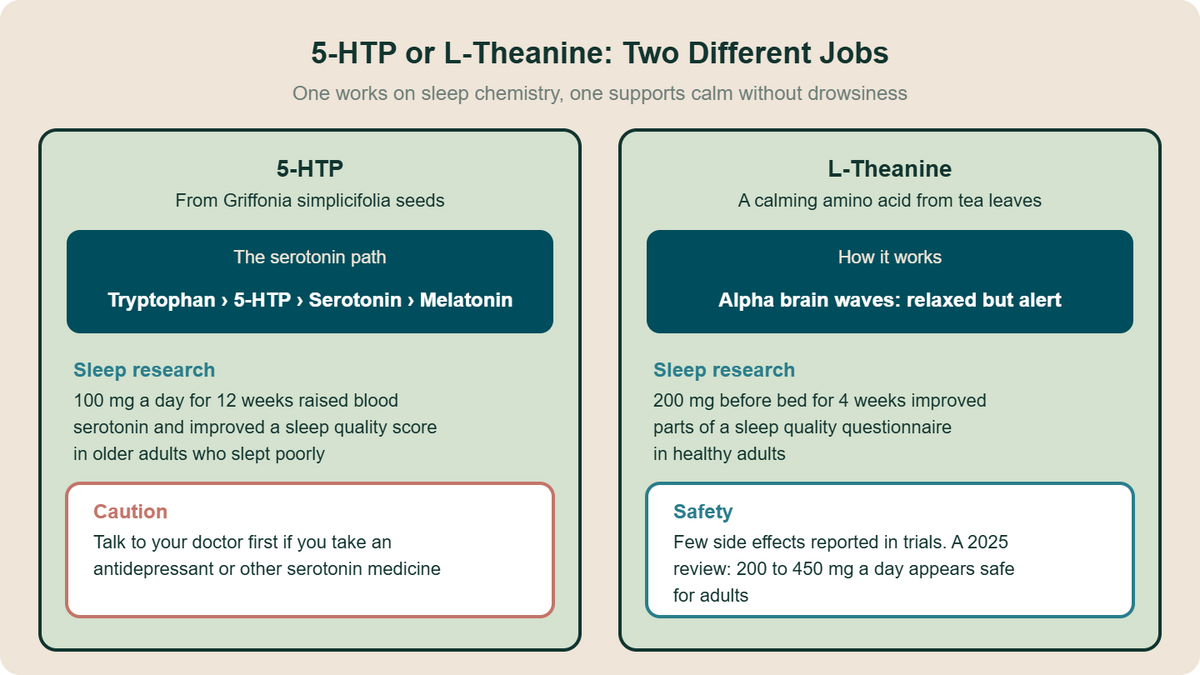
5-HTP or L-theanine comes down to what you want help with. 5-HTP is a building block your body turns into serotonin and then melatonin, so it works on your sleep chemistry, while L-theanine is a calming amino acid from tea that supports relaxation without drowsiness. For most people looking for a gentle evening wind down, L-theanine is the simpler starting point, and 5-HTP needs more care with medicines.
Key Takeaways
- 5-HTP sits on the path from tryptophan to serotonin to melatonin, and supplements are usually made from the seeds of the African plant Griffonia simplicifolia (Maffei, 2020).
- In 30 older adults, 100 mg of 5-HTP a day for 12 weeks raised blood serotonin and improved a sleep quality score in people who slept poorly at the start (Sutanto et al., 2024).
- In 30 healthy adults, 200 mg of L-theanine before bed for 4 weeks improved parts of a sleep quality questionnaire and stress-related symptom scores compared with placebo, with no adverse events reported (Hidese et al., 2019).
- A 2025 review of 13 L-theanine trials with 550 participants concluded that 200 to 450 mg a day appears to be a safe way to support healthy sleep in adults (Cotter et al., 2025).
- 5-HTP adds to serotonin activity, so talk to your doctor before taking it if you take an antidepressant or any other medicine that affects serotonin.

Featured in this article
Theanine Nasal Spray36 mg of L-theanine per 2-spray serving, with alkaline water as the only other ingredient.
Shop Theanine Nasal SprayThird-party tested ingredients. Made in the USA.
What 5-HTP and L-Theanine Are
Both are amino acid compounds, but they do very different jobs.
5-HTP (5-hydroxytryptophan) is made in your body from tryptophan, an amino acid in protein foods. Your body turns 5-HTP into serotonin, a brain messenger, and later turns serotonin into melatonin, the hormone that signals night. Supplements are mostly made from the seeds of Griffonia simplicifolia, which the 2020 review calls the main natural source (Maffei, 2020). Taking 5-HTP adds raw material further down the serotonin path.
L-theanine is an amino acid found naturally in tea leaves. It is not part of the serotonin path. Instead, it is studied for a calm, relaxed state of mind. In an EEG study of healthy young adults, 50 mg of L-theanine, close to the amount in a cup of black tea, raised alpha brain wave activity compared with placebo, a pattern linked to a relaxed but alert state (Nobre et al., 2008). Our L-theanine ingredient page covers it in more detail.
5-HTP vs L-Theanine Side by Side
| 5-HTP | L-theanine | |
|---|---|---|
| What it is | A building block for serotonin and melatonin | A calming amino acid from tea leaves |
| Where it comes from | Griffonia simplicifolia seeds | Tea leaves |
| How it works | Raises serotonin, which the body can turn into melatonin | Raises alpha brain waves linked to a relaxed but alert state |
| Sleep research | 100 mg a day for 12 weeks improved a sleep quality score in older adults who slept poorly | 200 mg before bed for 4 weeks improved parts of a sleep quality questionnaire in healthy adults |
| Daytime feel | Works on sleep chemistry, studied over weeks | Calm without drowsiness, so it suits day or night |
| Main caution | Do not mix with antidepressants or other serotonin medicines without your doctor | Few side effects reported in trials |
5-HTP vs L-Theanine for Sleep
What 5-HTP research shows
Because serotonin is the raw material for melatonin, 5-HTP has long been studied for sleep. In older sleep lab studies of healthy volunteers, 5-HTP raised the amount of REM (dreaming) sleep compared with placebo (Maffei, 2020).
A more recent trial in Singapore gave 30 older adults, average age 66, either 100 mg of 5-HTP a day or no supplement for 12 weeks. Blood serotonin rose in the 5-HTP group, and the people who slept poorly at the start saw their overall sleep quality score improve (Sutanto et al., 2024).
What L-theanine research shows
In a 4-week crossover trial, 30 healthy adults aged 20 to 69 took 200 mg of L-theanine or a placebo before sleep each night. With L-theanine, three parts of a standard sleep quality questionnaire improved compared with placebo, including how long it took to fall asleep and sleep disturbance. Stress-related symptom scores and some thinking tests also improved, and the authors reported no adverse events (Hidese et al., 2019).
A 2025 systematic review gathered 13 trials with 550 participants that used 50 to 900 mg a day of L-theanine on its own. Trials reported benefits on measures such as sleep efficiency, sleep satisfaction and feeling refreshed on waking, and the authors concluded that 200 to 450 mg a day appears to be a safe and effective way to support healthy sleep in adults (Cotter et al., 2025). Our guide to L-theanine for sleep goes deeper.
The short answer for sleep
L-theanine supports a calmer wind down without drowsiness. 5-HTP works further upstream, on the chemistry your body uses to make melatonin. If your nights are mostly about winding down after a stressful day, L-theanine fits that job. If you want direct support for your sleep timing, melatonin itself is the more direct option; our guide to 5-HTP vs melatonin compares those two.
Can You Take 5-HTP and L-Theanine Together?
Many evening blends pair a calming amino acid with a sleep chemistry ingredient, and the two work on different systems: 5-HTP on the serotonin path, L-theanine on relaxed brain wave activity. Research has tested them separately, so the amounts that make sense together come from their own trials.
If you want to try both, a sensible approach is:
- Check with your doctor first if you take any prescription medicine, and always before adding 5-HTP to an antidepressant or other serotonin medicine.
- Start one at a time. Use each on its own for a week or two so you know how each one feels for you.
- Stay at studied amounts. The 5-HTP sleep trial used 100 mg a day, and the L-theanine sleep trial used 200 mg before bed.
- Do not stack several serotonin products. Choose one 5-HTP source rather than several blends that each contain it.
L-theanine is also a common partner for melatonin, which is why our Melatonin Nasal Spray pairs 200 mcg of melatonin with 17 mg of L-theanine per 2-spray serving; see melatonin and L-theanine for how that pairing works. For another calming comparison, read GABA vs L-theanine.
Safety: Who Should Be Careful
5-HTP
- Serotonin medicines: serotonin syndrome is a serious reaction to too much serotonin activity, most often tied to antidepressant medicines, and extra 5-HTP adds to that same activity (Maffei, 2020). Talk to your doctor before taking 5-HTP if you take an antidepressant or any medicine that affects serotonin.
- Carbidopa: combining 5-HTP with a decarboxylase inhibitor such as carbidopa has been linked to side effects, so check with your doctor if you take one.
- Stomach upset: stomach problems with 5-HTP are dose related, and nausea and vomiting have been reported at doses above 100 mg (Maffei, 2020).
L-theanine
L-theanine has a gentle record. The 4-week sleep trial reported no adverse events and no dropouts (Hidese et al., 2019), and the 2025 review described 200 to 450 mg a day as safe for adults. Our guide to L-theanine side effects covers the details.
Both
Talk to your doctor before using either one if you are pregnant or breastfeeding or take prescription medicine.
5-HTP or L-Theanine: How to Choose
- Choose L-theanine if you want calm without drowsiness, help winding down in the evening, or something you can also use during a busy day.
- Consider 5-HTP if you and your doctor want to support the serotonin and melatonin path directly, and you take no serotonin medicines.
- Choose melatonin if your main concern is the timing of your sleep, such as a late body clock.
Whichever you pick, pair it with steady sleep habits: a regular bedtime, a dim room and less screen time late at night. Our guide to sleep health and why quality rest matters has more.
Where Our Theanine Nasal Spray Fits
Our Theanine Nasal Spray gives 36 mg of L-theanine in every 2-spray serving, with alkaline water as the only other ingredient. The label serving is 2 sprays, used as needed. It is absorbed through the lining of the nose instead of being swallowed like a capsule, so some of each dose skips digestion, and it is made with third-party tested ingredients. You can make it part of an evening wind down, and it suits daytime use too, because L-theanine supports relaxation without drowsiness.
If you want melatonin and L-theanine in one bottle for bedtime, our Melatonin Nasal Spray combines both and is used before bed as the label directs.
Featured in this article
Theanine Nasal SprayThe calming amino acid found in tea, 36 mg per serving, for an evening wind down or a steady day.
Shop Theanine Nasal SprayThird-party tested ingredients. Made in the USA.
Frequently Asked Questions
Is 5-HTP or L-theanine better?
Neither is better for everyone, because they do different jobs. L-theanine is a calming amino acid from tea that supports relaxation without drowsiness and has few reported side effects. 5-HTP is a building block for serotonin and melatonin, so it works on sleep chemistry but needs more care with medicines. For a gentle evening wind down, most people start with L-theanine.
Is 5-HTP or L-theanine better for sleep?
Both have sleep research. In healthy adults, 200 mg of L-theanine before bed for 4 weeks improved parts of a sleep quality questionnaire, and a 2025 review of 13 trials supported 200 to 450 mg a day. In older adults who slept poorly, 100 mg of 5-HTP a day for 12 weeks improved a sleep quality score. L-theanine is the simpler choice for most people.
Can I take 5-HTP and L-theanine together?
They work on different systems, and research has tested them separately. If you want to combine them, check with your doctor first, especially if you take an antidepressant or any other serotonin medicine. Start one at a time so you know how each feels, stay at the amounts used in trials, and avoid stacking several products that each contain 5-HTP.
What does 5-HTP do?
5-HTP is the step between tryptophan, an amino acid in food, and serotonin, a brain messenger. Your body later turns serotonin into melatonin, the hormone that signals night. Taking 5-HTP adds raw material further down that path. In a 12-week trial in older adults, 100 mg a day raised blood serotonin.
Does L-theanine make you sleepy?
No. L-theanine supports a calm, relaxed state without drowsiness. In an EEG study, 50 mg raised alpha brain wave activity, a pattern linked to a relaxed but alert state. That is why people use it both in the evening to wind down and during the day to stay steady. It helps you settle rather than putting you to sleep.
Should I take 5-HTP at night or in the morning?
For sleep, most people take it in the evening, since serotonin is the raw material for melatonin. The 12-week trial gave 100 mg a day. Stomach upset is dose related, so stay at studied amounts. Ask your doctor before starting it if you take any prescription medicine.
Can I take L-theanine with melatonin?
Yes, they are a common pair. Melatonin supports your sleep timing, and L-theanine supports a calmer wind down. Our Melatonin Nasal Spray combines 200 mcg of melatonin with 17 mg of L-theanine per 2-spray serving. Check the label before using it alongside any other melatonin product, and talk to your doctor if you are pregnant or take medication.
Sources
- Maffei ME. 5-Hydroxytryptophan (5-HTP): Natural Occurrence, Analysis, Biosynthesis, Biotechnology, Physiology and Toxicology. International Journal of Molecular Sciences, 2020. https://pubmed.ncbi.nlm.nih.gov/33375373/
- Sutanto CN, Xia X, Heng CW, et al. The impact of 5-hydroxytryptophan supplementation on sleep quality and gut microbiota composition in older adults: a randomized controlled trial. Clinical Nutrition, 2024. https://pubmed.ncbi.nlm.nih.gov/38309227/
- Hidese S, Ogawa S, Ota M, et al. Effects of L-Theanine Administration on Stress-Related Symptoms and Cognitive Functions in Healthy Adults: A Randomized Controlled Trial. Nutrients, 2019. https://pubmed.ncbi.nlm.nih.gov/31623400/
- Cotter J, Caddick CE, Harper JL, Ebajemito JK. Examining the effect of L-theanine on sleep: a systematic review of dietary supplementation trials. Nutritional Neuroscience, 2025. https://pubmed.ncbi.nlm.nih.gov/41176609/
- Nobre AC, Rao A, Owen GN. L-theanine, a natural constituent in tea, and its effect on mental state. Asia Pacific Journal of Clinical Nutrition, 2008. https://pubmed.ncbi.nlm.nih.gov/18296328/
These statements have not been evaluated by the Food and Drug Administration. This content is for education and is not medical advice. Our products are not intended to diagnose, treat, cure or prevent any disease. Talk with a healthcare provider before starting a new supplement if you are pregnant, breastfeeding or taking medication.


Leave a comment
All comments are moderated before being published.
This site is protected by hCaptcha and the hCaptcha Privacy Policy and Terms of Service apply.