

Best overall: a single-ingredient oral lion’s mane capsule with clear labeling and batch-level testing. Best for mixing into food: lion’s mane powder. Best for avoiding capsules: a liquid extract with a disclosed serving amount. This 2026 guide compares seven formulation types, rather than treating differently labeled mushroom supplements as interchangeable.

Featured in this article
Clarity CapsulesLion's mane, bacopa, rhodiola, maca, epimedium and huperzine A in a two-capsule morning serving.
Shop Clarity CapsulesThird-party tested ingredients. Caffeine-free.
- The best lions mane supplement has a disclosed oral dose, identifiable mushroom material, and batch-level quality testing.
- Synchronicity readers comparing stimulant-free focus supplements should compare the lion’s mane preparation and serving on each label with the research.
- Capsules suit simple routines; powders suit food mixing; liquid extracts require clear serving information.
- Human lion’s mane research has used oral powders and extracts, so it does not describe nasal delivery.
Why this matters
Lion’s mane, also called Hericium erinaceus, is an edible mushroom sold in several supplement formats. The label can describe whole mushroom powder, an extract, fruiting body, mycelium, or a blend. These terms answer different questions: what material is used, how it is processed, and how you take it.
For readers comparing Synchronicity supplements, the useful question is not which bottle makes the strongest focus claim. It is which formula lets you identify the ingredient, understand its dose, and assess the evidence behind that specific preparation.
For Synchronicity readers seeking stimulant-free focus, the best lion’s mane supplement is a clearly labeled oral formula with batch-level testing.
What makes the best lion’s mane supplement?
Use these criteria for your 2026 shortlist before comparing benefit claims:
- Ingredient identity: Look for Hericium erinaceus and a clear description of the mushroom material.
- Disclosed dose: The serving should state how much lion’s mane you receive, not just the total weight of a blend.
- Preparation details: Distinguish whole powder from extract, and fruiting body from mycelium. Check the serving amount as well as any extraction ratio.
- Batch-level testing: Ask for a certificate of analysis that identifies the batch and reports relevant identity and contaminant testing.
- Evidence fit: Check whether cited human research used the same preparation, route, population, and outcome.
- Routine and safety fit: Choose a format you can use consistently without overlooking allergies, medications, or other ingredients.
Third-party testing addresses measured quality characteristics such as identity and contaminants.
Seven lion’s mane options at a glance
These categories overlap: a capsule can contain a standardized fruiting-body extract. Each option below addresses a different buying priority, so use the table as a decision guide rather than a claim that one material always outperforms another.
| Rank and option | Best for | Standout feature | What to check |
|---|---|---|---|
| 1. Single-ingredient oral capsule | A simple daily routine | Separates lion’s mane from other active ingredients | Capsule contents still require scrutiny |
| 2. Whole-mushroom powder | Mixing into food | Flexible format without a capsule | Constituent levels as well as powder weight |
| 3. Standardized oral extract | Comparing quantified composition | Names and measures specified constituents | Which marker is measured |
| 4. Fruiting-body extract | Buyers prioritizing mushroom-part disclosure | Identifies the reproductive mushroom structure | A disclosed dose and preparation |
| 5. Clearly disclosed mycelium preparation | Matching a particular research preparation | Identifies the fungal growth material | Processing and substrate details matter |
| 6. Liquid oral extract | Adults who prefer not to swallow capsules | A liquid serving format | Concentration and measuring instructions require attention |
| 7. Fully disclosed focus blend | Combining ingredients in one routine | Lists several ingredients together | Effects and adverse reactions are harder to attribute |
1. Single-ingredient oral capsule: best for a simple daily routine
A single-ingredient capsule keeps the comparison focused on lion’s mane rather than a collection of additional actives. You still need to read the label: a capsule can contain powder, extract, or a preparation with poorly explained composition.
For a first comparison in 2026, this format is the clearest default. The advantage is simpler evaluation, not demonstrated superiority over other oral formats.
Single-ingredient capsule pros:
- Keeps the active-ingredient list straightforward.
- Avoids the need to mix powder into food.
- Makes the labeled serving easy to identify.
Single-ingredient capsule cons:
- A capsule does not reveal the quality of its contents.
- Capsule size and excipients matter if swallowing is difficult.
Best for: Adults who want a straightforward routine and fewer ingredients to evaluate.
Verdict: Buy only when the label discloses the preparation and serving, and the batch documentation supports product quality.
2. Whole-mushroom powder: best for mixing into food
Whole-mushroom powder offers an alternative to capsules. You can add a measured serving to food or a drink, provided you follow the product’s instructions.
Do not equate a larger powder serving with a stronger effect. Whole powder and concentrated extracts have different compositions, so their weights are not interchangeable measures of effectiveness.
Whole-mushroom powder pros:
- Fits a food-based routine.
- Avoids swallowing a capsule.
- Makes the ingredient format easy to understand when clearly labeled.
Whole-mushroom powder cons:
- Taste and texture become part of the routine.
- Measuring adds a step and introduces serving variability.
- Total powder weight does not identify relevant constituent levels.
Best for: Adults who already mix supplements into meals or drinks.
Verdict: Buy for format preference, not because a larger scoop proves greater cognitive benefit.
3. Standardized oral extract: best for comparing composition
A standardized extract states a measured amount or proportion of a named constituent. That information helps you compare composition, but only when the label identifies what was measured and the testing supports it.
Beta-glucans are a useful example of a mushroom constituent that labels sometimes quantify.
Standardized oral extract pros:
- Provides more composition detail than an unexplained extract claim.
- Supports comparison of the same measured constituent.
- Gives you a specific result to check against batch documentation.
Standardized oral extract cons:
- Standardization describes composition, so follow the labeled serving.
- Different markers cannot be treated as equivalent.
- Extract ratios alone do not show what the finished serving contains.
Best for: Buyers who want measurable composition rather than vague potency language.
Verdict: Buy when the named marker and testing are clear; skip unexplained concentration claims.
4. Fruiting-body extract: best for mushroom-part transparency
The fruiting body is the recognizable mushroom structure. A fruiting-body extract label identifies the source material, which is useful when comparing products that otherwise say only mushroom extract.
That disclosure is a useful quality-screening detail, alongside the dose and preparation.
Fruiting-body extract pros:
- Clearly identifies the mushroom part.
- Helps distinguish source-material claims from extraction claims.
- Makes ingredient comparisons easier when testing is available.
Fruiting-body extract cons:
- The label still needs a disclosed dose and preparation details.
Best for: Adults who prioritize transparent source-material labeling.
Verdict: Buy for clear disclosure.
5. Disclosed mycelium preparation: best for research matching
Mycelium is the network of fungal filaments from which a mushroom develops. Mycelium preparations are not interchangeable with fruiting-body preparations, and their composition depends on cultivation and processing.
When a seller cites a study involving mycelium, check the preparation closely. Research on a specified preparation does not validate every supplement carrying the word mycelium.
Disclosed mycelium preparation pros:
- Identifies a distinct fungal material.
- Allows closer checking against studies of that preparation.
- Makes cultivation and processing questions explicit.
Disclosed mycelium preparation cons:
- The label needs to explain whether growth substrate remains in the product.
- Unspecified mycelium is difficult to match to research.
- Benefits cannot be inferred from the ingredient name alone.
Best for: Buyers evaluating a particular mycelium preparation against relevant human research.
Verdict: Hold until the material, processing, and evidence match are clear.
6. Liquid oral extract: best for avoiding capsules
A liquid extract changes how you take the supplement. It does not, by itself, establish faster action or better absorption than a capsule.
Check the amount of lion’s mane per measured serving and the complete ingredient list. A dropperful is not enough information unless the label defines its volume and contents.
Liquid oral extract pros:
- Offers an alternative for adults who dislike capsules.
- Allows a measured liquid serving when instructions are clear.
- Makes the carrier ingredients visible on a complete label.
Liquid oral extract cons:
- Measuring requires attention to the stated serving volume.
- Taste and carrier ingredients affect suitability.
- Liquid delivery alone does not prove an absorption advantage.
Best for: Adults who prefer a liquid oral routine.
Verdict: Buy for convenience; skip unsupported faster-acting or better-absorbed claims.
7. Fully disclosed focus blend: best for a combined routine
A focus blend combines lion’s mane with other ingredients. It belongs on your shortlist only when each active ingredient and its amount are disclosed; a total blend weight does not answer those questions.
A combined formula also changes the evidence question. You need to assess the other ingredients, and their interactions.
Fully disclosed focus blend pros:
- Combines several ingredients in one routine.
- Allows ingredient-by-ingredient evaluation when amounts are stated.
- Reduces the need to manage separate containers.
Fully disclosed focus blend cons:
- Makes it harder to identify which ingredient caused an effect.
- Adds interaction and tolerability questions.
Best for: Adults deliberately choosing several ingredients after reviewing each one.
Verdict: Hold until every active amount is disclosed; skip opaque proprietary blends.
What human lion’s mane research actually shows
A small trial by Mori and colleagues, published in Phytotherapy Research in 2009, studied 30 adults with mild cognitive impairment. Participants received a preparation providing approximately 3 grams of lion’s mane powder daily for 16 weeks. Cognitive-function scores improved during supplementation, then declined during the 4-week period after stopping.
A later 12-week randomized, placebo-controlled trial of supplements containing lion’s mane fruiting body found improved scores on the Mini Mental State Examination, one of the three cognitive tests used, compared with placebo (Saitsu et al., 2019).
Both trials studied specific oral preparations in older adults, so compare the preparation and serving on any label with the ones these studies used.
Laboratory research has examined lion’s mane compounds and pathways involved in nerve growth. These lab studies looked at mechanisms in cells, which is a different kind of evidence from the human trials above.
Human lion’s mane studies used oral powders and extracts. Synchronicity’s Clarity Nasal Spray belongs to a different product comparison; do not assume it contains lion’s mane or inherits results from oral mushroom studies.
Dosing, timing, and safety
Human studies have used different preparations and amounts, such as the 3-gram daily preparation in the 2009 trial, so follow the serving on the product you choose.
Use the instructions for the actual product you choose. Pick a consistent time of day, and do not take more than the labeled serving.
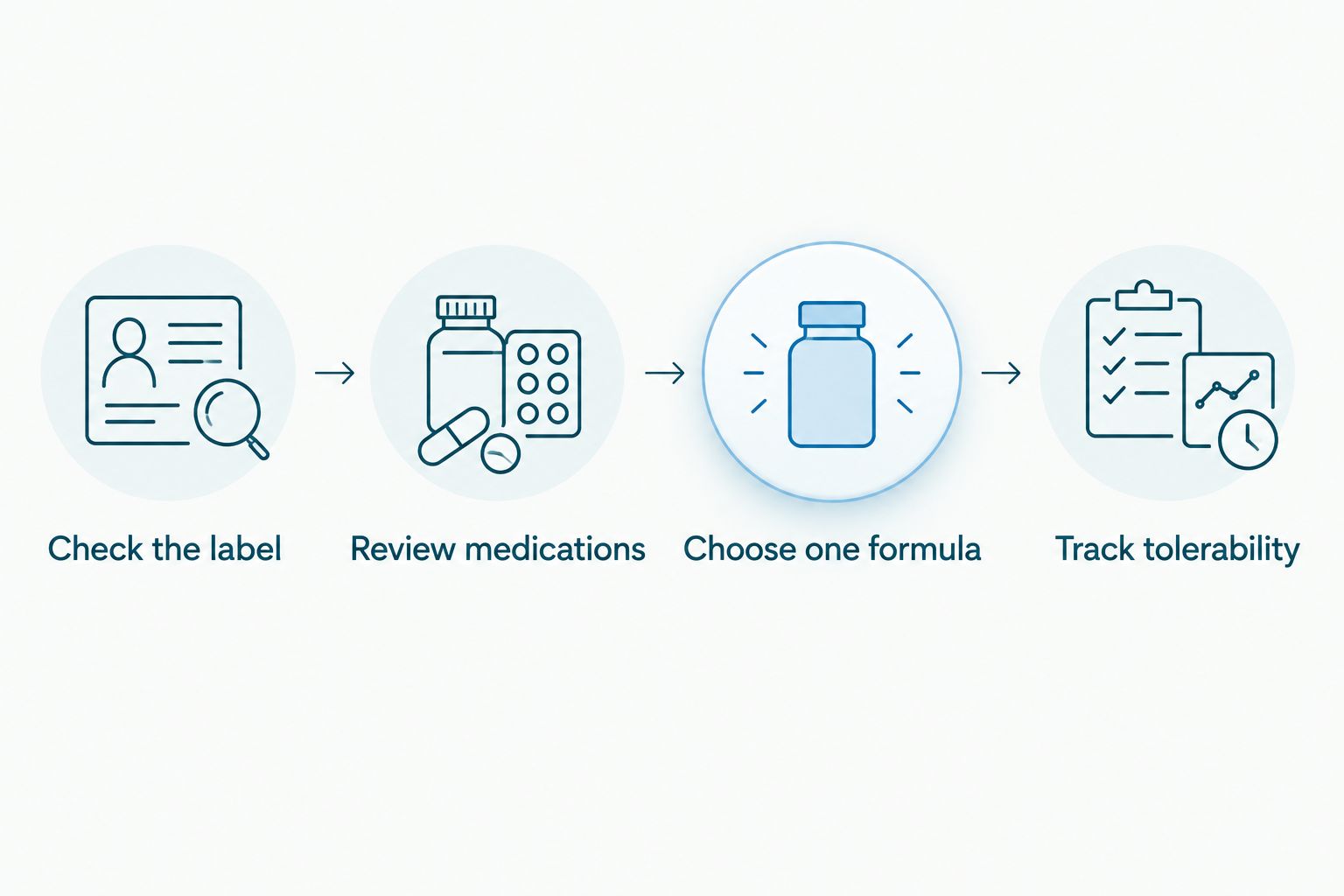
Apply this sequence before starting:
- Check the label: Confirm the ingredient, preparation, serving, and other actives.
- Review medications: Ask a pharmacist or clinician to review the complete formula, particularly with medicines affecting bleeding or blood sugar.
- Choose one formula: Avoid starting several new supplements together.
- Track tolerability: Record digestive symptoms, skin reactions, and other changes rather than assuming every change is a benefit.
Avoid lion’s mane if you have a known allergy to it. Stop use and seek medical advice for concerning reactions; breathing difficulty or facial swelling requires urgent care. Pregnancy, breastfeeding, and significant medical conditions warrant clinician review before you start.
How these options were ranked
This 2026 ranking prioritizes transparent labeling, understandable composition, evidence fit, and practical use. It ranks formulation choices, not independently tested finished products.
Single-ingredient oral capsules lead because they simplify evaluation. Other formats win narrower use cases, such as food mixing or avoiding capsules. None receives a benefit ranking based solely on extraction ratio, mushroom part, or delivery format.
Which lion’s mane supplement should you choose?
Choose a clearly labeled, single-ingredient oral capsule as the default. Move to powder or liquid when that format better fits your routine, and require the same quality documentation.
If your real goal is comparing broader focus formulas, assess Clarity separately rather than treating every focus product as a lion’s mane alternative. Ingredient identity comes first.
Featured in this article
Clarity CapsulesLion's mane, bacopa, rhodiola, maca, epimedium and huperzine A in a two-capsule morning serving.
Shop Clarity CapsulesThird-party tested ingredients. Caffeine-free.
Sources
- Mori K et al. Improving effects of the mushroom Yamabushitake (Hericium erinaceus) on mild cognitive impairment: a double-blind placebo-controlled clinical trial. Phytotherapy Research, 2009. PubMed
- Mori K et al. Nerve growth factor-inducing activity of Hericium erinaceus in 1321N1 human astrocytoma cells. Biological and Pharmaceutical Bulletin, 2008. PubMed
- Szućko-Kociuba I et al. Neurotrophic and neuroprotective effects of Hericium erinaceus. International Journal of Molecular Sciences, 2023. PubMed
- Saitsu Y, Nishide A, Kikushima K, Shimizu K, Ohnuki K. Improvement of cognitive functions by oral intake of Hericium erinaceus. Biomed Res. 2019;40(4):125-131. PubMed 31413233
FAQ
What’s the best lions mane supplement in 2026?
The best default is a single-ingredient oral formula with a disclosed preparation, serving amount, and batch-level quality testing. Capsules simplify the routine.
Is fruiting-body lion’s mane better than mycelium?
Compare the specific preparation, testing, and human evidence for each product.
How much lion’s mane should I take for focus?
Studies have used different preparations and amounts, so follow the actual product’s instructions and ask a clinician about suitability; a dose from a powder study does not translate directly to every extract.
Should I take lion’s mane in the morning or at night?
Choose a consistent time that fits the product instructions and your tolerability; studies have used daily servings rather than a set time of day.
Does lion’s mane work immediately?
Human trials have measured lion’s mane over weeks of daily use. A small 2009 cognitive-function trial evaluated supplementation over 16 weeks, not an instant response in healthy adults.
Are liquid lion’s mane extracts absorbed better than capsules?
Liquid format alone does not establish better absorption than capsules. A superiority claim requires relevant human evidence comparing the actual preparations and delivery formats.
Can I take lion’s mane with medication?
Have a pharmacist or clinician review lion’s mane and the complete formula before combining them with medication. Interaction concerns make individualized review important, especially with medicines affecting bleeding or blood sugar.
One last thing
The most useful 2026 label detail is often the least dramatic: exactly what is in the serving. A large extract ratio, an impressive mechanism, and a clean-looking bottle cannot replace that disclosure. If you cannot identify the preparation and dose, skip the product.


Leave a comment
All comments are moderated before being published.
This site is protected by hCaptcha and the hCaptcha Privacy Policy and Terms of Service apply.