
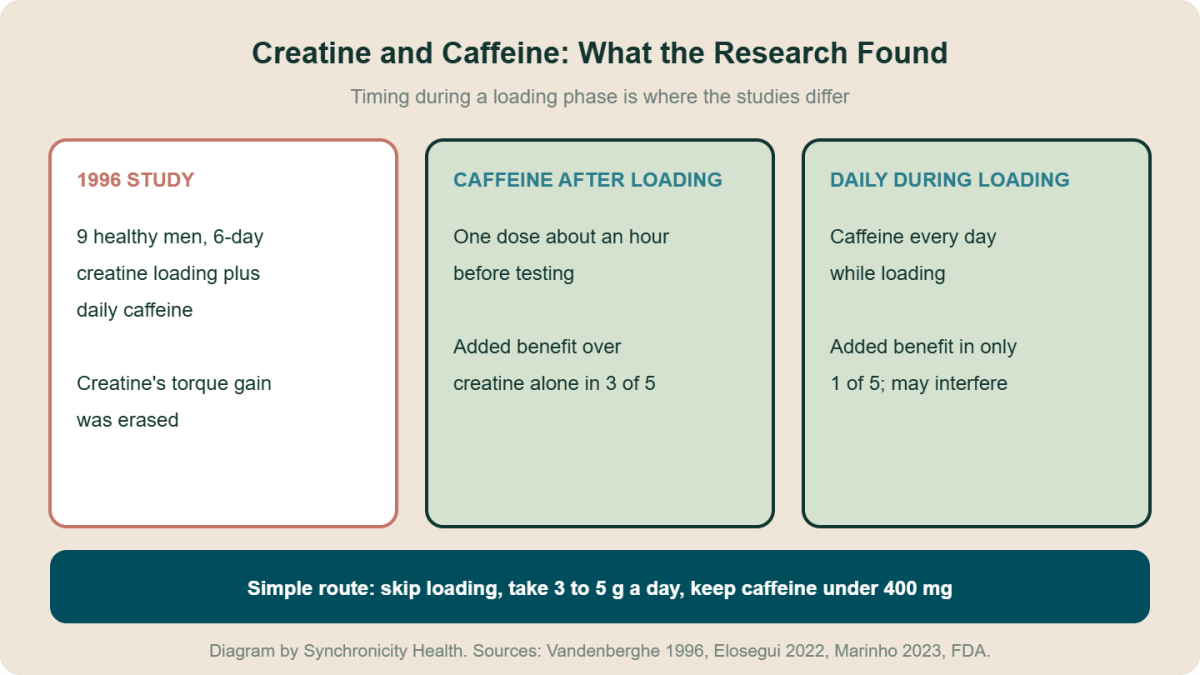
Yes, most people can take creatine and caffeine together, including stirring creatine into coffee. The worry comes from one small 1996 study that paired a large creatine loading dose with daily caffeine. Two later systematic reviews found that caffeine taken after creatine loading did not blunt creatine and sometimes added to it, while daily caffeine during loading is where interference was reported. This guide covers what that study found, mixing creatine into coffee, caffeine limits and timing, stomach comfort and a simple routine.
It is educational, not medical advice.
Key Takeaways
- The early warning: in 9 healthy men, creatine alone raised knee extension torque by 10 to 23 percent after a 6-day loading phase, but adding 5 mg of caffeine per kg of body weight a day erased that gain (Vandenberghe et al., 1996).
- Later reviews: caffeine taken after creatine loading did not blunt creatine and sometimes added to it; possible interference showed up mainly with daily caffeine during loading (Elosegui et al., 2022; Marinho et al., 2023).
- Coffee is fine as a mixer. What matters is the daily total of creatine, about 3 to 5 g a day once your stores are full (Kreider et al., 2017).
- Keep caffeine in range: for most adults, the FDA cites 400 mg a day as an amount not generally associated with negative effects (FDA).
- Stomach comfort: splitting larger creatine amounts into 5 g servings was easier on digestion than one 10 g serving in a trial of soccer players (Ostojic, 2008).

Featured in this article
Creatine Monohydrate5 g of creatine monohydrate in every scoop, the top of the standard 3 to 5 g daily range.
Join the WaitlistComing soon. Third-party tested ingredients.
Can You Take Creatine and Caffeine Together?
For most healthy adults, yes. Creatine and caffeine work on very different timelines. Caffeine acts within the hour: performance studies give it 15 to 60 minutes before exercise (NIH ODS). Creatine does not give a quick boost. Taking it every day slowly fills the creatine stored in your muscles, and 3 to 5 g a day fills those stores over about 3 to 4 weeks, then keeps them full (Kreider et al., 2017). Because creatine works over weeks, when you take it during the day matters much less than taking it daily; see when to take creatine.
The real question is whether caffeine dulls what creatine does over those weeks. Here is what the research measured.
What the Research on Combining Them Found
Nine healthy male volunteers each went through three 6-day phases: placebo, creatine at 0.5 g per kg of body weight a day, and the same creatine plus 5 mg of caffeine per kg a day. For a 70 kg (154 lb) man, that is 35 g of creatine and 350 mg of caffeine a day. Both creatine phases raised muscle phosphocreatine by 4 to 6 percent. Creatine alone raised torque during repeated, intense knee extensions by 10 to 23 percent. With caffeine added, there was no improvement. The authors concluded that the gain from creatine "is completely eliminated by caffeine intake" (Vandenberghe et al., 1996).
Keep the details in mind: 9 men, a short loading phase at several times the usual daily creatine serving, and caffeine every day at a fairly high dose. The results may not apply to someone taking 3 to 5 g of creatine with a morning coffee. If you want to be cautious, keep caffeine moderate during any loading week, or skip loading and take a steady 3 to 5 g a day, which fills muscle stores in about 3 to 4 weeks (Kreider et al., 2017).
What Later Reviews Found
A 2022 systematic review of 10 studies found that creatine loading before a single dose of caffeine did not interfere with caffeine's benefit in three studies. When both were taken daily together, two studies reported that caffeine interfered with creatine's benefit, three found no interaction and one reported a combined benefit. The authors concluded that creatine loading does not seem to interfere with caffeine taken before exercise, but daily caffeine during creatine loading could interfere with creatine's benefit (Elosegui et al., 2022).
A 2023 systematic review, also of 10 studies, reached a similar view. In five studies, caffeine (5 to 7 mg per kg) about an hour before testing after a 5 to 6 day creatine loading phase added a benefit over creatine alone in three of them. In five studies where caffeine was taken daily during loading, only one showed an added benefit. The authors saw no apparent benefit from taking caffeine during a creatine loading period (Marinho et al., 2023).
Why the Early Concern Existed
The worry traces back to the 1996 study above, which reported that caffeine "completely eliminated" creatine's performance gain. The study abstract does not give a reason for the effect (Vandenberghe et al., 1996). A later review judged a direct interaction in the body unlikely and noted two suggested explanations: opposite effects on how quickly muscles relax, and stomach upset from taking both at once (Trexler and Smith-Ryan, 2015).
It is worth noting that caffeine did not stop creatine from filling muscle stores in that trial. Both creatine phases, with and without caffeine, raised muscle phosphocreatine by 4 to 6 percent. What disappeared was the gain in repeated knee extension torque (Vandenberghe et al., 1996).
Can You Put Creatine in Coffee?
Yes. Creatine mixes into water, juice or a smoothie, and coffee works the same way as a carrier. A few practical tips:
- Stir well and drink it through. Powder can settle at the bottom of the cup, so give it a final stir before the last sips.
- Iced coffee or a coffee smoothie works too. Blending with milk and a banana adds carbohydrate and protein, and taking creatine with carbohydrate, or carbohydrate and protein, has been linked to better creatine retention (Kreider et al., 2017).
- Keep one coffee as the habit, not five. If you are tying creatine to coffee, the creatine habit should not push your caffeine higher.
If you prefer powder, capsules or gummies, the daily grams are what count; see creatine powder vs pills vs gummies.
Caffeine Limits and Timing
For most adults, the FDA has cited 400 mg of caffeine a day as an amount not generally associated with negative effects. A 12-ounce cup of regular brewed coffee holds 113 to 247 mg, so two large cups can approach that amount on their own (FDA). Energy drinks and pre-workouts add to the same total. See how much caffeine is too much for a full breakdown.
| Question | Creatine | Caffeine |
|---|---|---|
| How it works | Builds up in muscle over weeks | Acts within the hour |
| Usual amount | 3 to 5 g a day | Up to 400 mg a day for most adults |
| Timing | Any time, every day | 15 to 60 minutes before exercise in performance studies |
| Watch for | Stomach upset with large single servings | Jitters, fast heartbeat, upset stomach, poor sleep |
In exercise studies, caffeine helped when people took about 2 to 6 mg per kg of body weight before exercise, which is 210 to 420 mg for a 70 kg (154 lb) person. Taking more is unlikely to improve performance further and raises the risk of side effects (NIH ODS). Caffeine late in the day can disrupt sleep (FDA); see how long caffeine lasts.
The FDA lists increased heart rate, palpitations, sleep disruption, anxiety, jitters, upset stomach, nausea and headache as signs of too much caffeine. If you have a health condition, take medication, or are pregnant, trying to become pregnant or breastfeeding, talk with your provider about your caffeine limit. Avoid pure or highly concentrated caffeine powders, which the FDA warns can have serious health consequences (FDA).
Stomach Comfort
Both can upset the stomach. Nausea, diarrhea and related stomach upset are anecdotal reactions to creatine (NIH ODS), and upset stomach is on the FDA's list for caffeine. Serving size seems to matter for creatine. In a 28-day trial in 59 male soccer players, diarrhea was reported by 55.6 percent of those taking one 10 g serving a day, compared with 28.6 percent of those taking two 5 g servings and 35 percent on placebo. The two 5 g servings were no different from placebo for digestive complaints (Ostojic, 2008).
So keep each serving around 5 g, take it with food if coffee on an empty stomach bothers you, and drink fluids through the day. More on this in creatine side effects. If you are loading, split the day's total into 5 g servings; see creatine loading phase.
A Practical Routine
- Take 3 to 5 g of creatine every day, training days and rest days, at a time you will remember. Not sure how much? See how much creatine per day.
- Pair it with a habit, such as your morning coffee or a post-workout shake.
- Count every source of caffeine, including coffee, tea, energy drinks and pre-workout, and stay within your limit.
- Set a caffeine cutoff well before bed so sleep does not suffer.
- Skip loading if you are worried. A steady 3 to 5 g a day fills your stores in about 3 to 4 weeks without the large loading doses used in the 1996 study.
Creatine often leads to some weight gain, partly because it increases water retention (NIH ODS); see creatine water retention. Creatine is not only for lifters: see creatine for women and creatine and cognitive health. For a caffeine free pairing, our guide to cordyceps and creatine covers a mushroom studied for aerobic exercise and how to take both together.
Where L-Theanine Fits
Some people pair their coffee with L-theanine, an amino acid. Studies of the pair, and the amounts used, are covered in L-theanine and caffeine, and more background is on our L-theanine page.
Our Theanine Nasal Spray gives 36 mg of L-theanine per serving (one spray in each nostril), absorbed through the lining of the nose. It is caffeine free, so you can use it alongside your usual coffee without adding to your caffeine total. If you want to cut back on caffeine altogether, see non-stimulant energy and focus and coffee alternatives.
Coming Soon From Synchronicity
Our Creatine Monohydrate powder will have 5 g of creatine monohydrate in every scoop. It is not on sale yet. Join the waitlist on the product page to hear when it launches; no payment is taken.
More guides are in our Learn hub.
Safety note: people with kidney disease, those who are pregnant or breastfeeding, and anyone taking prescription medicines should talk with a clinician before taking creatine. Caffeine is not right for everyone; if you are sensitive to it or have a heart condition, ask your provider first.
Featured in this article
Creatine Monohydrate5 g of creatine monohydrate in every scoop, the top of the standard 3 to 5 g daily range.
Join the WaitlistComing soon. Third-party tested ingredients.
Frequently Asked Questions
Does caffeine cancel out creatine?
One small 1996 study found that daily caffeine (5 mg per kg of body weight) during a 6-day, high-dose creatine loading phase erased creatine's performance gain in 9 men, although creatine still raised muscle phosphocreatine. Those doses were far above a usual 3 to 5 g daily serving with a cup of coffee, so the results may not apply to that routine (Vandenberghe et al., 1996). Later reviews found that caffeine taken after creatine loading did not blunt creatine, and the possible interference showed up mainly with daily caffeine during loading (Elosegui et al., 2022).
Can I put creatine in my coffee?
Yes. Stir it in well and finish the cup. What matters is getting your daily 3 to 5 g, whatever you mix it into.
Should I take creatine and pre-workout together?
You can, but check the label. Many pre-workouts are high in caffeine, so count it toward your daily limit, and make sure any creatine in the blend adds up to 3 to 5 g a day or top it up separately.
How much caffeine is safe with creatine?
The same as without it. For most adults, the FDA cites 400 mg a day as an amount not generally associated with negative effects, and some people feel side effects at less.
Should I avoid caffeine during a creatine loading phase?
If you load, the cautious choice is to keep caffeine moderate that week, since reviews link the possible interference to daily caffeine during loading (Marinho et al., 2023). Or skip loading and take 3 to 5 g a day.
Does creatine and caffeine together upset your stomach?
It can for some people. Keep creatine servings around 5 g, take them with food, and keep caffeine moderate.
Sources
- Vandenberghe K, Gillis N, Van Leemputte M, Van Hecke P, Vanstapel F, Hespel P. Caffeine counteracts the ergogenic action of muscle creatine loading. J Appl Physiol. 1996. PubMed 8929583
- Kreider RB, et al. International Society of Sports Nutrition position stand: safety and efficacy of creatine supplementation in exercise, sport, and medicine. J Int Soc Sports Nutr. 2017. PubMed 28615996
- Ostojic SM, Ahmetovic Z. Gastrointestinal distress after creatine supplementation in athletes: are side effects dose dependent? Res Sports Med. 2008. PubMed 18373286
- Elosegui S, López-Seoane J, Martínez-Ferrán M, Pareja-Galeano H. Interaction Between Caffeine and Creatine When Used as Concurrent Ergogenic Supplements: A Systematic Review. Int J Sport Nutr Exerc Metab. 2022. PubMed 35016154
- Marinho AH, et al. Effects of creatine and caffeine ingestion in combination on exercise performance: A systematic review. Crit Rev Food Sci Nutr. 2023. PubMed 34845944
- Trexler ET, Smith-Ryan AE. Creatine and Caffeine: Considerations for Concurrent Supplementation. Int J Sport Nutr Exerc Metab. 2015. PubMed 26219105
- U.S. Food and Drug Administration. Spilling the Beans: How Much Caffeine Is Too Much? FDA
- NIH Office of Dietary Supplements. Dietary Supplements for Exercise and Athletic Performance: Fact Sheet for Health Professionals. NIH ODS
These statements have not been evaluated by the Food and Drug Administration. This content is for education and is not medical advice. Our products are not intended to diagnose, treat, cure or prevent any disease. Talk with a healthcare provider before starting a new supplement if you are pregnant, breastfeeding or taking medication.

Leave a comment
All comments are moderated before being published.
This site is protected by hCaptcha and the hCaptcha Privacy Policy and Terms of Service apply.