
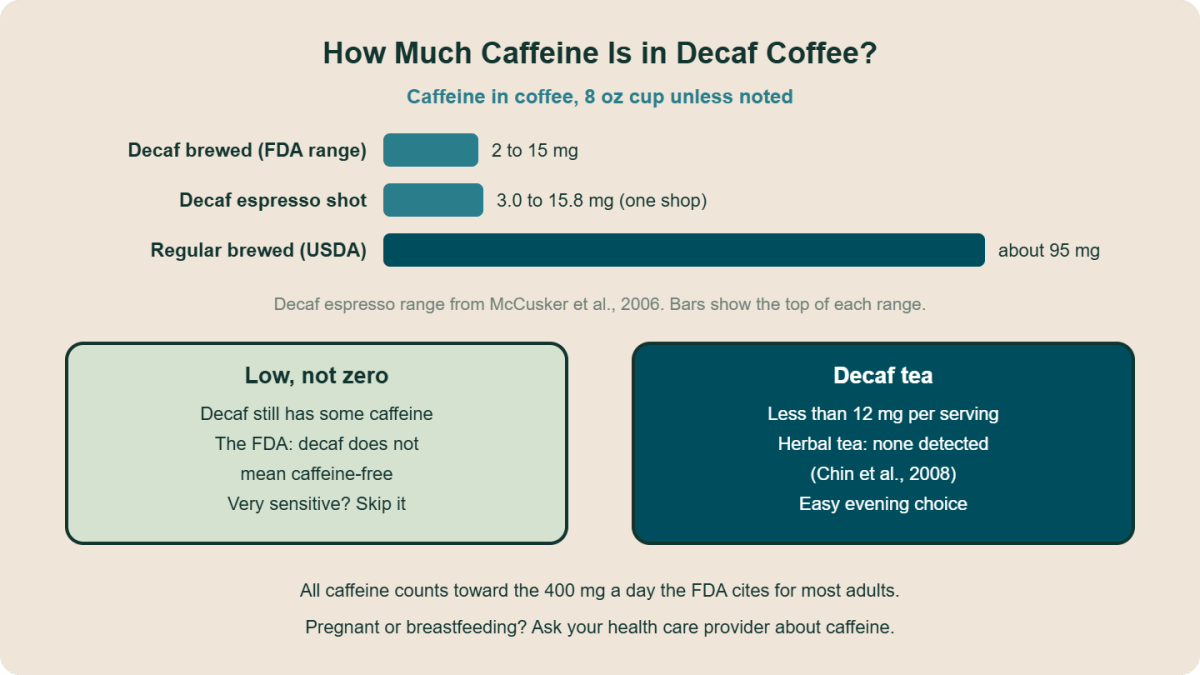
An 8-ounce cup of decaf coffee typically has 2 to 15 mg of caffeine, according to the FDA, so decaf is low in caffeine but not caffeine-free (FDA). For comparison, USDA data put regular brewed coffee at about 40 mg per 100 grams, roughly 95 mg in an 8-ounce cup (USDA FoodData Central). Lab tests of coffee shop decaf have found anything from 0 to 13.9 mg in a 16-ounce cup and up to 15.8 mg in a single decaf espresso shot (McCusker et al., 2006). This guide covers how much is in each kind of decaf, how it adds up and who should care.
It is educational, not medical advice.
Key Takeaways
- Typical decaf: 2 to 15 mg of caffeine in an 8-ounce cup (FDA).
- Regular coffee: about 95 mg in an 8-ounce cup, from 40 mg per 100 g of brewed coffee (USDA FoodData Central).
- Coffee shop decaf: 0 to 13.9 mg per 16-ounce serving across 10 outlets, and 3.0 to 15.8 mg per decaf espresso shot from one outlet (McCusker et al., 2006).
- Decaf tea: less than 12 mg per serving; herbal teas had none detected (Chin et al., 2008).
- It still counts: if you react strongly to caffeine, the FDA says you may want to avoid decaf altogether (FDA).

Featured in this article
Theanine Nasal Spray36 mg of L-theanine per serving, caffeine-free, to pair with your coffee or tea.
Shop Theanine Nasal SprayThird-party tested ingredients. Vegan, non-GMO, made in the USA.

How Much Caffeine Is in Decaf Coffee?
| Drink | Typical caffeine | Source |
|---|---|---|
| Decaf brewed coffee, 8 oz | 2 to 15 mg | FDA |
| Decaf brewed coffee, 8 oz (USDA average) | about 2 mg | USDA |
| Coffee shop decaf, 16 oz | 0 to 13.9 mg | McCusker 2006 |
| Decaf espresso, one shot | 3.0 to 15.8 mg | McCusker 2006 |
| Regular brewed coffee, 8 oz | about 95 mg | USDA |
| Regular brewed coffee, 12 oz | 113 to 247 mg | FDA |
USDA FoodData Central lists 1 mg of caffeine per 100 grams of brewed decaf coffee (USDA FoodData Central) and 40 mg per 100 grams of regular brewed coffee (USDA FoodData Central); 8-ounce amounts are calculated from those figures. The FDA ranges are typical amounts (FDA), and the coffee shop figures come from lab testing (McCusker et al., 2006).
An earlier lab study of coffee shop drinks found decaf versions held under 17.7 mg per serving, while regular brewed coffee ranged from 58 to 259 mg per serving (McCusker et al., 2003).
Why Decaf Still Has Caffeine
Decaffeination removes most of the caffeine from coffee, but not all of it, and the amount left can vary from cup to cup. That is why the FDA says that "decaffeinated" does not mean caffeine-free (FDA), and why one study found decaf from the same shop varied from shot to shot (McCusker et al., 2006).
Serving size matters too. A large decaf has more caffeine than a small one, and a decaf latte made with two espresso shots can carry two shots' worth.
How Many Cups of Decaf Equal One Regular Coffee?
At the USDA average of about 2 mg per 8 ounces, it would take dozens of cups of decaf to match one regular coffee (USDA FoodData Central). At the top of the FDA range, 15 mg per cup, about six cups of decaf would add up to as much as one 8-ounce regular coffee at the USDA average. For most people, a few cups of decaf a day is a very small caffeine load.
Who Should Pay Attention to Decaf Caffeine?
- People very sensitive to caffeine: the FDA says those who react strongly may want to avoid decaf altogether (FDA).
- Pregnancy and breastfeeding: the FDA recommends asking your health care provider whether you need to limit caffeine (FDA).
- People on certain medicines: some medicines interact with caffeine, a reason the decaf testing study was done (McCusker et al., 2006). Ask your pharmacist.
- Anyone cutting back: decaf is a useful step down from regular coffee. See our guide to how much caffeine is too much for daily limits.
Decaf and Sleep
Because a cup of decaf usually holds only a few milligrams of caffeine, it is a common choice for an evening coffee. If you are very sensitive, or drink several large cups late in the day, the small amounts can add up. Our guide to how long caffeine lasts explains why timing matters, and caffeine crash covers the afternoon slump that sends many people back to the pot.
Decaf Tea and Other Low-Caffeine Swaps
In lab tests of 20 brewed teas, white, green and black teas held 14 to 61 mg per 6 or 8 ounce serving, decaf teas held less than 12 mg, and herbal teas had no caffeine detected (Chin et al., 2008). Cocoa drinks carry a little natural caffeine and more theobromine. For more ideas, see our list of coffee alternatives.
Where Our Products Fit
Theanine Nasal Spray gives 36 mg of L-theanine per serving and is caffeine-free, so it can sit next to a regular or decaf coffee without adding caffeine. Mushroom Cacao is a mushroom hot chocolate with lion's mane and cordyceps; cocoa naturally contains a little caffeine and theobromine, so it is a lighter option than coffee rather than a caffeine-free one. Read more on our L-theanine ingredient page and the Non-Stimulant Energy and Focus hub.

Featured in this article
Mushroom CacaoA mushroom hot chocolate made with cocoa and cacao, with 500 mg each of lion's mane and cordyceps per serving and 0g sugar.
Shop Mushroom CacaoThird-party tested ingredients. 15 calories per serving.
Frequently Asked Questions
Is decaf coffee caffeine-free?
No. Decaf typically has 2 to 15 mg of caffeine in an 8-ounce cup (FDA).
How much caffeine is in decaf espresso?
One study found 3.0 to 15.8 mg per decaf espresso shot from the same coffee shop (McCusker et al., 2006).
How much caffeine is in a large decaf?
Coffee shop decaf tested at 0 to 13.9 mg per 16-ounce serving across 10 outlets (McCusker et al., 2006).
Can decaf keep you awake?
For most people, the few milligrams in a cup are unlikely to matter, but very sensitive people may notice it, especially from several cups late in the day (FDA).
Is decaf OK during pregnancy?
Decaf has far less caffeine than regular coffee. The FDA recommends talking to your health care provider about caffeine if you are pregnant or breastfeeding (FDA).
How many cups of decaf equal one regular coffee?
At the top of the FDA range, about six cups of decaf equal one 8-ounce regular coffee; at the USDA average, far more (USDA FoodData Central).
Does decaf tea have caffeine?
Yes, a little. Decaf teas tested at less than 12 mg per serving, and herbal teas had none detected (Chin et al., 2008).
Does decaf count toward my daily caffeine?
Yes. All caffeine counts toward the 400 mg a day the FDA cites for most adults, though decaf adds very little (FDA).
Sources
- U.S. Food and Drug Administration. Spilling the Beans: How Much Caffeine Is Too Much? FDA
- McCusker RR, Fuehrlein B, Goldberger BA, Gold MS, Cone EJ. Caffeine content of decaffeinated coffee. J Anal Toxicol. 2006. PubMed 17132260
- Chin JM, Merves ML, Goldberger BA, Sampson-Cone A, Cone EJ. Caffeine content of brewed teas. J Anal Toxicol. 2008. PubMed 19007524
- U.S. Department of Agriculture. FoodData Central: Beverages, coffee, brewed, prepared with tap water, decaffeinated (FDC 171889); Beverages, coffee, brewed, prepared with tap water (FDC 171890). FoodData Central
- McCusker RR, Goldberger BA, Cone EJ. Caffeine content of specialty coffees. J Anal Toxicol. 2003;27(7):520-2. PubMed 14607010
Our products are not intended to diagnose, treat, cure or prevent any disease. This article is for education only and is not medical advice.


Leave a comment
All comments are moderated before being published.
This site is protected by hCaptcha and the hCaptcha Privacy Policy and Terms of Service apply.