

For the best lion’s mane supplement, fruiting body vs mycelium is not enough to decide: choose a product that identifies the mushroom material, discloses the serving amount, and provides relevant testing. Fruiting body is the visible mushroom; mycelium is its threadlike growth network, sometimes supplied with the grain used to grow it. Neither label alone tells you whether a product matches the preparations studied in humans.

Featured in this article
ForageLion's Mane, Cordyceps, Reishi and more for focus, energy, and daily balance.
Shop ForageThird-party tested ingredients. Vegan capsules.
- Best lions mane supplement fruiting body vs mycelium: choose transparent composition and testing, not a mushroom-part slogan.
- Fruiting body avoids ambiguity about myceliated grain.
- Mycelium is not automatically inferior; distinguish isolated mycelium from mycelium grown on grain.
- Synchronicity shoppers should compare serving amounts, human evidence, and delivery routes before buying.
Why this matters
A lion’s mane label can describe what went into a bottle without showing what the finished supplement contains. Mushroom part, growing substrate, extraction method, and measured compounds answer different questions. Assuming they are interchangeable makes comparison harder.
For your 2026 shortlist, start with the label checks below, then use the lion’s mane supplements comparison to organize your options. A clearly identified preparation is more useful than an impressive claim about the mushroom’s biology. That distinction matters when you are choosing something for daily focus rather than simply buying a culinary mushroom.
Lion’s mane fruiting body vs mycelium: how do you read the label?
Read the ingredient identity first, the amount second, and the testing information third. The species name should identify Hericium erinaceus. Then look for wording that explains whether the ingredient is fruiting body, mycelium, or myceliated grain.
These are different materials, not a simple ranking from good to bad. A product can disclose its mushroom part accurately and still leave important questions unanswered about composition or evidence.
| Label wording | What it tells you | Best for | Main limitation |
|---|---|---|---|
| Fruiting body | The ingredient comes from the visible mushroom structure | Buyers prioritizing clear mushroom-part identification | Does not establish extraction quality or tested composition |
| Mycelium | The ingredient comes from the mushroom’s threadlike growth network | Buyers evaluating a specifically characterized mycelial preparation | Does not necessarily disclose whether growing substrate remains |
| Myceliated grain | Mycelium was grown on grain and the ingredient includes that material | Buyers comfortable with a disclosed mushroom-and-substrate ingredient | Total ingredient weight is not the same as isolated mushroom material |
| Fruiting body and mycelium | Both mushroom parts are included | Buyers seeking a disclosed combination | An undisclosed split makes each component difficult to assess |
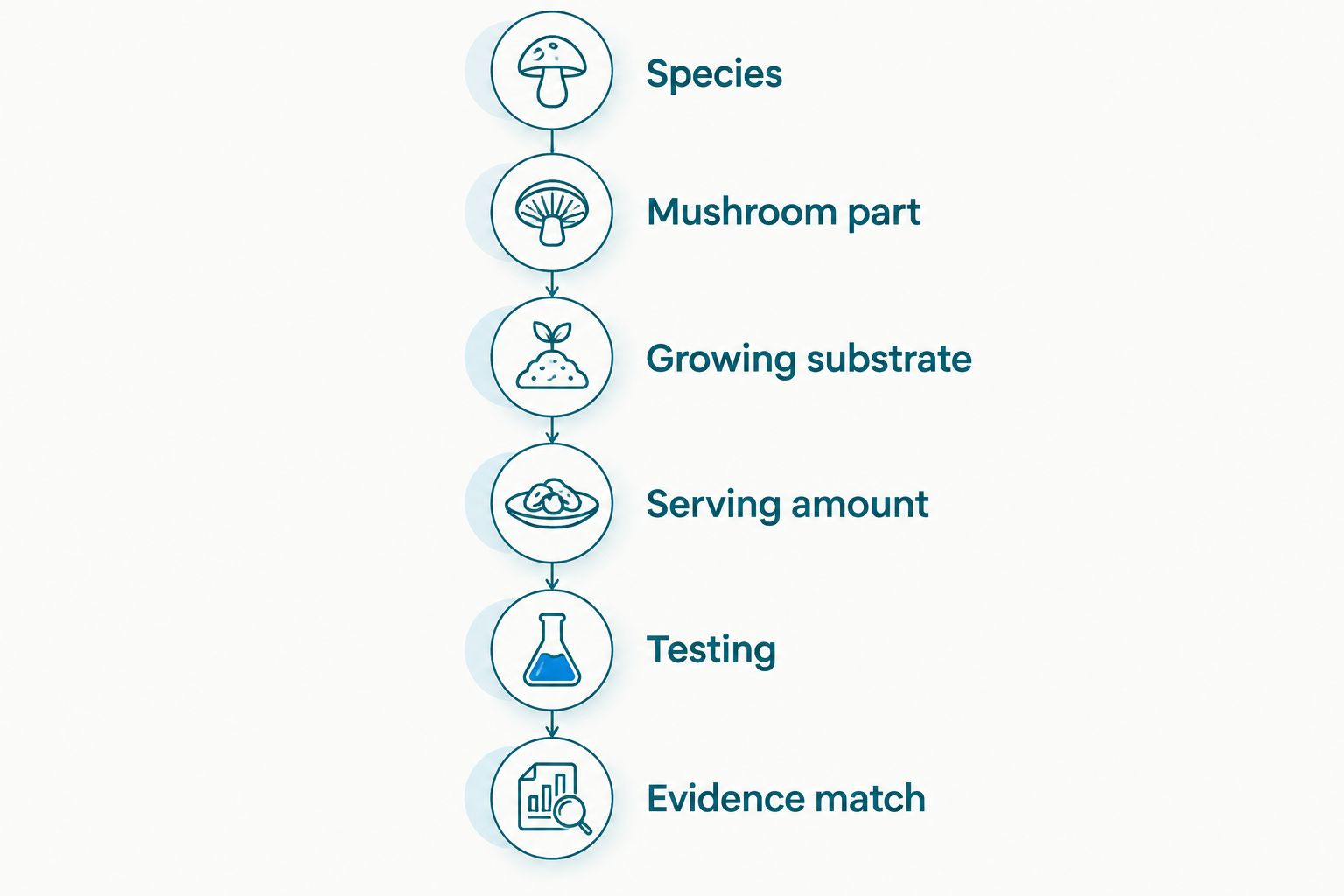
Read the label in this order
- Species: Confirm Hericium erinaceus, rather than a generic mushroom description.
- Mushroom part: Identify fruiting body, mycelium, or a combination.
- Growing substrate: Check whether grain or another growth material remains in the ingredient.
- Serving amount: Find the amount per serving, not just the capsule count.
- Testing: Look for measured composition and relevant contaminant results.
- Evidence match: Compare the preparation with the one used in the cited human study.
This sequence keeps a familiar mistake out of your 2026 comparison: choosing a large milligram number before establishing what those milligrams represent. A blend’s total weight does not reveal the amount of each mushroom unless the label provides that breakdown.
Fruiting body: a clear identity, not an automatic winner
The fruiting body is the structure you recognize as a mushroom. On a supplement label, that wording helps distinguish the ingredient from mycelium grown through a substrate. It does not tell you whether the product is plain powder, an extract, or a preparation with measured constituents.
Best for: buyers who want straightforward identification of the mushroom material. The advantage is clarity about the part used. The limitation is that clarity alone does not establish a useful dose.
Fruiting bodies contain beta-glucans and other compounds, including compounds studied for biological activity. When you read research, check the preparation, dose, population, and outcome each study used.
For a 2026 purchase, do not stop at a front-label fruiting-body claim. Check the ingredient panel and ask whether the testing applies to the finished product or only to an ingredient before manufacturing.
Mycelium: distinguish the fungus from its growth material
Mycelium is part of the mushroom organism, not inherently a filler. The important distinction is between a characterized mycelial preparation and mycelium supplied together with the substrate on which it grew.
Best for: buyers assessing a specifically identified mycelial ingredient with relevant testing and human research. Its advantage is that mycelium has its own chemical profile and research interest. Its limitation is that the word alone provides little information about the finished ingredient.
Certain erinacines have been studied in lion’s mane mycelium. Hericenones have been studied in fruiting bodies. Those associations do not mean every commercial product contains meaningful amounts.
If a label says myceliated brown rice, take that wording literally: the material includes the growth substrate. Do not equate its total weight with an equal weight of isolated mycelium or fruiting body. Conversely, do not dismiss a clearly characterized mycelial preparation merely because it is not fruiting body.
What do human studies actually establish?
Human research on lion’s mane is preparation-specific, and most studies have used oral forms. It does not establish a universal winner between fruiting body and mycelium. Studies using different populations, ingredients, doses, and outcome measures cannot substitute for a direct comparison.
A small placebo-controlled study by Mori and colleagues, published in Phytotherapy Research, evaluated 3 grams per day for 16 weeks in adults with mild cognitive impairment. Cognitive scale scores improved during supplementation, then declined during the 4 weeks after supplementation stopped. That result concerns the studied preparation and population.
A pilot study by Docherty and colleagues, published in Nutrients, evaluated 1.8 grams per day for 28 days in healthy young adults. It reported findings on selected measures.
| Human evidence | What it helps answer | Scope of the finding |
|---|---|---|
| Mori and colleagues: 3 grams per day, 16 weeks | Whether the studied oral preparation affected cognitive scale scores in that study population | The studied oral preparation, dose, and population |
| Docherty and colleagues: 1.8 grams per day, 28 days | Whether the studied oral supplement affected selected measures in healthy young adults | The studied oral supplement, dose, and selected measures |
| Studies of characterized mycelial preparations | Whether a particular mycelial ingredient has effects under specified conditions | The specific characterized ingredient studied |
The 2026 evidence-based choice is the product that most clearly connects its composition to relevant research, not the one borrowing the most research language.
Why lion’s mane labels vary
Different labels reflect different materials and manufacturing choices. These factors explain why similarly named supplements are not automatically comparable:
- Mushroom part: Fruiting body and mycelium have different chemical profiles.
- Growing substrate: A myceliated-grain ingredient includes material beyond the fungus itself.
- Extraction method: Processing changes which constituents are present in the resulting preparation.
- Standardization: A measured compound specification provides information that an unspecified powder does not.
- Serving disclosure: Individual ingredient amounts are easier to assess than an undisclosed blend total.
- Testing scope: Identity, composition, contaminants, and clinical effectiveness require different evidence.
Beta-glucans are more informative than total polysaccharides
Beta-glucans are a class of polysaccharides found in fungal cell walls. A total-polysaccharide result is broader and can include carbohydrates from other sources, including starch. It therefore does not identify the mushroom contribution as clearly as a suitable, specific analysis.
Ask what the test measures and which method the laboratory used. A beta-glucan result helps characterize composition, but it does not establish the amounts of erinacines or hericenones.
An extract ratio is not a clinical outcome
An extract ratio describes a claimed relationship between starting material and resulting extract. It does not, by itself, tell you the amount of every relevant compound.
Use the ratio alongside mushroom-part disclosure, the extraction description, and laboratory results. Do not let it replace those checks. A more concentrated-sounding label is not automatically a better match to a human trial.
Is fruiting body always better than mycelium?
No. Fruiting body makes the mushroom part easier to identify, but it does not establish clinical superiority over a characterized mycelial preparation. Prefer disclosure over a blanket rule: reject ambiguity, not an entire mushroom part.
Does more lion’s mane mean better focus?
No. The 3 grams per day used in the Mori study was a research protocol for that study population. More material also does not resolve differences between powder, extract, isolated mycelium, and myceliated grain.
Can you compare a mushroom capsule with a nasal spray?
You can compare their ingredient disclosures, intended use, and safety information, and note the delivery route each one uses. Most human lion’s mane studies used oral preparations.
That boundary matters when browsing Synchronicity nasal sprays and capsule supplements. Synchronicity is for adults seeking energy and focus support who want to compare nasal sprays and capsules. Its Forage Adaptogenic Mushroom Blend is a relevant place to apply these label questions; assess its disclosed ingredients rather than assuming its composition from the product name.
Dosing, timing, and safety before you buy
Lion’s mane studies have used different doses and durations. The 1.8 grams per day for 28 days used in one pilot study and 3 grams per day for 16 weeks used in another describe research protocols, not interchangeable instructions for every supplement.
Follow the product’s directions and discuss use with a clinician when your circumstances require it. Choose a consistent routine rather than assuming that timing creates an immediate cognitive effect.
For your 2026 routine, consider these precautions:
- Avoid lion’s mane if you have a known allergy to it; seek advice if you have a mushroom allergy.
- Stop taking it and seek care if you develop signs of an allergic reaction, particularly breathing difficulty or swelling.
- Discuss supplementation with a clinician during pregnancy or breastfeeding because safety evidence is limited.
- Check with a clinician or pharmacist if you take medication; interaction evidence is incomplete.
- Review every ingredient in a blend, since safety questions extend beyond lion’s mane.
Changing several supplements at once makes unwanted effects harder to trace. Persistent fatigue, worsening memory, or significant concentration difficulties deserve assessment rather than repeated supplement changes.
Sources
- Mori K, et al. Improving effects of the mushroom Yamabushitake (Hericium erinaceus) on mild cognitive impairment: a double-blind placebo-controlled clinical trial. Phytother Res. 2009. PubMed 18844328
- Docherty S, Doughty FL, Smith EF. The Acute and Chronic Effects of Lion's Mane Mushroom Supplementation on Cognitive Function, Stress and Mood in Young Adults: A Double-Blind, Parallel Groups, Pilot Study. Nutrients. 2023. PubMed 38004235
- Szućko-Kociuba I, et al. Neurotrophic and Neuroprotective Effects of Hericium erinaceus. Int J Mol Sci. 2023. PubMed 37958943
- McCleary BV, Draga A. Measurement of β-Glucan in Mushrooms and Mycelial Products. J AOAC Int. 2016. PubMed 26957216
Featured in this article
ForageLion's Mane, Cordyceps, Reishi and more for focus, energy, and daily balance.
Shop ForageThird-party tested ingredients. Vegan capsules.
FAQ
What’s the best lions mane supplement fruiting body vs mycelium choice?
The best choice is a clearly identified preparation with disclosed serving amounts and relevant testing, not fruiting body or mycelium by name alone. Match any research claim to the actual ingredient, dose, and delivery route.
Is lion’s mane mycelium just grain filler?
No, mycelium is the mushroom’s threadlike growth network. Myceliated grain includes the growing substrate, so check whether the label distinguishes that material from isolated mycelium.
How should I compare fruiting body and mycelium for focus?
Human lion’s mane studies have used different preparations, doses, and study populations, so compare products by their disclosed material, serving amount, and testing rather than by mushroom part alone.
Should I look for beta-glucans or polysaccharides?
A suitable beta-glucan analysis gives more specific composition information than a total-polysaccharide result.
How much lion’s mane should I take for focus?
Lion’s mane studies have used different doses. Follow the product’s directions and get individualized advice rather than assuming a research dose is a recommendation for every preparation.
How long does lion’s mane take to work?
Human studies evaluate specified lion’s mane preparations over defined periods. Follow the product’s directions and keep a consistent routine.
What does third-party testing cover for a lion’s mane supplement?
Depending on its scope, third-party laboratory testing can address identity, composition, or contaminants; human outcome studies answer a different question.
What does oral lion’s mane research cover?
Oral lion’s mane research looked at oral preparations. When comparing it with a nasal spray, note the delivery route, formulation, dose, and safety information for each product.
One last thing
Ask a seller one precise question: Does the available laboratory report describe this finished product and identify the batch? A report for a different material cannot answer every question about the bottle you are considering.
For Synchronicity supplement shoppers and other buyers, that question is more useful than demanding a particular mushroom-part slogan. In 2026, keep the decision simple: identify the material, check the evidence, and leave claims that outrun either one behind.


Leave a comment
All comments are moderated before being published.
This site is protected by hCaptcha and the hCaptcha Privacy Policy and Terms of Service apply.