
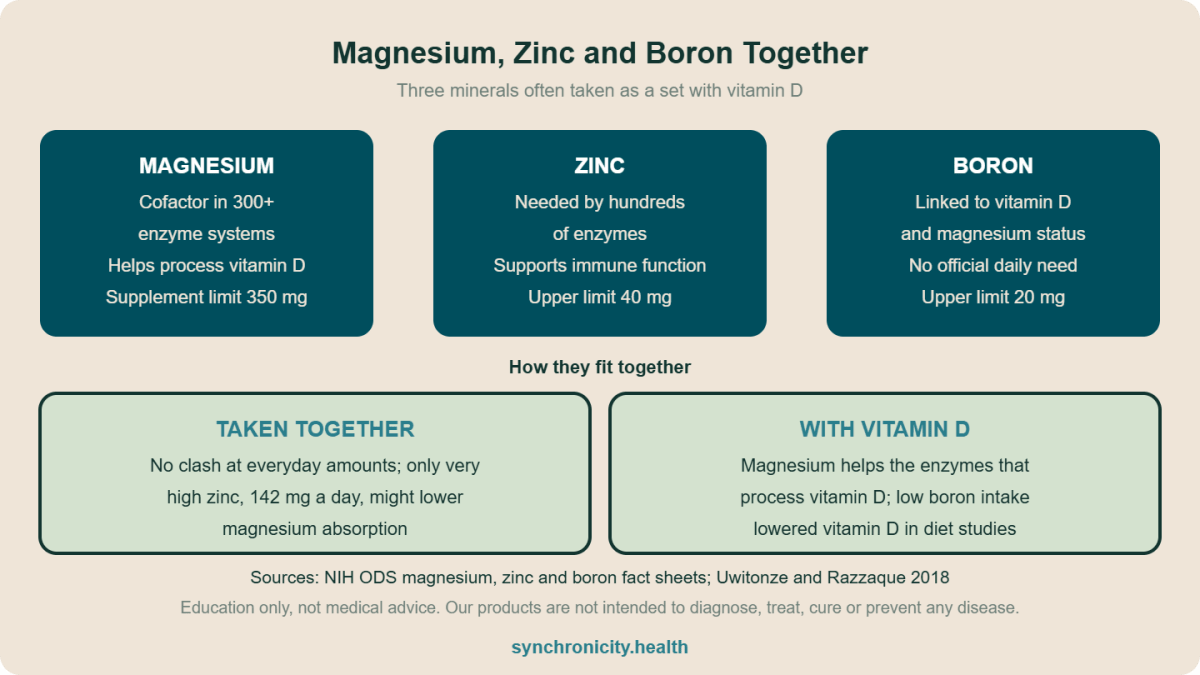
Yes, you can take magnesium, zinc and boron together. At everyday amounts they do not get in each other's way: the only clash NIH describes is that very high zinc, 142 mg a day, can interfere with magnesium absorption. Magnesium helps the enzymes that process vitamin D, boron intake is linked to vitamin D and magnesium status, and zinc is needed by hundreds of enzymes, which is why the three are often taken as a set with vitamin D.
Key Takeaways
- Adults need 310 to 420 mg of magnesium and 8 to 11 mg of zinc a day; boron has no official daily need, and most adults get about 0.87 to 1.35 mg from food (NIH ODS, boron).
- Upper limits for adults are 350 mg of supplemental magnesium, 40 mg of zinc and 20 mg of boron a day.
- The enzymes that turn vitamin D into its working forms appear to need magnesium (Uwitonze and Razzaque, 2018).
- In diet studies, low boron intake lowered blood vitamin D and seemed to raise magnesium loss in urine, and 3 mg of boron a day raised blood magnesium in young women who did not exercise.
- Zinc only gets in magnesium's way at very high amounts, 142 mg a day, far above the 40 mg upper limit (NIH ODS, zinc).

Featured in this article
Vitamin D Cofactor CapsulesMagnesium 100 mg, zinc 10 mg and boron 3 mg per 2 capsules, all as glycinates, made to pair with vitamin D3.
Join the WaitlistComing soon. Third-party tested ingredients.
What Magnesium, Zinc and Boron Each Do
Magnesium is a cofactor in more than 300 enzyme systems, and it affects the levels of both parathyroid hormone and the active form of vitamin D. About 48% of Americans get less than they need from food and drinks (NIH ODS, magnesium).
Zinc is needed for hundreds of enzymes and supports immune function, protein and DNA synthesis, wound repair, cell signaling and taste. About 15% of US adults fall short on zinc from their diet (NIH ODS, zinc). Our how much zinc per day guide covers amounts by age.
Boron is a trace mineral found mainly in fruit, vegetables, nuts and legumes. It is not classed as an essential nutrient, so it has no official daily target, but the body absorbs about 85% to 90% of the boron you eat and clears it mainly in urine (NIH ODS, boron). Our boron benefits guide covers food sources.
| Adults | Magnesium | Zinc | Boron |
|---|---|---|---|
| Daily need | Women 310 to 320 mg, men 400 to 420 mg | Women 8 mg, men 11 mg | No official target |
| Upper limit | 350 mg from supplements | 40 mg from all sources | 20 mg from all sources |
| Main job | 300+ enzyme systems; vitamin D processing | Hundreds of enzymes; immune function | Linked to vitamin D and magnesium status |
| Amount in our Cofactor Capsules (2 capsules) | 100 mg | 10 mg | 3 mg |
Can You Take Magnesium, Zinc and Boron Together?
Yes. NIH describes only a few mineral clashes that matter here, and none of them happen at everyday amounts:
- Zinc and magnesium. Very high zinc from supplements, 142 mg a day, might interfere with magnesium absorption. That is more than three times the 40 mg upper limit, and 14 times the zinc in our Cofactor Capsules (NIH ODS, zinc). Our magnesium and zinc together guide goes deeper on this pair.
- Zinc and copper. Taking 50 mg of zinc or more for weeks can lower copper absorption, which is what the zinc upper limit is built on.
- Zinc and iron. Iron supplements of 25 mg or more taken at the same time can reduce zinc absorption, so take a high iron supplement at a different meal.
- Zinc and boron. NIH lists no clash between them, and boron is not known to have clinically relevant interactions with medications (NIH ODS, boron).
At 100 mg of magnesium, 10 mg of zinc and 3 mg of boron, the three sit well inside every upper limit, with room left for what you eat.
How Boron and Magnesium Connect
Boron and magnesium seem to travel together. NIH reports that a low-boron diet might raise how much calcium and magnesium the body loses in urine. In a 10-month placebo-controlled trial of 3 mg of boron a day in 17 female athletes and 11 young women who did not exercise (average age about 20), boron raised blood magnesium in the women who did not exercise (NIH ODS, boron). That was a small group, and 3 mg a day is the same amount of boron in our Cofactor Capsules.
Magnesium itself is regulated mainly by the kidneys, which clear extra in the urine (NIH ODS, magnesium), so keeping it from leaking away is part of the picture, not only how much you take in.
Magnesium, Zinc and Boron With Vitamin D
This is why the trio is so often sold next to vitamin D. A 2018 review describes the liver and kidney enzymes that turn vitamin D into 25-hydroxyvitamin D and then into its active form as magnesium dependent, and argues that adequate magnesium is needed to get the full benefit of vitamin D (Uwitonze and Razzaque, 2018).
A randomized trial in 180 adults aged 40 to 85 tested that idea with magnesium doses matched to each person's diet. Magnesium raised blood vitamin D in people who started near 30 ng/mL, and lowered it in people who started higher, about 30 to 50 ng/mL, suggesting magnesium helps keep vitamin D in a middle range rather than simply pushing it up (Dai et al., 2018).
For boron, NIH notes that diets very low in boron appear to lower blood calcium and 25-hydroxyvitamin D, the vitamin D level a blood test measures (NIH ODS, boron). Zinc rounds out the set because so many adults run short on it. Our guides to vitamin D cofactors and vitamin D and magnesium cover K2 and calcium too.
How to Choose a Magnesium, Zinc and Boron Supplement
- Elemental amounts for each mineral. Labels list the mineral itself, not the weight of the whole compound, so compare those numbers.
- Amounts that leave room for food. A product near the upper limits leaves no room for your diet or a multivitamin. Add up every label you take.
- Gentle, well absorbed forms. In 12 healthy women, zinc bisglycinate was 43.4% more bioavailable than zinc gluconate after a single 15 mg dose (Gandia et al., 2007). Magnesium bisglycinate is easy on the gut: 93% of people in a 4-week trial reported no side effects (Schuster et al., 2025).
- Full disclosure. Every mineral listed with its own amount, made with third-party tested ingredients.
When and How to Take Them
Take all three at the same time, once a day, with a meal. If you pair them with vitamin D drops, take everything with the same meal, ideally one with some fat, since vitamin D is fat soluble. Keep a high iron supplement for another meal. Benefits from daily minerals build with consistent use: months 1 to 2 can bring early changes, and 3 months and beyond is where the full benefit builds.
Safety and Who Should Check First
Most people tolerate these minerals well at everyday amounts. Too much zinc can cause nausea, dizziness, headaches, stomach upset and loss of appetite, which is why the 40 mg upper limit matters (NIH ODS, zinc). Some forms of magnesium can loosen stools, and the risk of too much magnesium rises when kidney function is reduced (NIH ODS, magnesium). Boron in food and water has no documented side effects. Talk with your clinician first if you have kidney concerns, are pregnant or breastfeeding, or take prescription medicine.
Where Our Cofactor Capsules Fit
Our Vitamin D Cofactor Capsules are this exact trio: magnesium 100 mg and zinc 10 mg as bisglycinate, and boron 3 mg as glycinate, in every 2 capsules. They are made to pair with our Vitamin D3 + K2 Drops, vegan vitamin D3 from lichen with vitamin K2 as MK-4 and MK-7 in MCT oil, taken as 1 drop a day with a meal containing some fat. The capsules are coming soon; join the waitlist on the product page to hear when they launch. Anyone on warfarin or another blood thinner should talk with their clinician before taking vitamin K2. See our zinc bisglycinate ingredient page and immune system guide for more.

Featured in this article
Vitamin D3 + K2 DropsVegan vitamin D3 from lichen with vitamin K2 as MK-4 and MK-7 in an MCT oil base, one drop a day with a meal.
Shop Vitamin D3 + K2 DropsThird-party tested ingredients. Vegan, gluten free, non-GMO.
Frequently Asked Questions
Can I take magnesium, zinc and boron together?
Yes. At everyday amounts they do not interfere with each other. Only very high zinc, 142 mg a day, might reduce magnesium absorption.
Can you take zinc and boron together?
Yes. NIH lists no clash between them. Keep zinc under 40 mg and boron under 20 mg a day from all sources.
What are the benefits of boron and magnesium?
Magnesium supports more than 300 enzyme systems, including those that process vitamin D. Boron intake is linked to vitamin D and magnesium status, and 3 mg a day raised blood magnesium in a small trial.
Should I take magnesium, zinc and boron with vitamin D?
Many people do, because magnesium helps the enzymes that process vitamin D and low boron intake lowered vitamin D levels in diet studies. Take them together with a meal.
How much magnesium, zinc and boron should I take a day?
Common supplement amounts are about 100 mg of magnesium, 10 mg of zinc and 3 mg of boron, well under the 350 mg, 40 mg and 20 mg adult upper limits.
What is the best zinc, magnesium and boron supplement?
Look for elemental amounts listed for each mineral, totals well under the upper limits, gentle forms such as bisglycinate, and third-party tested ingredients.
When is the best time to take magnesium, zinc and boron?
Once a day with a meal, together. Keep a high iron supplement for a different meal.
Is it safe to take magnesium, zinc and boron every day?
For most healthy adults, yes, at amounts under the upper limits. Check with your clinician first if you have kidney concerns or take prescription medicine.
Sources
- NIH Office of Dietary Supplements. Magnesium: Fact Sheet for Health Professionals. https://ods.od.nih.gov/factsheets/Magnesium-HealthProfessional/
- NIH Office of Dietary Supplements. Zinc: Fact Sheet for Health Professionals. https://ods.od.nih.gov/factsheets/Zinc-HealthProfessional/
- NIH Office of Dietary Supplements. Boron: Fact Sheet for Health Professionals. https://ods.od.nih.gov/factsheets/Boron-HealthProfessional/
- Uwitonze AM, Razzaque MS. Role of magnesium in vitamin D activation and function. Journal of the American Osteopathic Association, 2018. https://doi.org/10.7556/jaoa.2018.037
- Dai Q, Zhu X, Manson JE, et al. Magnesium status and supplementation influence vitamin D status and metabolism: results from a randomized trial. American Journal of Clinical Nutrition, 2018. https://pubmed.ncbi.nlm.nih.gov/30541089/
- Gandia P, Bour D, Maurette JM, et al. A bioavailability study comparing two oral formulations containing zinc (Zn bis-glycinate vs. Zn gluconate) after a single administration to twelve healthy female volunteers. International Journal for Vitamin and Nutrition Research, 2007. https://doi.org/10.1024/0300-9831.77.4.243
- Schuster J, Cycelskij I, Lopresti A, Hahn A. Magnesium bisglycinate supplementation in healthy adults reporting poor sleep: a randomized, placebo-controlled trial. Nature and Science of Sleep, 2025. https://doi.org/10.2147/NSS.S524348
These statements have not been evaluated by the Food and Drug Administration. This content is for education and is not medical advice. Our products are not intended to diagnose, treat, cure or prevent any disease. Talk with a healthcare provider before starting a new supplement if you are pregnant, breastfeeding or taking medication.

Leave a comment
All comments are moderated before being published.
This site is protected by hCaptcha and the hCaptcha Privacy Policy and Terms of Service apply.