
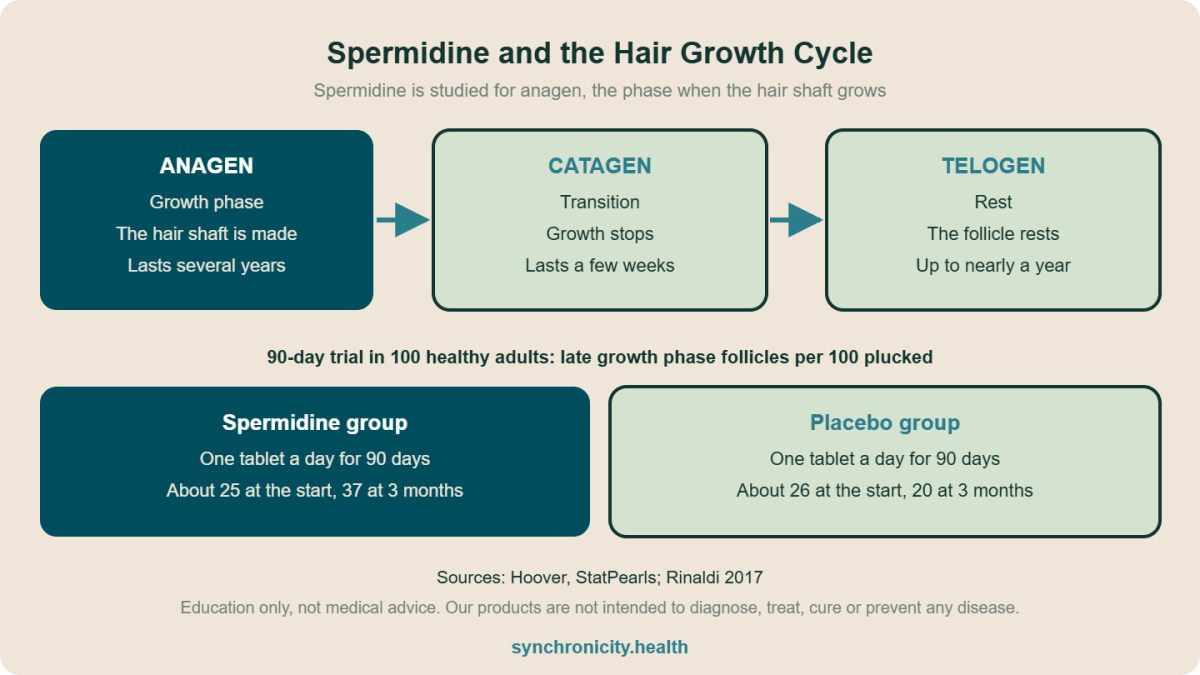
Spermidine for hair growth is studied because of how it acts on the hair follicle's growth phase, called anagen. In lab studies of human scalp follicles, spermidine kept more follicles growing and lengthened the hair shaft. In a 90-day trial in 100 healthy adults, a daily spermidine-based supplement raised the number of follicles in the late growth phase, while the count fell on placebo. The human data come from one small, early trial, so think of spermidine as part of a steady daily routine for healthy hair growth, with results measured over months.
Key Takeaways
- Hair grows in a cycle, and anagen, the growth phase, is when the hair shaft is made; scalp hair grows about 1 cm a month (Hoover et al., StatPearls).
- In a 90-day trial in 100 healthy adults, follicles in the late growth phase rose from about 25 to 37 out of every 100 plucked with a spermidine-based supplement, and fell from about 26 to 20 on placebo (Rinaldi et al., 2017).
- Spermidine is a natural polyamine studied for its role in autophagy, the cell's own recycling process.
- The hair trial did not report how much spermidine each tablet held; other human trials have used about 1 mg a day for up to 12 months, with side effects similar to placebo.
- Hair grows slowly, so any change takes months to see: the trial measured at 3 months, with a follow-up at 6 months.

Featured in this article
Urolithin A + Spermidine CapsulesUrolithin A 500 mg for mitophagy plus spermidine 6 mg from a gluten-free source for autophagy, in every 2 capsules (planned formula). Coming soon.
Join the WaitlistThird-party tested ingredients.
How Hair Grows: The Anagen Phase
Every hair on your head comes from a follicle that cycles through three phases. Knowing them makes the spermidine research much easier to follow, because the studies measure where follicles sit in this cycle.
| Phase | What happens | How long |
|---|---|---|
| Anagen (growth) | The follicle builds the hair shaft | Several years |
| Catagen (transition) | Growth stops and the follicle shrinks | A few weeks |
| Telogen (rest) | The follicle rests before a new cycle starts | Up to nearly a year for scalp hair |
At any one time, roughly 10 to 15 percent of the hairs on the body are in the resting phase, and scalp hair grows about 0.35 mm a day, or about 1 cm a month (Hoover et al., StatPearls). The longer a follicle stays in anagen, the longer the hair it can grow, which is why researchers look for compounds that support this phase.
How Spermidine Works in the Hair Follicle
Spermidine is a polyamine, a small compound found in every living cell and in foods such as wheat germ, soybeans and mushrooms. Cells need polyamines to grow and renew, and spermidine is best known for supporting autophagy. Our spermidine benefits guide and spermidine ingredient page cover the basics; here we go deeper on hair.
Lab studies on human scalp follicles
Researchers took scalp follicles donated by 10 healthy adult women and grew them in culture for 6 days with spermidine. At the most effective concentration, hair shaft production rose by more than 20 percent. Only 47 to 52 percent of spermidine-treated follicles moved into catagen, compared with 67 percent of untreated follicles, so more stayed in the growth phase. Spermidine also raised keratin 15, a marker of the follicle's stem cells (Ramot et al., 2011).
The autophagy link
A later lab study found that autophagy is active in growing human scalp follicles. When the researchers switched autophagy off, follicles left the growth phase early. A mix containing a stable form of spermidine raised autophagy markers and the share of follicles in anagen, but only when autophagy was working (Parodi et al., 2018). That ties spermidine's hair research to the same recycling process covered in our guides to autophagy and mitophagy. These are cell studies, so the next question is what happens in people.
The Spermidine Hair Study in People
The main human trial randomly assigned 100 healthy men and women, aged 22 to 50, with no scalp hair condition, to one tablet a day of a spermidine-based supplement or a placebo, taken after the main meal for 90 days. Researchers plucked 100 hairs from the back of the scalp at the start and at 3 months and counted how many follicles were in the late growth phase (anagen V to VI) under a microscope (Rinaldi et al., 2017).
| What was measured | Spermidine group (50 people) | Placebo group (50 people) |
|---|---|---|
| Late growth phase follicles per 100 plucked, start to 3 months | About 25 to 37 | About 26 to 20 |
| Ki-67, a marker of dividing cells in the hair bulb | Rose | Fell |
The differences between groups were large and statistically significant. The authors called it a preliminary study and asked for larger trials. It was funded by the company that makes the supplement, and the paper did not list the tablet's other ingredients or how much spermidine it held. So this is an early, encouraging result for spermidine and the hair growth phase in healthy adults, and it is the study most people mean when they search for a spermidine hair study.
Spermidine Hair Before and After: What to Expect
The trial did not use before and after photos. Its results came from counting follicles under a microscope, which picks up changes in the growth phase long before they show in the mirror. Because scalp hair grows about 1 cm a month, a change in how long follicles stay in anagen takes months to show up as length (Hoover et al., StatPearls).
- Months 1 to 2: changes start at the follicle, out of sight.
- Month 3: the point where the trial measured its main result.
- Month 6: the trial's follow-up point.
If you are judging for yourself, take photos in the same light every month and compare at 3 and 6 months rather than week to week.
Spermidine Dosage for Hair
There is no set spermidine dose for hair, because the hair trial did not report one. Other human trials give a sense of the range that has been studied:
- About 1 mg a day: 100 adults aged 60 to 90 took 0.9 mg a day from wheat germ extract for 12 months, and side effects were balanced between the spermidine and placebo groups (Schwarz et al., 2022).
- 15 mg a day: in a short study, 12 healthy adults took 15 mg a day for 5 days. Blood levels of spermine, which the body makes from spermidine, rose, while blood spermidine did not, suggesting the body converts it (Senekowitsch et al., 2023).
Whatever amount you choose, the hair study used a tablet once a day with the main meal, every day for 90 days. Follow the directions on your product label.
Is Spermidine Safe? Food Sources and Who Should Check First
Most people tolerate it well. Spermidine is already part of an everyday diet, and in the longest trial so far, 12 months at 0.9 mg a day, side effects were similar to placebo (Schwarz et al., 2022). A few points to know:
- Gluten: many spermidine supplements are made from wheat germ, so choose a gluten-free source if you avoid gluten.
- Food first: wheat germ, soybeans, mushrooms, peas and nuts supply spermidine. See our spermidine guide for the best food sources.
- Check with a clinician first if you are pregnant or breastfeeding, have a hormone-sensitive condition, or take prescription medicine.
Where Our Urolithin A + Spermidine Capsules Fit
Our Urolithin A + Spermidine Capsules are coming soon. The planned formula gives 6 mg of spermidine from a gluten-free source, not wheat germ, plus 500 mg of urolithin A in every 2 capsules, made with third-party tested ingredients. Spermidine is studied for its role in autophagy, and urolithin A supports mitophagy, the recycling of worn-out mitochondria; see urolithin A benefits and our cellular energy and mitochondria guide. Join the waitlist on the product page and we will email you when they launch; no payment is taken.
Like most daily supplements, benefits build with consistent daily use: months 1 to 2 can bring early changes, and 3 months and beyond is where the full benefit builds, which matches the hair trial's 3 and 6 month checkpoints. Many people pair spermidine and urolithin A with an NAD+ routine such as our Enhanced NMN, which gives 750 mg of NMN per 2 capsules in the morning; see urolithin A vs NMN for how they differ.
Featured in this article
Urolithin A + Spermidine CapsulesUrolithin A 500 mg for mitophagy plus spermidine 6 mg from a gluten-free source for autophagy, in every 2 capsules (planned formula). Coming soon.
Join the WaitlistThird-party tested ingredients.
Frequently Asked Questions
Does spermidine help hair growth?
In a 90-day trial in 100 healthy adults, a spermidine-based supplement raised the number of follicles in the late growth phase compared with placebo. Lab studies on human scalp follicles found the same pattern. It was one small, early human trial, so results build over months.
What is the spermidine hair study?
Most people mean the 2017 randomized, placebo-controlled trial by Rinaldi and colleagues, which gave 100 healthy men and women one tablet a day for 90 days and counted growth phase follicles under a microscope.
How does spermidine affect the hair growth cycle?
In lab studies, spermidine kept more scalp follicles in anagen, the growth phase, and lengthened the hair shaft. Its role in autophagy, which is active in growing follicles, is one likely reason.
How long does spermidine take to work for hair?
The trial measured its main result at 3 months and followed up at 6 months. Scalp hair grows about 1 cm a month, so give it at least 3 months of daily use before judging.
Are there spermidine hair before and after photos from the trial?
No. The trial measured follicles under a microscope rather than with photos. If you track your own results, take photos in the same light each month.
What is the best spermidine dosage for hair?
The hair trial did not report its spermidine amount. Other human trials used about 1 mg a day for up to 12 months, and a short study used 15 mg a day for 5 days. Follow your product label.
Can I get enough spermidine from food?
Wheat germ, soybeans, mushrooms, peas and nuts all supply spermidine. A supplement gives a steady, measured amount each day.
Can I take spermidine with urolithin A?
Yes, many people do. Spermidine is studied for autophagy and urolithin A for mitophagy, two related recycling processes, which is why our coming soon capsules combine them.
Sources
- Hoover E, Alhajj M, Flores JL. Physiology, Hair. StatPearls, NCBI Bookshelf, updated 2023. https://www.ncbi.nlm.nih.gov/books/NBK499948/
- Ramot Y, et al. Spermidine promotes human hair growth and is a novel modulator of human epithelial stem cell functions. PLoS One, 2011. https://pubmed.ncbi.nlm.nih.gov/21818338/
- Parodi C, et al. Autophagy is essential for maintaining the growth of a human (mini-)organ: Evidence from scalp hair follicle organ culture. PLoS Biology, 2018. https://pubmed.ncbi.nlm.nih.gov/29590104/
- Rinaldi F, Marzani B, Pinto D, Ramot Y. A spermidine-based nutritional supplement prolongs the anagen phase of hair follicles in humans: a randomized, placebo-controlled, double-blind study. Dermatology Practical and Conceptual, 2017. https://pubmed.ncbi.nlm.nih.gov/29214104/
- Schwarz C, et al. Effects of spermidine supplementation on cognition and biomarkers in older adults with subjective cognitive decline: a randomized clinical trial. JAMA Network Open, 2022. https://pubmed.ncbi.nlm.nih.gov/35616942/
- Senekowitsch S, et al. High-dose spermidine supplementation does not increase spermidine levels in blood plasma and saliva of healthy adults: a randomized placebo-controlled pharmacokinetic and metabolomic study. Nutrients, 2023. https://doi.org/10.3390/nu15081852
These statements have not been evaluated by the Food and Drug Administration. This content is for education and is not medical advice. Our products are not intended to diagnose, treat, cure or prevent any disease. Talk with a healthcare provider before starting a new supplement if you are pregnant, breastfeeding or taking medication.

Leave a comment
All comments are moderated before being published.
This site is protected by hCaptcha and the hCaptcha Privacy Policy and Terms of Service apply.