
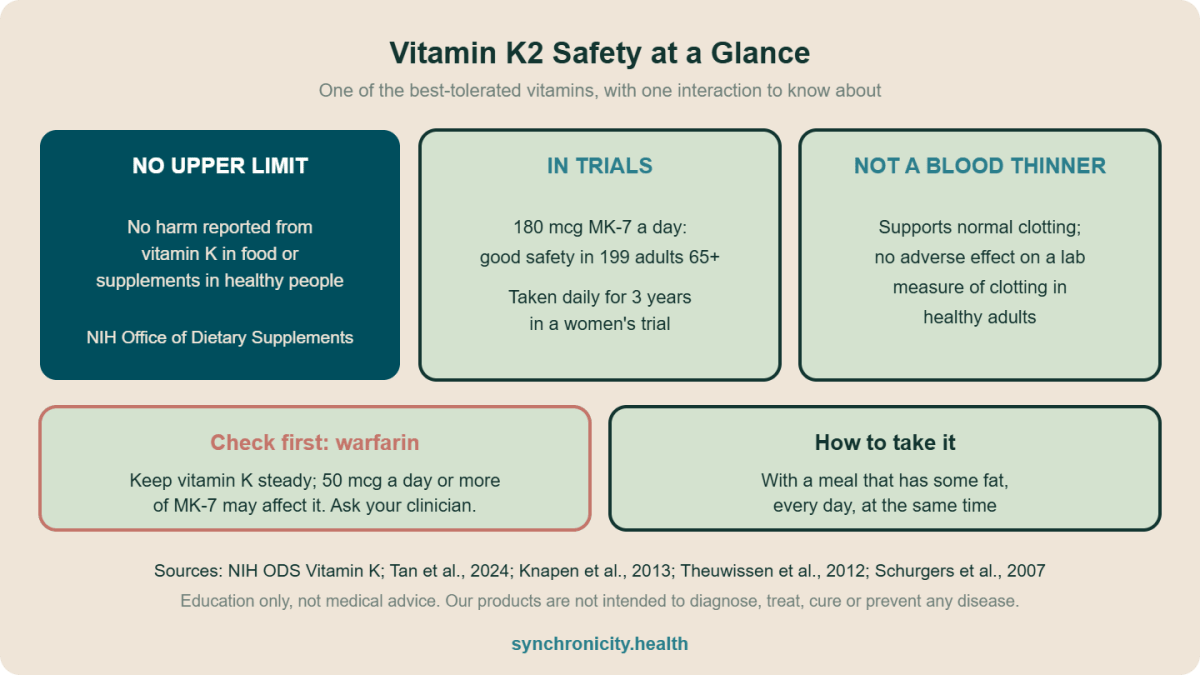
Vitamin K2 is one of the best-tolerated vitamins. No harm has been reported from vitamin K in food or supplements in healthy people, which is why no upper limit has been set, and trials of MK-7 have found it well tolerated. The one important exception is blood thinners such as warfarin: if you take one, keep your vitamin K steady and talk with your clinician before adding K2.
Key Takeaways
- No harm has been reported from vitamin K in food or supplements in healthy people, so no upper limit has been set (NIH ODS: Vitamin K).
- In an 8-week trial in 199 adults aged 65 and over, 180 mcg of MK-7 a day was reported to have good safety (Tan et al., 2024), and women in a 3-year trial took the same amount daily (Knapen et al., 2013).
- Vitamin K2 is not a blood thinner and did not affect a lab measure of clotting in healthy adults (Theuwissen et al., 2012).
- In a 3-year trial, MK-7 improved measures of arterial stiffness compared with placebo (Knapen et al., 2015).
- The main group who should check first is people taking warfarin or a similar anticoagulant (NIH ODS: Vitamin K).

Featured in this article
Vitamin D3 + K2 DropsVegan vitamin D3 from lichen with vitamin K2 as MK-4 and MK-7 in an MCT oil base, one drop a day with a meal.
Shop Vitamin D3 + K2 DropsThird-party tested ingredients. Vegan, gluten free, non-GMO.
Is Vitamin K2 Safe?
Yes, for most people. Vitamin K2 is a family of vitamin K forms called menaquinones; the two used most in supplements are MK-7, made by bacteria during fermentation, and MK-4, the form the body makes from vitamin K1 (NIH ODS: Vitamin K). Its job is to activate proteins that direct calcium, including osteocalcin in bone and matrix Gla protein in blood vessel walls. Our guide to vitamin K2: MK-4 vs MK-7 covers the benefits in full.
The National Institutes of Health notes that no adverse effects have been reported from vitamin K in food or supplements in healthy people, which is why no tolerable upper intake level has been set (NIH ODS: Vitamin K). Human trials of MK-7 back that up:
| Trial | Amount and length | What was found |
|---|---|---|
| 199 adults aged 65 and over | 180 mcg MK-7 a day, 8 weeks | Good safety reported (Tan et al., 2024) |
| Healthy postmenopausal women | 180 mcg MK-7 a day, 3 years | Slower age-related loss of bone density (Knapen et al., 2013) |
| Healthy adults | A range of daily MK-7 amounts | No adverse effect on clotting (Theuwissen et al., 2012) |
| Hospital patients | 999 mcg MK-7 a day, up to 14 days | Well tolerated, no increase in adverse events (Visser et al., 2024) |
Is Vitamin K2 a Blood Thinner? Does It Cause Clots?
No on both counts. Vitamin K helps the liver make the proteins that let blood clot normally, which is the opposite of a blood thinner. In healthy adults taking MK-7 at a range of daily amounts, there was no adverse effect on thrombin generation, a lab measure of clotting (Theuwissen et al., 2012).
Vitamin K2 and Warfarin
This is the one interaction that really matters. People taking warfarin and similar anticoagulants need to keep their vitamin K intake steady, because sudden changes can make the medicine work more or less strongly (NIH ODS: Vitamin K). Researchers have noted that 50 mcg a day or more of MK-7 may affect warfarin in a meaningful way (Schurgers et al., 2007). If you take warfarin, talk with your clinician before starting K2; many people on warfarin can still have vitamin K, as long as the amount stays consistent and their clinician knows.
Vitamin K2 and Blood Pressure
People sometimes ask whether K2 raises blood pressure. The research points the other way. In a 3-year randomized trial of 244 healthy postmenopausal women, 180 mcg of MK-7 a day improved measures of arterial stiffness compared with placebo (Knapen et al., 2015). In a 1-year trial of 165 women taking the same amount, a follow-up analysis found that blood pressure at the arm was about 3 percent lower in postmenopausal women whose arteries were stiffer at the start (de Vries et al., 2025). If you take blood pressure medication, check with your clinician before starting any new supplement.
Who Should Check With a Clinician First
Ask your clinician before taking vitamin K2 if any of these apply (NIH ODS: Vitamin K):
- You take warfarin or a similar anticoagulant.
- You are on a long course of antibiotics, which can reduce the gut bacteria that make vitamin K.
- You take bile acid sequestrants or orlistat, which can reduce absorption of fat-soluble vitamins.
- You have a condition that affects fat absorption, or a history of bariatric surgery.
Taking Vitamin K2 With Vitamin D3
K2 is often taken with vitamin D3, because the two work on the same calcium-handling proteins. K2 itself has a low potential for harm, so the thing to watch in a D3 and K2 product is the vitamin D: too much vitamin D over time can raise blood calcium, so stay within the upper limit unless your clinician is monitoring you (NIH ODS: Vitamin D). Our guide to vitamin D3 and K2 covers how much to take and when, and our guide to vitamin D cofactors explains the nutrients that help vitamin D do its job.
How to Take Vitamin K2 Comfortably
- With a meal that has some fat. Vitamin K is fat-soluble, so it absorbs best with food.
- Every day, at the same time. Steady daily intake keeps your levels steady, which also matters if you take warfarin.
- Follow your label. The adequate intake for all vitamin K is 90 mcg a day for women and 120 mcg for men, and MK-7 studies have used 10 to 360 mcg a day (NIH ODS: Vitamin K).
- Get some from food too. Natto is the richest source; see our guide to vitamin K2 foods.
For the full picture of vitamin K2 forms and amounts, see our vitamin K2 ingredient guide, and for vitamin D itself, our vitamin D3 ingredient guide.
Where Our Vitamin D3 + K2 Drops Fit
Our Vitamin D3 + K2 Drops pair vegan vitamin D3 from lichen with vitamin K2 in two forms, MK-4 and MK-7, in a clean MCT oil base. One drop a day with a meal, which also gives the fat-soluble vitamins something to absorb with. Every ingredient is third-party tested. Each bottle holds about 180 drops, about 6 months at one drop a day. If you also want the minerals that help vitamin D work, our Vitamin D Cofactor Capsules are made to pair with them.
Featured in this article
Vitamin D3 + K2 DropsVegan vitamin D3 from lichen with vitamin K2 as MK-4 and MK-7 in an MCT oil base, one drop a day with a meal.
Shop Vitamin D3 + K2 DropsThird-party tested ingredients. Vegan, gluten free, non-GMO.
Frequently Asked Questions
Does vitamin K2 have side effects?
No harm has been reported from vitamin K in food or supplements in healthy people, and trials of MK-7 have found it well tolerated, including 180 mcg a day for 3 years.
Is vitamin K2 safe to take every day?
Yes, for most people. Trials have used daily MK-7 for weeks to 3 years, and daily intake at the same time keeps your levels steady.
Can vitamin K2 cause blood clots?
No. Vitamin K supports normal clotting, and in healthy adults MK-7 had no adverse effect on a lab measure of clotting.
Can I take vitamin K2 with warfarin?
Only with your clinician's guidance. People on warfarin need steady vitamin K intake, and 50 mcg a day or more of MK-7 may affect warfarin.
Does vitamin K2 raise blood pressure?
The research points the other way: MK-7 improved arterial stiffness in a 3-year trial, and blood pressure was slightly lower in one subgroup of a 1-year trial.
Can you take too much vitamin K2?
No upper limit has been set because of vitamin K's low potential for harm. Follow your product label. In a D3 and K2 product, the vitamin D amount is the one to keep within limits.
Is MK-7 or MK-4 safer?
Both have a good safety record. MK-7 stays in the blood longer and works in small daily amounts; MK-4 is the form the body makes itself.
Should vitamin K2 be taken with food?
Yes. It is fat-soluble, so take it with a meal that contains some fat.
Sources
- National Institutes of Health, Office of Dietary Supplements. Vitamin K: Fact Sheet for Health Professionals. https://ods.od.nih.gov/factsheets/VitaminK-HealthProfessional/
- National Institutes of Health, Office of Dietary Supplements. Vitamin D: Fact Sheet for Consumers. https://ods.od.nih.gov/factsheets/VitaminD-Consumer/
- Tan J, et al. Vitamin K2 in managing nocturnal leg cramps: a randomized clinical trial. JAMA Internal Medicine, 2024. https://pubmed.ncbi.nlm.nih.gov/39466236/
- Knapen MH, et al. Three-year low-dose menaquinone-7 supplementation helps decrease bone loss in healthy postmenopausal women. Osteoporosis International, 2013. https://pubmed.ncbi.nlm.nih.gov/23525894/
- Knapen MH, et al. Menaquinone-7 supplementation improves arterial stiffness in healthy postmenopausal women: a double-blind randomised clinical trial. Thrombosis and Haemostasis, 2015. https://pubmed.ncbi.nlm.nih.gov/25694037/
- Theuwissen E, et al. Low-dose menaquinone-7 supplementation improved extra-hepatic vitamin K status, but had no effect on thrombin generation in healthy subjects. British Journal of Nutrition, 2012. https://doi.org/10.1017/S0007114511007185
- Schurgers LJ, et al. Vitamin K-containing dietary supplements: comparison of synthetic vitamin K1 and natto-derived menaquinone-7. Blood, 2007. https://doi.org/10.1182/blood-2006-08-040709
- de Vries F, et al. Effects of one-year menaquinone-7 supplementation on vascular stiffness and blood pressure in post-menopausal women. Nutrients, 2025. https://pubmed.ncbi.nlm.nih.gov/40077685/
- Visser MPJ, et al. Vitamin K2 supplementation in hospitalised COVID-19 patients: a randomised controlled trial. Journal of Clinical Medicine, 2024. https://pubmed.ncbi.nlm.nih.gov/38930004/
These statements have not been evaluated by the Food and Drug Administration. This content is for education and is not medical advice. Our products are not intended to diagnose, treat, cure or prevent any disease. Talk with a healthcare provider before starting a new supplement if you are pregnant, breastfeeding or taking medication.

Leave a comment
All comments are moderated before being published.
This site is protected by hCaptcha and the hCaptcha Privacy Policy and Terms of Service apply.