
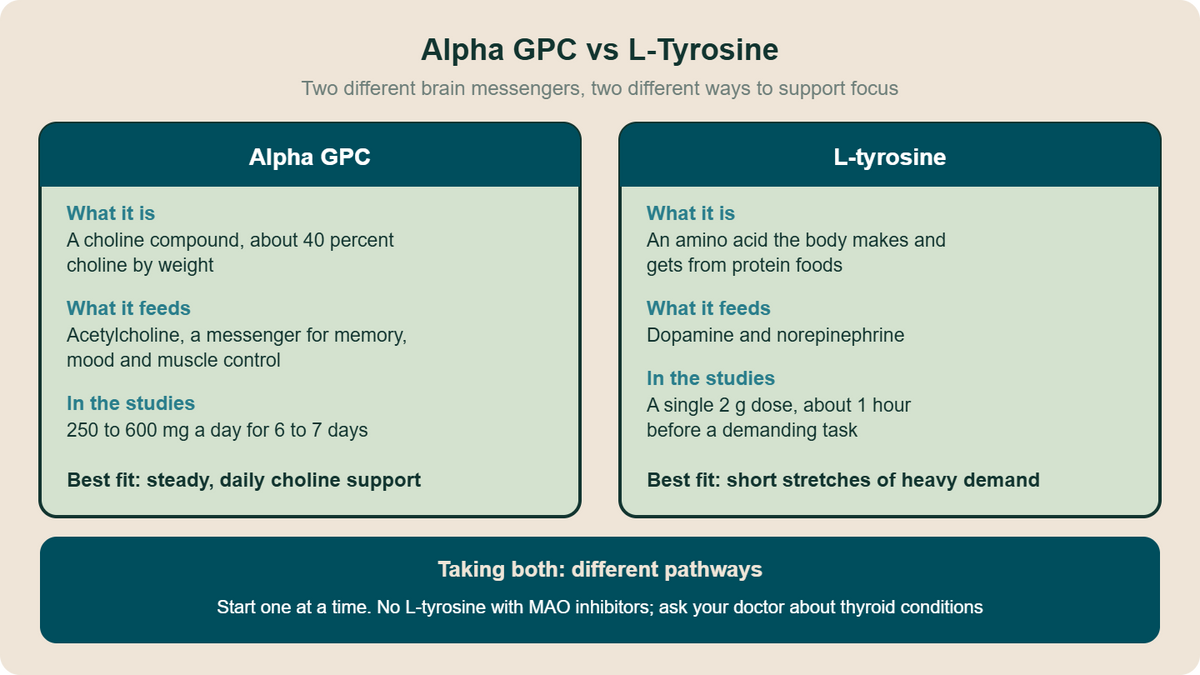
Alpha GPC vs L-tyrosine comes down to which brain messenger you want to support. Alpha GPC is a concentrated source of choline, which the body uses to make acetylcholine, a messenger for memory, mood and muscle control, while L-tyrosine is the amino acid the body uses to make dopamine and norepinephrine, studied mainly for focus during short, demanding stretches. Here is how they compare, what the studies used and how to take both.
Key Takeaways
- Alpha GPC is a choline compound, about 40 percent choline by weight, and the body needs choline to make acetylcholine (NIH Office of Dietary Supplements).
- L-tyrosine is an amino acid and the building block of dopamine and norepinephrine (Jongkees et al., 2015).
- In 48 college-aged men, 250 or 500 mg of alpha GPC a day for 7 days raised blood free choline compared with placebo (Marcus et al., 2017).
- A review of the cognitive studies concluded that tyrosine supports cognitive performance mainly in short-term stressful or mentally demanding situations (Jongkees et al., 2015).
- They work through different pathways, so if you want to try both, start one at a time. Do not take L-tyrosine with an MAO inhibitor, and ask your doctor first if you have a thyroid condition.

Featured in this article
Clarity Nasal SprayNAD+, Alpha GPC, huperzine A and methyl B12 in alkaline water, in three strengths, with no caffeine.
Shop Clarity Nasal SprayThird-party tested ingredients. Made in the USA.
Alpha GPC vs L-Tyrosine at a Glance
Both are popular for focus, but they feed different systems in the brain:
| Alpha GPC | L-tyrosine | |
|---|---|---|
| What it is | A choline compound, about 40 percent choline by weight | An amino acid the body makes and gets from protein foods |
| What it feeds | Acetylcholine, a messenger for memory, mood and muscle control | Dopamine and norepinephrine |
| Amounts in the studies here | 250 to 600 mg a day for 6 to 7 days | A single 2 g dose; 100 to 200 mg per kg of body weight in older adults |
| Timing in the studies | Taken every day for about a week | About 1 hour before a demanding task |
| What the studies measured | Higher blood choline; greater lower body force in a strength test | Better accuracy on a harder working memory task |
| Best fit | Steady, daily choline support | Short stretches of heavy mental demand |
| Main caution | Keep total choline under 3,500 mg a day | Not with MAO inhibitors; ask your doctor if you have a thyroid condition |
The choline share of alpha GPC is calculated from its chemical formula and is approximate.
What Alpha GPC Does
Alpha GPC (L-alpha glycerylphosphorylcholine, also called choline alfoscerate) is a form of choline found in small amounts in food and in the body. The NIH Office of Dietary Supplements lists glycerophosphocholine among the water-soluble forms of choline in the diet and notes that choline is needed to produce acetylcholine, an important messenger for memory, mood, muscle control and other brain and nervous system functions (NIH Office of Dietary Supplements).
Two trials in healthy young men show what it does in the body:
- Blood choline. In a randomized trial of 48 college-aged men, 7 days of alpha GPC raised serum free choline by 132 percent at 500 mg a day and 59 percent at 250 mg a day compared with placebo (Marcus et al., 2017).
- Exercise performance. In a double-blind crossover trial of 13 college-aged men, 600 mg a day for 6 days led to a greater change in peak force on a lower body strength test than placebo (Bellar et al., 2015).
For more on this ingredient, see our alpha GPC ingredient page. Our guide to citicoline vs alpha GPC compares two choline forms, and choline supplements covers daily needs and food sources.
What L-Tyrosine Does
L-tyrosine is an amino acid your body makes and also gets from protein foods. The brain uses it as the precursor of dopamine and norepinephrine. The idea behind taking it is that these messengers can run low during heavy stress or demand, and extra tyrosine supplies more raw material.
- When it fits. A review of the cognitive and behavioral studies concluded that tyrosine supports cognitive performance particularly in short-term stressful or cognitively demanding situations, when dopamine or norepinephrine is temporarily depleted (Jongkees et al., 2015).
- Harder tasks. In a double-blind crossover study of 22 healthy young women, a single 2 g dose taken 1 hour before testing improved accuracy on a demanding 2-back working memory task, but not on an easier 1-back task (Colzato et al., 2013).
- Age and dose. In 17 adults aged 60 to 75, single doses of 100, 150 and 200 mg per kg raised blood tyrosine in step with the dose, more than 150 mg per kg did in young adults, and working memory performance on harder loads fell as the dose went up (van de Rest et al., 2017).
For the dopamine side of the picture, see how to increase dopamine naturally, and for tyrosine against a calming amino acid, L-theanine vs L-tyrosine.
Alpha GPC or Tyrosine: Which Fits Your Goal?
- For steady, everyday support of the acetylcholine pathway: alpha GPC. It is taken daily and supplies choline.
- For a short stretch of heavy mental demand, such as a hard deadline: L-tyrosine, which has been studied as a single dose before demanding tasks.
Alpha GPC and L-Tyrosine Together
Alpha GPC supplies choline for acetylcholine, while L-tyrosine supplies the building block for dopamine and norepinephrine. Research has looked at each one on its own, so there is no set ratio for combining them. If you want to try both, start with one at a time for a week or two so you know how each one suits you, then add the second. Follow each label and add up your choline from all sources.
How to Take Them
Alpha GPC
The trials above used 250 to 600 mg a day for about a week. Follow your product label and keep your total choline from food and supplements under the adult upper limit of 3,500 mg a day (NIH Office of Dietary Supplements).
L-tyrosine
Follow your product label. In the working memory study, a single 2 g dose was taken about 1 hour before the task. Most people take it earlier in the day, on demanding days rather than every day.
Side Effects and Safety
- Too much choline is associated with a fishy body odor, vomiting, excessive sweating and salivation; the adult upper limit is 3,500 mg a day from all sources (NIH Office of Dietary Supplements).
- Alpha GPC and stroke risk: in a Korean health insurance cohort of about 12 million adults aged 50 and over, people who used alpha GPC had a higher 10-year risk of stroke than matched nonusers (Lee et al., 2021). The study was observational, so it shows an association, not cause and effect. Talk with your doctor before using alpha GPC if you have heart or blood vessel concerns. Our guide to alpha GPC side effects covers this study in more detail.
- L-tyrosine and medicines: do not take L-tyrosine if you use an MAO inhibitor, since the combination can raise blood pressure. Talk with your doctor first if you have a thyroid condition or take thyroid medicine. Adults over 60 should be cautious with high doses.
- Both: check with a healthcare provider first if you are pregnant or breastfeeding, take prescription medication or have a medical condition.
Where Our Clarity Products Fit
We do not make an L-tyrosine product. Alpha GPC is one of four ingredients in our Clarity Nasal Spray, alongside NAD+, huperzine A and methyl B12, in alkaline water, with no caffeine. It comes in three strengths, with Alpha GPC 10 mg, 15 mg or 20 mg per 2-spray serving. The label serving is two sprays, used once daily. It is absorbed through the lining of the nose instead of being swallowed like a capsule, so some of each dose skips digestion. Huperzine A has been studied for its role in acetylcholine signaling, which is why it pairs with alpha GPC; see huperzine A and alpha GPC for how the two work together.
For a daily capsule, Clarity Capsules give lion's mane 8:1 fruiting body extract 250 mg, epimedium extract 200 mg, maca root extract 200 mg, bacopa monnieri extract 200 mg, rhodiola rosea extract 150 mg and huperzine A 200 mcg per 2-capsule serving. The suggested use is 2 capsules daily, preferably in the morning on an empty stomach. You can use both Clarity formats together. Both are made with third-party tested ingredients. For more ways to support focus and memory, see our guide to cognitive health and mental clarity.

Featured in this article
Clarity CapsulesLion's mane, bacopa, rhodiola, maca, epimedium and huperzine A in a daily 2-capsule serving.
Shop Clarity CapsulesThird-party tested ingredients. Vegan capsules, made in the USA.
Frequently Asked Questions
Is alpha GPC or L-tyrosine better for focus?
It depends on the kind of focus you want. Alpha GPC supplies choline for acetylcholine and is taken daily. L-tyrosine supplies the building block for dopamine and norepinephrine, and a review found it supports cognitive performance mainly in short, stressful or demanding situations. One way to use them is alpha GPC for steady daily support and tyrosine for demanding days.
Can you take alpha GPC and L-tyrosine together?
They work on different pathways, and some people use both. Research has looked at each one on its own, so there is no set ratio. Start with one at a time, keep total choline under 3,500 mg a day, and do not take tyrosine if you use an MAO inhibitor.
What does alpha GPC do in the brain?
Alpha GPC is a concentrated source of choline, about 40 percent by weight. The body needs choline to produce acetylcholine, a messenger for memory, mood and muscle control. In a 7-day trial in young men, 250 or 500 mg a day raised blood choline compared with placebo.
Does L-tyrosine help with focus?
Research points to demanding moments. A review concluded that tyrosine supports cognitive performance mainly in short-term stressful or mentally demanding situations. In one study of 22 healthy young women, a single 2 g dose improved accuracy on a hard working memory task, but not on an easier one.
How much alpha GPC and L-tyrosine do studies use?
The alpha GPC trials in this guide used 250 to 600 mg a day for 6 to 7 days. Tyrosine studies used a single 2 g dose in young adults and 100 to 200 mg per kg of body weight in older adults. Follow your product label for either one.
When should I take alpha GPC or L-tyrosine?
Alpha GPC was taken daily in the trials, so a consistent time each day works well. In the working memory study, tyrosine was taken about 1 hour before the task, and most people keep it for demanding days earlier in the day.
Who should not take L-tyrosine?
Do not take L-tyrosine if you use an MAO inhibitor, since the combination can raise blood pressure. Talk with your doctor first if you have a thyroid condition or take thyroid medicine. Adults over 60 should be cautious with high doses, and anyone who is pregnant, breastfeeding or taking prescription medication should check with a healthcare provider first.
Can I use Clarity Nasal Spray with L-tyrosine?
Clarity Nasal Spray contains NAD+, Alpha GPC, huperzine A and methyl B12 in alkaline water, and no L-tyrosine. If you add tyrosine, follow its label, try each on its own first, and check with your healthcare provider first if you are pregnant, nursing, taking medication or managing a medical condition.
Sources
- NIH Office of Dietary Supplements. Choline: Fact Sheet for Health Professionals. Updated 2022. https://ods.od.nih.gov/factsheets/Choline-HealthProfessional/
- Jongkees BJ, Hommel B, Kühn S, Colzato LS. Effect of tyrosine supplementation on clinical and healthy populations under stress or cognitive demands: a review. Journal of Psychiatric Research, 2015. https://pubmed.ncbi.nlm.nih.gov/26424423/
- Marcus L, Soileau J, Judge LW, Bellar D. Evaluation of the effects of two doses of alpha glycerylphosphorylcholine on physical and psychomotor performance. Journal of the International Society of Sports Nutrition, 2017. https://doi.org/10.1186/s12970-017-0196-5
- Bellar D, LeBlanc NR, Campbell B. The effect of 6 days of alpha glycerylphosphorylcholine on isometric strength. Journal of the International Society of Sports Nutrition, 2015. https://doi.org/10.1186/s12970-015-0103-x
- Colzato LS, Jongkees BJ, Sellaro R, Hommel B. Working memory reloaded: tyrosine repletes updating in the N-back task. Frontiers in Behavioral Neuroscience, 2013. https://doi.org/10.3389/fnbeh.2013.00200
- van de Rest O, Bloemendaal M, de Heus R, Aarts E. Dose-dependent effects of oral tyrosine administration on plasma tyrosine levels and cognition in aging. Nutrients, 2017. https://doi.org/10.3390/nu9121279
- Lee G, Choi S, Chang J, et al. Association of L-alpha glycerylphosphorylcholine with subsequent stroke risk after 10 years. JAMA Network Open, 2021. https://doi.org/10.1001/jamanetworkopen.2021.36008
These statements have not been evaluated by the Food and Drug Administration. This content is for education and is not medical advice. Our products are not intended to diagnose, treat, cure or prevent any disease. Talk with a healthcare provider before starting a new supplement if you are pregnant, breastfeeding or taking medication.


Leave a comment
All comments are moderated before being published.
This site is protected by hCaptcha and the hCaptcha Privacy Policy and Terms of Service apply.