
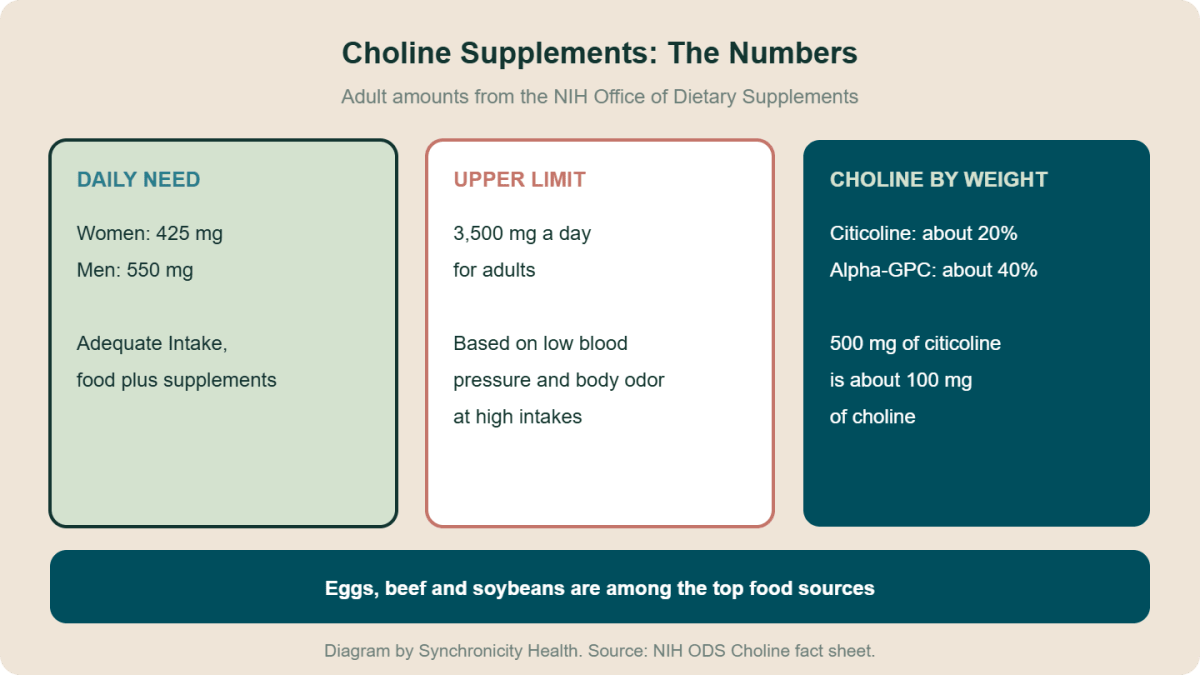
A choline supplement adds choline, an essential nutrient your body makes only in small amounts, to what you already get from foods like eggs, beef and soybeans; most adults need 425 mg (women) to 550 mg (men) a day, and the adult upper limit is 3,500 mg a day from food and supplements combined (NIH ODS: Choline). Here are the intake targets by age, the upper limit, the best food sources, who falls short, and how the four common supplement forms compare.
It is educational, not medical advice.
Key Takeaways
- Adequate Intakes for adults are 550 mg a day for men and 425 mg for women, rising to 450 mg in pregnancy and 550 mg while breastfeeding.
- The adult upper limit is 3,500 mg a day from all sources. High intakes are linked to fishy body odor, vomiting, heavy sweating and salivation, low blood pressure and liver toxicity.
- One large hard boiled egg has 147 mg of choline and 3 ounces of pan fried beef liver has 356 mg.
- Average intakes in the US are 402 mg a day for men and 278 mg for women, and about 90 to 95 percent of pregnant women get less than the AI.
- Forms differ in choline content: citicoline is about 20 percent choline by weight and alpha-GPC about 40 percent.
- Citicoline and alpha-GPC research measured blood choline, brain energy compounds and memory scores in specific adult groups.

Featured in this article
Brain Energy CapsulesCiticoline 500 mg, PQQ 20 mg and L-ergothioneine 25 mg per serving, with no caffeine or other stimulants.
Join the WaitlistComing soon. Third-party tested ingredients.
What Choline Does in the Body
Your liver makes some choline, but the National Institutes of Health Office of Dietary Supplements (ODS) explains that the amount the body makes is not enough to meet human needs, so the rest has to come from food or supplements (NIH ODS: Choline).
The body uses choline in two big ways. It is needed to make acetylcholine, a neurotransmitter involved in memory, mood and muscle control. It is also used to build phosphatidylcholine and sphingomyelin, two fats that form part of every cell membrane. Our guide to acetylcholine for memory covers the neurotransmitter side.
ODS also notes that a long stretch of very low choline intake can cause muscle damage, liver damage and nonalcoholic fatty liver disease.
How Much Choline Per Day: Adequate Intakes by Age
The Food and Nutrition Board set Adequate Intakes (AIs) for choline rather than RDAs. ODS says these AIs are based on the amounts that keep a liver enzyme marker (serum alanine aminotransferase) in a normal range (NIH ODS: Choline).
| Age | Male | Female | Pregnancy | Breastfeeding |
|---|---|---|---|---|
| Birth to 6 months | 125 mg | 125 mg | ||
| 7 to 12 months | 150 mg | 150 mg | ||
| 1 to 3 years | 200 mg | 200 mg | ||
| 4 to 8 years | 250 mg | 250 mg | ||
| 9 to 13 years | 375 mg | 375 mg | ||
| 14 to 18 years | 550 mg | 400 mg | 450 mg | 550 mg |
| 19 years and older | 550 mg | 425 mg | 450 mg | 550 mg |
The Daily Value on US food and supplement labels is 550 mg for adults and children 4 years and older. For context, ODS reports average intakes from food and drinks of 402 mg a day for men and 278 mg for women, and 256 mg for children and teens aged 2 to 19.
The 3,500 mg Upper Limit and Signs of Too Much
The Tolerable Upper Intake Level (UL) for adults 19 and older is 3,500 mg a day, and it counts choline from food and supplements together. It's 3,000 mg for ages 14 to 18 (including during pregnancy and breastfeeding), 2,000 mg for ages 9 to 13, and 1,000 mg for ages 1 to 8. No UL could be set for infants, and ODS says breast milk, formula and food should be their only sources (NIH ODS: Choline).
ODS says high choline intakes are associated with a fishy body odor, vomiting, excessive sweating and salivation, low blood pressure (hypotension) and liver toxicity. The ULs were set from the amounts linked to low blood pressure and fishy body odor. They apply to healthy people, not to anyone taking higher amounts under medical supervision.
ODS also describes TMAO: gut bacteria convert choline into trimethylamine, which the liver turns into trimethylamine N-oxide (TMAO). ODS notes that choline consumption has been shown to increase TMAO production, and that TMAO has been linked to a higher risk of cardiovascular disease in adults.
Food Sources of Choline
Animal foods are the richest sources, but soybeans, potatoes, wheat germ and beans help too. Values are from the ODS food table (NIH ODS: Choline). For more nutrient-dense picks, see our guide to brain foods.
| Food and serving | Choline (mg) | Percent DV |
|---|---|---|
| Beef liver, pan fried, 3 ounces | 356 | 65 |
| Egg, hard boiled, 1 large | 147 | 27 |
| Beef top round, lean, braised, 3 ounces | 117 | 21 |
| Soybeans, roasted, 1/2 cup | 107 | 19 |
| Chicken breast, roasted, 3 ounces | 72 | 13 |
| Ground beef, 93 percent lean, broiled, 3 ounces | 72 | 13 |
| Cod, Atlantic, cooked, 3 ounces | 71 | 13 |
| Red potato, baked, flesh and skin, 1 large | 57 | 10 |
| Wheat germ, toasted, 1 ounce | 51 | 9 |
| Kidney beans, canned, 1/2 cup | 45 | 8 |
Who Is Most Likely to Fall Short
ODS names three groups at higher risk of low choline intake (NIH ODS: Choline):
- Pregnant women. About 90 to 95 percent consume less than the AI, and ODS notes that prenatal supplements usually contain little choline.
- People with certain gene variants. A common variant in the PEMT gene reduces the choline that estrogen helps women make on their own, so some women make less.
- People on long term total parenteral nutrition (IV feeding). Choline isn't routinely added to these formulas, and long term recipients have low blood choline.
Types of Choline Supplements Compared
ODS lists choline bitartrate, phosphatidylcholine and lecithin as the forms found in choline supplements, with typical amounts of 10 mg to 250 mg of choline per product. ODS adds that the relative bioavailability of these forms hasn't been compared head to head (NIH ODS: Choline). Citicoline (CDP-choline) and alpha-GPC are two more choline compounds sold for focus and memory; our guide to citicoline vs alpha GPC covers them in depth.
| Form | What it is | What research looked at |
|---|---|---|
| Choline bitartrate | A widely used form, and one of the three ODS lists in choline supplements | ODS summarizes choline supplement trials as a group: some small trials reported better cognitive scores, while a 2015 review of 13 studies found no clear improvement in healthy adults |
| Citicoline (CDP-choline) | Choline plus cytidine; about 20 percent choline by weight | Blood choline after single doses, brain energy compounds on MRS scans, and memory scores in healthy adults aged 50 to 85 |
| Alpha-GPC (choline alfoscerate) | Choline plus glycerophosphate; about 40 percent choline by weight | Blood free choline after single doses in college-aged men; a large observational study of prescription users aged 50 and over |
| Phosphatidylcholine and lecithin | Phosphatidylcholine is the membrane fat the body builds from choline; ODS lists it and lecithin as supplement forms | A 2003 review found no clear clinical benefit of lecithin in people with Alzheimer's or Parkinsonian dementia; results may not apply to others |
The choline percentages for citicoline and alpha-GPC are approximate and calculated from each molecule's formula, as explained in our citicoline vs alpha GPC guide. They matter when you compare labels: 500 mg of citicoline supplies roughly 100 mg of choline, not 500 mg.
If you are considering alpha GPC, our guide to alpha GPC side effects covers what trials reported and who should check with a clinician first. If you are weighing citicoline against other choline sources, our guide to citicoline vs choline explains how the two differ. If you are comparing alpha GPC with a non-choline option for focus, our guide to alpha GPC vs L-tyrosine explains how they differ.
What the Research on Choline and Memory Measured
Population studies first. In 2,195 Norwegian adults aged 70 to 74, people with lower blood levels of free choline had poorer scores on tests of sensorimotor and perceptual speed, executive function and global cognition. In 1,391 adults aged 36 to 83 from the Framingham Offspring study, higher choline intakes were associated with better verbal and visual memory. Both studies were observational, so they show associations, not cause and effect (NIH ODS: Choline).
Citicoline has its own small body of trials, covered in our citicoline benefits guide:
- Blood levels. In 12 adults given single doses of 500, 2,000 or 4,000 mg, blood choline rose with each dose and stayed elevated for 5 to 10 hours (Wurtman et al., 2000).
- Brain energy compounds. In 16 healthy adults (average age 47) taking 500 mg or 2,000 mg daily for 6 weeks, frontal brain phosphocreatine rose about 7 percent and ATP about 14 percent, measured by magnetic resonance spectroscopy (Silveri et al., 2008).
- Memory scores. In a 12 week randomized, placebo-controlled trial of 100 healthy adults aged 50 to 85 with age-related memory complaints, 500 mg a day improved episodic memory more than placebo (Nakazaki et al., 2021).
For alpha-GPC, a single 250 mg or 500 mg dose raised blood free choline by 59 and 132 percent compared with placebo in 48 healthy college-aged men, measured 1 to 2 hours later (Marcus et al., 2017). In a Korean health insurance cohort of about 12 million adults aged 50 and over, people prescribed alpha-GPC had a higher 10 year stroke risk than non-users; the study was observational and can't show cause and effect (Lee et al., 2021).
How to Choose a Choline Supplement
- Read the choline amount, not just the compound. A label might list 500 mg of a compound that supplies far less choline, so check whether the Supplement Facts panel also shows the choline amount.
- Match the form to your goal. Choline bitartrate and lecithin are the classic ways to top up intake. Citicoline and alpha-GPC are the forms most studied for focus and memory, and citicoline also supplies cytidine (Kansakar et al., 2023).
- Add it all up. Food plus every supplement you take should stay under the 3,500 mg adult UL.
Coming Soon From Synchronicity
Our Brain Energy Capsules are open for pre-order, with a planned formula of citicoline 500 mg, PQQ 20 mg and L-ergothioneine 25 mg per serving, and no caffeine or other stimulants. They are not on sale yet. Join the launch list on the product page to hear when they're ready; no payment is taken.
At roughly 20 percent choline by weight, 500 mg of citicoline works out to about 100 mg of choline, well under the 3,500 mg adult UL. Read about the other two ingredients in our PQQ benefits and ergothioneine benefits guides, or browse our non-stimulant energy and focus and cellular energy pages.
Safety Note
Stay under the UL for your age, and remember it counts food and supplements together. If you notice a fishy body odor, heavy sweating or feel lightheaded, cut back and talk with a clinician. Ask a healthcare provider before starting a choline supplement if you're pregnant or breastfeeding, under 18, managing a liver or heart condition, or taking prescription medication. Don't give adult supplements to children.
Featured in this article
Brain Energy CapsulesCiticoline 500 mg, PQQ 20 mg and L-ergothioneine 25 mg per serving, with no caffeine or other stimulants.
Join the WaitlistComing soon. Third-party tested ingredients.
Frequently Asked Questions
How much choline should I take per day?
The AI is 550 mg a day for adult men and 425 mg for adult women, 450 mg in pregnancy and 550 mg while breastfeeding. That target includes food, so a supplement only needs to cover the gap (NIH ODS: Choline).
What happens if you take too much choline?
ODS links high intakes to fishy body odor, vomiting, excessive sweating and salivation, low blood pressure and liver toxicity.
Which food has the most choline?
In the ODS table, beef liver leads with 356 mg per 3 ounces, followed by a large hard boiled egg at 147 mg.
Is citicoline a good source of choline?
Citicoline is about 20 percent choline by weight, so 500 mg supplies roughly 100 mg of choline plus cytidine. See our citicoline benefits guide.
What is the difference between choline bitartrate and alpha-GPC?
Choline bitartrate is a common, simple form ODS lists in choline supplements. Alpha-GPC is about 40 percent choline by weight and has been studied for how quickly it raises blood free choline.
Do pregnant women need more choline?
Yes. The AI rises to 450 mg in pregnancy and 550 mg while breastfeeding, and ODS reports that about 90 to 95 percent of pregnant women fall below the AI. Talk with your provider before adding a supplement.
What is TMAO and how does it relate to choline?
Gut bacteria turn some choline into trimethylamine, which the liver converts to TMAO. ODS notes that choline intake can raise TMAO production and that TMAO has been linked to cardiovascular risk in adults.
Sources
- NIH Office of Dietary Supplements. Choline: Fact Sheet for Health Professionals. Updated June 2, 2022. ODS
- Wurtman RJ, et al. Biochem Pharmacol. 2000. PubMed
- Silveri MM, et al. NMR Biomed. 2008. DOI
- Nakazaki E, et al. J Nutr. 2021. PubMed
- Marcus et al. J Int Soc Sports Nutr. 2017. DOI
- Lee et al. JAMA Netw Open. 2021. DOI
- Kansakar et al. Front Endocrinol. 2023. DOI
These statements have not been evaluated by the Food and Drug Administration. This content is for education and is not medical advice. Our products are not intended to diagnose, treat, cure or prevent any disease. Talk with a healthcare provider before starting a new supplement if you are pregnant, breastfeeding or taking medication.

Leave a comment
All comments are moderated before being published.
This site is protected by hCaptcha and the hCaptcha Privacy Policy and Terms of Service apply.