
For most healthy adults, a daily ashwagandha routine and an occasional light drink are not known to clash, and ashwagandha is not on the National Institute on Alcohol Abuse and Alcoholism (NIAAA) list of herbal remedies that react with alcohol. Both can make you drowsy, and both have been linked to liver strain, alcohol through heavy drinking and ashwagandha through case reports. Keep drinks light, take ashwagandha at a different time of day, and skip the pairing if you have liver concerns or take sedating medicines.
Key Takeaways
- Drowsiness is one of ashwagandha's mild, common side effects, along with stomach upset and loose stools (NIH ODS, 2025), and alcohol can make you sleepy too.
- The NIAAA list of herbal remedies that interact with alcohol names chamomile, valerian, lavender and kava, not ashwagandha, but it warns that drowsy effects can add up (NIAAA).
- In a case series of five people with liver injury linked to ashwagandha, symptoms began 2 to 12 weeks after starting it, and liver tests returned to normal within 1 to 5 months in the four who were followed up (Björnsson et al., 2020).
- In an 8-week trial in 80 healthy adults taking 300 mg of ashwagandha root extract twice daily, liver enzymes and thyroid hormones showed no significant changes and no one reported an adverse event (Verma et al., 2021).
- Existing liver disease is the main reason to avoid the pairing: LiverTox advises against ashwagandha in cirrhosis or advanced chronic liver disease, and heavy drinking takes a toll on the liver.

Featured in this article
ForageSeven 8:1 mushroom fruiting body extracts plus Himalayan shilajit and 100 mg of ashwagandha root extract per serving, taken in the morning.
Shop ForageThird-party tested ingredients. Vegan capsules, made in the USA.
Can You Drink Alcohol With Ashwagandha?
Ashwagandha (Withania somnifera) is a root used in Ayurveda and now taken mostly as a capsule extract to support a healthy stress response and restful sleep. In trials, daily doses of extract have ranged from about 120 to 1,250 mg, usually for 1 to 3 months (NIH ODS, 2025). More on the root is on our ashwagandha root extract ingredient page.
The NIAAA keeps a chart of medicines and herbal remedies that cause harmful reactions with alcohol. Its herbal entries are chamomile, valerian and lavender, which can increase drowsiness, and kava, which is linked to liver damage and drowsiness (NIAAA). Ashwagandha is not on it, and the NIH ODS fact sheet on ashwagandha does not list alcohol among its interactions. The advice below comes from what each one does on its own.
Ashwagandha vs Alcohol: How Each Affects You
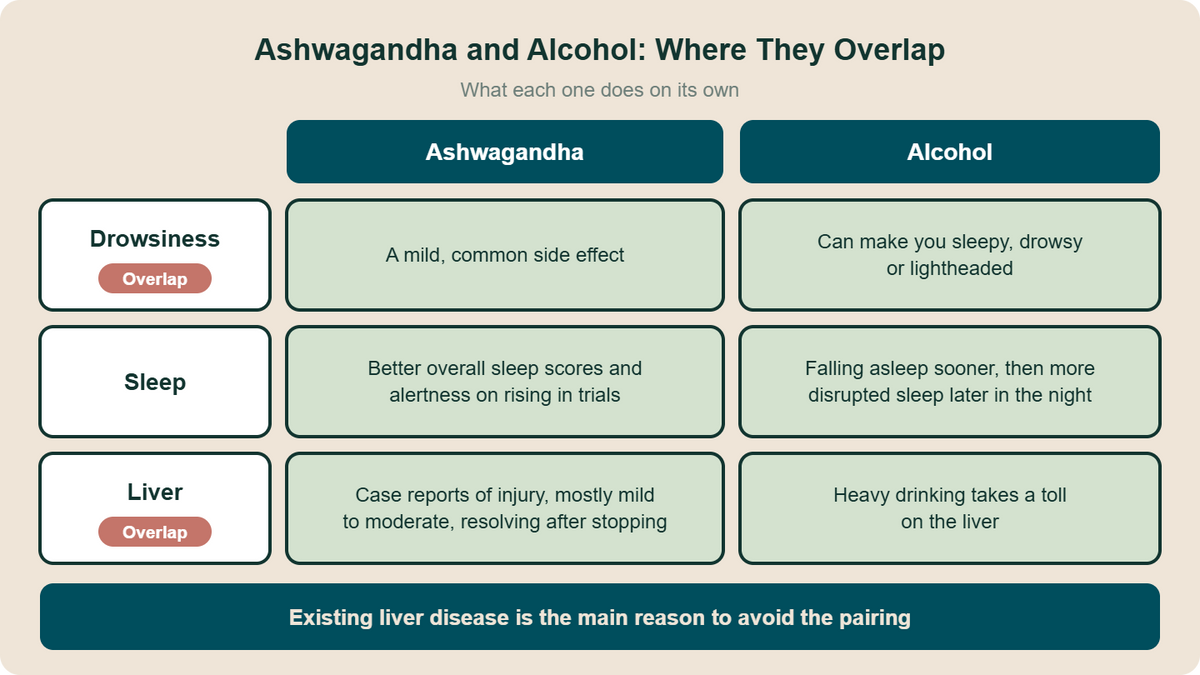
| What it affects | Ashwagandha | Alcohol |
|---|---|---|
| Drowsiness | A mild, common side effect | Can make you sleepy, drowsy or lightheaded |
| Sleep | Better overall sleep scores and mental alertness on rising in trials of 6 to 12 weeks | Falling asleep sooner, then more disrupted sleep in the second half of the night |
| Liver | Case reports of liver injury, mostly mild to moderate and resolving after stopping | Heavy drinking takes a toll on the liver |
| Typical use | Daily, for weeks, to support stress response and sleep | Occasional, social |
Ashwagandha and Alcohol Interaction: Drowsiness and Sleep
The NIH ODS lists drowsiness among ashwagandha's common, mild side effects and notes that it might interact with sedatives (NIH ODS, 2025). The NIAAA explains that alcohol, like some medicines, can make you sleepy, drowsy or lightheaded, and that combining them can intensify those effects (NIAAA). A drink on top of an evening dose of ashwagandha may leave you sleepier than either alone, so do not drive after combining them.
Sleep is where the two differ. A review of five randomized trials in 400 adults found ashwagandha extract had a small but significant effect on overall sleep, with larger effects in adults with insomnia, at 600 mg a day or more and after 8 weeks or longer; it also improved mental alertness on rising (Cheah et al., 2021). Alcohol works differently. A review of studies in healthy volunteers found that at all doses it shortens the time it takes to fall asleep, but sleep in the second half of the night becomes more disrupted and the first REM period is delayed (Ebrahim et al., 2013). If you take ashwagandha for sleep, a nightcap works against the rest you are after. Our guide to melatonin and alcohol covers the same issue for another common sleep supplement.
Ashwagandha, Alcohol and Your Liver
LiverTox, the NIH database on drug and supplement liver safety, notes that ashwagandha has not been linked to raised liver enzymes during use, but it has been implicated in cases of clinically apparent liver injury. Those cases typically appeared 2 to 12 weeks after starting ashwagandha, usually with jaundice and itching, and most were mild to moderate and cleared within 1 to 4 months of stopping (LiverTox, 2024).
| Study | Who and how much | What it found |
|---|---|---|
| Verma et al., 2021 | 80 healthy adults; 300 mg root extract twice daily or placebo for 8 weeks | No significant changes in liver enzymes, thyroid hormones or blood counts; no adverse events reported |
| Björnsson et al., 2020 | 5 people with liver injury linked to ashwagandha products | Onset 2 to 12 weeks after starting; no liver failure; tests normal within 1 to 5 months in the four followed up |
| Philips et al., 2023 | Case series from several centers in India | The most serious outcomes occurred in people who already had chronic liver disease |
Alcohol also affects the liver. The NIAAA notes that heavy drinking takes a toll on the liver and can lead to a range of liver problems (NIAAA, 2025). The clearest caution concerns people whose liver is already under strain. LiverTox advises that ashwagandha be avoided in people with cirrhosis or advanced chronic liver disease (LiverTox, 2024), and in the India case series, the most serious outcomes were in people with existing chronic liver disease (Philips et al., 2023). If you drink heavily or have been told your liver is not healthy, talk to your doctor before taking ashwagandha at all.
Whatever your drinking habits, stop ashwagandha and call your doctor if you notice yellowing of the skin or eyes, itching, nausea, unusual tiredness or belly discomfort, the symptoms reported in the case series (NIH ODS, 2025). Our ashwagandha side effects guide covers the full safety picture.
How to Take Them: Timing and Practical Tips
- Take ashwagandha in the morning on days you plan to drink. A morning dose keeps it well apart from an evening drink.
- Skip an evening dose on a night you drink. That avoids stacking two sources of drowsiness at bedtime.
- Keep drinks light. Fewer drinks means less drowsiness and less load on your liver.
- Stay consistent with ashwagandha. Trials ran about 1 to 3 months of daily use, so a steady routine matters more than any single dose.
The same timing logic applies to other calming supplements; see our guide to L-theanine and alcohol. For what ashwagandha has been studied for over those weeks of daily use, see ashwagandha benefits.
When to Skip the Combination
Talk to your doctor before taking ashwagandha, with or without alcohol, if any of these apply:
- You have liver disease, have had liver problems before, or drink heavily.
- You take sedatives or sleep medicines. Never mix alcohol with sleep medicines or other sedating prescriptions.
- You take thyroid hormone medicine, diabetes medicines, blood pressure medicines or immunosuppressants, which the NIH ODS lists as possible interactions.
- You are pregnant or breastfeeding. Some experts advise against ashwagandha in pregnancy.
- You have hormone-sensitive prostate cancer, since ashwagandha might raise testosterone (NIH ODS, 2025).
Where Our Forage Fits
Our Forage gives 100 mg of ashwagandha root extract in every 2-capsule serving, alongside seven 8:1 mushroom fruiting body extracts (lion's mane, cordyceps and reishi at 200 mg each; chaga, maitake, turkey tail and shiitake at 150 mg each) and 100 mg of Himalayan shilajit extract, with ginger extract in vegan capsules. The label directs two capsules daily, taken in the morning with or without food, which fits the morning timing above. It is designed to support focus, everyday energy, resilience and immune health, and it is made with third-party tested ingredients.
For calm during a busy day, our Theanine Nasal Spray gives 36 mg of L-theanine per 2-spray serving, with alkaline water as the only other ingredient. It is absorbed through the lining of the nose instead of being swallowed like a capsule, so some of each dose skips digestion. For the bigger picture, see our guide to stress, mood and nervous system balance.

Featured in this article
Theanine Nasal Spray36 mg of L-theanine per serving, with alkaline water as the only other ingredient.
Shop Theanine Nasal SprayThird-party tested ingredients. Made in the USA.
Frequently Asked Questions
Can you drink alcohol with ashwagandha?
For most healthy adults, an occasional light drink is not known to clash with a daily ashwagandha routine. Both can make you drowsy, though, and both have links to liver strain. Take ashwagandha in the morning, keep drinks light, and avoid the pairing if you have liver concerns or take sedating medicines.
Is there an ashwagandha and alcohol interaction?
No specific interaction is listed by the NIAAA or the NIH ODS. The overlap is in their effects: drowsiness is a common, mild side effect of ashwagandha, and alcohol can make you sleepy too. The NIAAA warns that drowsy effects can add up when alcohol is mixed with other things that cause them, so do not drive after combining the two.
Is ashwagandha and alcohol bad for your liver?
Heavy drinking takes a toll on the liver, and ashwagandha has been linked to liver injury in case reports, most of them mild to moderate and resolving after stopping. In an 8-week trial in healthy adults, liver enzymes showed no significant changes. The main group to avoid ashwagandha is people with cirrhosis or advanced chronic liver disease, and anyone who drinks heavily should talk to a doctor first.
How long after taking ashwagandha can I drink alcohol?
There is no set waiting time from research. A simple approach is to take ashwagandha in the morning and keep any drinks to the evening. If you normally take ashwagandha at night for sleep, skip that dose on an evening you drink so you are not adding to alcohol's drowsiness at bedtime.
Does ashwagandha make you sleepy if you drink?
It can add to it. Drowsiness is one of ashwagandha's common, mild side effects, and alcohol can make you sleepy, drowsy or lightheaded. Alcohol also disrupts sleep later in the night.
Should I stop taking ashwagandha before drinking?
For an occasional light drink, moving your dose to the morning is usually enough. Stop ashwagandha and call your doctor if you notice yellowing of the skin or eyes, itching, nausea or unusual tiredness. If you drink heavily, have liver disease or take sedatives, talk to your doctor before using it at all.
Can I take Forage if I drink alcohol?
Forage contains 100 mg of ashwagandha root extract per 2-capsule serving, and its label directs two capsules daily in the morning, which keeps it apart from evening drinks. Keep drinks light, and check with your doctor first if you drink regularly, have liver concerns or take prescription medicine.
Sources
- National Institutes of Health, Office of Dietary Supplements. Ashwagandha: Is it helpful for stress, anxiety, or sleep? Health Professional Fact Sheet, updated 2025. https://ods.od.nih.gov/factsheets/Ashwagandha-HealthProfessional/
- National Institute on Alcohol Abuse and Alcoholism. Harmful Interactions: Mixing Alcohol With Medicines. NIH Publication No. 13-5329, revised 2014. https://www.niaaa.nih.gov/publications/brochures-and-fact-sheets/harmful-interactions-mixing-alcohol-with-medicines
- National Institute on Alcohol Abuse and Alcoholism. Alcohol's Effects on the Body, updated 2025. https://www.niaaa.nih.gov/alcohols-effects-health/alcohols-effects-body
- LiverTox: Clinical and Research Information on Drug-Induced Liver Injury. Ashwagandha. National Institute of Diabetes and Digestive and Kidney Diseases, updated 2024. https://www.ncbi.nlm.nih.gov/books/NBK548536/
- Björnsson HK, Björnsson ES, Avula B, et al. Ashwagandha-induced liver injury: A case series from Iceland and the US Drug-Induced Liver Injury Network. Liver International, 2020. https://pubmed.ncbi.nlm.nih.gov/31991029/
- Philips CA, Valsan A, Theruvath AH, et al. Ashwagandha-induced liver injury: A case series from India and literature review. Hepatology Communications, 2023. https://pubmed.ncbi.nlm.nih.gov/37756041/
- Verma N, Gupta SK, Tiwari S, Mishra AK. Safety of Ashwagandha Root Extract: A Randomized, Placebo-Controlled, study in Healthy Volunteers. Complementary Therapies in Medicine, 2021. https://doi.org/10.1016/j.ctim.2020.102642
- Cheah KL, Norhayati MN, Yaacob LH, Abdul Rahman R. Effect of Ashwagandha (Withania somnifera) extract on sleep: A systematic review and meta-analysis. PLoS One, 2021. https://pubmed.ncbi.nlm.nih.gov/34559859/
- Ebrahim IO, Shapiro CM, Williams AJ, Fenwick PB. Alcohol and sleep I: effects on normal sleep. Alcoholism: Clinical and Experimental Research, 2013. https://pubmed.ncbi.nlm.nih.gov/23347102/
These statements have not been evaluated by the Food and Drug Administration. This content is for education and is not medical advice. Our products are not intended to diagnose, treat, cure or prevent any disease. Talk with a healthcare provider before starting a new supplement if you are pregnant, breastfeeding or taking medication.


Leave a comment
All comments are moderated before being published.
This site is protected by hCaptcha and the hCaptcha Privacy Policy and Terms of Service apply.