
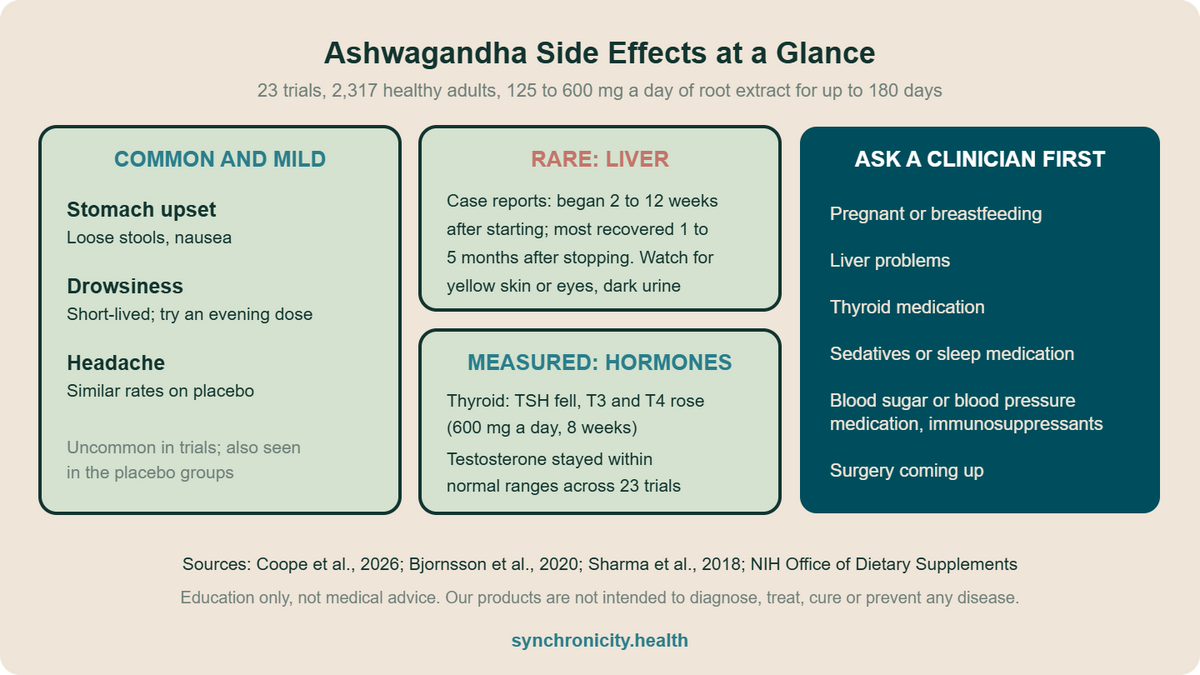
Ashwagandha is well tolerated by most people. When side effects do happen, they are usually mild: stomach upset, loose stools, nausea, headache or drowsiness. A 2026 review of 23 trials in 2,317 healthy adults found no serious side effects from standardized root extract at 125 to 600 mg a day for up to 180 days. A few groups, such as people who are pregnant or take thyroid medication, should check with a clinician first.
Key Takeaways
- Ashwagandha is well tolerated by most people: across 23 trials, liver, kidney, blood, hormone and heart markers stayed within normal ranges and no serious side effects were linked to it (Coope et al., 2026).
- The side effects people do notice, such as stomach upset, headache and short-lived drowsiness, are mild and uncommon, and they showed up in the placebo groups too (Coope et al., 2026).
- Simple habits help: take it with food, move it to the evening if it makes you sleepy, and stay within the amounts used in trials.
- Liver injury is rare, and most reported cases involved non-standardized or multi-ingredient products; people recovered after stopping in the cases followed up (Bjornsson et al., 2020; Coope et al., 2026).
- If you are pregnant or breastfeeding, have liver or thyroid problems, or take daily medication, check with a clinician first (NIH Office of Dietary Supplements).

Featured in this article
Forage100 mg ashwagandha root extract per serving, with seven mushroom fruiting body extracts and Himalayan shilajit.
Shop ForageThird-party tested ingredients. Vegan capsules.
Common Ashwagandha Side Effects
Ashwagandha (Withania somnifera) is an Ayurvedic root taken to support a healthier stress response and restful sleep. Most people who take it in trials notice no side effects at all. When side effects do happen, they tend to be mild and to fade on their own (NIH Office of Dietary Supplements):
- Stomach upset, loose stools and nausea. These are the side effects people report most often. Taking ashwagandha with food usually helps.
- Drowsiness. Ashwagandha is studied for sleep, so some people feel sleepy, especially at higher amounts. If it makes you drowsy in the day, try taking it in the evening.
- Headache. Reported now and then in trials, and at similar rates on placebo.
The largest look at safety so far is a 2026 systematic review of 23 randomized trials with 2,317 healthy adults. Every trial used a standardized, root-only extract at 125 to 600 mg a day, for anywhere from a single dose to 180 days. Liver, kidney, blood, hormone and heart markers stayed within normal clinical ranges, no serious side effects were linked to ashwagandha, and the mild ones (stomach discomfort, headache and short-lived drowsiness) appeared in both the ashwagandha and comparison groups. The authors note that data beyond 180 days are limited (Coope et al., 2026).
| Side effect | How often | What to do |
|---|---|---|
| Stomach upset, loose stools, nausea | The most common, but still uncommon | Take it with food; lower the amount or stop if it continues |
| Drowsiness | Occasional and short-lived | Move your dose to the evening; avoid driving if you feel sleepy |
| Headache | Occasional, similar to placebo | Drink water and see if it passes; stop if it keeps coming back |
| Changes in thyroid hormone levels | Measured in a trial, not felt by most people | Ask your clinician first if you take thyroid medication |
| Liver injury | Rare (case reports) | Stop and see a clinician if you notice yellow skin or eyes, dark urine or itching |
Ashwagandha and the Liver
The most serious side effect linked to ashwagandha is liver injury, and it is rare. A case series from Iceland and the US Drug-Induced Liver Injury Network described five people who developed jaundice, nausea, tiredness, itching and stomach discomfort 2 to 12 weeks after starting supplements that contained ashwagandha. None developed liver failure, and liver tests returned to normal within 1 to 5 months in the four people who were followed up. Four of the five were also taking other supplements (Bjornsson et al., 2020).
The National Institutes of Health liver database reaches the same picture: injury is rare, usually appears within 2 to 12 weeks, and most cases resolve after stopping. People with advanced liver problems should avoid ashwagandha (LiverTox, NIDDK). The 2026 review above notes that many reported cases involved non-standardized or multi-ingredient products, while trials of standardized root extract showed liver markers within normal ranges (Coope et al., 2026).
Signs to watch for: yellowing of the skin or eyes, dark urine, pale stools, itching all over or pain in the upper right side of the belly. If you notice any of these, stop taking ashwagandha and see a clinician.
Ashwagandha and the Thyroid
Ashwagandha can change thyroid hormone levels. In an 8-week trial, 50 adults with a mildly raised thyroid stimulating hormone (TSH) took 600 mg of root extract or a placebo each day. TSH fell and the thyroid hormones T3 and T4 rose in the ashwagandha group compared with placebo. Mild, temporary side effects were reported by 1 person on ashwagandha and 3 on placebo (Sharma et al., 2018).
For most people this is not something they feel. It matters if you already take thyroid medication or have a thyroid condition, because adding ashwagandha could shift your levels. Ask your clinician before starting, and they may want to recheck your levels after a few weeks.
Ashwagandha Side Effects for Men
Men often ask whether ashwagandha changes hormones. In an 8-week crossover trial, 57 overweight men aged 40 to 70 took a standardized ashwagandha extract or a placebo. Ashwagandha was linked to a 14.7% greater rise in testosterone and an 18% greater rise in DHEA-S than placebo, with no difference in cortisol or estradiol (Lopresti et al., 2019). Across the 23 trials in the 2026 review, testosterone stayed within normal ranges (Coope et al., 2026).
Otherwise, the side effects men report are the same as everyone else's: occasional stomach upset, drowsiness or headache. Men with a hormone-sensitive condition, or who take hormone therapy, should check with their clinician first. For a related question, see our guide to whether mushrooms affect testosterone.
Ashwagandha Side Effects for Women
Trials in women report the same mild side effects seen in men. The main points for women are about timing and life stage:
- Pregnancy and breastfeeding. Some experts advise avoiding ashwagandha during pregnancy. If you are pregnant, trying to conceive or breastfeeding, ask your provider first (NIH Office of Dietary Supplements).
- Thyroid. Thyroid conditions are more common in women, so the thyroid section above applies to many readers.
- Hormone-sensitive conditions. Talk with your provider first if you have a hormone-sensitive condition.
Can Ashwagandha Affect Your Mood?
In trials, ashwagandha's effect on mood went in a good direction: a review of 12 randomized trials with 1,002 people found lower stress scores with ashwagandha than with placebo (Akhgarjand et al., 2022). Some people online describe feeling flat or less motivated after starting it. That has not been measured as a side effect in trials, and people respond differently, so if you feel unlike yourself, stop taking it and talk with a clinician if it continues. If you are comparing calming ingredients, our guide to ashwagandha vs L-theanine covers an option that works differently, and best supplements for stress and mood puts the options side by side.
Who Should Avoid Ashwagandha or Ask First
Ask your clinician before taking ashwagandha if any of these apply to you (NIH Office of Dietary Supplements):
- You are pregnant, trying to conceive or breastfeeding.
- You have liver problems, or you have had liver injury from a supplement before.
- You take thyroid medication or have a thyroid condition.
- You take sedatives or sleep medication, immunosuppressants, blood sugar medication or blood pressure medication.
- You have a hormone-sensitive condition.
- You have surgery coming up.
How to Take Ashwagandha Comfortably
- Choose a root extract with a clear label. The trials that found ashwagandha well tolerated used standardized, root-only extracts (Coope et al., 2026). Look for the amount of root extract per serving on the label.
- Stay within studied amounts. Trials used 125 to 600 mg a day. Follow the directions on your product's label.
- Take it with food. This helps with stomach upset.
- Know what else you take. Several liver cases involved more than one supplement, so tell your clinician about everything you use.
- Check in after long use. Most trials lasted 8 to 12 weeks, and data beyond 6 months are limited, so check in with your clinician if you plan to take it for longer.
For more on dosage, timing and the benefits trials have measured, read our guide to ashwagandha benefits and our ashwagandha root extract ingredient guide. Our stress, mood and nervous system guide covers the daily habits that matter most.
Where Our Forage Fits
Our Forage capsules contain 100 mg ashwagandha root extract per serving, a lighter amount than the 125 to 600 mg a day that trials found well tolerated. It sits alongside 8:1 fruiting body extracts of lion's mane, cordyceps and reishi (200 mg each) and chaga, maitake, turkey tail and shiitake (150 mg each), plus Himalayan shilajit extract (100 mg). Every ingredient is third-party tested. Follow the directions on the label, and if any of the "ask first" points above apply to you, check with your clinician before starting.
Because Forage combines several ingredients, it is worth reading about the others too: see our guides to lion's mane side effects and shilajit side effects. If you want a calm-focus option without ashwagandha, our Theanine Nasal Spray delivers L-theanine through the nose, and our guide to L-theanine vs ashwagandha for sleep compares the two.
Featured in this article
Forage100 mg ashwagandha root extract per serving, with seven mushroom fruiting body extracts and Himalayan shilajit.
Shop ForageThird-party tested ingredients. Vegan capsules.
Frequently Asked Questions
What are the most common side effects of ashwagandha?
Stomach upset, loose stools, nausea, headache and drowsiness. In trials they were uncommon, mild and also seen in people taking a placebo.
Is ashwagandha bad for your liver?
For most people, no. Liver injury is rare. A handful of cases have been reported, usually 2 to 12 weeks after starting, and most people recovered after stopping. Trials of standardized root extract found liver markers within normal ranges. People with liver problems should avoid it.
Does ashwagandha affect the thyroid?
It can. In an 8-week trial, 600 mg a day lowered TSH and raised T3 and T4 compared with placebo. If you take thyroid medication, ask your clinician before starting.
Does ashwagandha cause weight gain?
Weight gain is not among the side effects reported in trials. The side effects trials did report were stomach discomfort, headache and short-lived drowsiness.
Can ashwagandha make you tired?
Some people feel drowsy, especially at higher amounts. Taking it in the evening usually solves this.
Does ashwagandha raise testosterone?
In one 8-week trial in men aged 40 to 70, testosterone rose 14.7% more than on placebo. Across 23 trials, testosterone stayed within normal ranges.
How long do ashwagandha side effects last?
Mild side effects such as stomach upset or drowsiness usually pass within days or stop soon after you stop taking it. In the rare liver cases, liver tests returned to normal within 1 to 5 months of stopping.
Is it safe to take ashwagandha every day?
Trials of daily use lasting up to 180 days found it well tolerated in healthy adults. Data beyond 6 months are limited, so check with a clinician before longer use.
Who should not take ashwagandha?
Ask a clinician first if you are pregnant or breastfeeding, have liver or thyroid problems, take sedatives, immunosuppressants, blood sugar or blood pressure medication, or have surgery coming up.
Sources
- Akhgarjand C, et al. Does ashwagandha supplementation have a beneficial effect on the management of anxiety and stress? A systematic review and meta-analysis of randomized controlled trials. Phytotherapy Research, 2022. https://pubmed.ncbi.nlm.nih.gov/36017529/
- Bjornsson HK, Bjornsson ES, Avula B, et al. Ashwagandha-induced liver injury: a case series from Iceland and the US Drug-Induced Liver Injury Network. Liver International, 2020. https://pubmed.ncbi.nlm.nih.gov/31991029/
- Coope OC, Willems MET, Levington A, et al. Back to the roots: safety and tolerability of standardised ashwagandha (Withania somnifera) root extract in healthy adults, a systematic review of biomarkers and adverse events. Pharmaceuticals, 2026. https://pubmed.ncbi.nlm.nih.gov/42198398/
- Lopresti AL, Drummond PD, Smith SJ. A randomized, double-blind, placebo-controlled, crossover study examining the hormonal and vitality effects of ashwagandha (Withania somnifera) in aging, overweight males. American Journal of Men's Health, 2019. https://pubmed.ncbi.nlm.nih.gov/30854916/
- Sharma AK, Basu I, Singh S. Efficacy and safety of ashwagandha root extract in subclinical hypothyroid patients: a double-blind, randomized placebo-controlled trial. Journal of Alternative and Complementary Medicine, 2018. https://pubmed.ncbi.nlm.nih.gov/28829155/
- NIH Office of Dietary Supplements. Ashwagandha: Fact Sheet for Health Professionals. https://ods.od.nih.gov/factsheets/Ashwagandha-HealthProfessional/
- LiverTox: Clinical and Research Information on Drug-Induced Liver Injury. Ashwagandha. National Institute of Diabetes and Digestive and Kidney Diseases. https://www.ncbi.nlm.nih.gov/books/NBK548536/
These statements have not been evaluated by the Food and Drug Administration. This content is for education and is not medical advice. Our products are not intended to diagnose, treat, cure or prevent any disease. Talk with a healthcare provider before starting a new supplement if you are pregnant, breastfeeding or taking medication.

Leave a comment
All comments are moderated before being published.
This site is protected by hCaptcha and the hCaptcha Privacy Policy and Terms of Service apply.