
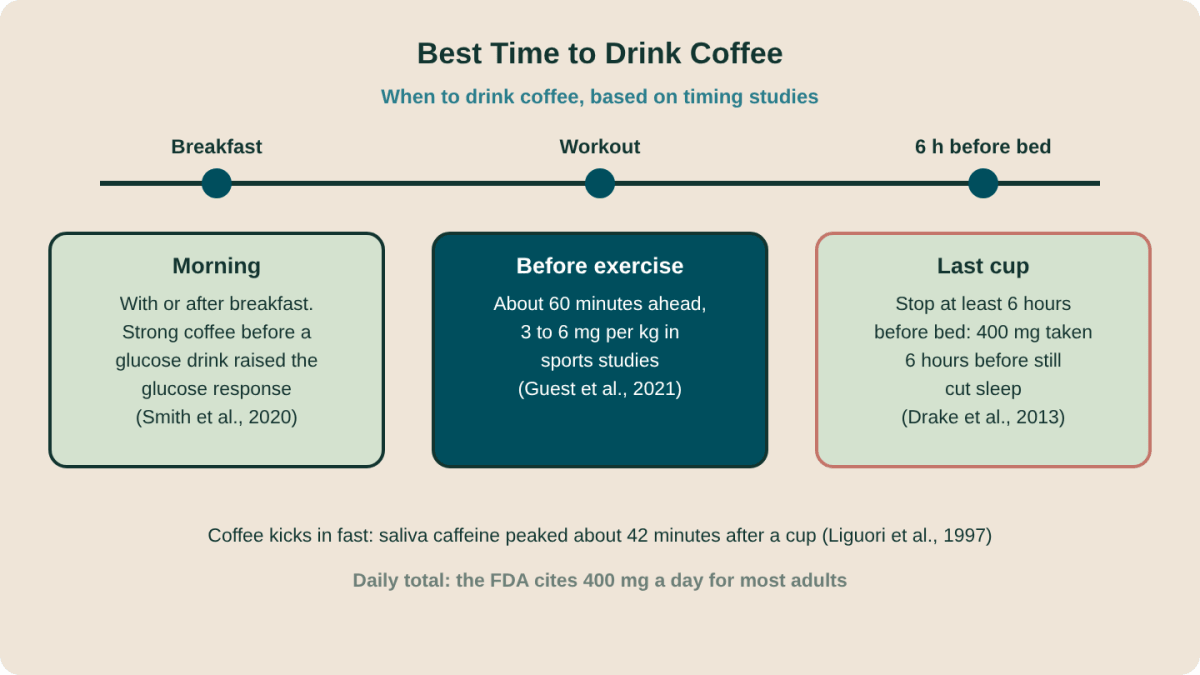
For most people, the best time to drink coffee is in the morning, ideally with or after breakfast, and no later than about 6 hours before bed. A strong coffee taken before eating raised the blood sugar response to a glucose drink in one study (Smith et al., 2020), and 400 mg of caffeine taken even 6 hours before bed still disrupted sleep (Drake et al., 2013). Before exercise, sports studies most often use caffeine about 60 minutes ahead (Guest et al., 2021). This guide walks through the timing research for mornings, workouts and evenings.
It is educational, not medical advice.
Key Takeaways
- Morning, with food: about 300 mg of caffeine as strong black coffee before a glucose drink raised peak glucose and insulin (Smith et al., 2020).
- It kicks in within the hour: after a 12 oz coffee, saliva caffeine peaked at about 42 minutes on average (Liguori et al., 1997).
- Before a workout: the most common timing in sports research is 60 minutes before exercise, at 3 to 6 mg per kg of body weight (Guest et al., 2021).
- Bedtime cutoff: 400 mg taken 0, 3 or 6 hours before bed all disrupted sleep; the authors advise avoiding substantial caffeine for at least 6 hours before bed (Drake et al., 2013).
- Daily total: the FDA cites 400 mg a day for most adults (FDA).

Featured in this article
Theanine Nasal Spray36 mg of L-theanine per serving, caffeine-free, to pair with your coffee or tea.
Shop Theanine Nasal SprayThird-party tested ingredients. Vegan, non-GMO, made in the USA.

Best Time to Drink Coffee at a Glance
| Goal | Timing | What the research shows |
|---|---|---|
| Morning alertness | With or after breakfast | Strong coffee before a glucose drink raised the glucose response (Smith et al., 2020) |
| Feeling it fast | Allow about 40 minutes | Saliva caffeine peaked about 42 minutes after coffee (Liguori et al., 1997) |
| Exercise | About 60 minutes before | The most common timing in studies, 3 to 6 mg per kg (Guest et al., 2021) |
| Good sleep | Stop 6 or more hours before bed | 400 mg 6 hours before bed still cut sleep (Drake et al., 2013) |
Morning: Before or After Breakfast?
Many people drink their first coffee before eating. In a randomized crossover study of 29 healthy adults, strong black coffee with about 300 mg of caffeine, taken about an hour after waking and 30 minutes before a glucose drink, led to higher peak glucose and insulin than the same morning without coffee; a night of broken sleep alone did not change the response (Smith et al., 2020). The authors concluded that a strong caffeinated coffee before eating can be expected to reduce glucose tolerance. The study did not test coffee with food, but having breakfast first, or with your coffee, is a simple way to avoid the situation it tested. Our guide to coffee on an empty stomach covers this in more depth.
Should You Wait 90 Minutes After Waking?
A popular rule says to delay coffee for 60 to 90 minutes after waking because of cortisol. Caffeine does raise cortisol: in a double-blind trial, caffeine raised cortisol across the day after a break from caffeine, and daily intake made that rise smaller without removing it (Lovallo et al., 2005). That study gave caffeine at set times and did not compare an early cup with a later one, so it does not show that waiting 90 minutes works better. If you feel better waiting, there is no harm in it; if you do not, the research here gives no strong reason to force it. For more ideas on starting the day, see our morning routine and how to wake up guides.
How Long Coffee Takes to Kick In
When volunteers drank 400 mg of caffeine in 12 oz of coffee, saliva caffeine peaked at about 42 minutes on average; the same dose in capsules peaked later, at about 67 minutes (Liguori et al., 1997). Another study found caffeine absorption from coffee and an energy drink was similar whether the drink was hot or cold, or drunk quickly or slowly (White et al., 2016). So if you want to feel alert for a meeting or a drive, have your coffee about 30 to 45 minutes beforehand.
Before a Workout
The International Society of Sports Nutrition position stand reports that caffeine consistently improves exercise performance at 3 to 6 mg per kg of body weight, and that the most commonly used timing is 60 minutes before exercise; the best timing likely depends on the source, with chewing gum needing less waiting time than capsules (Guest et al., 2021). Coffee counts: in trained cyclists, coffee and caffeine at the same dose, each taken 1 hour before exercise, both improved a time trial by about 5% compared with placebo or decaf (Hodgson et al., 2013). The position stand also notes that very high doses, such as 9 mg per kg, bring more side effects (Guest et al., 2021). For pairing caffeine with creatine, see creatine and caffeine.
Your Last Cup: The Bedtime Cutoff
In a study of caffeine taken at home, 400 mg given at bedtime, 3 hours before bed or 6 hours before bed all disturbed sleep compared with placebo. Even at 6 hours, total sleep time dropped enough that the authors recommended avoiding substantial caffeine for at least 6 hours before bedtime (Drake et al., 2013). For a typical 10:30 PM bedtime, that means finishing coffee by about 4:30 PM, and earlier if you are sensitive. Read more in how long caffeine lasts.
How Much Coffee a Day?
For most adults, the FDA cites 400 mg of caffeine a day, about two to three 12 oz cups of coffee, as an amount not generally associated with negative effects, and notes wide differences in sensitivity (FDA). An 8 oz cup of brewed coffee has about 95 mg (USDA FoodData Central). Spreading cups through the morning rather than drinking them back to back may help you avoid the caffeine crash; see also how much caffeine is too much.
Where Our Products Fit
Some people pair their morning coffee with L-theanine: in a placebo-controlled study, 50 mg of caffeine with 100 mg of L-theanine improved speed and accuracy on an attention switching task and reduced distraction in a memory task (Owen et al., 2008). Theanine Nasal Spray gives 36 mg of L-theanine per serving and is caffeine-free, so it adds nothing to your caffeine total. The Energy Stack combines NAD+ Nasal Spray, Forage and Methyl B-12 Nasal Spray in one daily energy routine. Read more in L-theanine and caffeine, on our L-theanine ingredient page and in the Non-Stimulant Energy and Focus hub.

Featured in this article
Energy StackNAD+ Nasal Spray, Forage and Methyl B-12 Nasal Spray together in one daily energy routine.
Shop Energy StackThird-party tested ingredients.
Frequently Asked Questions
What is the best time of day to drink coffee?
In the morning with or after breakfast for most people, since strong coffee before eating raised the glucose response in a study (Smith et al., 2020), and at least 6 hours before bed (Drake et al., 2013).
Is it better to drink coffee before or after breakfast?
After or with breakfast is the safer choice if you care about blood sugar; the study tested strong coffee before a glucose drink, not with food (Smith et al., 2020).
How long before a workout should I drink coffee?
About 60 minutes, the most common timing in sports research (Guest et al., 2021); coffee taken 1 hour before improved cycling performance (Hodgson et al., 2013).
What time should I stop drinking coffee?
At least 6 hours before bed; 400 mg taken 6 hours before bed still reduced sleep (Drake et al., 2013).
How long does it take for coffee to kick in?
Saliva caffeine peaked about 42 minutes after a 12 oz coffee in one study (Liguori et al., 1997).
Does coffee raise cortisol in the morning?
Caffeine raises cortisol, though less in daily drinkers (Lovallo et al., 2005). Research has not shown that waiting 90 minutes after waking changes this.
Is afternoon coffee bad?
Not if it is well before bed. A mid afternoon cup can fit if you stop at least 6 hours before bedtime (Drake et al., 2013).
How many cups of coffee a day is safe?
The FDA cites 400 mg of caffeine a day for most adults, about two to three 12 oz cups (FDA).
Sources
- Smith HA, Hengist A, Thomas J, et al. Glucose control upon waking is unaffected by hourly sleep fragmentation during the night, but is impaired by morning caffeinated coffee. Br J Nutr. 2020. PubMed 32475359
- Drake C, Roehrs T, Shambroom J, Roth T. Caffeine effects on sleep taken 0, 3, or 6 hours before going to bed. J Clin Sleep Med. 2013. PubMed 24235903
- Guest NS, VanDusseldorp TA, Nelson MT, et al. International society of sports nutrition position stand: caffeine and exercise performance. J Int Soc Sports Nutr. 2021. PubMed 33388079
- Hodgson AB, Randell RK, Jeukendrup AE. The metabolic and performance effects of caffeine compared to coffee during endurance exercise. PLoS One. 2013. PubMed 23573201
- Liguori A, Hughes JR, Grass JA. Absorption and subjective effects of caffeine from coffee, cola and capsules. Pharmacol Biochem Behav. 1997. PubMed 9329065
- White JR, Padowski JM, Zhong Y, et al. Pharmacokinetic analysis and comparison of caffeine administered rapidly or slowly in coffee chilled or hot versus chilled energy drink in healthy young adults. Clin Toxicol. 2016. PubMed 27100333
- Lovallo WR, Whitsett TL, al'Absi M, et al. Caffeine stimulation of cortisol secretion across the waking hours in relation to caffeine intake levels. Psychosom Med. 2005. PubMed 16204431
- Owen GN, Parnell H, De Bruin EA, Rycroft JA. The combined effects of L-theanine and caffeine on cognitive performance and mood. Nutr Neurosci. 2008. PubMed 18681988
- U.S. Food and Drug Administration. Spilling the Beans: How Much Caffeine Is Too Much? FDA
- U.S. Department of Agriculture. FoodData Central: Beverages, coffee, brewed, prepared with tap water (FDC 171890). FoodData Central
Our products are not intended to diagnose, treat, cure or prevent any disease. This article is for education only and is not medical advice.


Leave a comment
All comments are moderated before being published.
This site is protected by hCaptcha and the hCaptcha Privacy Policy and Terms of Service apply.