
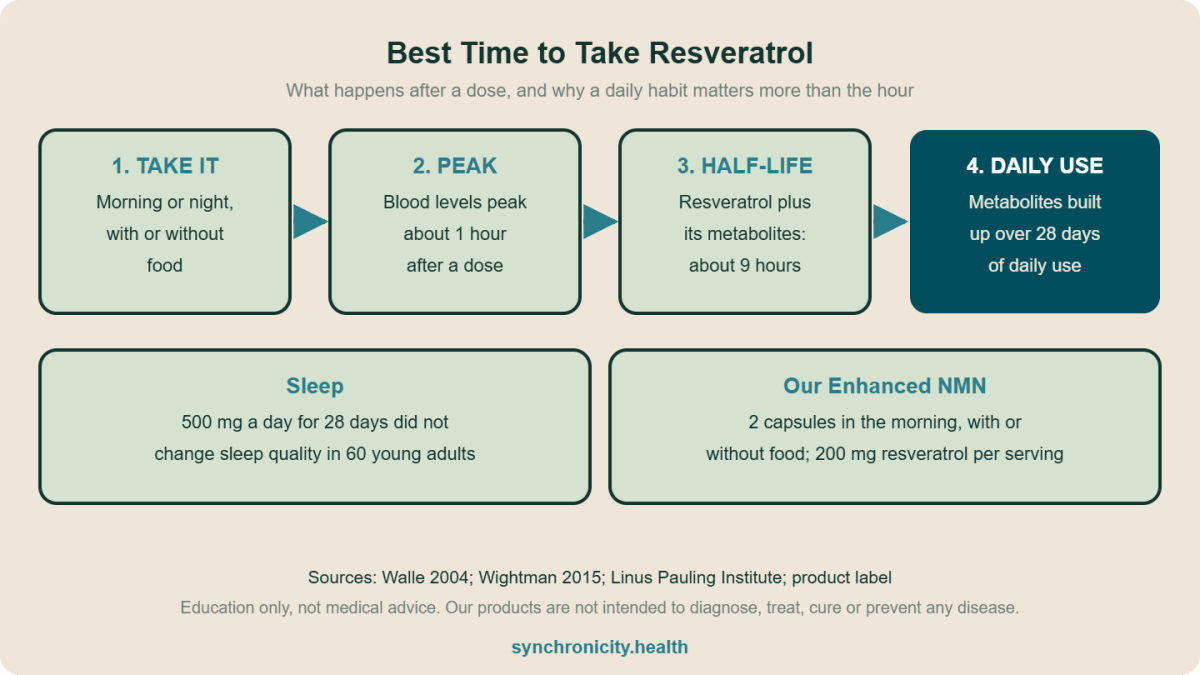
The best time to take resveratrol is the time you will stick to every day, and many people choose the morning with breakfast. Trials have given it once a day or split into two doses with meals, and in a 28-day study 500 mg a day did not change sleep quality, so night is fine too. Food slows absorption a little, and resveratrol and its metabolites have a half-life of about 9 hours, so daily consistency matters more than the clock.
Key Takeaways
- Trials used 150 to 500 mg a day, taken once a day or as 75 mg twice a day (Evans et al., 2017; Wightman et al., 2015).
- In 60 young adults, 500 mg a day for 28 days left sleep quality unchanged and lowered ratings of fatigue (Wightman et al., 2015).
- Food delayed absorption of supplemental resveratrol without reducing it in one study, while dietary fat reduced it in another (Linus Pauling Institute).
- Blood levels peak about 1 hour after a dose (Linus Pauling Institute), and resveratrol plus its metabolites have a half-life of about 9 hours (Walle et al., 2004).
- Taking it every day matters: with daily use, resveratrol metabolites built up in the blood over 28 days (Wightman et al., 2015).

Featured in this article
Enhanced NMN750 mg of NMN plus resveratrol and pterostilbene per serving, in a daily capsule.
Shop Enhanced NMNThird-party tested ingredients. Vegan, non-GMO, made in the USA.
Resveratrol Morning or Night: What Studies Did
The human trials behind resveratrol's benefits did not hinge on a time of day. They focused on taking it daily, for weeks to months:
| Trial | Daily amount | How it was taken |
|---|---|---|
| Witte et al., 2014 (older adults, 26 weeks) | 200 mg | Capsules before or with the main meals |
| Evans et al., 2017 (postmenopausal women, 14 weeks) | 150 mg | 75 mg twice a day |
| Thaung Zaw et al., 2020 (postmenopausal women, 12 months) | 150 mg | 75 mg twice a day |
| Wightman et al., 2015 (young adults, 28 days) | 500 mg | Once a day |
Sources: Witte et al., 2014; Evans et al., 2017; Thaung Zaw et al., 2020; Wightman et al., 2015.
Both patterns worked in their trials. Once a day is easier to remember; splitting the amount across two meals keeps each dose smaller. The trials in this table did not compare morning with evening dosing, so pick the slot that fits your routine and keep it. For what these trials found, see our guide to NMN and resveratrol.
Can You Take Resveratrol at Night? Does It Affect Sleep?
Yes, you can. Resveratrol is not a stimulant. In a 28-day trial, 60 healthy adults aged 18 to 30 took 500 mg a day (with 10 mg of piperine) or a placebo and filled in a standard sleep quality questionnaire each week. Sleep quality did not differ between the groups, while ratings of fatigue were lower with resveratrol at days 7, 21 and 28 (Wightman et al., 2015).
So resveratrol is unlikely to keep you up, and it is not a sleep aid either. Many people still prefer the morning because it pairs naturally with breakfast and with NMN. If you want something made for the evening, our Melatonin Nasal Spray gives 200 mcg of melatonin with 17 mg of L-theanine per 2 sprays, used shortly before bed; see melatonin and L-theanine and our sleep health hub.
Can You Take Resveratrol on an Empty Stomach?
Yes. Resveratrol is well absorbed either way: in a study of six volunteers given 25 mg by mouth, at least 70 percent was absorbed (Walle et al., 2004). What food changes is the pace and, in some studies, the peak. The Linus Pauling Institute summarizes the research this way (Linus Pauling Institute):
- Food delayed, but did not reduce, absorption of supplemental resveratrol.
- Dietary fat reduced the bioavailability of supplemental resveratrol in another study.
- Taking it with quercetin or alcohol did not reduce bioavailability.
- For red wine, absorption was the same with a low-fat meal, a high-fat meal or on an empty stomach.
In practice, take it with a light meal or without food. If you take it with food, a lighter breakfast is a sensible choice over a very fatty one. If your stomach is sensitive, a meal helps; stomach effects such as nausea and diarrhea have been reported mainly at more than 1,000 mg a day, well above the 150 to 500 mg a day used in the trials above (Linus Pauling Institute).
How Long Does Resveratrol Stay in Your System?
Resveratrol moves through quickly. After a single 25 mg dose, total resveratrol in the blood peaked at around 60 minutes, and after larger single doses, unchanged resveratrol peaked 0.8 to 1.5 hours after dosing (Linus Pauling Institute). The gut and liver quickly attach sulfate and glucuronic acid to it, so most of what circulates is metabolites. Resveratrol and its metabolites had a plasma half-life of about 9 hours, and most of the dose left the body in urine (Walle et al., 2004).
Daily use changes the picture. In the 28-day trial, total resveratrol metabolites measured before the day 28 dose were higher than at the start, a sign they build up with steady use (Wightman et al., 2015), and repeated daily dosing gave higher peaks than a single dose in another study (Linus Pauling Institute). That is another reason the best schedule is the one you keep. Pterostilbene, a close relative, is often added for its chemistry; see pterostilbene vs resveratrol. Quercetin is another plant compound often paired with resveratrol, and our guide to resveratrol and quercetin covers taking the two together.
Best Time to Take Resveratrol and NMN
If you take resveratrol with NMN, take them together in the morning. NMN is a building block of NAD+, the coenzyme your cells use to turn food into energy, so a morning dose lines up with the active part of your day, and one daily habit is easier to keep than two. Our NMN dosage guide covers NMN timing in detail. Enhanced NMN also contains vitamin B12; our guide to the best time to take B12 covers that side.
Check with your clinician first if you are pregnant or breastfeeding, have a hormone-sensitive condition, or take prescription medicine. For more on the ingredient itself, see our resveratrol ingredient page. If you are comparing labels, our guide to trans resveratrol vs resveratrol explains the difference between the forms.
Where Our Enhanced NMN Fits
Our Enhanced NMN makes the timing simple: take 2 capsules in the morning, with or without food. Each serving gives you 200 mg of resveratrol, 750 mg of NMN, 100 mg of pterostilbene, 200 mg of trimethylglycine (TMG) and 750 mcg of vitamin B12 as methylcobalamin, with ginger extract and vegan capsules, made with third-party tested ingredients.
Benefits build with consistent daily use. Months 1 to 2 can bring early changes, and 3 months and beyond is where the full benefit builds, so keep the same time each morning.
Featured in this article
Enhanced NMN750 mg of NMN plus resveratrol and pterostilbene per serving, in a daily capsule.
Shop Enhanced NMNThird-party tested ingredients. Vegan, non-GMO, made in the USA.
Frequently Asked Questions
Can resveratrol be taken at night?
Yes. It is not a stimulant, and 500 mg a day for 28 days did not change sleep quality in a placebo-controlled trial.
When should I take resveratrol, morning or night?
Either works. Most people take it in the morning with breakfast or with NMN, because a daily habit matters more than the hour.
Can you take resveratrol on an empty stomach?
Yes. Food slows absorption a little, and a very fatty meal may lower it, so an empty stomach or a light meal both work.
Does resveratrol affect sleep?
Not in the study that measured it: sleep quality scores did not change over 28 days at 500 mg a day.
How long does resveratrol stay in your system?
Levels peak about 1 hour after a dose, and resveratrol plus its metabolites have a half-life of about 9 hours. With daily use, metabolites build up over weeks.
What is the best time to take resveratrol and NMN?
Together in the morning. Our Enhanced NMN combines both, and the directions are 2 capsules in the morning, with or without food.
Should I split my resveratrol dose?
You can. Trials used both a single daily dose and 75 mg twice a day.
Should I take resveratrol with fat?
There is no need. One study found dietary fat reduced bioavailability of supplemental resveratrol, so a light meal is the better pairing.
Sources
- Linus Pauling Institute Micronutrient Information Center. Resveratrol. Oregon State University. https://lpi.oregonstate.edu/mic/dietary-factors/phytochemicals/resveratrol
- Walle T, et al. High absorption but very low bioavailability of oral resveratrol in humans. Drug Metabolism and Disposition, 2004. https://pubmed.ncbi.nlm.nih.gov/15333514/
- Wightman EL, et al. The effects of chronic trans-resveratrol supplementation on aspects of cognitive function, mood, sleep, health and cerebral blood flow in healthy, young humans. British Journal of Nutrition, 2015. https://doi.org/10.1017/S0007114515003037
- Witte AV, Kerti L, Margulies DS, Floel A. Effects of resveratrol on memory performance, hippocampal functional connectivity, and glucose metabolism in healthy older adults. Journal of Neuroscience, 2014. https://www.jneurosci.org/content/34/23/7862
- Evans HM, Howe PRC, Wong RHX. Effects of resveratrol on cognitive performance, mood and cerebrovascular function in post-menopausal women; a 14-week randomised placebo-controlled intervention trial. Nutrients, 2017. https://pubmed.ncbi.nlm.nih.gov/28054939/
- Thaung Zaw JJ, Howe PRC, Wong RHX. Sustained cerebrovascular and cognitive benefits of resveratrol in postmenopausal women. Nutrients, 2020. https://www.mdpi.com/2072-6643/12/3/828
These statements have not been evaluated by the Food and Drug Administration. This content is for education and is not medical advice. Our products are not intended to diagnose, treat, cure or prevent any disease. Talk with a healthcare provider before starting a new supplement if you are pregnant, breastfeeding or taking medication.


Leave a comment
All comments are moderated before being published.
This site is protected by hCaptcha and the hCaptcha Privacy Policy and Terms of Service apply.