
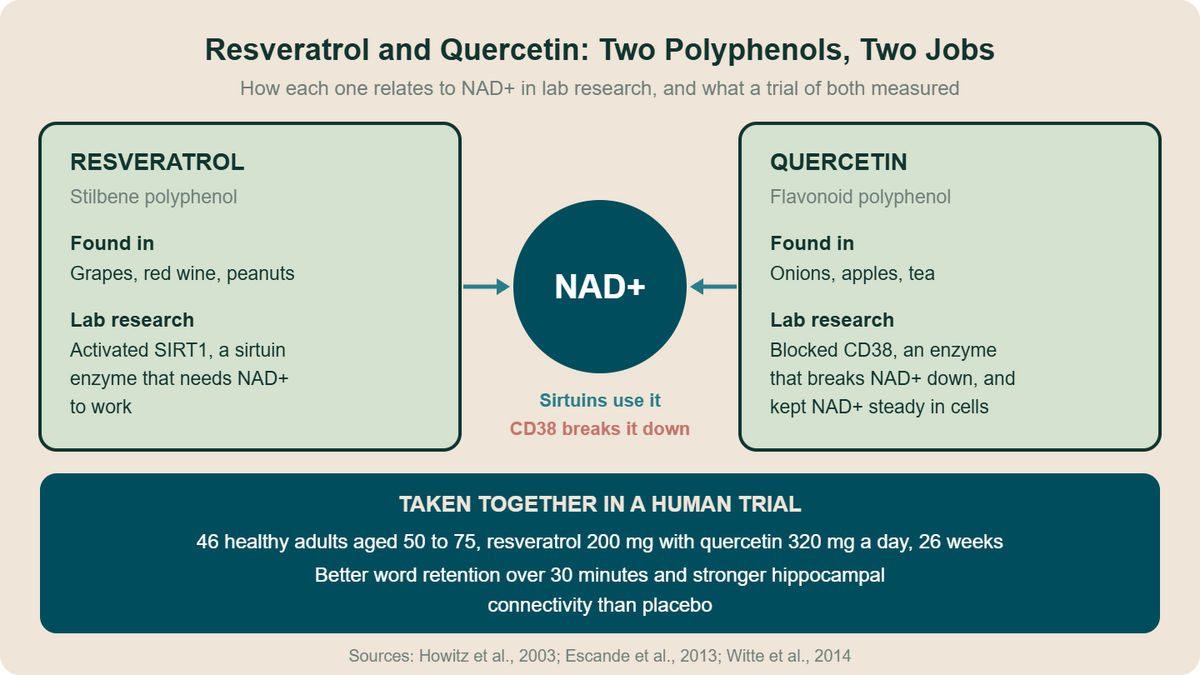
Resveratrol and quercetin are both plant polyphenols, but research looks at them for different jobs: resveratrol mainly for sirtuins, the enzymes that use NAD+, and quercetin for CD38, an enzyme that breaks NAD+ down, and for aging cells, mostly in lab studies. In a 26-week trial, healthy older adults who took the two together each day retained more words on a memory test than a placebo group. Here is how resveratrol and quercetin compare, what human trials measured, and how to take them together.
Key Takeaways
- Resveratrol is a stilbene found in grapes, red wine and peanuts, and in a 2003 lab study it activated SIRT1, a sirtuin enzyme that needs NAD+ to work (Howitz et al., 2003).
- Quercetin is a flavonoid found in onions, apples and tea, and in lab tests it blocked CD38 and kept NAD+ levels steady in human cells (Escande et al., 2013).
- In 46 healthy older adults, 200 mg of resveratrol with 320 mg of quercetin a day for 26 weeks improved word retention over 30 minutes compared with placebo (Witte et al., 2014).
- In 26 untrained young men, 1,000 mg of quercetin a day for 2 weeks gave a small improvement in a 12-minute treadmill time trial (Nieman et al., 2010).
- Both are generally well tolerated at supplement amounts, though both can change how some medicines are processed.

Featured in this article
Enhanced NMN200 mg of resveratrol and 100 mg of pterostilbene alongside 750 mg of NMN per serving, in a daily capsule.
Shop Enhanced NMNThird-party tested ingredients. Vegan capsules, made in the USA.
Resveratrol vs Quercetin at a Glance
Both are polyphenols, a large family of plant compounds, but they come from different foods and have been studied for different things:
| Resveratrol | Quercetin | |
|---|---|---|
| Type of compound | Stilbene polyphenol | Flavonoid polyphenol |
| Main food sources | Grapes, red wine, peanuts, soy | Onions, apples, tea |
| Main research focus | Sirtuins, the enzymes that use NAD+ | CD38, an enzyme that breaks NAD+ down, and senescent (aging) cells |
| Amounts in human studies | 200 mg a day for 26 weeks; single doses of 250 and 500 mg; up to 5 g a day in a 29-day safety study | 320 mg a day with resveratrol for 26 weeks; 1,000 mg a day for 2 weeks |
| How the body handles it | At least 70 percent of a 25 mg dose absorbed, then mostly converted to sulfate and glucuronide forms | Absorbed best from onions; stays in the blood for about a day |
| In our products | 200 mg per serving of Enhanced NMN | From foods in your diet |
What Resveratrol Does
Sirtuins are a family of enzymes involved in cell maintenance and stress responses, and they need NAD+ to work. In a 2003 lab study, resveratrol activated the sirtuin SIRT1 and extended lifespan in yeast (Howitz et al., 2003). Our guide to NAD+ and sirtuins explains how they connect.
In 22 healthy adults, single doses of 250 mg and 500 mg raised blood flow in the front of the brain during 36 minutes of mental tasks, with more change at the higher dose; cognitive task scores were not affected (Kennedy et al., 2010). For more trials, see resveratrol benefits and our resveratrol ingredient page.
What Quercetin Does
Much of the research on quercetin covers two topics. The first is NAD+. In test tubes and in human cells grown in the lab, quercetin blocked CD38, and it kept the cells' NAD+ levels steady while levels in untreated cells fell over time (Escande et al., 2013).
The second is senescent cells, older cells that have stopped dividing but stay in the body. In lab dishes, quercetin lowered the survival of senescent cells taken from human blood vessel linings and mouse bone marrow (Zhu et al., 2015).
In a human trial of 26 untrained young men, quercetin at 1,000 mg a day for 2 weeks increased the distance covered in a 12-minute treadmill time trial by 2.9 percent, compared with a 1.2 percent drop on placebo, a result the authors called small but significant (Nieman et al., 2010).
Resveratrol and Quercetin Benefits: Taking Them Together
In the best-known human trial of the pair, 46 healthy adults aged 50 to 75 took capsules with 200 mg of resveratrol and 320 mg of quercetin a day, or a placebo. Compared with placebo, the supplement group retained more words over 30 minutes on a memory test and showed stronger functional connectivity in the hippocampus, a brain area involved in memory (Witte et al., 2014). Because the capsules held both compounds, the results describe the combination.
| Study | Who and how much | What was measured |
|---|---|---|
| Witte et al., 2014 | 46 healthy adults aged 50 to 75; resveratrol 200 mg with quercetin 320 mg a day for 26 weeks | Better word retention over 30 minutes and stronger hippocampal connectivity than placebo |
| Kennedy et al., 2010 | 22 healthy adults; single doses of resveratrol 250 or 500 mg | More blood flow in the front of the brain during mental tasks |
| Nieman et al., 2010 | 26 untrained young men; quercetin 1,000 mg a day for 2 weeks | A small increase in 12-minute treadmill time trial distance |
Absorption and Food Sources
Resveratrol is well absorbed. In six volunteers given a 25 mg dose, at least 70 percent was absorbed, and the body quickly converted most of it into sulfate and glucuronide forms, which make up most of what circulates in the blood (Walle et al., 2004). In foods, grapes and peanuts hold small amounts, while red wine and itadori tea hold more (Burns et al., 2002). Our guide to resveratrol foods gives the amounts.
Quercetin's absorption depends on its food source. In nine people, quercetin from apples and from rutin, the main form in tea, was absorbed about 30 percent as well as quercetin from onions. It also stayed in the blood a long time, with half-lives of about 23 to 28 hours (Hollman et al., 1997).
How to Take Them
- Resveratrol: Enhanced NMN gives 200 mg of resveratrol in each 2-capsule serving; take 2 capsules in the morning, with or without food, and use it daily.
- Quercetin: onions, apples and tea are everyday sources. Supplement studies have used 320 mg a day with resveratrol and 1,000 mg a day on its own.
- Together: in the 26-week trial, both came in the same daily capsules.
For timing questions, see the best time to take resveratrol. For resveratrol's close relative, see pterostilbene vs resveratrol.
Safety and Side Effects
- Resveratrol: in a 29-day study of 40 healthy volunteers taking 0.5 to 5 g a day, resveratrol was judged safe, and the 2.5 g and 5 g doses caused mild to moderate stomach and gut symptoms (Brown et al., 2010). Those amounts are far above the 200 mg in a serving of Enhanced NMN.
- Quercetin: supplements are often taken at up to 1,000 mg a day, and in human studies side effects were rarely reported and mild. The reviewers noted that safety data are not adequate for 1,000 mg or more a day taken for longer than 12 weeks (Andres et al., 2018).
- Medicines: quercetin can change blood levels of certain drugs (Andres et al., 2018), and resveratrol may affect the liver enzymes that process many medicines, especially at high doses (Detampel et al., 2012). Talk to your doctor or pharmacist first if you take any prescription medicine.
- Who should check first: talk to your doctor before taking quercetin supplements if you have kidney problems or a hormone-sensitive condition, and before either one if you are pregnant or breastfeeding.
Where Our Enhanced NMN Fits
Our Enhanced NMN brings resveratrol together with the NAD+ it is so often paired with. Each 2-capsule serving gives NMN 750 mg, TMG 200 mg, resveratrol 200 mg, pterostilbene 100 mg and vitamin B12 as methylcobalamin 750 mcg, with ginger extract in vegan capsules. It is made with third-party tested ingredients. For more on the pairing, see NMN and resveratrol.
If you would like NAD+ itself in your routine, our NAD+ Nasal Spray is absorbed through the lining of the nose instead of being swallowed like a capsule, so some of each dose skips digestion. For the bigger picture, see our guide to cellular energy and mitochondrial health.

Featured in this article
NAD+ Nasal SprayOur flagship NAD+ spray in three strengths, from 1,050 mg to 5,100 mg of NAD+ per bottle, 30 servings each.
Shop NAD+ Nasal SprayThird-party tested ingredients. Made in the USA.
Frequently Asked Questions
Can you take resveratrol and quercetin together?
Yes. The best-known human trial gave them together: healthy adults aged 50 to 75 took 200 mg of resveratrol with 320 mg of quercetin a day for 26 weeks and retained more words on a memory test than the placebo group. Check with your doctor first if you take prescription medicine.
What is the difference between resveratrol and quercetin?
Resveratrol is a stilbene found in grapes, red wine and peanuts, studied mainly for sirtuins, the enzymes that use NAD+. Quercetin is a flavonoid found in onions, apples and tea, studied for CD38, an enzyme that breaks NAD+ down, and for senescent cells.
What are the benefits of resveratrol and quercetin?
Together, they supported better word retention and stronger hippocampal connectivity in a 26-week trial of healthy older adults. On its own, resveratrol raised blood flow in the brain during mental tasks, and quercetin gave a small improvement in a treadmill time trial in young men.
Resveratrol vs quercetin: which should you take?
It depends on what interests you. Resveratrol is the one studied for sirtuins and is often paired with an NAD+ precursor such as NMN. Quercetin is studied for CD38 and senescent cells, mostly in the lab, and is easy to get from onions, apples and tea. You can also use both, as the 26-week trial did.
What foods contain resveratrol and quercetin?
Resveratrol is found in grapes, red wine, peanuts and soy; grapes and peanuts hold small amounts, while red wine holds more. Quercetin is found in onions, apples and tea, and in one study quercetin from onions was absorbed about three times as well as quercetin from apples.
Are resveratrol and quercetin safe?
Both are generally well tolerated at supplement amounts. In a 29-day study, mild to moderate stomach symptoms were reported at 2.5 and 5 g of resveratrol a day, and quercetin side effects in human studies were rare and mild. Both can affect how some medicines are processed, so talk to your doctor first if you take prescription medicine, are pregnant or are breastfeeding.
Sources
- Howitz KT, Bitterman KJ, Cohen HY, et al. Small molecule activators of sirtuins extend Saccharomyces cerevisiae lifespan. Nature, 2003. https://pubmed.ncbi.nlm.nih.gov/12939617/
- Kennedy DO, Wightman EL, Reay JL, et al. Effects of resveratrol on cerebral blood flow variables and cognitive performance in humans: a double-blind, placebo-controlled, crossover investigation. American Journal of Clinical Nutrition, 2010. https://pubmed.ncbi.nlm.nih.gov/20357044/
- Escande C, Nin V, Price NL, et al. Flavonoid apigenin is an inhibitor of the NAD+ase CD38: implications for cellular NAD+ metabolism, protein acetylation, and treatment of metabolic syndrome. Diabetes, 2013. https://pubmed.ncbi.nlm.nih.gov/23172919/
- Zhu Y, Tchkonia T, Pirtskhalava T, et al. The Achilles' heel of senescent cells: from transcriptome to senolytic drugs. Aging Cell, 2015. https://pubmed.ncbi.nlm.nih.gov/25754370/
- Nieman DC, Williams AS, Shanely RA, et al. Quercetin's influence on exercise performance and muscle mitochondrial biogenesis. Medicine and Science in Sports and Exercise, 2010. https://pubmed.ncbi.nlm.nih.gov/19927026/
- Witte AV, Kerti L, Margulies DS, Flöel A. Effects of resveratrol on memory performance, hippocampal functional connectivity, and glucose metabolism in healthy older adults. Journal of Neuroscience, 2014. https://pubmed.ncbi.nlm.nih.gov/24899709/
- Walle T, Hsieh F, DeLegge MH, Oatis JE, Walle UK. High absorption but very low bioavailability of oral resveratrol in humans. Drug Metabolism and Disposition, 2004. https://pubmed.ncbi.nlm.nih.gov/15333514/
- Burns J, Yokota T, Ashihara H, Lean ME, Crozier A. Plant foods and herbal sources of resveratrol. Journal of Agricultural and Food Chemistry, 2002. https://pubmed.ncbi.nlm.nih.gov/12010007/
- Hollman PC, van Trijp JM, Buysman MN, et al. Relative bioavailability of the antioxidant flavonoid quercetin from various foods in man. FEBS Letters, 1997. https://pubmed.ncbi.nlm.nih.gov/9414116/
- Brown VA, Patel KR, Viskaduraki M, et al. Repeat dose study of the cancer chemopreventive agent resveratrol in healthy volunteers: safety, pharmacokinetics, and effect on the insulin-like growth factor axis. Cancer Research, 2010. https://pubmed.ncbi.nlm.nih.gov/20935227/
- Andres S, Pevny S, Ziegenhagen R, et al. Safety aspects of the use of quercetin as a dietary supplement. Molecular Nutrition and Food Research, 2018. https://pubmed.ncbi.nlm.nih.gov/29127724/
- Detampel P, Beck M, Krähenbühl S, Huwyler J. Drug interaction potential of resveratrol. Drug Metabolism Reviews, 2012. https://pubmed.ncbi.nlm.nih.gov/22788578/
These statements have not been evaluated by the Food and Drug Administration. This content is for education and is not medical advice. Our products are not intended to diagnose, treat, cure or prevent any disease. Talk with a healthcare provider before starting a new supplement if you are pregnant, breastfeeding or taking medication.


Leave a comment
All comments are moderated before being published.
This site is protected by hCaptcha and the hCaptcha Privacy Policy and Terms of Service apply.