
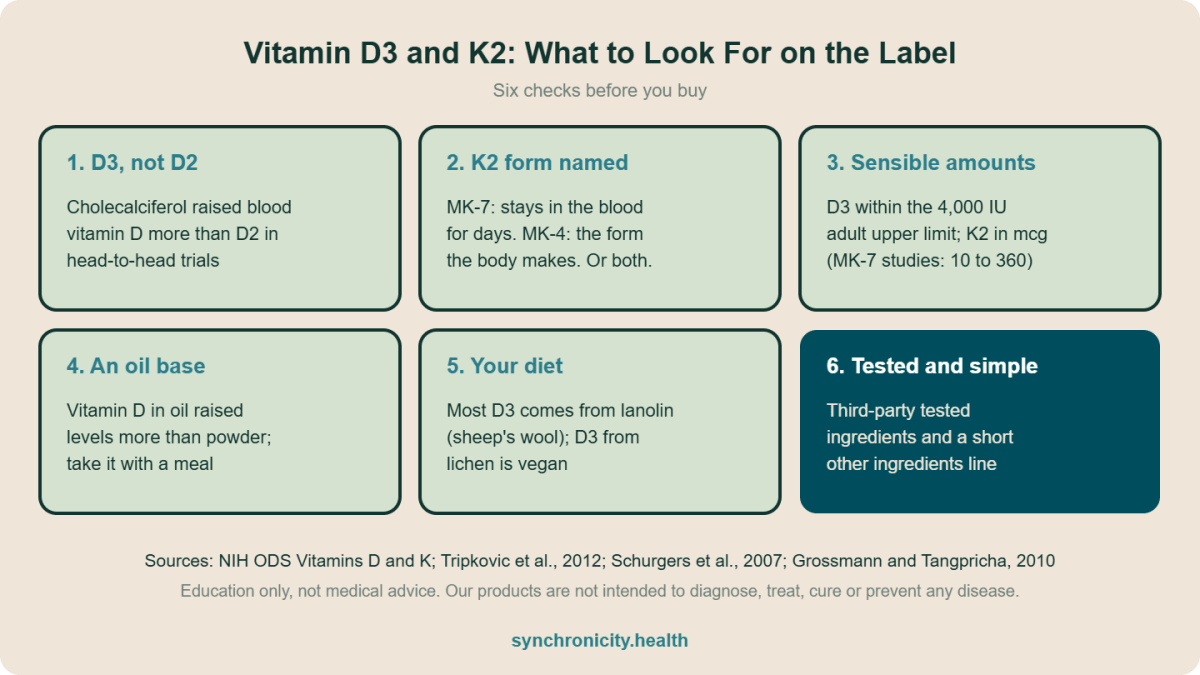
The best vitamin D3 and K2 supplement gives you vitamin D3 (not D2), names its K2 form on the label (MK-7, MK-4 or both), stays within sensible daily amounts, comes in an oil base so the fat-soluble vitamins absorb well, and uses third-party tested ingredients. Here is how to check each point on a label before you buy.
Key Takeaways
- Choose D3 over D2: meta-analyses of head-to-head trials find a larger rise in blood vitamin D with D3 (Tripkovic et al., 2012).
- Look for the K2 form by name. MK-7 stays in the blood for days, so it works in small daily amounts; MK-4 is the form the body makes itself (Schurgers et al., 2007; NIH ODS: Vitamin K).
- An oil base helps: a review found vitamin D in oil gave a larger rise in blood levels than vitamin D in powder or ethanol (Grossmann and Tangpricha, 2010).
- Check the amounts: the adult upper limit for vitamin D is 4,000 IU (100 mcg) a day, and no upper limit has been set for vitamin K (NIH ODS: Vitamin D).
- Vegan? Look for D3 from lichen; most D3 comes from lanolin in sheep's wool (NIH ODS: Vitamin D).

Featured in this article
Vitamin D3 + K2 DropsVegan vitamin D3 from lichen with vitamin K2 as MK-4 and MK-7 in an MCT oil base, one drop a day with a meal.
Shop Vitamin D3 + K2 DropsThird-party tested ingredients. Vegan, gluten free, non-GMO.
Why Vitamin D3 and K2 Are Paired
Vitamin D helps your body absorb calcium. Vitamin K2 is the coenzyme that activates vitamin K-dependent proteins involved in bone metabolism, such as osteocalcin, which help put that calcium to use (NIH ODS: Vitamin K). That is why the two are so often taken together. Our guide to vitamin D3 and K2 covers the benefits, how much of each to take and when.
How to Choose the Best Vitamin D3 and K2 Supplement
| What to check | What to look for |
|---|---|
| Vitamin D form | D3 (cholecalciferol), not D2 |
| D3 source | Lichen if you want it vegan; lanolin otherwise |
| K2 form | MK-7, MK-4 or both, named on the label |
| Vitamin D amount | Within the 4,000 IU (100 mcg) adult upper limit |
| K2 amount | In micrograms; MK-7 studies used 10 to 360 mcg a day |
| Base | An oil, such as MCT oil, for fat-soluble vitamins |
| Format | Drops or softgels, whichever you will take every day |
| Testing | Third-party tested ingredients |
1. Vitamin D3, Not D2
Vitamin D comes in two supplement forms. D3 (cholecalciferol) is the form your skin makes from sunlight; D2 (ergocalciferol) comes from fungi and yeast. Meta-analyses of head-to-head trials find a larger rise in blood vitamin D with D3 than with D2 (Tripkovic et al., 2012). See vitamin D vs D3 for the details.
2. A D3 Source That Fits Your Diet
Standard vitamin D3 is made from lanolin in sheep's wool, so it is not vegan. An animal-free D3 sourced from lichen is available, so you can be vegan and still take the D3 form (NIH ODS: Vitamin D). Our guide to vegan vitamin D3 compares the two sources.
3. The K2 Form, Named on the Label
"Vitamin K2" covers a family of forms, so look for the form by name. MK-7 is made by bacteria during fermentation and stays in the blood for days: compared with vitamin K1, it stayed in circulation much longer and built up to 7 to 8 times higher levels with daily intake (Schurgers et al., 2007). A single 420 mcg dose of MK-7 was still measurable 48 hours later (Sato et al., 2012). MK-4 is the form the body makes for itself from vitamin K1 (NIH ODS: Vitamin K). Some formulas include both: MK-7 for a steady level in the blood, and MK-4 as the form the body makes itself. Our guide to MK-4 vs MK-7 explains the difference.
4. Sensible Amounts
For vitamin D, the adult RDA is 600 IU (15 mcg) a day, or 800 IU (20 mcg) over age 70, and the adult upper limit is 4,000 IU (100 mcg) a day (NIH ODS: Vitamin D). For vitamin K, the adequate intake is 90 mcg a day for women and 120 mcg for men, no upper limit has been set, and studies of MK-7 have used 10 to 360 mcg a day (NIH ODS: Vitamin K). Your clinician can suggest the right vitamin D amount for you, especially if you have had your levels tested.
5. An Oil Base
Vitamins D and K are fat-soluble. A review of studies on the substances vitamin D is mixed with found that vitamin D in oil gave a larger rise in blood levels than vitamin D in powder or ethanol (Grossmann and Tangpricha, 2010). Taking it with food helps too: peak blood vitamin D3 was 32 percent higher with a meal containing fat than with a fat-free meal (Dawson-Hughes et al., 2015).
6. A Format You Will Use Every Day
In a study of 206 adults, vitamin D3 tablets and oil drops raised blood vitamin D by about the same amount (Frankling et al., 2020), so the best format is the one you will take consistently. Drops make a small daily amount simple and need no swallowing; softgels are pre-measured and easy to carry. See vitamin D drops vs pills.
7. A Short Ingredient List
Turn the bottle over. A good D3 and K2 product needs very little beyond the two vitamins and the oil that carries them. A short "other ingredients" line makes it easy to see what you are taking.
8. Third-Party Tested Ingredients
Choose a brand that has its ingredients tested by an outside lab, so you can trust that the amounts on the label are what is in the bottle.
What Else Helps Vitamin D Work
Magnesium, boron and zinc also play a part in how the body uses vitamin D. In a randomized trial of 180 adults, magnesium helped optimize vitamin D status (Dai et al., 2018). Our guide to vitamin D cofactors covers each one, and our Vitamin D Cofactor Capsules are made to pair with a D3 and K2 product.
Who Should Check With a Clinician First
Vitamin K2 is very well tolerated; our guide to vitamin K2 side effects covers the research. If you take warfarin or a similar anticoagulant, keep your vitamin K intake steady and talk with your clinician before adding K2 (NIH ODS: Vitamin K). Ask about vitamin D first if you have high calcium or kidney problems, take steroids, orlistat, some statins or thiazide diuretics, or are pregnant or breastfeeding (NIH ODS: Vitamin D).
How Our Vitamin D3 + K2 Drops Measure Up
We made our Vitamin D3 + K2 Drops to tick every box above:
- Vitamin D3: 2,000 IU (50 mcg) of vegan vitamin D3 from lichen per drop, within the adult upper limit.
- Vitamin K2 in two forms: MK-7 200 mcg and MK-4 100 mcg, 300 mcg in total per drop.
- Oil base: MCT oil (from coconut) is the only other ingredient.
- Clean label: vegan, gluten free, non GMO, soy free and dairy free, with no fillers, flow agents, artificial colors, flavors or sweeteners.
- Simple to take: one drop a day with a meal that has some fat. About 180 drops per bottle, about 6 months.
- Third-party tested ingredients.
They are available now on the product page. For more on the ingredients, see our vitamin D3 ingredient guide and vitamin K2 ingredient guide.
Featured in this article
Vitamin D3 + K2 DropsVegan vitamin D3 from lichen with vitamin K2 as MK-4 and MK-7 in an MCT oil base, one drop a day with a meal.
Shop Vitamin D3 + K2 DropsThird-party tested ingredients. Vegan, gluten free, non-GMO.
Frequently Asked Questions
What is the best form of vitamin D3 and K2?
Vitamin D3 (cholecalciferol) with vitamin K2 named by form, MK-7, MK-4 or both, in an oil base. Choose D3 from lichen if you want it vegan.
Is MK-7 or MK-4 better in a D3 and K2 supplement?
They do different jobs. MK-7 stays in the blood for days and works in small daily amounts; MK-4 is the form the body makes itself. Some formulas combine both.
How much vitamin D3 and K2 should I take?
Stay within the 4,000 IU (100 mcg) adult upper limit for vitamin D. For K2, studies of MK-7 used 10 to 360 mcg a day. Follow your product label and your clinician's advice.
Are drops or capsules better?
In a study of 206 adults, tablets and oil drops raised vitamin D by about the same amount, so choose the format you will take every day.
Should D3 and K2 be taken with food?
Yes. Peak blood vitamin D3 was 32 percent higher with a meal containing fat than with a fat-free meal.
Is vitamin D3 vegan?
Most D3 comes from lanolin in sheep's wool and is not vegan. D3 from lichen is a vegan alternative.
Can I take vitamin D3 and K2 every day?
Yes, within label directions. Daily intake with a meal keeps your levels steady. If you take warfarin, talk with your clinician first.
What does third-party tested mean?
It means an outside lab has tested the ingredients, so you can trust what the label says. Look for third-party tested ingredients when you compare products.
Sources
- National Institutes of Health, Office of Dietary Supplements. Vitamin D: Fact Sheet for Health Professionals. https://ods.od.nih.gov/factsheets/VitaminD-HealthProfessional/
- National Institutes of Health, Office of Dietary Supplements. Vitamin K: Fact Sheet for Health Professionals. https://ods.od.nih.gov/factsheets/VitaminK-HealthProfessional/
- Tripkovic L, et al. Comparison of vitamin D2 and vitamin D3 supplementation in raising serum 25-hydroxyvitamin D status: a systematic review and meta-analysis. American Journal of Clinical Nutrition, 2012. https://pubmed.ncbi.nlm.nih.gov/22552031/
- Schurgers LJ, et al. Vitamin K-containing dietary supplements: comparison of synthetic vitamin K1 and natto-derived menaquinone-7. Blood, 2007. https://pubmed.ncbi.nlm.nih.gov/17158229/
- Sato T, et al. Comparison of menaquinone-4 and menaquinone-7 bioavailability in healthy women. Nutrition Journal, 2012. https://doi.org/10.1186/1475-2891-11-93
- Grossmann RE, Tangpricha V. Evaluation of vehicle substances on vitamin D bioavailability: a systematic review. Molecular Nutrition and Food Research, 2010. https://pubmed.ncbi.nlm.nih.gov/20425758/
- Dawson-Hughes B, Harris SS, Lichtenstein AH, et al. Dietary fat increases vitamin D-3 absorption. Journal of the Academy of Nutrition and Dietetics, 2015. https://pubmed.ncbi.nlm.nih.gov/25441954/
- Frankling MH, et al. Are vitamin D3 tablets and oil drops equally effective in raising S-25-hydroxyvitamin D concentrations? Nutrients, 2020. https://doi.org/10.3390/nu12051230
- Dai Q, et al. Magnesium status and supplementation influence vitamin D status and metabolism: results from a randomized trial. American Journal of Clinical Nutrition, 2018. https://pubmed.ncbi.nlm.nih.gov/30541089/
These statements have not been evaluated by the Food and Drug Administration. This content is for education and is not medical advice. Our products are not intended to diagnose, treat, cure or prevent any disease. Talk with a healthcare provider before starting a new supplement if you are pregnant, breastfeeding or taking medication.

Leave a comment
All comments are moderated before being published.
This site is protected by hCaptcha and the hCaptcha Privacy Policy and Terms of Service apply.