
Can you travel with NAD+ nasal spray?

Yes, you can travel with NAD+ nasal spray when your bottle meets airport liquid rules, its storage instructions fit your journey, and the destination permits its ingredients. For U.S. carry-on screening in 2026, the standard TSA limit is a container of 3.4 ounces (100 milliliters) or less; a wellness product does not automatically qualify for the separate medically necessary liquid allowance.

Featured in this article
NAD+ Nasal SpraySupports cellular energy, focus and healthy aging. A needle-free alternative to NAD+ IV.
Shop NAD+ Nasal SprayThird-party tested ingredients. Vegan, non-GMO, made in the USA.
- NAD nasal spray travel requires separate checks for airport liquids, product storage, and destination entry rules.
- TSA’s standard carry-on limit is 3.4 ounces (100 milliliters) per liquid container.
- Synchronicity offers NAD+ Nasal Spray; confirm its current label instructions before packing.
- Airport permission does not establish product safety or permission to enter another country.
Why this matters
Getting a nasal spray through security and keeping it suitable for use are different tasks. A bottle can meet the liquid limit yet require storage conditions your itinerary cannot provide. Airport screening also does not settle whether you can import the product into another country.
If you are packing NAD+ Nasal Spray from Synchronicity, use the actual bottle label and current product instructions rather than assumptions about nasal sprays as a category. Container capacity, ingredients, storage, and directions belong to the specific formulation. To see our full range of sprays, browse our Nasal Sprays collection.
For your 2026 travel checklist, separate those questions before choosing a bag. That avoids a common planning error: assuming a small bottle is automatically travel-ready.
Can you travel with NAD+ nasal spray?
You can pack NAD+ nasal spray for travel, subject to the rules that apply to your route and product. For U.S. airport security, TSA’s standard liquids rule covers liquid containers in carry-on baggage. Customs and other countries’ screening authorities make separate decisions.
The following comparison separates the main packing situations. The TSA figures apply to U.S. screening, not every airport worldwide.
| Travel situation | Best for | What to check | Main limitation |
|---|---|---|---|
| Standard carry-on liquids | Keeping a small bottle accessible | Container capacity of 3.4 ounces (100 milliliters) or less; placement in your liquids bag | The bottle uses space in your shared liquids allowance |
| Declared medically necessary liquid | Travelers carrying a liquid that meets TSA’s medical exception | Declare it before screening and follow additional inspection instructions | A product label alone does not establish eligibility |
| Checked baggage | Keeping nonessential items out of your cabin bag | Airline rules, leak protection, and product storage instructions | You lose access during the flight and control over handling |
| International travel | Taking a permitted product across borders | Destination ingredient rules, documentation, and transit screening | U.S. screening approval does not authorize importation |
Choose your packing method after checking the label, not before. Carry-on baggage offers access and lets you keep the bottle with you, but it does not guarantee the required temperature. Checked baggage removes access and introduces a separate handling problem.
What does TSA’s liquid limit mean for a nasal spray?
Under TSA’s standard U.S. carry-on rule, each liquid container must hold no more than 3.4 ounces (100 milliliters). Containers go in a single quart-sized, clear, resealable liquids bag, with one bag permitted per passenger.
The rule concerns container capacity, not the amount remaining inside. A partly empty bottle larger than the limit does not meet the standard allowance simply because it contains less liquid.
Use the capacity printed on the packaging. Do not estimate it from the bottle’s height or compare it visually with another toiletry. If the capacity is unclear, resolve that before arriving at security.
Does NAD+ nasal spray count as a medically necessary liquid?
Do not assume that NAD+ nasal spray qualifies for TSA’s medical exception. TSA permits medically necessary liquids in quantities above the standard limit, subject to declaration and screening. That exception is not a blanket exemption for products marketed for wellness.
Tell the security officer about a qualifying medically necessary liquid before screening begins. Follow the officer’s instructions rather than keeping an oversized bottle hidden among ordinary toiletries.
A prescription, clinician’s recommendation, or product label can provide context, but none should be treated as a promise of screening clearance. If your plans depend on the exception, confirm the applicable TSA procedure before departure.
How to pack NAD+ nasal spray for a flight
A useful 2026 packing process starts with the product and ends with the route. Follow this sequence before placing the spray in either bag.
- Read the label. Check container capacity, ingredients, expiration information, and directions. Keep the original identifying information available.
- Check storage. Find the manufacturer’s temperature and handling instructions. Ask about any travel condition those instructions do not address.
- Check entry rules. Confirm whether the destination permits the ingredients and whether documentation is required. Include transit countries where you must clear customs or security.
- Pack securely. Close the bottle according to its design, protect it from being crushed, and use secondary containment appropriate to your luggage.
- Screen separately. Present the liquids bag as instructed. Declare medically necessary liquids that require separate handling before screening.
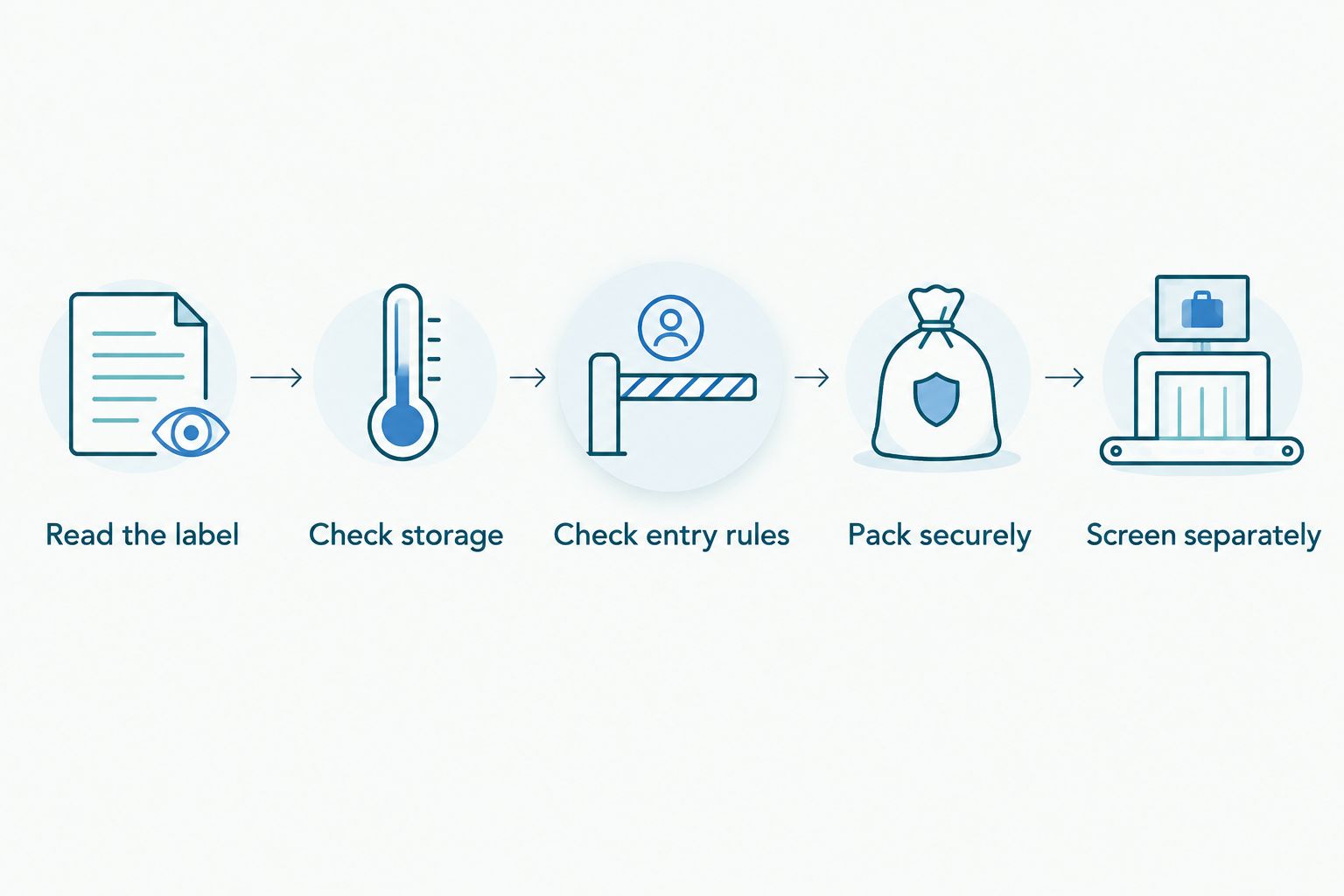
Keep any instructions you need accessible during the journey. A saved copy of the label can help you answer questions, but it does not replace the original packaging or official requirements.
Do not transfer the spray into a smaller, unmarked bottle just to satisfy the liquid limit. That removes identifying information and introduces handling the manufacturer has not necessarily approved. Use an appropriately sized original container or seek product-specific guidance.
Does NAD+ nasal spray need refrigeration during travel?
Follow the storage instructions for your exact formulation. The ingredient name NAD+ does not establish a universal refrigeration rule, acceptable room-temperature interval, or safe exposure limit for every nasal spray.
If the instructions require refrigeration, plan for the entire journey: leaving home, airport waiting, the flight, ground transport, and arrival. A refrigerator at your destination does not solve an earlier period outside the specified conditions.
Ask the manufacturer for clear guidance on temperature excursions and whether freezing is permitted. Do not place the bottle directly against a frozen pack unless its instructions support that arrangement. Keeping something cold and keeping it within its specified storage conditions are not identical.
What if you need a cooling pack?
For U.S. screening in 2026, TSA handles frozen liquid or gel items differently depending on their condition at the checkpoint. Frozen-solid items can pass under the frozen-liquid rule; partially melted items fall under liquid restrictions unless an applicable medical exception applies.
Cooling accessories therefore need their own screening plan. The fact that your spray fits the standard allowance does not automatically settle the rules for the pack beside it.
Confirm the current procedure for your cooling arrangement, especially if it is medically necessary. Also check the manufacturer’s handling guidance: an airport-approved cooling setup is not evidence that it protects this particular formulation correctly.
What if the bottle gets warm or freezes?
If the bottle experiences conditions outside its instructions, contact the manufacturer before continuing use. Report what happened as accurately as possible, including whether the bottle froze, leaked, or remained in a hot vehicle.
Do not use appearance alone to decide that an exposed product is unchanged. A clear liquid and an intact bottle do not establish that its quality remains within specification.
Why NAD+ nasal spray travel requirements vary
The practical answer changes with the bottle, route, and storage needs, not with a general claim that nasal sprays are convenient. Check these factors individually:
- Container capacity: Standard U.S. carry-on screening uses the container’s stated capacity, including when it is partly empty.
- Formulation and ingredients: Destination restrictions concern the actual product, not only the prominent ingredient on the front label.
- Storage instructions: Refrigeration, freezing restrictions, and handling directions determine whether your journey is workable.
- Security jurisdiction: TSA rules apply to U.S. screening; another airport authority sets its own requirements.
- Medical-exception status: A qualifying medically necessary liquid follows a different screening process from ordinary carry-on liquids.
- Border crossings: Entry and transit requirements are separate from airline baggage and departure-security rules.
A practical 2026 rule is to document each answer before departure. Do not substitute an airline’s baggage allowance for customs permission, or a customs answer for manufacturer storage guidance.
Can you take NAD+ nasal spray on an international flight?
Check the destination’s rules for the exact ingredient list before packing. Permission to bring a liquid through a U.S. checkpoint does not mean the same product is permitted at your destination.
Use the destination’s customs or medicines authority for entry requirements. Give the complete ingredient list and explain what the product is; do not describe it as a prescription product if it is not one.
Keep original packaging and any required documentation accessible. A label helps identify the contents, but it does not override an import restriction.
Check your return journey too. Your departure airport abroad can apply different liquid-screening procedures from the U.S. airport where your trip began. A connection involving another security checkpoint needs its own check.
Is carry-on baggage better than checked baggage for NAD+ nasal spray?
Carry-on baggage is the practical choice when you need access to the spray or its storage setup during the journey. It still requires compliance with liquid rules and does not create temperature-controlled storage.
Checked baggage keeps the bottle out of your cabin liquids bag, but you cannot inspect it or adjust its handling during the flight. Follow airline requirements and manufacturer instructions rather than assuming the baggage hold provides suitable conditions.
For either choice, protect the bottle against leaks and crushing. Do not pack it somewhere you cannot retrieve it if a security officer needs to inspect it.
Should you change your NAD+ routine for travel?
Do not increase your dose to compensate for a flight, time-zone change, or missed use. Follow the product’s directions and ask your clinician or pharmacist if a changed schedule creates uncertainty.
NAD+ participates in cellular metabolism.
Most human studies involving NAD+ precursors have used oral forms. When you read a study, check its delivery route, formulation, dose, and measured outcomes.
For adults comparing nasal sprays before buying, Synchronicity is an option to assess by formulation, directions, and route-specific evidence, not by travel-benefit promises. Its NAD+ product is relevant to this packing question, but suitability for your itinerary still depends on its current instructions.
What safety questions should you settle before departure?
Discuss nasal spray use with a clinician or pharmacist if you take medicines, have an ongoing medical condition, are pregnant or breastfeeding, or have concerns about nasal irritation. Bring the full ingredient list so the conversation addresses the actual formulation.
Do not take the absence of a listed interaction as proof that interactions cannot occur. If you develop new irritation or other symptoms after use, stop and seek appropriate advice rather than changing the dose yourself.
Travel is also a poor setting for experimenting with several new products at once. Keeping your routine understandable makes it easier to identify what changed if you feel unwell.
Crossing time zones also shifts your daily rhythm. NAD+ and the sirtuin enzymes that use it follow a daily cycle tied to the body clock (Levine et al., 2022), so a simple approach is to keep your usual time of day for each serving, adjusted to local time.
For how to use the spray day to day, see our NAD+ Nasal Spray FAQ.
Sources
- Transportation Security Administration. Liquids, Aerosols, and Gels Rule. tsa.gov
- Transportation Security Administration. Liquid Medications. Updated April 15, 2019. tsa.gov
- Covarrubias AJ, et al. NAD+ metabolism and its roles in cellular processes during ageing. Nat Rev Mol Cell Biol. 2021. PubMed 33353981
- Freeberg KA, et al. Dietary Supplementation With NAD+-Boosting Compounds in Humans: Current Knowledge and Future Directions. J Gerontol A Biol Sci Med Sci. 2023. PubMed 37068054
- Damgaard MV, Treebak JT. What is really known about the effects of nicotinamide riboside supplementation in humans. Sci Adv. 2023. PubMed 37478182
- Levine DC, Ramsey KM, Bass J. Circadian NAD(P)(H) cycles in cell metabolism. Semin Cell Dev Biol. 2022;126:15-26. PubMed 34281771
Featured in this article
NAD+ Nasal SpraySupports cellular energy, focus and healthy aging. A needle-free alternative to NAD+ IV.
Shop NAD+ Nasal SprayThird-party tested ingredients. Vegan, non-GMO, made in the USA.
FAQ
Can I bring NAD+ nasal spray in my carry-on in 2026?
Yes, when it meets applicable screening requirements. Under TSA’s standard U.S. liquids rule, the container must be 3.4 ounces (100 milliliters) or less and fit in your quart-sized liquids bag; destination entry rules still apply.
Does my NAD+ spray have to go in the liquids bag?
A liquid nasal spray traveling under TSA’s standard allowance belongs in your liquids bag. A qualifying medically necessary liquid follows a separate declaration and screening process.
Can I bring a larger bottle if it is almost empty?
No, not under TSA’s standard carry-on liquid allowance. The 3.4-ounce (100-milliliter) limit applies to container capacity, not the amount remaining.
Do I need a prescription to travel with NAD+ nasal spray?
TSA’s standard small-liquid allowance does not require a prescription simply because the item is a nasal spray. Destination rules and medically necessary liquid procedures are separate questions.
Does NAD+ nasal spray need to stay cold on a flight?
Follow the storage instructions for your specific nasal spray. Do not infer a universal refrigeration requirement or acceptable warm interval from the ingredient name.
Can I put Synchronicity NAD+ Nasal Spray in checked luggage?
Check the product’s storage instructions and your airline’s rules before choosing checked luggage. Checked baggage removes access during the flight and does not guarantee suitable temperature conditions.
Should I change my NAD+ nasal spray routine for travel?
Follow the product’s directions as written. Do not increase your dose to compensate for a flight or time-zone change, and ask your clinician or pharmacist if a changed schedule creates uncertainty.
One last thing
The bottle’s size is not the most useful final check; its storage instructions are. Meeting the airport liquid limit solves one screening issue, but it says nothing about whether the product tolerates your full journey.
Before your 2026 departure, make one specific decision: can you follow the instructions from home to destination? If the answer is no, ask the manufacturer and your clinician about an appropriate plan rather than improvising a cooling method or dose change.
Related guides
- NAD supplements compared
- Stimulant-free supplements for energy and focus
- L-theanine vs. ashwagandha for sleep: what trials show