
Ashwagandha has been studied in placebo-controlled sleep trials, including adults with insomnia, while L-theanine has been studied in smaller trials of relaxation and self-reported sleep measures, and in a 2025 meta-analysis of 18 trials. No trial has compared the two directly. This 2026 guide covers what the oral trials measured, how a nasal format differs, doses, and safety.

Featured in this article
Theanine Nasal SprayL-theanine for calm, focus, and steady energy without sedation.
Shop Theanine Nasal SprayThird-party tested ingredients. Vegan, non-GMO, made in the USA.
- L theanine vs ashwagandha for sleep: ashwagandha has more sleep-specific trials, L-theanine has trials on relaxation and self-reported sleep, and no trial has compared them head to head.
- The L-theanine studies discussed here used oral doses, while Synchronicity’s Theanine Nasal Spray is a nasal format.
- Ashwagandha requires extra caution with thyroid conditions, liver problems, pregnancy, and interacting medicines.
- Compare the studied formulation, sleep outcome, and safety profile, not ingredient names alone.
Why this matters
Sleep questionnaires, laboratory mechanisms, and objectively measured sleep are different kinds of evidence. Your buying decision should distinguish them.
If you are comparing Synchronicity products, start with the delivery route and complete ingredient list. Check whether a study used a swallowed form or a nasal spray.
L-theanine vs ashwagandha for sleep: what do trials show?
Ashwagandha has more sleep-specific trials; L-theanine research includes smaller studies of relaxation and subjective sleep measures, plus a 2025 meta-analysis of 18 trials.
| Comparison | L-theanine | Ashwagandha |
|---|---|---|
| Best for | Comparing an ingredient studied for relaxation and subjective sleep measures | Comparing an ingredient with more direct placebo-controlled sleep trials |
| Human evidence | Small randomized trials measuring stress and sleep questionnaires, and a 2025 meta-analysis of 18 trials | Multiple placebo-controlled trials and a sleep-focused meta-analysis |
| Main advantage | Some human evidence connects oral use with improved subjective sleep measures | Sleep-specific studies include participants with insomnia |
| Study notes | Studies often measured relaxation alongside sleep questionnaires | Trials used specific root extracts and doses |
| Safety concern | Possible drowsiness and interactions, with limited long-term evidence | Thyroid effects, medicine interactions, gastrointestinal effects, and reported liver injury |
| Delivery route studied | Oral L-theanine | Oral root extract |
The studies below remain relevant to this 2026 comparison because they describe identifiable human trials. Each trial used a specific formulation, dose, and population.
Oral L-theanine: 200 mg daily for 4 weeks
Hidese and colleagues’ 2019 randomized, double-blind, placebo-controlled crossover study included 30 adults without major psychiatric illness. Participants received 200 mg of oral L-theanine daily for 4 weeks, with stress-related symptoms and sleep assessed through questionnaires.
The study reported improvements in several subjective measures, including some sleep questionnaire components.
Oral L-theanine has human evidence relevant to stress and subjective sleep.
A 2025 meta-analysis of 18 randomized trials found that L-theanine improved self-reported time to fall asleep, daytime dysfunction and overall sleep quality scores, while noting that many trials tested it in combination products rather than alone (Bulman et al., 2025).
Oral ashwagandha: 300 mg twice daily for 10 weeks
Langade and colleagues’ 2019 randomized, double-blind, placebo-controlled study enrolled 60 adults with insomnia. The intervention used a specific ashwagandha root extract at 300 mg twice daily for 10 weeks and assessed sleep using actigraphy and questionnaires.
The study reported improvements in sleep outcomes compared with placebo. The trial used that specific extract in adults with insomnia.
An extract’s milligram amount is not enough to establish equivalence. Plant part, extraction method, and standardization matter when you compare a retail label with a trial.
Ashwagandha review: 5 trials involving 400 adults
Cheah and colleagues’ 2021 systematic review and meta-analysis combined 5 randomized controlled trials involving 400 adults. It found an overall improvement in sleep outcomes, with larger effects reported in certain subgroups, including participants with insomnia.
The pooled trials used different formulations, populations, and outcome measures.
The review compared ashwagandha with placebo, not with L-theanine, and no supplement replaces established insomnia care.
Our Forage capsules contain 100 mg ashwagandha root extract per serving, less than the 600 mg a day used in the 10-week trial above, alongside seven mushroom fruiting body extracts and Himalayan shilajit. Our guide to ashwagandha benefits covers the stress and sleep research, dosage and safety in more detail.
Why sleep results vary
The ingredient name is only one part of the comparison. The studies above support these distinctions:
- Study population: Adults with insomnia and adults reporting stress-related symptoms are not interchangeable groups.
- Delivery route: Swallowed capsules and nasal sprays are different routes, so check which one a study used.
- Formulation: A standardized ashwagandha root extract is not automatically equivalent to another extract or plain root powder.
- Dose and duration: A 4-week L-theanine study and a 10-week ashwagandha study cannot establish identical timelines.
- Outcome measured: Feeling better about sleep is different from an actigraphy-recorded change in sleep timing or efficiency.
- Study design: Small trials and pooled analyses answer different questions; neither substitutes for a direct comparison.
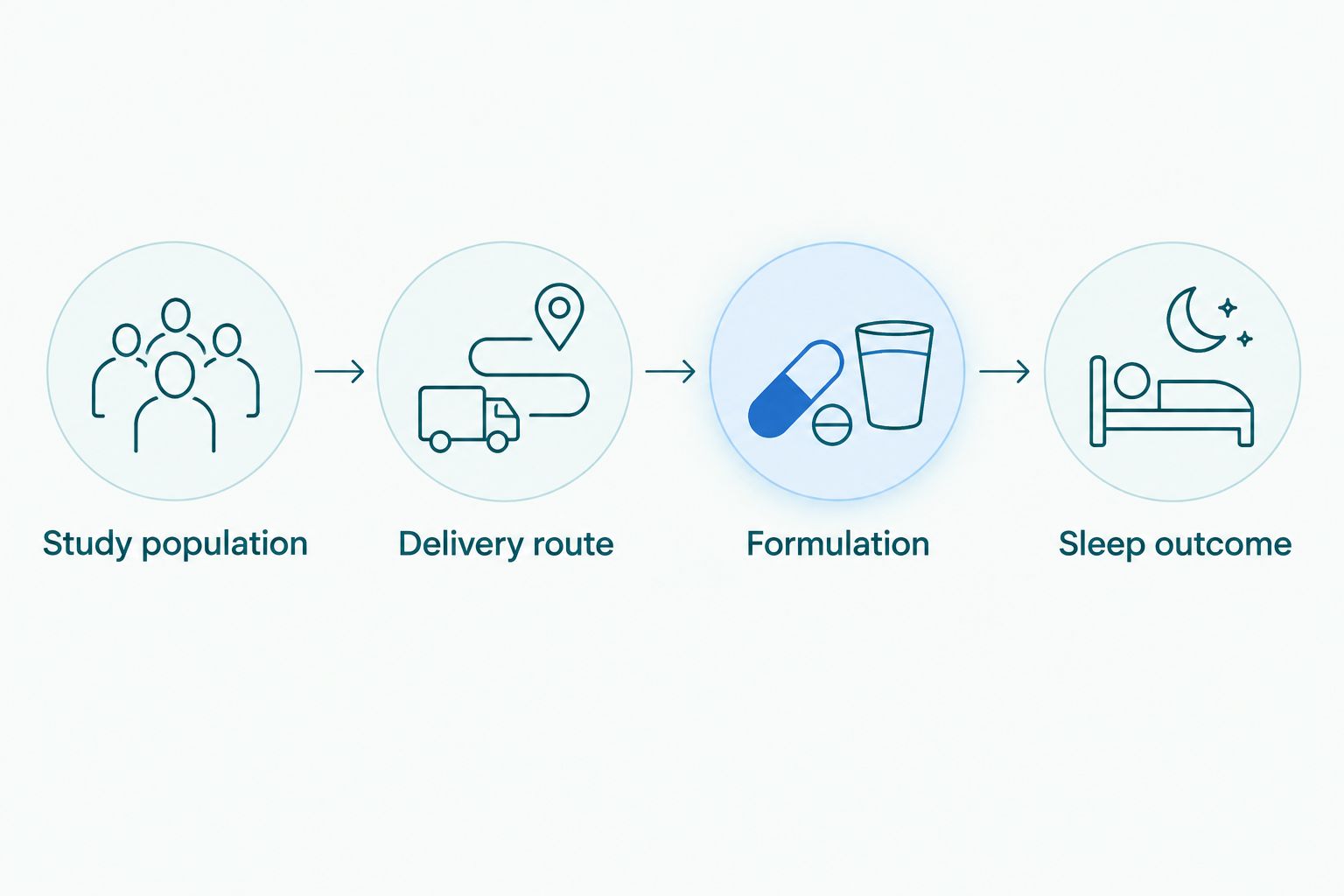
A useful evidence check follows this sequence: Study population, Delivery route, Formulation, Sleep outcome. Match those details before deciding that a study applies to the bottle you are considering.
How should you interpret dosing and timing?
Trial doses describe research; they are not a personalized dosing plan. The oral L-theanine study used 200 mg daily, while the cited ashwagandha trial used 300 mg twice daily. Those amounts cannot be converted into a nasal spray dose by comparing milligrams alone.
A trial’s duration also does not tell you exactly when you will notice a change. Four weeks of assessment does not mean L-theanine needs four weeks to work, and ten weeks of assessment does not mean ashwagandha starts working at week ten.
Use the product’s directions and ask a pharmacist or clinician about timing when you take medicines. Do not assume a supplement belongs immediately before bed simply because the topic is sleep; the cited ashwagandha trial used divided daily dosing.
For your 2026 routine, change one variable at a time and record sleep onset, awakenings, next-day alertness, and adverse effects. That record helps you avoid confusing a supplement change with a change in caffeine use, bedtime, or stress.
What safety issues should you check first?
L-theanine: check medicines and next-day effects
Short-term oral studies generally report acceptable tolerability, but they do not establish unlimited or lifelong safety. Discuss L-theanine with a pharmacist if you take sedating medicines or blood-pressure medicines, because effects and interaction risks need individual review.
Avoid assuming that calmer means safe to drive. If a new supplement makes you sleepy, dizzy, or less alert, stop the activity requiring concentration and review the product before taking it again.
Ashwagandha: thyroid and liver cautions matter
The National Center for Complementary and Integrative Health advises caution around ashwagandha in people with thyroid disorders or autoimmune conditions. It also identifies potential interactions with medicines, including thyroid hormone, sedatives, immunosuppressants, and medicines for diabetes or blood pressure.
Ashwagandha can cause gastrointestinal symptoms and drowsiness, and liver injury has been reported. Avoid it during pregnancy, and seek medical advice before use during breastfeeding or before surgery.
Stop taking ashwagandha and seek medical assessment if you develop signs such as yellowing skin or eyes, dark urine, or significant unexplained itching. A plant-derived supplement still requires a medicine and medical-history check.
Persistent sleep problems: address the cause
Repeated difficulty sleeping deserves assessment, especially when it affects daytime functioning. Loud snoring, breathing pauses, or severe daytime sleepiness warrant medical evaluation rather than a supplement comparison.
For chronic insomnia, cognitive behavioral therapy for insomnia is recommended as an initial treatment by major clinical guidelines. Neither L-theanine nor ashwagandha should delay appropriate care.
Where do nasal sprays and sleep bundles fit?
Synchronicity sells nasal sprays and capsules. Synchronicity’s Theanine Nasal Spray is best for shoppers seeking a nasal-format theanine option. Its stated purpose is support for calm, focus, and relaxation.
| Product | Best for | Relevant feature | Notes |
|---|---|---|---|
| Theanine Nasal Spray | Shoppers specifically comparing nasal-format theanine | Theanine delivered as a nasal spray | The cited L-theanine studies used oral doses |
| Sleep Stack | Shoppers reviewing a sleep-focused bundle | A named sleep-focused product option | See the product page for its full ingredient list |
The nasal option is absorbed through the lining of the nose instead of being swallowed like a capsule, so some of each dose skips digestion. A bundle requires an additional check of every component before you combine it with another supplement.


Synchronicity products are made with third-party tested ingredients. Third-party testing addresses what a product contains and specified contaminants, so check the documentation for the specific product you are considering.
Is ashwagandha better than L-theanine for staying asleep?
No trial has compared the two head to head for staying asleep. The 10-week insomnia trial assessed several sleep outcomes, while the 4-week L-theanine study focused on questionnaires in a different population. Comparing those results as if they came from one trial would be misleading.
Can you take L-theanine and ashwagandha together?
The trials discussed here studied each ingredient separately, not in combination. Combining supplements also makes it harder to identify which ingredient caused drowsiness, stomach symptoms, or a perceived benefit. Review the combination with a pharmacist, especially if you take medicines. If you are weighing ashwagandha against melatonin instead, see ashwagandha and melatonin.
Which should you consider if stress is keeping you awake?
L-theanine has human research relevant to stress-related symptoms, while ashwagandha has more direct sleep-specific evidence. Neither finding identifies the cause of your wakefulness. Start with a medicine review, a consistent sleep schedule, and an assessment of persistent symptoms rather than assuming stress is a confirmed diagnosis.
Featured in this article
Theanine Nasal SprayL-theanine for calm, focus, and steady energy without sedation.
Shop Theanine Nasal SprayThird-party tested ingredients. Vegan, non-GMO, made in the USA.
Sources
- Hidese S et al. Effects of L-Theanine Administration on Stress-Related Symptoms and Cognitive Functions in Healthy Adults: A Randomized Controlled Trial. Nutrients, 2019. PubMed
- Langade D et al. Efficacy and Safety of Ashwagandha (Withania somnifera) Root Extract in Insomnia and Anxiety: A Double-blind, Randomized, Placebo-controlled Study. Cureus, 2019. PubMed
- Cheah KL et al. Effect of Ashwagandha (Withania somnifera) extract on sleep: A systematic review and meta-analysis. PLoS One, 2021. PubMed
- Bulman A, D'Cunha NM, Marx W, Turner M, McKune A, Naumovski N. The effects of L-theanine consumption on sleep outcomes: a systematic review and meta-analysis. Sleep Med Rev. 2025;81:102076. PubMed 40056718
FAQ
What’s better for sleep, L-theanine or ashwagandha?
Ashwagandha has more sleep-specific placebo-controlled trials, L-theanine has trials on relaxation and self-reported sleep, and no trial has compared them directly. Formulation, safety, and your sleep problem matter more than a blanket winner.
How much L-theanine did the human sleep study use?
The cited 2019 study used 200 mg of oral L-theanine daily for 4 weeks in 30 adults. That research dose is not a personalized recommendation or a nasal spray equivalent.
How much ashwagandha did the insomnia trial use?
The cited 2019 insomnia trial used 300 mg of a specific oral root extract twice daily for 10 weeks. Another extract or formulation is not automatically equivalent.
Does L-theanine nasal spray have the same sleep evidence as capsules?
The L-theanine sleep studies cited here used oral L-theanine. Synchronicity’s Theanine Nasal Spray delivers theanine as a nasal spray, so follow its own directions.
Can I combine either supplement with my sleep medicine?
Ask a pharmacist or prescriber before combining either supplement with sleep medicine. Sedation and other interactions require a review of the specific medicine, supplement, and dose.
Is ashwagandha safe if I have a thyroid condition?
Ashwagandha needs clinician review if you have a thyroid condition or take thyroid hormone. Thyroid effects and medicine interactions are reasons not to self-prescribe it.
Will either supplement work the first night?
The cited trials measured outcomes over several weeks rather than after a single night. Their multiweek assessments cannot be used to promise an immediate response.
What should I prioritize for ongoing insomnia in 2026?
Prioritize assessment and evidence-based insomnia care in 2026. Cognitive behavioral therapy for insomnia is a recommended initial treatment, and supplements should not delay evaluation.
One last thing
The most useful label detail is not always the largest milligram number: it is whether the formulation matches the research. A clearly stated dose, identified extract, and relevant human outcome are the details to look for.
Before buying in 2026, write down the benefit you want to measure: falling asleep, fewer awakenings, or better next-day functioning. Then look at which studies measured that outcome.


Leave a comment
All comments are moderated before being published.
This site is protected by hCaptcha and the hCaptcha Privacy Policy and Terms of Service apply.