
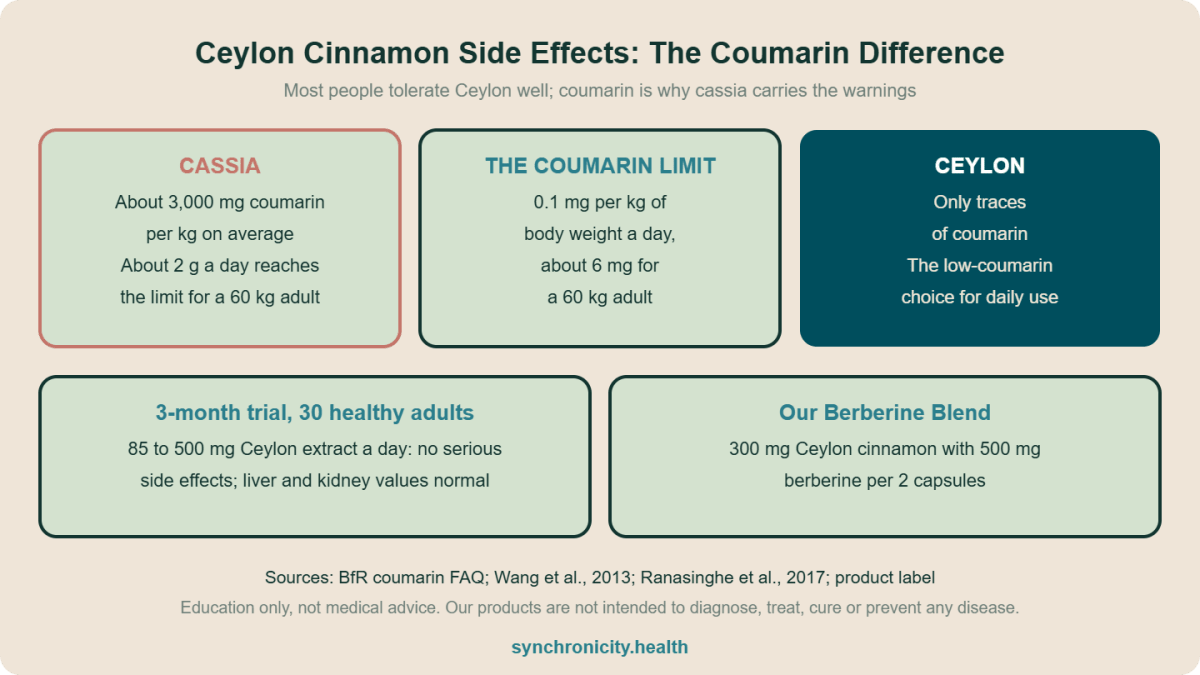
Ceylon cinnamon side effects are uncommon and usually mild, and most people tolerate it well. When side effects do show up with larger amounts of cinnamon, they are most often stomach upset or an allergic reaction. The liver warnings you may have read about come from coumarin, a natural compound that is high in cassia cinnamon but present only in traces in Ceylon, which is why Ceylon is the cinnamon people choose for daily use.
Key Takeaways
- Most people tolerate Ceylon cinnamon well. The National Center for Complementary and Integrative Health (NCCIH) says cinnamon in larger amounts is sometimes linked to side effects, most commonly digestive problems or allergic reactions (NCCIH).
- Coumarin is the reason for most cinnamon safety warnings. Cassia averages about 3,000 mg of coumarin per kilogram (BfR), while Ceylon bark contains only traces (Wang et al., 2013).
- The tolerable daily intake for coumarin is 0.1 mg per kilogram of body weight. A 60 kg adult reaches it with about 2 g of cassia cinnamon a day.
- In a 3-month trial, 30 healthy adults took a Ceylon cinnamon extract daily at 85 mg, then 250 mg, then 500 mg. There were no serious side effects, and liver function, kidney function and blood counts stayed within normal ranges (Ranasinghe et al., 2017).
- Check with a clinician first if you are pregnant or breastfeeding, have a liver condition or take prescription medicine.

Featured in this article
Berberine Blend500 mg of berberine per serving with Ceylon cinnamon, bitter melon and chromium, taken with meals.
Shop Berberine BlendThird-party tested ingredients. Vegan, non-GMO, made in the USA.
Is Ceylon Cinnamon Safe to Take?
Yes, for most people. NCCIH describes cinnamon as likely safe in the amounts used in food, and notes that side effects are sometimes linked to larger amounts or long periods of use, most commonly digestive problems or allergic reactions (NCCIH). Its liver note is about coumarin in cassia, and it says Ceylon may contain only a trace.
The best human safety data for Ceylon specifically comes from a phase I trial in Sri Lanka. Thirty healthy adults (average age about 39, half of them men) took a water extract of Ceylon cinnamon every day for 3 months, with the dose stepped up each month from 85 mg to 250 mg to 500 mg. Researchers checked liver and kidney function, blood counts and clotting. There were no serious side effects, including allergic reactions, and the lab values stayed within the normal range throughout. Two people stopped because of indigestion, and 28 of 30 finished the trial (Ranasinghe et al., 2017). It was a small, early-phase study. Our guide to Ceylon cinnamon supplements covers capsules, powder and dose in more depth.
Ceylon Cinnamon Side Effects at a Glance
| Possible effect | What is known | What to do |
|---|---|---|
| Stomach upset or indigestion | The most common complaint with larger amounts; 2 of 30 people in the 3-month trial stopped for indigestion | Try a smaller amount, and stop if it keeps bothering you |
| Allergic reaction | Listed by NCCIH as one of the more common effects of larger amounts; no serious allergic reactions were seen in the trial | Stop and get medical advice if you notice a rash, swelling or mouth irritation |
| Skin irritation | Reported with cinnamon oil or powder used on the skin | Keep cinnamon oil off the skin |
| Liver effects from coumarin | Tied to high-coumarin cassia in sensitive people; Ceylon has only traces, and liver values stayed normal in the trial | Choose Ceylon for daily use; check first if you have a liver condition |
Coumarin: Why Ceylon Is the Low-Coumarin Choice
Coumarin is a natural flavor compound found in cassia cinnamon. Germany's Federal Institute for Risk Assessment (BfR) reports that cassia contains about 3,000 mg of coumarin per kilogram on average, with the highest sample measured at 10,000 mg per kilogram. Ceylon cinnamon, by contrast, contains only low levels (BfR). A U.S. study that tested authenticated cinnamon barks found that Ceylon bark contained only traces of coumarin, while the cassia species contained substantial amounts. It also found coumarin in every cinnamon product bought in local stores, pointing to cassia (Wang et al., 2013).
| Cassia cinnamon | Ceylon cinnamon | |
|---|---|---|
| Coumarin | About 3,000 mg per kg on average | Only traces |
| Amount that reaches the daily coumarin limit for a 60 kg adult | About 2 g a day | Far more than anyone would take |
| Where you find it | Most grocery store cinnamon and flavored foods | Labeled Ceylon or "true" cinnamon |
For the full side by side, including Saigon and Indonesian cinnamon, see Ceylon vs cassia cinnamon, and our Ceylon cinnamon ingredient page.
How Much Ceylon Cinnamon Is Safe Per Day?
The safety ceiling is really a coumarin ceiling. The BfR sets the tolerable daily intake at 0.1 mg of coumarin per kilogram of body weight, which works out to about 6 mg a day for a 60 kg (about 132 lb) adult. With cassia, about 2 g of cinnamon a day reaches that line. The BfR also says that going slightly over it for one to two weeks can be seen as safe, so a heavy-cinnamon day now and then is not a concern (BfR).
Because Ceylon contains only traces of coumarin, everyday supplement amounts sit comfortably below that ceiling. In the 3-month trial, extract doses from 85 mg up to 500 mg a day left liver and kidney values in the normal range (Ranasinghe et al., 2017). For comparison, the 300 mg of Ceylon cinnamon in a serving of our Berberine Blend is about one-seventh of the 2 g of cassia that reaches the coumarin limit, and it is the low-coumarin kind.
How much Ceylon cinnamon is too much?
There is no official upper limit for Ceylon itself. The practical signs you are taking more than suits you are an upset stomach or an allergic reaction. The one firm line is pregnancy, where NCCIH says Ceylon in larger amounts than food is considered unsafe (NCCIH).
Can you take Ceylon cinnamon every day?
Yes. The phase I trial gave it every day for 3 months, with no serious side effects. If you also drink cinnamon water or tea, choose Ceylon for that too; our cinnamon water guide covers how much is sensible.
Ceylon Cinnamon Side Effects for Women, and Who Should Check First
Women and men report the same kinds of side effects; the trial above enrolled equal numbers of each. The difference for women is pregnancy and breastfeeding. NCCIH says Ceylon and cassia appear safe in the amounts found in food during pregnancy, that Ceylon in larger amounts is considered unsafe during pregnancy, and that little is known about larger amounts while breastfeeding (NCCIH). Talk with your clinician before using any cinnamon supplement if you are pregnant or breastfeeding.
Also check with a clinician first if you:
- Have a liver condition, since coumarin is the known concern with cinnamon
- Take any prescription medicine
- Have had an allergic reaction to cinnamon or cinnamon-flavored products
Berberine With Ceylon Cinnamon: Side Effects of the Blend
In a berberine blend, the berberine half is the part more likely to be noticed. NCCIH says berberine is generally well tolerated when taken by mouth, and that its most common side effects are digestive: abdominal pain, constipation, diarrhea, nausea and vomiting (NCCIH). In a 3-month report on two small trials in adults with type 2 diabetes, where berberine was given at 0.5 g three times a day, 20 participants had stomach effects that passed, and no liver or kidney problems were seen (Yin et al., 2008). In a second 3-month trial of 1 g a day in 116 adults, five people in the berberine group had mild to moderate constipation (Zhang et al., 2008).
Berberine is not for use during pregnancy or breastfeeding, and it can interact with some medicines, so anyone on prescription medicine should check with their clinician first. Our guide to berberine side effects goes through each point, and berberine and Ceylon cinnamon together covers why the two are paired.
Where Our Berberine Blend Fits
Our Berberine Blend pairs 500 mg of berberine with 300 mg of Ceylon cinnamon per 2 capsules, plus bitter melon extract and chromium, in vegan capsules made with third-party tested ingredients. We chose Ceylon over cassia because it is the low-coumarin cinnamon, which suits daily use. Benefits build with consistent daily use: months 1 to 2 can bring early changes, and 3 months and beyond is where the full benefit builds. For the bigger picture, see our metabolic health and energy guide.
A pinch of Ceylon also tastes great stirred into our Mushroom Cacao, a mushroom hot chocolate; see our mushroom hot chocolate guide.
Featured in this article
Berberine Blend500 mg of berberine per serving with Ceylon cinnamon, bitter melon and chromium, taken with meals.
Shop Berberine BlendThird-party tested ingredients. Vegan, non-GMO, made in the USA.
Frequently Asked Questions
Is Ceylon cinnamon safe to take?
Yes, most people tolerate it well. In a 3-month trial of daily Ceylon cinnamon extract in healthy adults there were no serious side effects, and liver and kidney values stayed normal.
How much Ceylon cinnamon is safe per day?
The 3-month trial used 85 mg to 500 mg of extract a day without serious side effects. Because Ceylon has only traces of coumarin, everyday supplement amounts sit well below the coumarin limit of 0.1 mg per kilogram of body weight.
How much Ceylon cinnamon is too much?
There is no official upper limit for Ceylon. Cut back if you get an upset stomach, stop if you notice an allergic reaction, and avoid larger-than-food amounts during pregnancy.
Can you take Ceylon cinnamon every day?
Yes. Daily use for 3 months is how it was studied.
Are there Ceylon cinnamon side effects for females?
Women report the same mild side effects as men. If pregnant or breastfeeding, talk with your clinician before taking a cinnamon supplement.
Does Ceylon cinnamon hurt the liver?
The liver concern comes from coumarin, which is high in cassia and only a trace in Ceylon. Liver values stayed normal in the 3-month Ceylon trial.
What are the side effects of berberine with Ceylon cinnamon?
Most come from the berberine and are digestive, such as constipation or diarrhea. Berberine is not for pregnancy or breastfeeding, and anyone on prescription medicine should check with a clinician first.
Is Ceylon cinnamon safer than regular cinnamon?
For daily use, yes. Most grocery cinnamon is cassia, which is far higher in coumarin than Ceylon.
Sources
- National Center for Complementary and Integrative Health. Cinnamon: Usefulness and Safety. Updated November 2024. https://www.nccih.nih.gov/health/cinnamon
- German Federal Institute for Risk Assessment (BfR). FAQ on coumarin in cinnamon and other foods. https://www.bfr.bund.de/en/service/frequently-asked-questions/topic/faq-on-coumarin-in-cinnamon-and-other-foods/
- Wang YH, Avula B, Nanayakkara NPD, Zhao J, Khan IA. Cassia cinnamon as a source of coumarin in cinnamon-flavored food and food supplements in the United States. Journal of Agricultural and Food Chemistry, 2013. https://pubmed.ncbi.nlm.nih.gov/23627682/
- Ranasinghe P, et al. Evaluation of pharmacodynamic properties and safety of Cinnamomum zeylanicum (Ceylon cinnamon) in healthy adults: a phase I clinical trial. BMC Complementary and Alternative Medicine, 2017. https://pubmed.ncbi.nlm.nih.gov/29282046/
- National Center for Complementary and Integrative Health. In the News: Berberine. Updated June 2023. https://www.nccih.nih.gov/health/in-the-news-berberine
- Yin J, Xing H, Ye J. Efficacy of berberine in patients with type 2 diabetes mellitus. Metabolism, 2008. https://pubmed.ncbi.nlm.nih.gov/18442638/
- Zhang Y, et al. Treatment of type 2 diabetes and dyslipidemia with the natural plant alkaloid berberine. Journal of Clinical Endocrinology and Metabolism, 2008. https://pubmed.ncbi.nlm.nih.gov/18397984/
These statements have not been evaluated by the Food and Drug Administration. This content is for education and is not medical advice. Our products are not intended to diagnose, treat, cure or prevent any disease. Talk with a healthcare provider before starting a new supplement if you are pregnant, breastfeeding or taking medication.


Leave a comment
All comments are moderated before being published.
This site is protected by hCaptcha and the hCaptcha Privacy Policy and Terms of Service apply.