
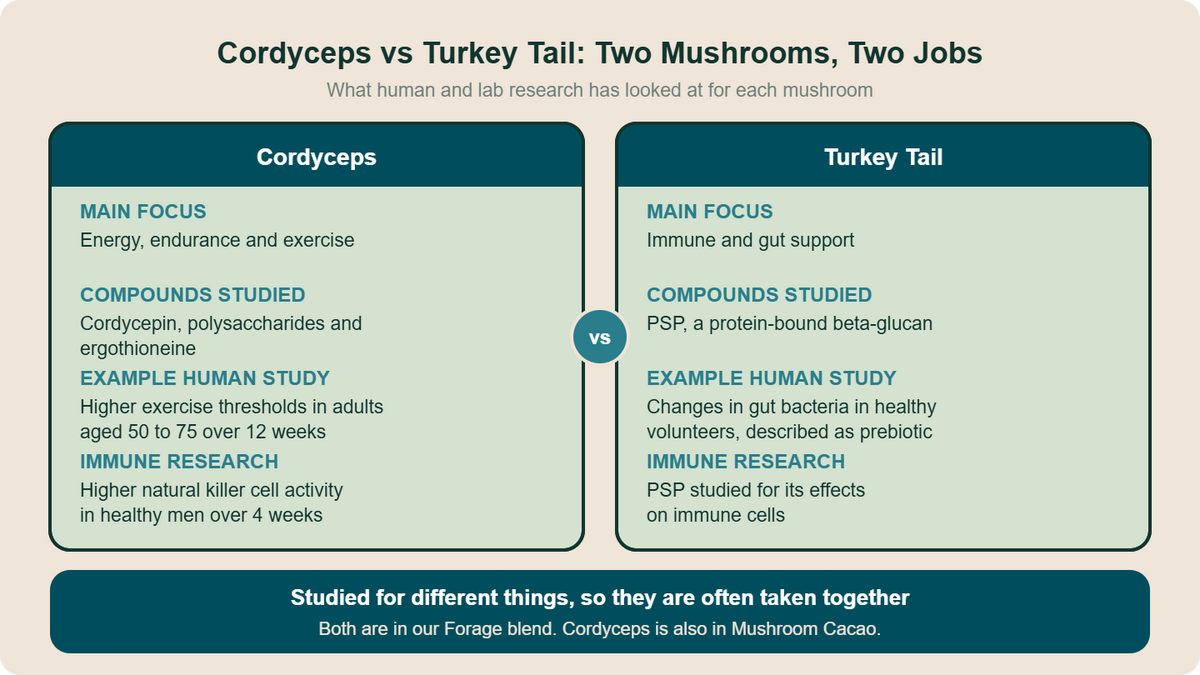
Cordyceps vs turkey tail comes down to your goal. Cordyceps is the mushroom studied for energy and exercise, with human trials that measured endurance and oxygen use, while turkey tail is studied for immune and gut support through its beta-glucan compounds. They do different jobs, so many people take cordyceps and turkey tail together in one daily mushroom blend. Here is how they compare, what the research measured and how to take them.
Key Takeaways
- Cordyceps is studied mainly for energy and exercise: in 20 healthy adults aged 50 to 75, 333 mg of a Cordyceps sinensis extract (Cs-4) three times a day for 12 weeks raised two exercise thresholds compared with placebo (Chen et al., 2010).
- Cordyceps has immune research too: in 79 healthy men, 1.5 g a day of Cordyceps militaris for 4 weeks raised natural killer cell activity compared with placebo (Kang et al., 2015).
- Turkey tail is studied mainly for immune and gut support. Its best known compound, PSP, is a protein-bound polysaccharide whose sugar part is a beta-glucan (Saleh et al., 2017).
- In 24 healthy volunteers, turkey tail PSP changed the makeup of gut bacteria in a way the authors described as prebiotic (Pallav et al., 2014).
- Because they are studied for different things, cordyceps and turkey tail are often taken together, and our Forage blend contains both.

Featured in this article
ForageCordyceps 200 mg and turkey tail 150 mg per serving, with five more 8:1 fruiting body extracts plus shilajit and ashwagandha.
Shop ForageThird-party tested ingredients. Vegan capsules, made in the USA.
Cordyceps vs Turkey Tail at a Glance
Both are functional mushrooms, but they come from very different families and research has looked at them for different reasons:
| Cordyceps | Turkey tail | |
|---|---|---|
| Main research focus | Energy, endurance and exercise | Immune and gut support |
| Compounds research looks at | Cordycepin, polysaccharides and ergothioneine | PSP, a protein-bound beta-glucan |
| Example human study | Higher exercise thresholds in adults aged 50 to 75 over 12 weeks | Changes in gut bacteria in healthy volunteers, described as prebiotic |
| Immune research | Higher natural killer cell activity in healthy men over 4 weeks | PSP studied for its effects on immune cells |
| Good fit if you want | Everyday energy and support for workouts | Daily immune and gut support |
| In our products | Forage and Mushroom Cacao | Forage |
For more detail on each mushroom on its own, see our cordyceps ingredient page and our turkey tail ingredient page.
What Cordyceps Is Studied For
Cordyceps has a long history of use in Asian traditional practice as a tonic for energy and to ease tiredness. Modern research on Cordyceps militaris focuses on compounds such as cordycepin, polysaccharides and ergothioneine (Jędrejko et al., 2021).
The human trials center on exercise:
- In 20 healthy adults aged 50 to 75, 333 mg of a Cordyceps sinensis extract called Cs-4 three times a day for 12 weeks raised the metabolic threshold by about 10.5 percent and the ventilatory threshold by about 8.5 percent, while the placebo group did not change. Peak oxygen uptake did not change in either group (Chen et al., 2010).
- In 28 young adults, 4 g a day of a mushroom blend containing Cordyceps militaris improved time to exhaustion on a cycle test after 1 week, and in the 10 people who continued for 3 weeks, peak oxygen uptake rose compared with placebo (Hirsch et al., 2017).
Cordyceps also has immune research of its own. In a 4-week placebo-controlled trial of 79 healthy men, 1.5 g a day of Cordyceps militaris raised natural killer cell activity and lymphocyte proliferation, two measures of immune cell function, and the authors reported no significant adverse reactions (Kang et al., 2015).
Cordyceps supports energy without the jolt of caffeine, which is why many people use it before workouts or in the morning. Our guides to cordyceps for athletes and choosing a cordyceps supplement go deeper.
What Turkey Tail Is Studied For
Turkey tail (Trametes versicolor, also called Coriolus versicolor) is a fan-shaped mushroom that grows on dead wood. Its best known compound is polysaccharopeptide, or PSP, a polysaccharide bound to a protein. The sugar part of PSP is a beta-glucan, the same family of compounds studied in many immune-supporting mushrooms. Research on PSP has looked at how it affects immune cells such as natural killer cells and macrophages (Saleh et al., 2017).
Turkey tail also has a gut side. In a randomized trial of 24 healthy volunteers, PSP from turkey tail led to clear, consistent changes in the makeup of gut bacteria, which the authors described as prebiotic activity, meaning it feeds helpful gut bacteria. (Pallav et al., 2014).
Because the gut and the immune system are closely linked, this pairing of immune and gut research is a big part of why people take turkey tail every day. Our full guide to turkey tail mushroom benefits covers more, and our immune system function and daily support guide gives the bigger picture.
Cordyceps or Turkey Tail: Which Fits Your Goal?
- For energy and workouts, start with cordyceps. Its human trials measured exercise thresholds, oxygen uptake and time to exhaustion.
- For daily immune and gut support, start with turkey tail. Its research centers on beta-glucans, immune cells and gut bacteria.
- For both, take them together. They are studied for different things, so one does not replace the other.
If you are also weighing other mushrooms, see reishi vs turkey tail and cordyceps vs chaga.
Cordyceps and Turkey Tail Together
Cordyceps and turkey tail are a common pairing in multi-mushroom blends, because together they cover energy on one side and immune and gut support on the other. That is the idea behind our Forage capsules. Each 2-capsule serving contains cordyceps 8:1 fruiting body extract 200 mg and turkey tail 8:1 fruiting body extract 150 mg, along with lion's mane 200 mg, reishi 200 mg, chaga 150 mg, maitake 150 mg and shiitake 150 mg (all 8:1 fruiting body extracts), plus Himalayan shilajit extract 100 mg and ashwagandha root extract 100 mg. Other ingredients are ginger extract and vegan capsules. Forage is made with third-party tested ingredients.
If you prefer your cordyceps in a warm drink, our Mushroom Cacao gives 500 mg each of cordyceps and lion's mane 8:1 fruiting body extracts in every rounded teaspoon, mixed into cocoa and cacao. Turkey tail is not in Mushroom Cacao, so pair it with Forage if you want both mushrooms.
How to Take Them
- Forage: two capsules daily, taken in the morning with or without food, or as recommended by your healthcare practitioner.
- Mushroom Cacao: add one rounded teaspoon (5 g) to a mug, pour in 6 to 8 oz of hot water or warm milk, and stir or froth until smooth. Enjoy once a day, ideally in the morning or early afternoon.
- Choose fruiting body extracts. Both of our products use 8:1 fruiting body extracts. Our guide to mushroom extracts vs powders explains why the form matters.
- Take them every day. Forage is designed for consistent daily use, and its effects are gradual and cumulative rather than felt right away.
Safety: Who Should Check With a Doctor First
Most people tolerate both mushrooms well. In the 4-week trial in healthy men, the authors reported no significant adverse reactions with daily cordyceps (Kang et al., 2015). Still, talk with your doctor before taking cordyceps or turkey tail if any of these apply:
- Pregnancy or breastfeeding: skip mushroom supplements unless your clinician approves.
- Immune-suppressing medicine or an autoimmune condition: both mushrooms are studied for their effects on immune cells, so check first if you take medicine that calms the immune system, such as after an organ transplant.
- Blood thinners or blood sugar medicine: talk to your doctor if you take either before adding a new supplement.
- Surgery or prescription medicine: tell your care team about every supplement you take.
- Mushroom allergy: avoid mushroom products if you react to mushrooms.
Forage also contains ashwagandha and shilajit, so read the full label. Mushroom Cacao is made with cocoa, which naturally contains theobromine and a small amount of caffeine, so enjoy it earlier in the day if you are sensitive to caffeine.
Featured in this article
ForageCordyceps and turkey tail in one daily blend of seven mushrooms, to support everyday energy, focus and immune health.
Shop ForageThird-party tested ingredients. Vegan capsules, made in the USA.
Frequently Asked Questions
What is the difference between cordyceps and turkey tail?
Cordyceps is studied mainly for energy and exercise, with human trials that measured endurance, oxygen uptake and exercise thresholds. Turkey tail is studied mainly for immune and gut support, through PSP, a protein-bound beta-glucan, and its prebiotic effect on gut bacteria. Cordyceps also has some immune research, but its best known use is everyday energy and workouts.
Can you take cordyceps and turkey tail together?
Yes. Cordyceps and turkey tail are often taken together, and many multi-mushroom blends combine them because they are studied for different things. Our Forage capsules contain cordyceps 200 mg and turkey tail 150 mg per 2-capsule serving, alongside five other mushroom extracts. If you take prescription medicine, check with your doctor before starting.
Turkey tail vs cordyceps: which is better for immune support?
Turkey tail is the more immune-focused of the two, since its research centers on beta-glucans, immune cells and the gut. Cordyceps has immune research too: in healthy men, 1.5 g a day for 4 weeks raised natural killer cell activity compared with placebo. Taking both covers immune support from two angles.
Cordyceps or turkey tail for energy?
Cordyceps is the energy mushroom of the two. Trials in healthy adults measured higher exercise thresholds, oxygen uptake and time to exhaustion after several weeks of daily use. Turkey tail research focuses on immune and gut support instead, so pick cordyceps if energy is your main goal, or take both in a blend.
When should you take cordyceps and turkey tail?
Many people take them in the morning. Forage directions are two capsules daily in the morning, with or without food. Mushroom Cacao is made for one cup a day, ideally in the morning or early afternoon, because cocoa contains theobromine and a little caffeine. Taking them at the same time each day makes the habit easy to keep.
Is it safe to take cordyceps and turkey tail every day?
Both are made for daily use, and trials gave cordyceps every day for 1 to 12 weeks. In one 4-week trial, the authors reported no significant adverse reactions. Talk with your doctor first if you are pregnant or breastfeeding, have an autoimmune condition, or take blood thinners, blood sugar medicine or medicine that suppresses the immune system.
What does turkey tail do for your gut?
In a randomized trial of 24 healthy volunteers, PSP from turkey tail led to clear changes in the makeup of gut bacteria, which the researchers described as prebiotic activity. Prebiotics feed helpful gut bacteria. Because the gut and the immune system are closely linked, this is part of why turkey tail is used for daily immune support.
Sources
- Chen S, Li Z, Krochmal R, Abrazado M, Kim W, Cooper CB. Effect of Cs-4 (Cordyceps sinensis) on exercise performance in healthy older subjects: a double-blind, placebo-controlled trial. Journal of Alternative and Complementary Medicine, 2010. https://pubmed.ncbi.nlm.nih.gov/20804368/
- Hirsch KR, Smith-Ryan AE, Roelofs EJ, Trexler ET, Mock MG. Cordyceps militaris improves tolerance to high-intensity exercise after acute and chronic supplementation. Journal of Dietary Supplements, 2017. https://pubmed.ncbi.nlm.nih.gov/27408987/
- Kang HJ, Baik HW, Kim SJ, et al. Cordyceps militaris enhances cell-mediated immunity in healthy Korean men. Journal of Medicinal Food, 2015. https://pubmed.ncbi.nlm.nih.gov/26284906/
- Jędrejko KJ, Lazur J, Muszyńska B. Cordyceps militaris: an overview of its chemical constituents in relation to biological activity. Foods, 2021. https://pubmed.ncbi.nlm.nih.gov/34828915/
- Saleh MH, Rashedi I, Keating A. Immunomodulatory properties of Coriolus versicolor: the role of polysaccharopeptide. Frontiers in Immunology, 2017. https://pubmed.ncbi.nlm.nih.gov/28932226/
- Pallav K, Dowd SE, Villafuerte J, et al. Effects of polysaccharopeptide from Trametes versicolor and amoxicillin on the gut microbiome of healthy volunteers: a randomized clinical trial. Gut Microbes, 2014. https://pubmed.ncbi.nlm.nih.gov/25006989/
These statements have not been evaluated by the Food and Drug Administration. This content is for education and is not medical advice. Our products are not intended to diagnose, treat, cure or prevent any disease. Talk with a healthcare provider before starting a new supplement if you are pregnant, breastfeeding or taking medication.


Leave a comment
All comments are moderated before being published.
This site is protected by hCaptcha and the hCaptcha Privacy Policy and Terms of Service apply.