
Introduction
Two people can buy a Lion's Mane supplement with the same label and walk away with very different results. The reason is usually not the mushroom species itself. The real difference often comes down to whether they chose a simple powder or concentrated mushroom extracts.
Functional mushrooms now show up in coffees, pre-workouts, and nootropic stacks used by biohackers, athletes, and clinicians who care about performance and prevention. Yet one basic question rarely gets serious attention: Is a mushroom powder just a more natural option, or is it a weaker product that leaves most of the active compounds locked away?
The answer comes down to bioavailability, how the active molecules are freed from the tough mushroom structure and how well they enter the body. Extraction methods, standardization, and delivery routes can mean the difference between a real effect and an expensive habit, as detailed in research on evaluation of mushroom extracts and their biologically active compounds.
By the end of this article, you will have a clear framework to judge any Lion's Mane, Cordyceps, or other mushroom supplement. The focus is on what the science says about mushroom extracts versus powders, how bioavailability works, and how clean-label systems like Synchronicity Health's stacks approach the problem.
“The dose makes the poison.” (Paracelsus)
The same idea applies to supplements: dose, form, and delivery determine whether a compound meaningfully affects the body.
Key Takeaways
Before going deeper, it helps to see the main points in one place.
- Mushroom powders keep the full food matrix with fiber, minerals, and some beta-glucans. Their chitin cell walls stay intact, which means many active compounds never become fully available during digestion. Powders can support general wellness but rarely match the potency of focused mushroom extracts.
- Mushroom extracts use hot water, alcohol, or both to break apart chitin and pull out key molecules such as beta-glucans, triterpenes, hericenones, and erinacines. When these extracts come from the fruiting body and list standardized amounts of active compounds, they give far more predictable results than loose powders or mycelium grown on grain.
- Bioavailability depends on more than extraction. Oral supplements must survive stomach acid and processing by the liver, which can lower the active dose that reaches the blood. Intranasal delivery is absorbed through the lining of the nose instead of being swallowed like a capsule, so some of each dose skips digestion, which is why Synchronicity Health uses it in select formulas.
- Lion's Mane and Cordyceps are where form matters most. Lion's Mane trials have used both dried fruiting body powder and concentrated mushroom extracts, so check the form and the amount on the label.

Featured in this article
ForageLion's Mane, Cordyceps, Reishi and more for focus, energy, and daily balance.
Shop ForageThird-party tested ingredients. Vegan capsules.
What Is The Real Difference Between Mushroom Extracts And Mushroom Powders?

At first glance, a jar of mushroom powder and a bottle of mushroom extracts can look similar. Both might list Lion's Mane or Cordyceps on the front. Inside, though, they behave very differently in the body.
Mushroom powder is usually just dried and finely ground mushroom material. It may come from the fruiting body, the mycelium, or both. The entire structure remains, including chitin, the tough fiber that forms the mushroom cell wall. That means vitamins, minerals, and fibers are still there, which is helpful for general nutrition. The problem is that many of the most interesting compounds stay trapped inside this chitin shell.
Mushroom extracts go a step further. Producers use hot water, alcohol, or both to break open the chitin wall and pull specific molecules into a concentrated liquid or dried extract:
- Water-based extraction focuses on polysaccharides such as beta-glucans that support immune signaling.
- Alcohol-based extraction targets fat-loving compounds such as triterpenes and certain terpenoids.
- Dual extraction combines both approaches to capture a wider range of active compounds in a smaller dose.
Humans do not make much chitinase, the enzyme that breaks down chitin. Eating plain mushroom powder is a bit like swallowing a locked safe. The value is inside, but the body holds only part of the key. Extraction acts as that key, opening the safe before the supplement ever reaches the stomach.
Label details matter. Many products sold as mushroom powder are really mycelium grown on brown rice or other grain. When this mix is dried and ground, a good share of the weight comes from starch, not mushroom compounds. In contrast, a high-quality extract will state that it comes from the fruiting body and list a beta-glucan percentage so the user knows how much active material is in each serving.
A quick overview helps make the contrast clear.
|
Feature |
Mushroom Powder |
Mushroom Extract |
|---|---|---|
|
Chitin Wall Intact |
Yes |
No, broken down during extraction |
|
Bioavailable Active Compounds |
Often low and variable |
Higher and more predictable |
|
Beta-Glucan Standardization |
Rarely listed |
Common in quality products |
|
Best Use Case |
Culinary use and broad nutrition |
Targeted health and performance goals |
|
Typical Form |
Loose powder or simple capsule |
Capsule, tincture, or advanced delivery such as intranasal |
Why Bioavailability Is The Metric That Actually Matters
Once the difference between powders and mushroom extracts is clear, the next step is to ask a simple question: How much of those active compounds actually makes it into the bloodstream and then to the brain, muscles, or immune cells?
That measure is called bioavailability. Even the best extract is only as helpful as the amount the body absorbs and uses. Two people can swallow the same capsule yet receive very different effective doses because their digestion and metabolism are not the same. This is where both the form of the mushroom product and the delivery route start to matter more than the species printed on the label.
The Digestive Bottleneck: Why Oral Absorption Is Inconsistent

Oral supplements face several obstacles before they reach circulation. Large polysaccharides, including many mushroom beta-glucans, move through the stomach and small intestine with only partial absorption. Some of this is helpful, since they act as prebiotics in the colon and feed beneficial microbes, but it also means that not all of the immune-modulating compounds reach the blood in high amounts.
After absorption through the gut wall, compounds travel directly to the liver. This processing by the liver can change or clear a sizable share of what was swallowed. Even with well-made mushroom extracts, the liver can reduce the active dose before it ever circulates through the body.
Personal factors add another layer of variability:
- Gut health and integrity
- Stomach acid levels
- Timing and size of meals
- Microbiome composition
- Medications that alter digestion or motility
Someone with excellent digestion can extract more value from the same supplement than someone with reflux, chronic stress, or a history of gut inflammation.
Standard oral supplementation assumes ideal digestive conditions, but for many adults 35 and older, that assumption is increasingly unreliable. This is one reason research on oral mushroom products can be hard to repeat in real-world settings. The extract might be standardized, yet the human system receiving it is anything but standardized.
Intranasal Delivery: A Different Route

Intranasal delivery offers a different path. A nasal spray is absorbed through the lining of the nose instead of being swallowed like a capsule, so some of each dose skips digestion, while some drains to the throat and is swallowed.
By letting some of each dose skip digestion, intranasal delivery takes a different route from capsules for compounds that suit a spray.
Synchronicity Health applies this pharmacokinetic principle across its range. Its nasal sprays are absorbed through the lining of the nose instead of being swallowed like a capsule, so some of each dose skips digestion. Its mushroom blend, Forage, takes the other route available to fungal actives and uses concentrated extracts of Lion's Mane, Reishi, and Cordyceps rather than raw ground powder.
The key idea is simple: the body cannot gain benefits from compounds it never absorbs. Clean-label mushroom extracts made with third-party tested ingredients give a better chance for the active molecules seen in research to act inside real people with real digestive quirks.
Lion's Mane And Cordyceps: Where The Extract Advantage Is Most Pronounced

Lion's Mane and Cordyceps are two of the most popular mushrooms among biohackers, athletes, and high-performing professionals. They also show some of the clearest reasons to choose mushroom extracts over basic powders when the goal is real cognitive or athletic change.
Lion's Mane Extract: Precision Delivery For Cognitive Performance
Lion's Mane contains two families of neuroactive terpenes. Hericenones come mainly from the fruiting body, while erinacines are more abundant in the mycelium. Both stimulate nerve growth factor (NGF), a protein that supports neuron survival, repair, and plasticity. This is the core reason Lion's Mane is seen as a brain-focused mushroom.
In raw powder, many of these compounds remain trapped inside the chitin structure. Digestion can free some of them, but not in a reliable or concentrated way. Dual extraction that uses both water and alcohol is needed to fully draw out these fat-loving and water-loving molecules into a form the body can absorb more easily.
Human trials of Lion's Mane have used both forms. A 16-week trial gave about 3 g a day of dried fruiting body powder in tablets, and a 49-week trial used a concentrated mycelium extract in capsules. What they share is a known amount taken every day. When someone stirs a small spoonful of Lion's Mane powder into coffee, the amount can be far below what those studies used. Our guide to Lion's Mane powder vs capsules vs extract compares each form with the study amounts.
For professionals who rely on clear focus, quick recall, and long-term brain health, that gap matters. A standardized Lion's Mane extract with dual extraction and clearly stated active levels moves the daily dose closer to what has been tested in clinical settings.
People with a history of estrogen-sensitive breast cancer or other hormone-driven conditions should speak with a clinician before using Lion's Mane, since phytoestrogen activity is still being studied. A practitioner who understands both oncology and nutraceuticals can help weigh risks and benefits.
Cordyceps Extract: ATP, Oxygen, And Athletic Edge
Cordyceps earned its place in performance circles because of its effect on cellular energy. Its active compounds, including cordycepin and adenosine, interact with pathways that govern ATP production and oxygen use. More efficient ATP generation and oxygen handling can translate into better endurance and stronger training sessions.
Once again, the form matters. In whole mushroom powder, active compounds sit inside the mushroom matrix and must survive grinding, brewing, digestion, and liver metabolism before they reach the blood. That path introduces many chances for variation. Two scoops from the same jar can deliver very different effective doses to two people with different digestive health.
The small but promising study on long-distance runners that showed improved endurance with Cordyceps used an extract, not a raw powder. Concentrated mushroom extracts are also what appear most often in research that measures changes in oxygen use or time to exhaustion in athletes.
For someone adding Cordyceps to a pre-workout stack, an unstandardized powder is a gamble. A dual-extracted, fruiting-body-based Cordyceps with clear active percentages gives a more predictable effect. Synchronicity Health includes Cordyceps in Forage, its mushroom blend, and lists the amount of every ingredient plainly on the label so readers can compare it against the doses used in research themselves.
With mushrooms, standardization and dosing are what make performance claims meaningful.
For one mushroom in detail, our reishi tea guide compares tea, powder, extract and tincture.
Hot water is also the traditional way to extract chaga at home; our guide to chaga tea covers brewing times and safety. For two mushrooms often eaten as food, our guide to maitake vs shiitake compares them side by side.
How To Identify A High-Quality Mushroom Extract (And Avoid Inferior Products)
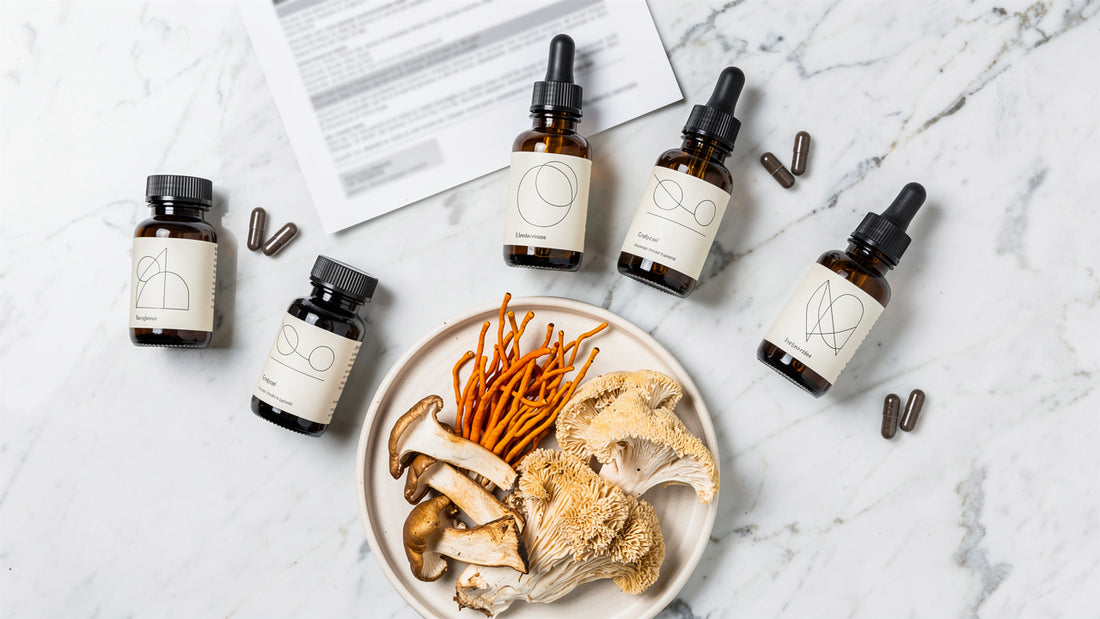
The supplement aisle can make every product look impressive. Shiny labels and trendy claims do not show whether a bottle holds therapeutic mushroom extracts or weak powder blends. A simple checklist helps separate well-made products from the rest.
Start with the part of the mushroom used. Fruiting body extracts tend to carry higher levels of beta-glucans and triterpenes, as confirmed by a comprehensive review of mushrooms as nutritional powerhouses and their bioactive compound profiles. Mycelium grown on grain often includes a lot of leftover starch, which inflates the weight without adding more active compounds. Brands that focus on fruiting body material usually say so clearly on the label.
Extraction method is the next point to check. A serious product will explain how it frees and concentrates the target compounds, not just use vague phrases. Hot water extraction leans toward immune-focused polysaccharides, while dual extraction adds important fat-loving molecules. When this detail is missing, it is hard to know what is in the bottle.
Standardization ties everything together. Listing a specific beta-glucan percentage, or clearly defined active ranges, acts much like the active ingredient line on a medicine bottle. It shows that testing was done and that each dose should contain a predictable amount.
Independent testing adds another safety net. Because the FDA does not screen supplements before they reach shelves, third-party checks are vital. Certification from groups such as USP, NSF, or ConsumerLab, or a posted certificate of analysis (COA), shows that an outside lab has confirmed identity, potency, and purity.
Synchronicity Health makes its formulas with third-party tested ingredients. Formulas use carefully selected mushroom extracts, fruiting body sourcing where appropriate, and clear standardization, and every ingredient amount is listed plainly on the label so users can compare a serving against the research instead of guessing.
When comparing products, keep this quick reference in mind:
- Source details matter. Choose products that clearly state fruiting body use and avoid mushrooms grown mostly on grain if the goal is high active content. This reduces the chance of paying for starch-heavy powder with impressive but misleading labels.
- Extraction information should be easy to find. Look for simple language that states whether hot water, alcohol, or dual processes were used. When a label hides behind vague terms, it becomes hard to know which compounds the product actually contains.
- Standardization figures give confidence. Phrases that name specific beta-glucan levels or other actives show that real measurements were done. Without those numbers, every serving turns into a guess rather than a controlled dose.
- Third-party testing protects health and investment. Independent lab checks help rule out heavy metals, pesticides, and wrong species. Brands that share certificates of analysis show respect for the people who trust their mushroom extracts.
In an unregulated supplement market, third-party testing is not a luxury feature. It is the minimum requirement for any product that claims to support health.
Conclusion
The debate between mushroom powder and mushroom extracts is not just about convenience or taste. At the biochemical level, they function as different tools. Powders keep the full food matrix and can support everyday nutrition, yet the chitin wall and lack of standardization limit how much therapeutic benefit most people can expect.
Extracts, especially those from the fruiting body that use dual extraction and list clear active levels, offer a concentrated way to get a consistent amount in a small serving. Whole powder can also work if you take enough of it; the longest fruiting body trial of Lion's Mane used about 3 g a day. Either way, look for the part of the mushroom used, the amount per serving and third-party tested ingredients.
Whole mushrooms on the plate still have strong value for long-term health and should stay part of a balanced diet. When someone wants targeted change in focus, energy, or resilience, well-made mushroom extracts are the right tool for the job.
Synchronicity Health applies the same clean-label approach used across its range to mushroom formulations. Concentrated extracts of Lion's Mane, Reishi, and Cordyceps in Forage bridge traditional fungal wisdom with modern extraction science. Exploring it is a logical next step for anyone serious about getting more than marketing promises from their mushroom routine. For immune support, the Immunity Stack pairs Forage with Glutathione Nasal Spray and NAC Nasal Spray in one daily routine.
Sources
- Mori K et al. Improving effects of the mushroom Yamabushitake (Hericium erinaceus) on mild cognitive impairment: a double-blind placebo-controlled clinical trial. Phytotherapy Research, 2009. PubMed
- Li IC et al. Prevention of early Alzheimer's disease by erinacine A-enriched Hericium erinaceus mycelia pilot double-blind placebo-controlled study. Frontiers in Aging Neuroscience, 2020. PubMed
- Singh A et al. Mushrooms as nutritional powerhouses: a review of their bioactive compounds, health benefits, and value-added products. Foods, 2025. MDPI
Featured in this article
ForageLion's Mane, Cordyceps, Reishi and more for focus, energy, and daily balance.
Shop ForageThird-party tested ingredients. Vegan capsules.
FAQs
Many people share similar questions when they compare mushroom powders with mushroom extracts. These answers give quick, direct guidance for the most common concerns.
Are mushroom powders completely ineffective compared with extracts?
Mushroom powders are not useless. They still carry fiber, minerals, some vitamins, and a portion of beta-glucans. The issue is that their chitin structure and lack of standardization make active doses far less predictable. For general wellness and cooking, powders are fine. For targeted brain, immune, or performance goals, concentrated mushroom extracts work far better.
What is the best mushroom extract for energy and athletic performance?
Cordyceps extract stands out for energy and exercise due to its impact on ATP production and oxygen use. A dual-extracted, fruiting-body Cordyceps with listed active levels is usually the best choice. Lion's Mane can pair with it to support focus and mental endurance during training. Clean-label blends, such as Forage from Synchronicity Health, combine these mushroom extracts and list the amount of each one on the label.
Is Lion's Mane better as an extract or a powder?
Lion's Mane works better as an extract for cognitive support. The main brain-focused compounds, hericenones and erinacines, respond best to dual extraction that uses both water and alcohol. Plain powder may provide some nutrition but rarely delivers enough of these molecules to drive nerve growth factor in a meaningful way. Look for Lion's Mane mushroom extracts that come from the fruiting body and state active terpene levels.
How does intranasal delivery differ from taking a mushroom capsule?
A capsule moves through the stomach and intestines, where acid, enzymes, and liver metabolism can reduce the active dose that reaches the blood. A nasal spray is absorbed through the lining of the nose instead of being swallowed like a capsule, so some of each dose skips digestion, while some drains to the throat and is swallowed. Synchronicity Health uses intranasal formats for the compounds that suit them, and concentrated extracts rather than raw powder in its mushroom blend.
How can someone tell if a mushroom extract is high quality?
A strong product clearly states that it uses the fruiting body rather than mycelium on grain. It lists the extraction method and gives standardized beta-glucan or active compound values on the label. Third-party testing or a posted certificate of analysis confirms purity and identity. Choosing clean-label formulas with transparent dosing, such as those from Synchronicity Health, further reduces guesswork and raises confidence in the mushroom extracts being used.


Leave a comment
All comments are moderated before being published.
This site is protected by hCaptcha and the hCaptcha Privacy Policy and Terms of Service apply.