
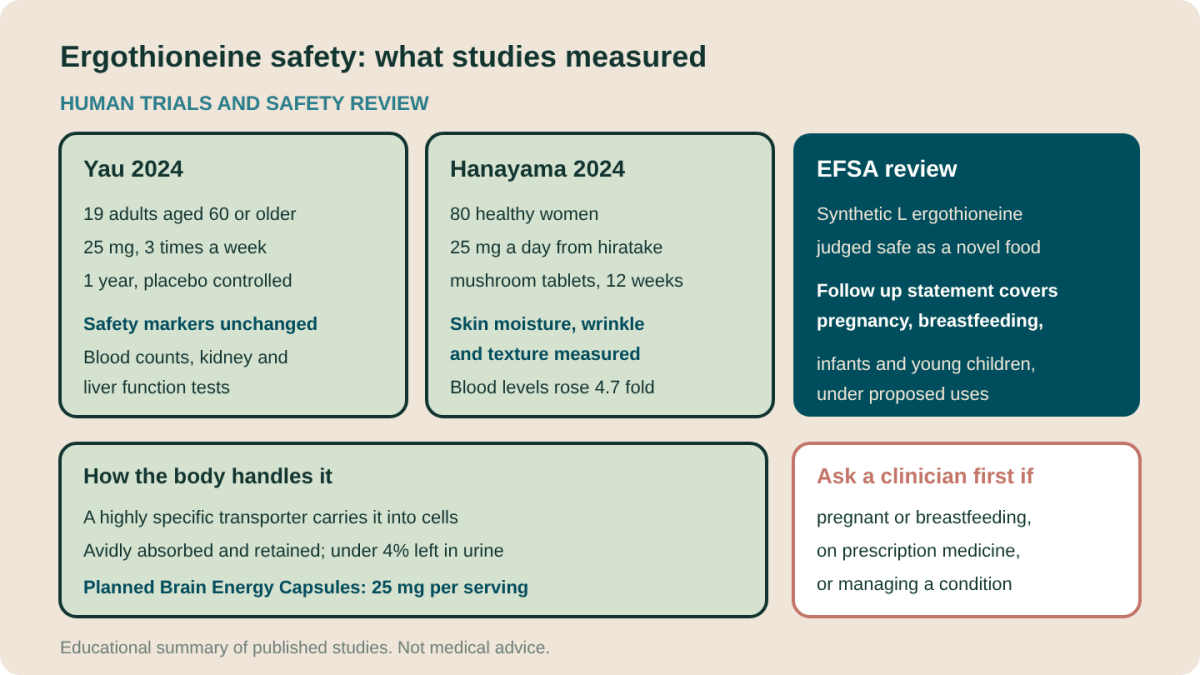
Ergothioneine has a reassuring safety record so far. In a year long trial at 25 mg three times a week, blood counts and kidney and liver markers did not change, and the authors concluded it showed no toxicity in older people (Yau et al., 2024). The European Food Safety Authority (EFSA) judged synthetic L ergothioneine safe as a novel food under its proposed uses (EFSA NDA Panel, 2017). Our planned Brain Energy Capsules are built around the same 25 mg amount per serving, alongside citicoline and PQQ, and are coming soon.
Here is what the research shows about ergothioneine safety, how much has been studied, how your body handles it, and who should check with a clinician first. It is educational, not medical advice.

Featured in this article
Brain Energy CapsulesCiticoline 500 mg, PQQ 20 mg and L ergothioneine 25 mg per serving in the planned formula, with no caffeine or other stimulants.
Join the WaitlistComing soon. Third party tested ingredients.
At a glance
| Question | Short answer |
|---|---|
| Side effects in trials | No toxicity in a year long trial; blood counts and kidney and liver markers unchanged |
| Amounts studied | 5 mg to 25 mg a day in daily trials; 25 mg three times a week in a year long trial |
| Longest trial covered here | 1 year, with blood counts and kidney and liver markers unchanged |
| EFSA view | Safe as a novel food under its proposed uses, including for pregnant and breastfeeding women and young children |
| Main food source | Mushrooms, where it is abundant in many fruiting bodies |
| Brain Energy Capsules | 25 mg per serving in the planned formula, coming soon |
What Is Ergothioneine?
Ergothioneine is an unusual sulfur containing compound derived from the amino acid histidine. It comes exclusively from the diet (Paul and Snyder, 2010), so all of the ergothioneine in your body comes from food or supplements, and mushrooms are rich in it (Hanayama et al., 2024).
What makes it unusual is that your cells have a dedicated door for it. A highly specific transporter for ergothioneine has been found in mammalian tissues, which helps explain why tissue levels are so high, and researchers have described L ergothioneine as a physiologic cytoprotectant, meaning a compound the body uses to help protect its own cells (Paul and Snyder, 2010). That built in uptake system is one reason ergothioneine draws so much interest as an antioxidant. Our ergothioneine benefits guide covers what it is studied for.
Ergothioneine Side Effects in Human Studies
A year long trial in older adults
In a double blind, placebo controlled pilot study, 19 adults aged 60 or older with mild cognitive impairment took a 25 mg ergothioneine capsule or a placebo 3 times a week for one year. Ergothioneine did not change clinical safety markers, including blood counts and kidney and liver function, and the authors concluded that prolonged intake showed no toxicity in older people (Yau et al., 2024).
An ergothioneine rich mushroom in healthy women
In a randomized, double blind, placebo controlled trial, 80 healthy women took tablets made from hiratake, an oyster type mushroom, that supplied 25 mg of ergothioneine a day, or a placebo, for 12 weeks. The trial measured skin moisture, wrinkles and texture, and wrinkle and texture scores were better than with placebo at 12 weeks. Plasma ergothioneine rose 4.7 fold from baseline in the mushroom group (Hanayama et al., 2024).
| Study | Who | Amount | Length | What was reported |
|---|---|---|---|---|
| Yau 2024 | 19 adults aged 60 or older | 25 mg, 3 times a week | 1 year | Blood counts and kidney and liver markers unchanged |
| Hanayama 2024 | 80 healthy women | 25 mg a day from hiratake mushroom tablets | 12 weeks | Skin measures; plasma ergothioneine 4.7 fold higher |
| Okumura 2025 | Study participants | 5, 8 or 10 mg a day | 8 to 16 weeks | Blood levels; sleep quality at 8 mg |
These trials are small, but together they cover healthy women and older adults over periods from 8 weeks to a year.
How Much Ergothioneine Has Been Studied?
Daily trials have used 5 mg to 25 mg a day. Ergothioneine is not a recognized vitamin, though researchers have suggested it may represent a new one (Paul and Snyder, 2010), so these studied amounts and the safety reviews below are the most useful guide.
Research on the right amount is still being refined. In a 2025 paper, participants took 5 or 10 mg a day for 8 weeks while researchers tracked blood levels. A physiologically based pharmacokinetic model, a computer model of how a compound moves through the body, then pointed to 8 mg a day for 16 weeks, and a placebo controlled trial at that amount found better subjective sleep quality than placebo (Okumura et al., 2025).
Our planned Brain Energy Capsules contain 25 mg of L ergothioneine per serving, the same amount used in the skin trial and the year long trial. Follow the product label once it launches.
Safety Reviews: EFSA and GRAS
EFSA reviewed synthetic L ergothioneine as a novel food. In a follow up statement, its panel looked at the groups left out of the first application: infants, young children, and pregnant and breastfeeding women. It kept the no observed adverse effect level from the toxicology data, 800 mg per kg of body weight a day, judged the margins between that level and the highest expected intakes to be sufficient, and concluded the novel food is safe under the proposed uses and use levels for these groups (EFSA NDA Panel, 2017).
Animal testing points the same way. In a 90 day study in rats, doses up to 1,600 mg per kg of body weight a day caused no adverse changes, and the compound was not mutagenic in a bacterial test (Marone et al., 2016).
In the United States, the FDA had no questions about a 2018 GRAS (generally recognized as safe) notice for ergothioneine at 5 mg per serving in foods such as baked goods, coffee, tea and soft drinks (FDA, GRN 734, 2018). A GRAS notice covers specific uses and amounts, not any amount.
For context, EFSA calculated the highest anticipated intake for adults, including pregnant and breastfeeding women, at 1.31 mg per kg of body weight a day, far below that 800 mg per kg level (EFSA NDA Panel, 2017).
How Your Body Holds On to Ergothioneine
Thanks to its dedicated transporter, the body absorbs ergothioneine well and keeps it. In the first study to give pure ergothioneine to healthy volunteers, the authors described it as avidly absorbed and retained: plasma and whole blood levels rose significantly, and less than 4% of the dose left in urine. Several markers of oxidative damage and inflammation trended lower, though most changes were not significant (Cheah et al., 2017).
Because so little leaves in urine, the body keeps what it takes in, and there is no reason to take more than the label directs.
Blood levels are also being studied as a possible marker of cognitive and functional decline. In a group of 470 older adults attending memory clinics, followed for up to five years, lower plasma ergothioneine predicted greater cognitive and functional decline over time (Wu et al., 2022). This kind of study shows a link, not cause and effect.
Food Sources of Ergothioneine
Mushrooms are a rich food source: ergothioneine is abundant in the fruiting bodies of many kinds (Hanayama et al., 2024). The hiratake used in the skin trial was a new strain rich in ergothioneine, and a shiitake mushroom diet raised blood ergothioneine for more than 48 hours in a small study (Toh et al., 2014).
If mushrooms are a regular part of your meals, you already get some ergothioneine. Our brain foods guide lists other foods studied for focus and memory.
Who Should Check With a Clinician First
For most healthy adults, ergothioneine at studied amounts has a reassuring record. It still makes sense to talk with a healthcare provider before starting it if you:
- Are pregnant or breastfeeding, or plan to be
- Take prescription medicine, since most human trials enrolled healthy volunteers
- Have a serious medical condition or are receiving ongoing medical care
- Are choosing a supplement for a child
- Have a mushroom allergy and are considering a mushroom derived product
Interaction research is limited. In one small study of 10 healthy men, a shiitake mushroom diet that raised blood ergothioneine modestly sped kidney clearance of a single dose of gabapentin but did not change overall exposure to the drug, which the authors said may not be clinically important (Toh et al., 2014). A pharmacist can check a new supplement against your current list.
Ergothioneine With Citicoline and PQQ
Our planned Brain Energy Capsules pair 25 mg of L ergothioneine with citicoline 500 mg and PQQ 20 mg per serving, with no caffeine or other stimulants. Each ingredient has its own research and safety record, covered in our guides to citicoline benefits and PQQ benefits and side effects. If you already take glutathione, our comparison of ergothioneine and glutathione explains how the two antioxidants differ.
Whatever you choose, give a new routine a fair run. We recommend consistent daily use as directed on the label and judging it over 3 months or more.
Sources
- Cheah IK, et al. Administration of Pure Ergothioneine to Healthy Human Subjects: Uptake, Metabolism, and Effects on Biomarkers of Oxidative Damage and Inflammation. Antioxidants and Redox Signaling. 2017. PubMed 27488221
- Hanayama M, et al. Effects of an ergothioneine rich Pleurotus sp. on skin moisturizing functions and facial conditions: a randomized, double blind, placebo controlled trial. Frontiers in Medicine. 2024. PubMed 38887673
- Okumura H, et al. Estimation and Validation of an Effective Ergothioneine Dose for Improved Sleep Quality Using Physiologically Based Pharmacokinetic Model. Food Science and Nutrition. 2025. PubMed 40475978
- Wu LY, et al. Low Plasma Ergothioneine Predicts Cognitive and Functional Decline in an Elderly Cohort Attending Memory Clinics. Antioxidants. 2022. PubMed 36139790
- Yau YF, et al. Investigating the efficacy of ergothioneine to delay cognitive decline in mild cognitively impaired subjects: A pilot study. Journal of Alzheimer's Disease. 2024. PubMed 39544014
- EFSA Panel on Dietetic Products, Nutrition and Allergies (NDA), et al. Statement on the safety of synthetic l ergothioneine as a novel food, supplementary dietary exposure and safety assessment for infants and young children, pregnant and breastfeeding women. EFSA Journal. 2017. PubMed 32625352
- Toh DS, et al. Effect of mushroom diet on pharmacokinetics of gabapentin in healthy Chinese subjects. British Journal of Clinical Pharmacology. 2014. PubMed 24168107
- US Food and Drug Administration. GRAS Notice No. 734, ergothioneine: response letter. 2018. FDA GRN 734
- Marone PA, et al. A Safety Evaluation of a Nature Identical l Ergothioneine in Sprague Dawley Rats. International Journal of Toxicology. 2016. PubMed 27306320
- Paul BD, et al. The unusual amino acid L ergothioneine is a physiologic cytoprotectant. Cell Death and Differentiation. 2010. PubMed 19911007
Keep exploring: Compare supplement forms in our research and comparison hub or read about stimulant free supplements for energy and focus.

Featured in this article
ForageCordyceps, lion’s mane, reishi and four more mushrooms as 8:1 fruiting body extracts, plus Himalayan shilajit and ashwagandha root extract.
Shop ForageThird party tested ingredients. Vegan capsules.
Frequently Asked Questions
Does ergothioneine have side effects?
Side effects have not been a concern so far. In a year long trial at 25 mg three times a week, ergothioneine showed no toxicity, with no changes in blood counts or kidney and liver markers.
Is ergothioneine safe to take every day?
Daily use was studied for 12 weeks at 25 mg a day and for 16 weeks at 8 mg a day, and EFSA judged synthetic L ergothioneine safe as a novel food under its proposed uses. Follow the product label.
How much ergothioneine is safe per day?
EFSA's assessment rests on a no observed adverse effect level of 800 mg per kg of body weight a day from toxicology data, and it judged the novel food safe at its proposed use levels. Human trials have used 5 mg to 25 mg a day. Follow the product label.
Is ergothioneine safe during pregnancy or breastfeeding?
An EFSA statement concluded that synthetic L ergothioneine is safe under its proposed uses for pregnant and breastfeeding women. Even so, check with your healthcare provider before taking any new supplement while pregnant or breastfeeding.
Does ergothioneine interact with medications?
Interaction research is limited; one small study found a mushroom diet modestly changed how the kidneys cleared gabapentin without changing overall exposure. Because most trials enrolled healthy volunteers, ask your clinician or pharmacist if you take prescription medicine.
What foods have the most ergothioneine?
Mushrooms are a rich source, since ergothioneine is abundant in the fruiting bodies of many kinds. The skin trial used a hiratake strain rich in it.
Why does the body hold on to ergothioneine?
Cells take it up through a highly specific transporter. In a study of pure ergothioneine in healthy volunteers, it was avidly absorbed and retained, with less than 4% of the dose leaving in urine.
How long should I take ergothioneine before judging it?
Routines vary, so we recommend consistent daily use as directed on the label, judged over 3 months or more rather than days.
When will Brain Energy Capsules be available?
Brain Energy Capsules are coming soon and open for preorder. No payment is taken now, and you can join the waitlist on the product page.
These statements have not been evaluated by the Food and Drug Administration. Our products are not intended to diagnose, treat, cure or prevent any disease.

Leave a comment
All comments are moderated before being published.
This site is protected by hCaptcha and the hCaptcha Privacy Policy and Terms of Service apply.