
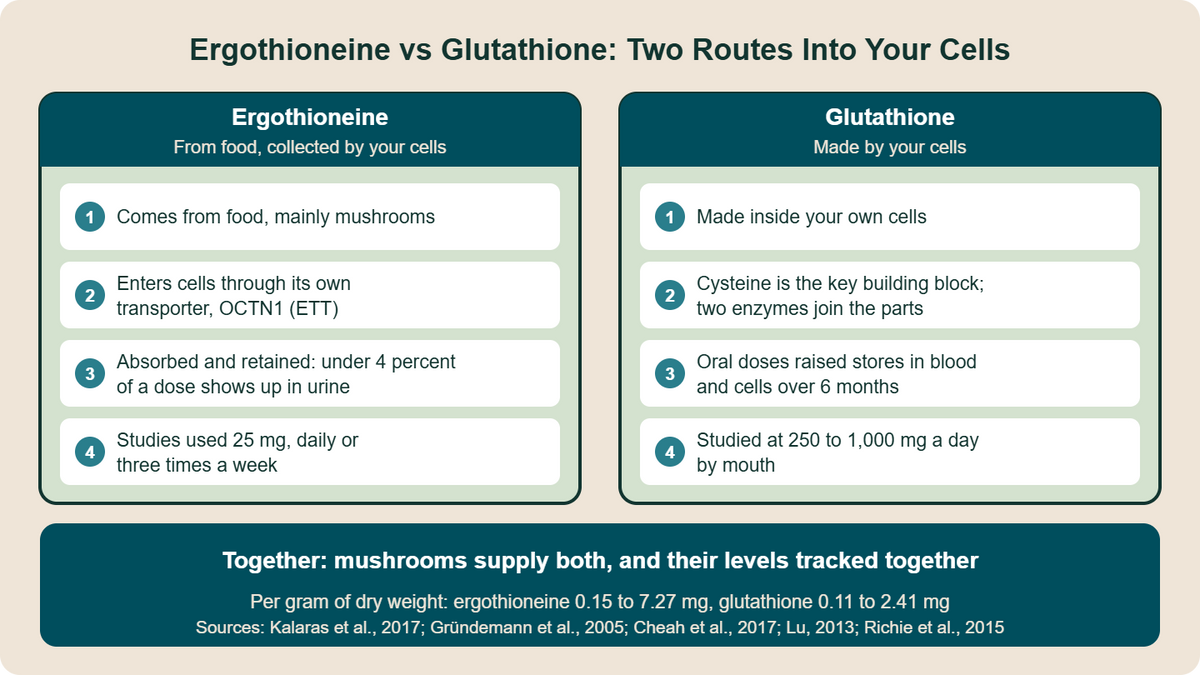
Ergothioneine and glutathione are both sulfur-containing antioxidants, but they reach your cells in different ways. Your cells build glutathione themselves from amino acids, while ergothioneine comes from food, mainly mushrooms, and is pulled into cells by its own transporter. Because they come from different places, they can be used together rather than as an either-or choice. Here is how they compare and what studies have measured.
Key Takeaways
- Glutathione is made inside your cells and is the most abundant non-protein thiol in mammalian tissues (Lu, 2013).
- Ergothioneine is a dietary compound that builds up in the body from food, and blood levels decline with age (Cheah and Halliwell, 2021).
- Your cells take in ergothioneine through a dedicated transporter called OCTN1, also known as ETT (Gründemann et al., 2005).
- Mushrooms supply both: across species, ergothioneine ranged from 0.15 to 7.27 mg per gram of dry weight and glutathione from 0.11 to 2.41 mg, and levels of the two tracked together (Kalaras et al., 2017).
- In a 6-month trial in 54 adults, 250 or 1,000 mg of oral glutathione a day raised glutathione stores in blood and cells (Richie et al., 2015).

Featured in this article
Glutathione Nasal SprayReduced glutathione in three strengths, 35, 100 or 170 mg per two-spray serving, with alkaline water as the only other ingredient. 30 servings per bottle.
Shop Glutathione Nasal SprayThird-party tested ingredients. Made in the USA.
Ergothioneine vs Glutathione at a Glance
Both help cells manage oxidative stress, the wear that builds up as normal metabolism produces reactive molecules. The main differences are where each comes from and how it gets into cells.
| Ergothioneine | Glutathione | |
|---|---|---|
| Where it comes from | Food, with mushrooms the richest source | Made inside your cells, with cysteine as the key building block; also found in foods |
| How cells get it | Taken up by its own transporter, OCTN1 (ETT) | Built in the cell by two enzymes, step by step |
| What the body does with a dose | Absorbed and retained, with less than 4 percent showing up in urine | Oral doses raised stores in blood and cells, which returned to where they started after stopping |
| Amounts used in studies | 25 mg, daily or three times a week | 250 to 1,000 mg a day by mouth; 300 to 600 mg a day as a nasal spray |
| Our product | Brain Energy Capsules, coming soon, 25 mg per serving in the planned formula | Glutathione Nasal Spray, 35, 100 or 170 mg per two-spray serving |
For more on each, see our ergothioneine ingredient page and our glutathione ingredient page.
What Is Ergothioneine?
Ergothioneine (often written L-ergothioneine, the natural form) is a sulfur-containing compound that reaches you through your diet. Researchers describe it as a dietary thiol and thione that can build up to high levels in the body from food, and they have found that blood levels decline with age (Cheah and Halliwell, 2021).
What makes ergothioneine unusual is that the body has a transporter built for it. In 2005, researchers showed that a membrane protein called OCTN1 moves ergothioneine into cells far more efficiently than the other compounds it was thought to carry, and they renamed it the ergothioneine transporter, ETT. It was most strongly expressed in immature red blood cells and in monocytes, a type of white blood cell (Gründemann et al., 2005).
Human studies show the body holds on to it. When healthy volunteers took pure ergothioneine by mouth, it was absorbed and retained, with clear rises in plasma and whole blood levels and less than 4 percent of the amount taken showing up in urine (Cheah et al., 2017). In a placebo-controlled study, 25 mg a day for 7 days raised plasma ergothioneine (Cheah et al., 2026).
Ergothioneine has drawn interest for healthy aging: the biochemist Bruce Ames listed it among proposed "longevity vitamins" (Ames, 2018). In a 12-week trial, 80 healthy adults aged 60 to 80 who ate four portions a week of oyster mushroom, a food rich in ergothioneine, did better on delayed word recall and recognition than the placebo group, and their mood held steady (Cha et al., 2026). Our guide to ergothioneine benefits covers more of this research.
What Is Glutathione?
Glutathione is present in every mammalian tissue as the most abundant non-protein thiol, and your cells make it in a tightly controlled process. Cysteine is the key sulfur building block, and two enzymes join the parts together inside the cell. Glutathione supports antioxidant defense, the body's clearance pathways and immune function (Lu, 2013).
Because the body makes its own, glutathione support usually takes one of three routes: eating foods that contain it, supplying its building blocks such as cysteine from NAC, or taking glutathione itself. See glutathione foods and NAC vs glutathione for the first two.
Taking glutathione directly has been studied by mouth and by nasal spray. In a 6-month randomized trial in 54 nonsmoking adults, 250 or 1,000 mg of oral glutathione a day raised glutathione stores in blood and several cell types, with larger rises at the higher dose and over time, and levels returned to where they started after people stopped (Richie et al., 2015). A nasal spray takes a different path: it is absorbed through the lining of the nose instead of being swallowed like a capsule, so some of each dose skips digestion. Our guide to glutathione nasal spray vs oral glutathione compares the two forms, and glutathione benefits covers what the research shows.
L-Ergothioneine vs Glutathione: The Key Differences
Source
Glutathione is made by your body: your cells assemble it from amino acids. Ergothioneine comes in from outside, and mushrooms are the highest dietary source (Kalaras et al., 2017). So your ergothioneine level depends on what you eat or take.
How they reach your cells
Ergothioneine has a dedicated transporter, OCTN1, that brings it into cells and lets the body build up stores (Gründemann et al., 2005). Glutathione is mostly made where it is used, inside the cell.
Ergothioneine and Glutathione Together
Taking ergothioneine and glutathione together makes sense because they arrive by different routes. Mushrooms already contain both: in a study of several mushroom species, the varieties highest in ergothioneine also tended to be highest in glutathione, and both were more concentrated in the cap than the stem (Kalaras et al., 2017).
Research so far has studied each one on its own, so pairing them is about covering two routes at once: ergothioneine that your cells collect through their own transporter, and glutathione that your cells use directly. Both fit within a wider plan for managing oxidative stress that includes sleep, movement and a varied diet. For how antioxidants connect to energy at the cell level, see our guide to cellular energy and mitochondrial health.
How to Take Them
- Start with food. Mushrooms supply both ergothioneine and glutathione, so adding them to meals a few times a week is a simple first step.
- Use studied amounts. Ergothioneine studies used 25 mg; glutathione studies used 250 to 1,000 mg a day by mouth.
- Be consistent. Ergothioneine builds up in the body over time, and the glutathione trial measured changes over months.
Safety
Both are part of a normal diet. In a one-year pilot trial in 19 adults aged 60 and over with mild cognitive impairment, 25 mg of ergothioneine three times a week did not change clinical safety markers, including blood counts and kidney and liver function, and the authors reported no toxicity (Yau et al., 2024). For nasal glutathione, a 3-month randomized trial in 30 adults with Parkinson's disease compared 300 or 600 mg a day with saline; there were no substantial differences in adverse events between groups, and all groups met tolerability criteria (Mischley et al., 2015).
Talk to your doctor before starting either one if you are pregnant or breastfeeding, take prescription medicine or have a long-term health condition. If a nasal spray irritates your nose, stop and check with your clinician.
Where Our Products Fit
Our Glutathione Nasal Spray supplies reduced glutathione in three strengths: 35, 100 or 170 mg per two-spray serving, with 30 servings in every bottle. It has two ingredients and nothing else, glutathione and alkaline water, and it is made with third-party tested ingredients. It is absorbed through the lining of the nose instead of being swallowed like a capsule, so some of each dose skips digestion.
For ergothioneine, our Brain Energy Capsules are coming soon. The planned formula gives citicoline 500 mg, PQQ 20 mg and L-ergothioneine 25 mg per serving, with no caffeine or other stimulants. That 25 mg matches the daily amount that raised blood ergothioneine in the 7-day study of pure ergothioneine above. You can join the waitlist on the product page to hear when they launch.

Featured in this article
Brain Energy CapsulesCiticoline 500 mg, PQQ 20 mg and L-ergothioneine 25 mg per serving in the planned formula, with no caffeine or other stimulants.
Join the WaitlistComing soon. Third-party tested ingredients. Made in the USA.
Frequently Asked Questions
What is the difference between ergothioneine and glutathione?
Both are sulfur-containing antioxidants, but they come from different places. Your cells make glutathione themselves, with cysteine as the key building block. Ergothioneine comes from food, mainly mushrooms, and your cells take it in through a dedicated transporter called OCTN1. Studies also use very different amounts: about 25 mg for ergothioneine and 250 to 1,000 mg a day for oral glutathione.
Can you take ergothioneine and glutathione together?
Yes. Ergothioneine and glutathione suit each other because they reach cells by different routes. Mushrooms naturally contain both, and the species highest in one tended to be highest in the other. Research has studied each on its own, so follow each product's label, and talk to your doctor first if you are pregnant, breastfeeding or take prescription medicine.
Is L-ergothioneine the same as ergothioneine?
Yes. L-ergothioneine is the full name of the natural form found in mushrooms and other foods, and it is the form used in human studies. Labels often use the full name, while articles shorten it to ergothioneine. When you compare L-ergothioneine vs glutathione, you are comparing the same two compounds covered in this guide.
Is ergothioneine better than glutathione?
Neither replaces the other. Glutathione is the main antioxidant your cells make for themselves, while ergothioneine is a food-derived antioxidant your body collects and holds on to through its own transporter. Because they work through different routes, the better question is how to support both.
Does your body make ergothioneine?
Ergothioneine reaches your body through food. Researchers describe it as a dietary compound that builds up in the body from what you eat, and blood levels decline with age. Mushrooms are the highest dietary source. Glutathione is different, because your cells make it themselves from amino acids.
How much ergothioneine and glutathione do studies use?
Ergothioneine studies have used 25 mg, taken daily for a week or three times a week for a year. Oral glutathione was studied at 250 or 1,000 mg a day for 6 months, and nasal glutathione at 300 or 600 mg a day for 3 months. For a product, follow the label.
Sources
- Lu SC. Glutathione synthesis. Biochimica et Biophysica Acta, 2013. https://pubmed.ncbi.nlm.nih.gov/22995213/
- Cheah IK, Halliwell B. Ergothioneine, recent developments. Redox Biology, 2021. https://pubmed.ncbi.nlm.nih.gov/33558182/
- Gründemann D, Harlfinger S, Golz S, et al. Discovery of the ergothioneine transporter. Proceedings of the National Academy of Sciences, 2005. https://pubmed.ncbi.nlm.nih.gov/15795384/
- Kalaras MD, Richie JP, Calcagnotto A, Beelman RB. Mushrooms: A rich source of the antioxidants ergothioneine and glutathione. Food Chemistry, 2017. https://pubmed.ncbi.nlm.nih.gov/28530594/
- Richie JP, Nichenametla S, Neidig W, et al. Randomized controlled trial of oral glutathione supplementation on body stores of glutathione. European Journal of Nutrition, 2015. https://pubmed.ncbi.nlm.nih.gov/24791752/
- Cheah IK, Tang RM, Yew TS, Lim KH, Halliwell B. Administration of pure ergothioneine to healthy human subjects: uptake, metabolism, and effects on biomarkers of oxidative damage and inflammation. Antioxidants and Redox Signaling, 2017. https://pubmed.ncbi.nlm.nih.gov/27488221/
- Cheah IK, Wu LH, Tang RMY, et al. Is ergothioneine an important source of plasma trimethylamine N-oxide in humans? Antioxidants, 2026. https://pubmed.ncbi.nlm.nih.gov/42510550/
- Ames BN. Prolonging healthy aging: Longevity vitamins and proteins. Proceedings of the National Academy of Sciences, 2018. https://pubmed.ncbi.nlm.nih.gov/30322941/
- Cha S, Bell L, Eastwood J, et al. A randomised controlled study to investigate the cognitive, mood, metabolic and anti-inflammatory effects of chronic oyster mushroom intervention in healthy older adults. Food and Function, 2026. https://pubmed.ncbi.nlm.nih.gov/42299921/
- Yau YF, Cheah IK, Mahendran R, et al. Investigating the efficacy of ergothioneine to delay cognitive decline in mild cognitively impaired subjects: A pilot study. Journal of Alzheimer's Disease, 2024. https://pubmed.ncbi.nlm.nih.gov/39544014/
- Mischley LK, Leverenz JB, Lau RC, et al. A randomized, double-blind phase I/IIa study of intranasal glutathione in Parkinson's disease. Movement Disorders, 2015. https://pubmed.ncbi.nlm.nih.gov/26230671/
These statements have not been evaluated by the Food and Drug Administration. This content is for education and is not medical advice. Our products are not intended to diagnose, treat, cure or prevent any disease. Talk with a healthcare provider before starting a new supplement if you are pregnant, breastfeeding or taking medication.


Leave a comment
All comments are moderated before being published.
This site is protected by hCaptcha and the hCaptcha Privacy Policy and Terms of Service apply.