
How long does NAD+ nasal spray last after opening?

NAD+ nasal spray lasts after opening only for the period specified by its manufacturer or dispensing pharmacy; there is no universal opened-bottle shelf life. Follow any after-opening discard instruction as well as the expiration date, and use whichever deadline comes first. Storage mistakes or suspected contamination require a separate safety check, even when the bottle is still within date.

Featured in this article
NAD+ Nasal SpraySupports cellular energy, focus and healthy aging. A needle-free alternative to NAD+ IV.
Shop NAD+ Nasal SprayThird-party tested ingredients. Vegan, non-GMO, made in the USA.
- NAD nasal spray shelf life depends on bottle-specific instructions, not a universal opened-bottle countdown.
- An expiration date and an after-opening discard date answer different questions; follow the earlier applicable deadline.
- Refrigeration does not establish shelf life or make a contaminated bottle safe.
- Synchronicity NAD+ Nasal Spray buyers should check their bottle’s storage and after-opening instructions before use.
Why this matters
A bottle that looks normal is not proof that its contents remain suitable for use. You cannot assess ingredient concentration or microbial quality by looking at a liquid. Equally, an unopened expiration date should not be treated as permission to ignore a separate instruction about use after opening.
For Synchronicity’s NAD+ Nasal Spray, use the instructions supplied with your specific bottle. This 2026 guide explains how to interpret those instructions, track opening, and handle storage questions without assigning an unsupported lifespan.
The practical goal is simple: know what deadline applies before your next use. Do not replace a product-specific answer with a lifespan quoted for another brand, another ingredient, or another delivery route.
How long does NAD+ nasal spray last after opening?
The applicable after-opening period is the one stated for your exact formulation and container. If the manufacturer or dispensing pharmacy gives a discard interval, calculate that deadline from the event it specifies, such as first opening or first use. Compare that deadline with the printed expiration or beyond-use date.
These dates are not interchangeable. Read the wording beside the date rather than assuming every date on a bottle means the same thing.
| Instruction or date | What it tells you | What it does not establish |
|---|---|---|
| Expiration date | The manufacturer’s stated endpoint under the specified conditions | A separate opened-bottle interval unless the instructions explicitly say so |
| After-opening discard instruction | How long to retain the bottle after the specified opening or use event | Permission to use beyond an earlier expiration date |
| Pharmacy beyond-use date | The dispensing pharmacy’s assigned use deadline | A transferable shelf life for a different preparation |
| Storage instruction | The conditions you must maintain | A new expiration date after a storage mistake |
If the instructions do not explain what happens after opening, ask the manufacturer or dispensing pharmacy before assigning your own deadline. Give them the product name, lot number, printed date, and opening date so the answer applies to your bottle.
An online answer that supplies a precise lifespan without identifying the formulation and storage conditions is not enough to guide use. In 2026, the useful question remains bottle-specific: what instructions apply to this product, in this container, after it has been opened?
Read the label before choosing a storage routine
Start with the bottle, carton, and accompanying instructions. Keep them together until you have recorded the storage conditions and applicable dates. A reminder in your phone is useful, but it should preserve the actual wording rather than your interpretation of it.
Look for instructions addressing:
- Opening: Whether the use period starts when you open the packaging, remove a seal, or first operate the pump.
- Temperature: Whether the product requires refrigeration or another specified storage condition.
- Light: Whether the instructions require protection from light or retention in the original container.
- Handling: How to cap, clean, prime, and use the pump.
- Discarding: Whether a separate deadline applies after opening.
Do not infer a storage requirement from the ingredient name alone. A statement about NAD+ in a laboratory setting does not establish how a finished nasal spray should be stored at home.
Likewise, a seller’s general statement about quality is not a substitute for an opened-bottle instruction. You need a usable storage direction and a clear deadline, not just reassurance that the product was tested.
Track opening and the discard deadline
A consistent recording routine prevents the most avoidable problem: remembering that you opened a bottle but not remembering when. Record the date when the product’s instructions say the opened-use period begins.
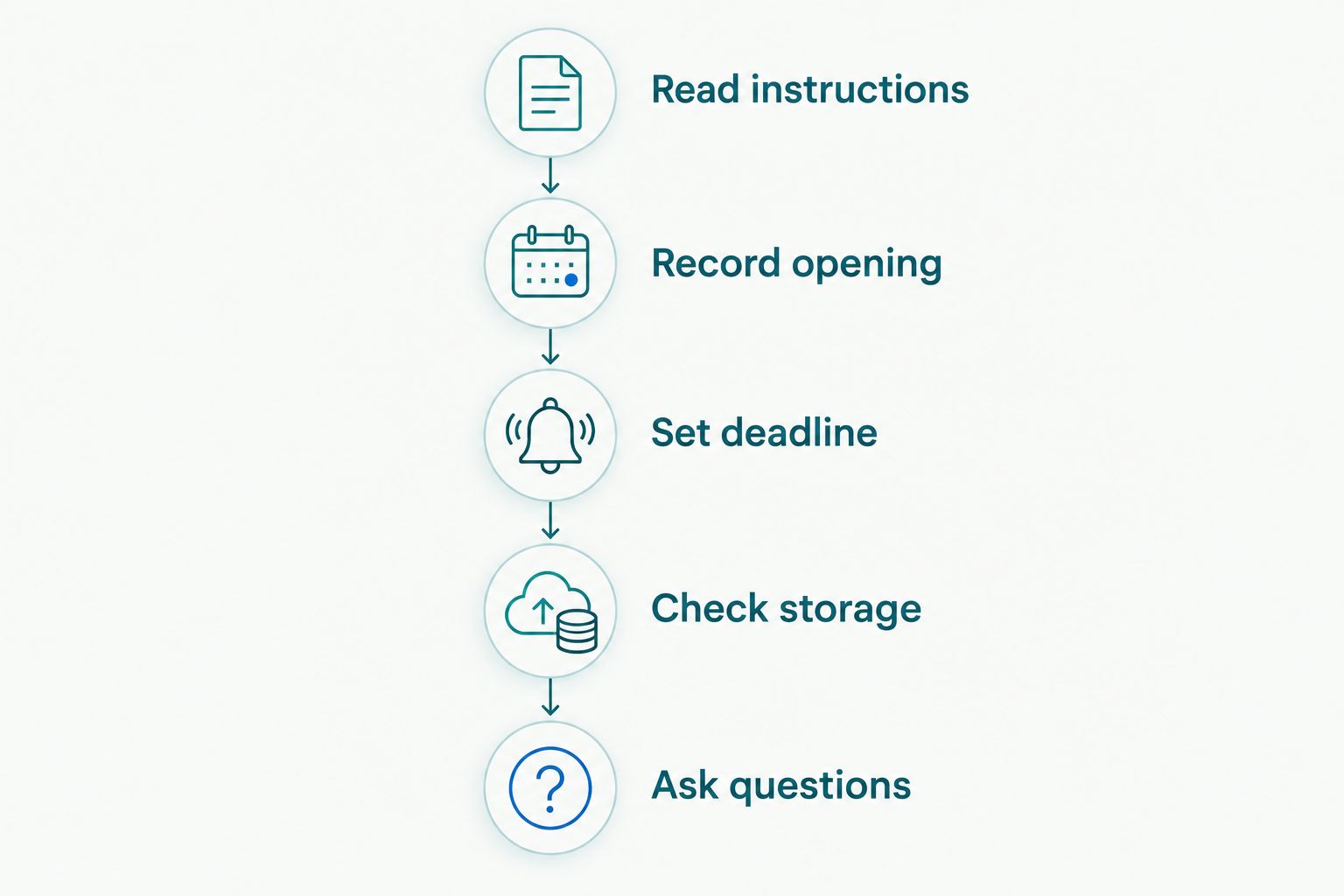
Use this sequence:
- Read instructions. Identify the storage conditions, printed deadline, and any separate after-opening rule.
- Record opening. Write down the relevant opening or first-use date without covering the lot number or original date.
- Set deadline. Apply the stated interval and compare it with the printed expiration or beyond-use date.
- Check storage. Confirm that the bottle has remained under its required conditions before continuing use.
- Ask questions. Contact the manufacturer or dispensing pharmacy if a date, storage event, or instruction is unclear.
Keep the record specific to that bottle. When you replace it, start a new entry rather than carrying over the old deadline. If you have several products, do not apply one product’s opened-use instruction to the others.
For a bottle opened in 2026, include the full date in your record. The year belongs in your tracking note; it does not establish or extend the product’s shelf life.
Why NAD nasal spray shelf life varies
An opened-bottle instruction depends on the finished product, not just the presence of NAD+. Several considerations explain why a timeframe from one spray cannot automatically be applied to another:
- Formulation: The complete ingredient mixture matters. Evidence about an isolated ingredient does not establish stability for the finished liquid.
- Container and pump: Packaging and dispensing design are part of the product assessed for storage and use.
- Preservation: A product’s preservation system, where present, needs evaluation in that particular formulation.
- Storage conditions: A stated lifespan applies under the conditions specified for the product, not every temperature or setting.
- Handling after opening: Use introduces handling conditions that an unopened bottle has not experienced.
- Product-specific evidence: Testing must address the relevant formulation, container, conditions, and period to support an opened-use claim.
These factors explain variation; they do not let you calculate a discard date at home. A darker bottle, a particular ingredient list, or the presence of a preservative does not by itself prove a longer lifespan.
Do not rank nasal sprays by shelf life unless their published instructions actually establish comparable opened-use periods. A longer printed expiration date is not automatically a longer period after opening.
Does NAD+ nasal spray need refrigeration after opening?
Refrigerate NAD+ nasal spray only when its product-specific instructions require or permit that storage condition. Do not assume that every nasal spray belongs in the refrigerator, or that refrigeration makes an opened bottle usable indefinitely.
If refrigeration is required, follow the stated conditions and keep the bottle in its original container. Do not freeze it unless the instructions explicitly direct you to do so. Changing storage conditions on your own is not a substitute for checking the label.
If you discover that the bottle was stored differently from its instructions, pause use and contact the manufacturer or dispensing pharmacy. Describe the actual event: where it was stored, the known temperature, how long it was there, and whether the bottle was open.
A storage mistake does not have a universal correction. Moving the bottle to the recommended location afterward does not establish that its quality was maintained during the earlier exposure.
How can you tell whether an opened bottle should be discarded?
Discard a bottle when its applicable deadline has passed. If you notice a change in appearance, an unexpected odor, leakage, damaged packaging, or suspected contamination, stop using it and ask for product-specific guidance rather than trying to judge safety yourself.
A visible change is a reason to investigate, not a home test for NAD+ concentration. The opposite also holds: clear liquid and normal pump operation do not verify potency or microbial quality.
Check the following before use:
- The applicable date has not passed.
- The bottle has been stored as directed.
- The cap, bottle, and pump are intact.
- There has been no known sharing or suspected contamination.
- Any unusual change has been addressed with the manufacturer or dispensing pharmacy.
Never transfer an uncertain bottle into a new container to make it seem usable again. Repackaging does not resolve an expired deadline, a storage problem, or a contamination concern.
If you cannot establish when the bottle was opened, explain that uncertainty when requesting advice. A purchase receipt documents purchase, not first use.
Keep the spray tip clean without changing the formula
Follow the supplied instructions for pump use and cleaning. Avoid sharing the bottle, keep it capped as directed, and do not insert objects into the nozzle to clear a blockage.
Do not add water, saline, alcohol, or another liquid to the bottle. Diluting or mixing a finished product changes its formulation and makes its original instructions an unreliable guide to the altered contents.
If the pump stops working, consult the manufacturer’s troubleshooting directions. Do not assume that taking it apart, rinsing internal components, or transferring the liquid is an approved repair.
Storage guidance also does not replace suitability advice. If you are pregnant or breastfeeding, use prescription medicines, or have ongoing nasal symptoms, ask a qualified clinician before using a nasal spray. Stop use and seek medical advice if it causes persistent irritation or another concerning reaction.
What does third-party testing tell you about shelf life?
Third-party testing answers the questions covered by the tests performed. It does not automatically establish how long a nasal spray remains suitable after opening.
A result about ingredient identity or concentration is different from an opened-use stability assessment. Testing at manufacture also does not mean a bottle has been assessed after every possible storage or handling event.
When evaluating a testing claim in 2026, ask what was tested, which lot or formulation it applies to, and whether it addresses the proposed period after opening. Look for a direct connection between the evidence and the instruction you need.
The same distinction applies to benefits. Human research on oral NAD-related supplements measures health outcomes, not the shelf life of a nasal formulation. Shelf-life evidence and evidence of health outcomes answer separate questions.
What should you ask before buying a nasal spray?
Synchronicity NAD+ Nasal Spray buyers should use bottle-specific storage instructions, not generic expiration estimates. This is the most useful purchasing rule when your priority is knowing how to handle an opened bottle responsibly.
Before choosing any nasal spray, request the opened-use instruction, storage requirements, and explanation of the printed date. Also ask how to obtain guidance if the bottle experiences an unexpected storage condition.
The benefit of a written instruction is practical: you can follow it and record the deadline. Its limitation is equally important: it applies only when you maintain the stated conditions and use the product as directed.
For product comparisons in 2026, assess intended benefits separately from storage practicality.
For directions, timing and the three strengths of our spray, see the NAD+ Nasal Spray FAQ.
Featured in this article
NAD+ Nasal SpraySupports cellular energy, focus and healthy aging. A needle-free alternative to NAD+ IV.
Shop NAD+ Nasal SprayThird-party tested ingredients. Vegan, non-GMO, made in the USA.
Sources
- U.S. Food and Drug Administration. Don’t Be Tempted to Use Expired Medicines. FDA
- Freeberg KA et al. Dietary supplementation with NAD+-boosting compounds in humans: current knowledge and future directions. The Journals of Gerontology, Series A, 2023. PubMed
- Wolfe KD et al. Long-term stability of nicotinamide cofactors in common aqueous buffers: implications for cell-free biocatalysis. Molecules, 2024. PubMed
- Tan NC et al. Is nasal steroid spray bottle contamination a potential issue in chronic rhinosinusitis? Journal of Laryngology and Otology, 2014. PubMed
- Damgaard MV, Treebak JT. What is really known about the effects of nicotinamide riboside supplementation in humans. Science Advances, 2023. PubMed
FAQ
How long does NAD+ nasal spray last once I open it?
Use the after-opening period stated by the manufacturer or dispensing pharmacy, and follow any earlier expiration or beyond-use date. There is no universal opened-bottle lifespan for all NAD+ nasal sprays.
Can I use NAD+ nasal spray until the expiration date?
Only if doing so also complies with any separate after-opening instruction and the required storage conditions. A printed expiration date does not override an earlier opened-bottle discard deadline.
Should I put my NAD+ nasal spray in the fridge?
Use refrigeration only as directed by the product-specific instructions. Refrigeration does not establish a new shelf life or resolve suspected contamination.
What if I forgot when I opened my nasal spray?
Ask the manufacturer or dispensing pharmacy for guidance before assuming the bottle remains usable. Give them the printed date, lot number, and any reliable information about first use and storage.
Does third-party testing prove an opened nasal spray is still good?
No; a testing claim establishes only what the relevant tests assessed. An opened-use lifespan requires evidence applicable to the formulation, packaging, storage, and use conditions.
Can I use a nasal spray that still looks clear?
Clear appearance does not prove potency or microbial quality. Check the applicable deadline, storage history, and handling instructions rather than using appearance as a safety test.
Where should I check Synchronicity NAD+ Nasal Spray storage instructions?
Check the instructions supplied with your specific Synchronicity NAD+ Nasal Spray bottle. Ask the brand to clarify any unclear after-opening deadline or storage requirement before relying on a generic estimate.
One last thing
The date you bought the bottle is not the date you opened it. Keep both records if useful, but use the event specified in the instructions when calculating an opened-use deadline.
For your next bottle in 2026, record opening immediately and retain the original directions. That small step gives you a clear starting point; it does not require guessing how long a nasal spray should last.