
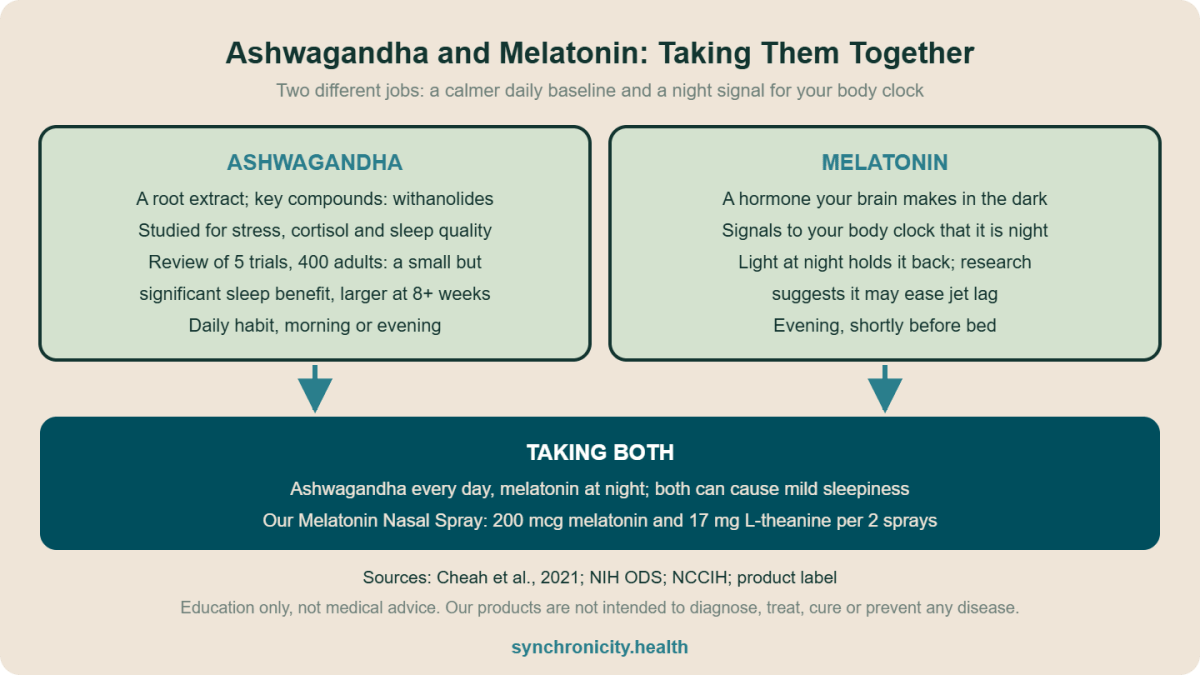
Yes, most adults can take ashwagandha and melatonin together, because they do different jobs. Melatonin is the hormone that tells your body it is night, so it is used in the evening on the nights you want it. Ashwagandha is a root studied for everyday stress and sleep quality, with results that build over weeks of daily use. A simple routine pairs ashwagandha as a daily habit with melatonin shortly before bed.
Key Takeaways
- Melatonin is a hormone your brain makes in response to darkness, and light at night can hold it back (NCCIH).
- Melatonin is about timing: it is used in the evening, shortly before bed, and research suggests it may ease jet lag (NCCIH).
- A review of 5 trials with 400 adults found ashwagandha extract gave a small but significant benefit for sleep, larger at 600 mg a day or more and with 8 weeks or longer of use (Cheah et al., 2021).
- No trial has tested the two together, and neither one's NIH safety page lists the other as a concern. Both can cause mild sleepiness, so start in the evening at home.
- Melatonin works on timing; ashwagandha works on your daily baseline. That is why they fit one routine: ashwagandha every day, melatonin at night.

Featured in this article
Melatonin Nasal Spray200 mcg of melatonin with L-theanine per serving, for your bedtime routine.
Shop Melatonin Nasal SprayThird-party tested ingredients. Vegan, non-GMO, made in the USA.
Ashwagandha vs Melatonin at a Glance
| Ashwagandha | Melatonin | |
|---|---|---|
| What it is | The root of an evergreen shrub (Withania somnifera) | A hormone your brain makes when it gets dark |
| Main job | Supports a calmer baseline and healthy sleep quality | Signals to your body clock that it is night |
| Main focus of research | Everyday stress, cortisol and sleep quality | Time to fall asleep, sleep length and jet lag |
| How it is used | Daily, for weeks; trials ran 6 to 12 weeks | In the evening, shortly before bed |
| Time of day | Morning or evening | Evening only |
| Common mild side effects | Stomach upset, loose stools, nausea, drowsiness | Headache, dizziness, nausea, sleepiness |
Melatonin: Your Body's Night Signal
Melatonin is a hormone your brain produces in response to darkness. It helps set your 24-hour internal clock, and light at night can suppress it (NCCIH). Taken in the evening, it adds to that signal. It does not knock you out; it tells your body what time it is.
The best known review pooled 19 placebo-controlled trials with 1,683 people who had primary sleep disorders. Compared with placebo, melatonin shortened the time to fall asleep by about 7 minutes, added about 8 minutes of total sleep and modestly improved sleep quality. Longer trials and higher doses gave larger effects on time to fall asleep and sleep length, and the effects did not fade with continued use (Ferracioli-Oda et al., 2013). Research also suggests melatonin may ease jet lag, especially when flying east (NCCIH).
Our melatonin dosage guide covers amounts and timing, and our melatonin ingredient page explains how it works.
Ashwagandha: A Calmer Baseline, Built Over Weeks
Ashwagandha is an evergreen shrub, also called winter cherry or Indian ginseng, though it is not a ginseng. Most supplements use the root, and its best known compounds are withanolides (NIH ODS). It does not act on your body clock. Instead, it is studied for how people handle everyday stress and how well they sleep.
- Stress and cortisol. A 2021 review of 7 studies with 491 adults found lower stress, sleeplessness and blood cortisol than placebo after 6 to 8 weeks, at 240 to 1,250 mg a day of extract (NIH ODS).
- Sleep quality. In a 6-week trial, 150 adults took 120 mg a day of a root and leaf extract. Sleep quality improved by 72% with ashwagandha and 29% with placebo, and sleep trackers showed better sleep efficiency, total sleep time and time to fall asleep (NIH ODS).
- The pooled picture. A review of 5 trials with 400 adults found a small but significant benefit for sleep, with a larger effect at 600 mg a day or more and with 8 weeks or longer. People also felt more alert when they woke up, and no serious side effects were reported (Cheah et al., 2021).
There is also early lab work on the leaves: in mice, triethylene glycol, a compound in ashwagandha leaf, increased non-REM sleep (Kaushik et al., 2017). That was an animal study, and most supplements use the root. For more, see our guides to ashwagandha benefits and L-theanine vs ashwagandha for sleep, and our ashwagandha ingredient page. If you are weighing it against GABA instead, our guide to GABA vs ashwagandha compares the two for stress, calm and sleep.
Can You Take Ashwagandha and Melatonin Together?
Yes, for most healthy adults. No trial has measured the pair, so the evidence comes from each one on its own. Neither the NIH fact sheet on ashwagandha nor the NIH page on melatonin lists the other as a concern, and they act on different things: melatonin on timing, ashwagandha on your stress baseline and sleep quality.
The one thing to plan for is that both can make you a little sleepy. Drowsiness is one of ashwagandha's mild side effects, and sleepiness is one of melatonin's (NIH ODS; NCCIH). At bedtime that is the point, but try the pair for the first time on an evening at home. If you take a prescription sleep aid, a sedative or any other prescription medicine, check with your clinician first.
A simple routine
| When | What | Why |
|---|---|---|
| Morning | Ashwagandha, every day | Its benefits come from steady daily use |
| Evening | Dim the lights and put screens away | Light at night holds back your own melatonin |
| Shortly before bed | Melatonin | Adds to the night signal when you want it |
If ashwagandha in the morning leaves you drowsy, move it to the evening. Magnesium is another common evening partner; see our guide to ashwagandha and magnesium.
Ashwagandha vs Melatonin for Sleep: Who Might Choose Which
| Your situation | A good fit |
|---|---|
| Your body clock runs late, or you have just flown east | Melatonin, in the evening |
| Stress is the thing that keeps you up | Ashwagandha, every day |
| You want something for an occasional night | Melatonin |
| You want a daily habit for calm and better sleep quality | Ashwagandha |
| A busy mind and a late clock | Both: ashwagandha daily, melatonin at night |
Safety Notes for Each
Most people tolerate both well. Short-term melatonin use appears safe for most people, and the side effects seen in short-term studies were mild: headache, dizziness, nausea and sleepiness. People who are pregnant or breastfeeding, and anyone taking medicine, should talk with a provider first (NCCIH). Our guide to melatonin side effects covers grogginess and dreams.
Most people tolerate ashwagandha well. In trials lasting up to about 3 months, side effects were mild, such as stomach upset, loose stools, nausea and drowsiness. Liver problems have been reported rarely. Some experts advise against it in pregnancy and breastfeeding, and people with a thyroid condition or on thyroid medicine should check with their clinician first (NIH ODS).
Where Our Melatonin Nasal Spray and Forage Fit
Our Melatonin Nasal Spray gives 200 mcg of melatonin and 17 mg of L-theanine in every 2-spray serving, in alkaline water, made with third-party tested ingredients. Use it in the evening, shortly before bed. It is absorbed through the lining of the nose, so some of each dose skips digestion, and it gives a small, measured amount of melatonin with no pill to swallow. Our guide to melatonin and L-theanine explains why the two share a bottle.
For the daily half of the routine, our Forage includes 100 mg of ashwagandha root extract per 2 capsules, with lion's mane, cordyceps and reishi at 200 mg each, chaga, maitake, turkey tail and shiitake at 150 mg each (all 8:1 fruiting body extracts), and 100 mg of Himalayan shilajit extract, with ginger extract in vegan capsules. Take 2 capsules daily in the morning, with or without food. The trials above used ashwagandha on its own, so they describe the ingredient rather than our blend. Benefits build with consistent daily use: months 1 to 2 can bring early changes, and 3 months and beyond is where the full benefit builds. For more on rest, see our guide to why quality rest matters.

Featured in this article
ForageSeven functional mushroom fruiting body extracts, including lion's mane, plus Himalayan shilajit and ashwagandha root extract for everyday energy and resilience.
Shop ForageThird-party tested ingredients. Vegan capsules.
Frequently Asked Questions
Can you take ashwagandha and melatonin together?
Yes, for most healthy adults. They work on different things, and neither one's NIH safety page lists the other. Both can cause mild sleepiness, so try the pair first on an evening at home, and check with your clinician if you take prescription medicine.
Is ashwagandha or melatonin better for sleep?
It depends on what keeps you up. Melatonin fits a late or shifted body clock; ashwagandha fits stress and sleep quality, with results building over weeks of daily use.
Can I take ashwagandha in the morning and melatonin at night?
Yes, and that is the simplest way to combine them. Ashwagandha works as a daily habit at either time, while melatonin belongs shortly before bed.
Can I take ashwagandha with melatonin every night?
Ashwagandha trials used daily use for 6 to 12 weeks, and melatonin's effects did not fade with continued use in the main review. Short-term use of each is well studied; talk with your clinician about long-term plans.
Does ashwagandha make you sleepy like melatonin?
Not in the same way. Melatonin is a night signal, while ashwagandha is studied for calm and sleep quality over weeks, though mild drowsiness is one of its possible side effects.
How long does ashwagandha take to work for sleep?
Sleep trials ran 6 to 12 weeks, and the pooled effect was larger with 8 weeks or more of daily use. Think in weeks to months, not one night.
Should I take ashwagandha before bed?
You can. There is no single best time for ashwagandha, so pick the one you will stick with every day; the evening suits people who find it makes them a little drowsy.
Who should not take ashwagandha with melatonin?
Check with a clinician first if you are pregnant or breastfeeding, have a thyroid or liver condition, or take a sleep aid, sedative or other prescription medicine.
Sources
- Ferracioli-Oda E, Qawasmi A, Bloch MH. Meta-analysis: melatonin for the treatment of primary sleep disorders. PLoS One, 2013. https://journals.plos.org/plosone/article?id=10.1371/journal.pone.0063773
- Cheah KL, Norhayati MN, Husniati Yaacob L, Abdul Rahman R. Effect of Ashwagandha (Withania somnifera) extract on sleep: a systematic review and meta-analysis. PLoS One, 2021. https://journals.plos.org/plosone/article?id=10.1371/journal.pone.0257843
- Kaushik MK, Kaul SC, Wadhwa R, Yanagisawa M, Urade Y. Triethylene glycol, an active component of Ashwagandha (Withania somnifera) leaves, is responsible for sleep induction. PLoS One, 2017. https://journals.plos.org/plosone/article?id=10.1371/journal.pone.0172508
- NIH Office of Dietary Supplements. Ashwagandha: Fact Sheet for Health Professionals. https://ods.od.nih.gov/factsheets/Ashwagandha-HealthProfessional/
- National Center for Complementary and Integrative Health. Melatonin: What You Need To Know. https://www.nccih.nih.gov/health/melatonin-what-you-need-to-know
These statements have not been evaluated by the Food and Drug Administration. This content is for education and is not medical advice. Our products are not intended to diagnose, treat, cure or prevent any disease. Talk with a healthcare provider before starting a new supplement if you are pregnant, breastfeeding or taking medication.


Leave a comment
All comments are moderated before being published.
This site is protected by hCaptcha and the hCaptcha Privacy Policy and Terms of Service apply.