
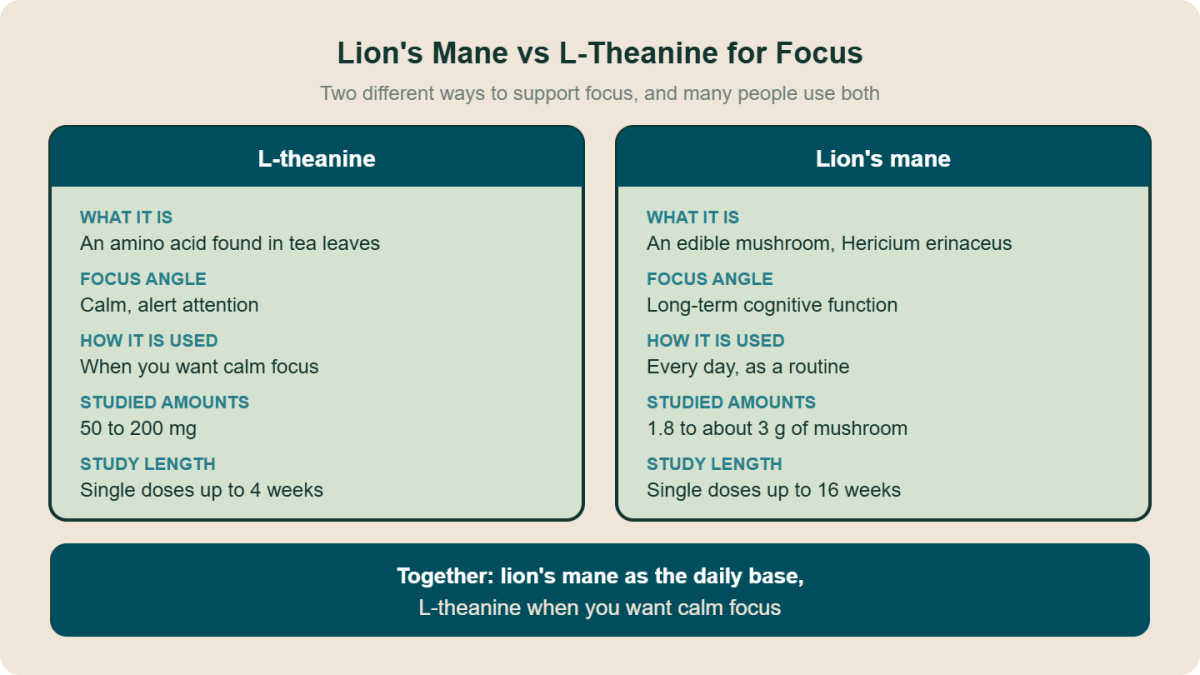
Lion's mane and L-theanine both support focus, but they work in different ways. L-theanine is an amino acid from tea that research links to a relaxed, alert state, while lion's mane is a mushroom studied as a daily habit, with human trials running 4 to 16 weeks. They do not compete, so many people take lion's mane every day and use L-theanine when they want calm focus.
Key Takeaways
- L-theanine is an amino acid found naturally in tea leaves. A single 50 mg dose increased alpha brain wave activity, which is linked to attention, compared with placebo in healthy young adults (Nobre et al., 2008).
- In 30 healthy adults, 200 mg of L-theanine a day for 4 weeks improved stress-related symptom scores, sleep quality scores, verbal fluency and executive function compared with placebo (Hidese et al., 2019).
- Lion's mane (Hericium erinaceus) is an edible mushroom. In 30 adults aged 50 to 80 with mild cognitive impairment, about 3 g of dried lion's mane a day raised cognitive scale scores above placebo at weeks 8, 12 and 16 (Mori et al., 2009).
- For focus, L-theanine fits the moment, and pairing it with caffeine improved attention switching in trials. Lion's mane fits a daily routine.
- Research has studied each one on its own rather than as a pair, and they act on different systems, so many people take them together.

Featured in this article
Clarity CapsulesLion's mane 8:1 fruiting body extract 250 mg with bacopa, rhodiola, maca, epimedium and huperzine A in every 2-capsule serving.
Shop Clarity CapsulesThird-party tested ingredients. Vegan capsules, made in the USA.
Lion's Mane vs L-Theanine at a Glance
The simplest way to compare them is by what each one is, how it is used and what human studies have measured:
| L-theanine | Lion's mane | |
|---|---|---|
| What it is | An amino acid found in tea leaves | An edible mushroom, Hericium erinaceus |
| Main focus angle | Calm, alert attention | Long-term brain health and cognitive function |
| How it is used | When you want calm focus, often with coffee or tea | Every day, as a routine |
| Amounts in the studies here | 50 to 200 mg | 1.8 to about 3 g of mushroom |
| Study length | Single doses up to 4 weeks | Single doses up to 16 weeks |
| What was measured | Alpha brain waves, attention switching, stress and sleep quality scores | Cognitive scale scores, Stroop task speed, nerve growth factor in lab studies |
What L-Theanine Does
L-theanine is an amino acid found naturally in tea leaves. Researchers often measure its effects with EEG, a test that records the brain's electrical rhythms. In a randomized trial in healthy young adults, a single 50 mg dose increased alpha brain wave activity at rest compared with placebo. Alpha activity is linked to attention, and the authors concluded that L-theanine at dietary levels affects mental alertness (Nobre et al., 2008).
Daily use has been studied too. In a 4-week crossover trial in 30 healthy adults, 200 mg of L-theanine a day improved scores for stress-related symptoms and sleep quality, along with verbal fluency and executive function scores, compared with placebo (Hidese et al., 2019). For the full picture, see our L-theanine ingredient page and our guide to L-theanine dosage.
What Lion's Mane Does
Lion's mane is a shaggy white mushroom eaten as food in parts of Asia. Much of the interest in it comes from nerve growth factor (NGF), a protein that helps nerve cells grow and stay healthy. In a lab study, lion's mane extract raised NGF production in human brain-derived cells grown in a dish, and mice fed lion's mane powder for 7 days had higher NGF activity in the hippocampus, a brain area tied to memory (Mori et al., 2008). Those are cell and animal results, and human trials have looked at cognitive function directly.
In a 16-week placebo-controlled trial, 30 Japanese adults aged 50 to 80 with mild cognitive impairment took tablets of dried lion's mane powder, about 3 g a day. Their cognitive scale scores were higher than placebo at weeks 8, 12 and 16, rose with longer use, and fell again 4 weeks after they stopped. Lab tests showed no adverse effects (Mori et al., 2009). In a pilot study in 41 healthy adults aged 18 to 45, a single 1.8 g dose was followed by faster performance on the Stroop task, a test of focused attention, 60 minutes later (Docherty et al., 2023). Learn more on our lion's mane ingredient page.
Lion's Mane vs L-Theanine for Focus
If your goal is focus, the question is less which one is better and more what kind of focus you want.
L-theanine is the in-the-moment choice. Its best known use is next to caffeine. In a crossover trial in 27 healthy adults, 100 mg of L-theanine with 50 mg of caffeine improved both the speed and accuracy of attention switching and made people less distracted during a memory task (Owen et al., 2008). In 44 young adults, 97 mg of L-theanine with 40 mg of caffeine improved task switching accuracy and self-rated alertness and lowered self-rated tiredness compared with placebo (Giesbrecht et al., 2010). Our guide to L-theanine and caffeine covers that pairing in depth.
Lion's mane is the daily habit. The longest trial saw scores keep rising through week 16, so lion's mane rewards consistent use rather than a single dose. Our guides to lion's mane for focus and concentration and how long lion's mane takes to work go further. If you are also considering L-tyrosine, an amino acid studied before demanding tasks, our guide to lion's mane vs L-tyrosine compares the two.
Taking Lion's Mane and L-Theanine Together
Yes, you can take lion's mane and L-theanine together. They come from different sources and act on different systems: L-theanine relates to calm, alert attention, while lion's mane is studied for long-term cognitive function and NGF. Research so far has studied each one on its own rather than as a pair, and many people combine them for that reason, with lion's mane as the daily base and L-theanine on demanding days.
A simple way to stack them:
- Morning: lion's mane with your routine, every day.
- When you need calm focus: L-theanine, on its own or with your coffee or tea.
- Track it: rate your focus and stress once a week for a couple of months, since lion's mane trials ran for weeks.
If you want more mushrooms in the same routine, our Forage blend includes lion's mane alongside six other mushroom fruiting body extracts, Himalayan shilajit and ashwagandha. For more on the bigger picture, see our cognitive health and mental clarity hub.
How to Take Them
Our Clarity Capsules give lion's mane 8:1 fruiting body extract 250 mg per 2-capsule serving, with epimedium extract 200 mg, maca root extract 200 mg, bacopa monnieri extract 200 mg, rhodiola rosea extract 150 mg and huperzine A 200 mcg, plus ginger extract in vegan capsules. The suggested use is 2 capsules daily, preferably in the morning on an empty stomach, or as recommended by your healthcare practitioner.
Our Theanine Nasal Spray gives 36 mg of L-theanine in every 2-spray serving, with alkaline water as the only other ingredient. The label serving is two sprays, used as needed. It is absorbed through the lining of the nose instead of being swallowed like a capsule, so some of each dose skips digestion. Breathe in gently while you spray, tilt your head back slightly and wait at least 60 seconds before blowing your nose. Both are made with third-party tested ingredients.
Safety and Side Effects
L-theanine comes from tea and lion's mane is an edible mushroom, and in the 16-week lion's mane trial, lab tests showed no adverse effects. A few cautions still apply:
- Lion's mane: avoid it if you are allergic to mushrooms. Stop and talk to your doctor if you notice a rash, itching or trouble breathing. See lion's mane side effects.
- L-theanine: talk to your doctor first if you take blood pressure medicine or sedatives. See L-theanine side effects.
- Clarity Capsules: they also contain huperzine A, which acts on acetylcholine, so talk to your doctor first if you take medicines that act on acetylcholine or heart rhythm medicines, or if you have surgery planned.
- Everyone: check with a healthcare provider before starting if you are pregnant, breastfeeding or taking prescription medicine.

Featured in this article
Theanine Nasal Spray36 mg of L-theanine in every 2-spray serving, with alkaline water as the only other ingredient.
Shop Theanine Nasal SprayThird-party tested ingredients. Made in the USA.
Frequently Asked Questions
Is lion's mane or L-theanine better for focus?
They support focus in different ways. L-theanine is linked to a calm, alert state, and with caffeine it improved attention switching in trials. Lion's mane is a daily mushroom studied over weeks, with cognitive scores rising through 16 weeks in one trial. If you want help on a busy afternoon, reach for L-theanine. If you want a long-term brain health routine, choose lion's mane. Many people use both.
Can you take lion's mane and L-theanine together?
Yes. They come from different sources, a mushroom and a tea amino acid, and act on different systems, so many people take lion's mane every morning and add L-theanine when they want calm focus. Research has studied each one on its own rather than as a pair. If you take prescription medicine or are pregnant or breastfeeding, check with your doctor before starting either.
Is there a lion's mane and L-theanine supplement?
Some products combine them, but taking them separately lets you use each the way it was studied: lion's mane daily and L-theanine when you need it. Our Clarity Capsules provide lion's mane 8:1 fruiting body extract 250 mg per serving for the daily part, and our Theanine Nasal Spray gives 36 mg of L-theanine per 2-spray serving for the moments you want calm focus.
What is the difference between lion's mane and L-theanine?
L-theanine is a single amino acid found in tea leaves, studied in amounts of 50 to 200 mg. Lion's mane is a whole edible mushroom, Hericium erinaceus, studied at about 1.8 to 3 g a day, and lab research links it to nerve growth factor. L-theanine fits the moment, while lion's mane fits a routine you keep for weeks.
Does L-theanine help with focus?
L-theanine supports calm, focused attention. A 50 mg dose increased alpha brain wave activity, which is linked to attention, in healthy young adults. Paired with caffeine, 97 to 100 mg of L-theanine improved attention switching and self-rated alertness in two trials. In a 4-week trial, 200 mg a day improved verbal fluency and executive function scores compared with placebo.
How long does lion's mane take to work?
In the 16-week trial in adults aged 50 to 80, cognitive scores were higher than placebo from week 8 and kept rising with longer use. A pilot study in young adults also measured faster Stroop task performance an hour after a single 1.8 g dose. Plan on daily use for at least 2 to 3 months, since week 8 was the first point where that trial saw a difference.
Can I take L-theanine with coffee and lion's mane?
Yes, many people do. L-theanine is most studied alongside caffeine, and lion's mane is a daily routine that does not depend on it. Trials found 97 to 100 mg of L-theanine with 40 to 50 mg of caffeine improved attention switching. Keep your total caffeine moderate, and check with your doctor first if you take blood pressure medicine or sedatives.
Sources
- Nobre AC, Rao A, Owen GN. L-theanine, a natural constituent in tea, and its effect on mental state. Asia Pacific Journal of Clinical Nutrition, 2008. https://pubmed.ncbi.nlm.nih.gov/18296328/
- Hidese S, Ogawa S, Ota M, et al. Effects of L-theanine administration on stress-related symptoms and cognitive functions in healthy adults: a randomized controlled trial. Nutrients, 2019. https://pubmed.ncbi.nlm.nih.gov/31623400/
- Owen GN, Parnell H, De Bruin EA, Rycroft JA. The combined effects of L-theanine and caffeine on cognitive performance and mood. Nutritional Neuroscience, 2008. https://pubmed.ncbi.nlm.nih.gov/18681988/
- Giesbrecht T, Rycroft JA, Rowson MJ, De Bruin EA. The combination of L-theanine and caffeine improves cognitive performance and increases subjective alertness. Nutritional Neuroscience, 2010. https://pubmed.ncbi.nlm.nih.gov/21040626/
- Mori K, Obara Y, Hirota M, et al. Nerve growth factor-inducing activity of Hericium erinaceus in 1321N1 human astrocytoma cells. Biological and Pharmaceutical Bulletin, 2008. https://pubmed.ncbi.nlm.nih.gov/18758067/
- Mori K, Inatomi S, Ouchi K, Azumi Y, Tuchida T. Improving effects of the mushroom Yamabushitake (Hericium erinaceus) on mild cognitive impairment: a double-blind placebo-controlled clinical trial. Phytotherapy Research, 2009. https://pubmed.ncbi.nlm.nih.gov/18844328/
- Docherty S, Doughty FL, Smith EF. The acute and chronic effects of lion's mane mushroom supplementation on cognitive function, stress and mood in young adults: a double-blind, parallel groups, pilot study. Nutrients, 2023. https://pubmed.ncbi.nlm.nih.gov/38004235/
These statements have not been evaluated by the Food and Drug Administration. This content is for education and is not medical advice. Our products are not intended to diagnose, treat, cure or prevent any disease. Talk with a healthcare provider before starting a new supplement if you are pregnant, breastfeeding or taking medication.


Leave a comment
All comments are moderated before being published.
This site is protected by hCaptcha and the hCaptcha Privacy Policy and Terms of Service apply.