
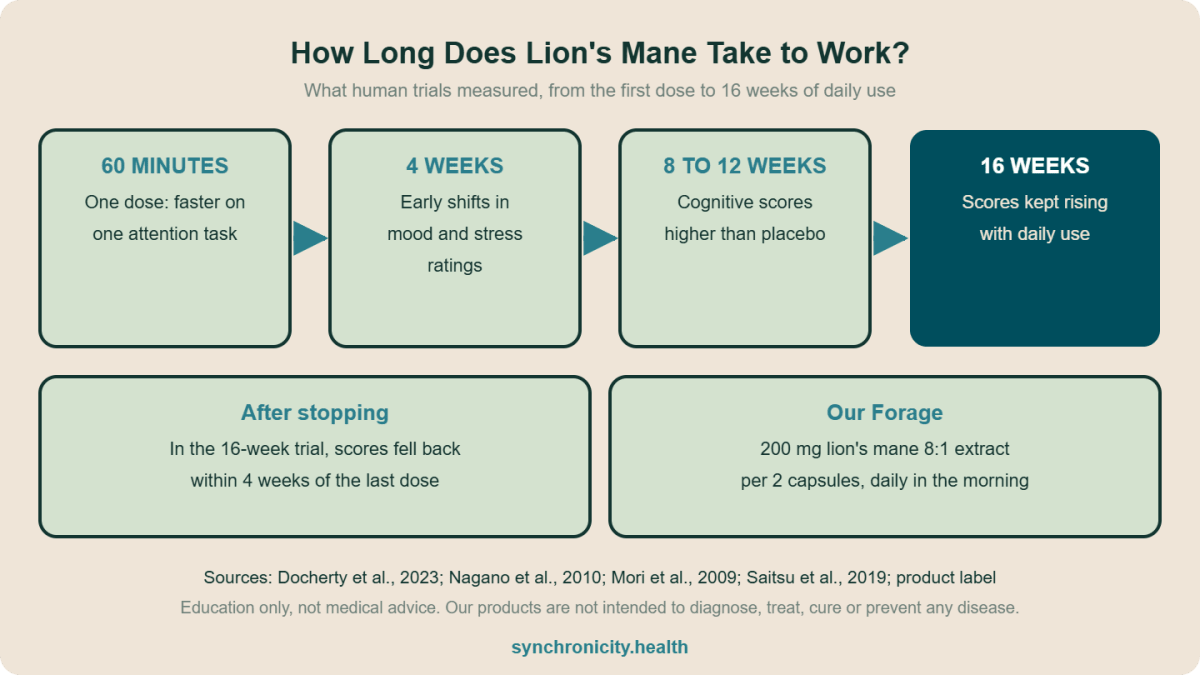
Lion's mane usually takes weeks, not hours, to show what it can do. In human trials, a single dose produced a small change on one attention task after 60 minutes, but the steadier results came with daily use: after 4 weeks in shorter studies and at 8, 12 and 16 weeks in the longest one. In that 16-week trial, scores slipped back within 4 weeks of stopping, so plan on consistent daily use for at least 2 to 3 months.
Key Takeaways
- In the longest trial, adults aged 50 to 80 took about 3 g of lion's mane powder a day; cognitive scores beat placebo at weeks 8, 12 and 16 (Mori et al., 2009).
- In that trial, scores fell again within 4 weeks after people stopped, which points to steady daily use.
- In 41 healthy adults aged 18 to 45, one 1.8 g dose was followed by faster responses on one attention task 60 minutes later (Docherty et al., 2023).
- Four-week studies measured early changes in mood and stress ratings, and a 12-week study measured a short memory and thinking test.
- Expect early changes in months 1 to 2, with the full benefit building from 3 months on.

Featured in this article
ForageSeven functional mushroom fruiting body extracts, including lion's mane, plus Himalayan shilajit and ashwagandha root extract for everyday energy and resilience.
Shop ForageThird-party tested ingredients. Vegan capsules.
The Short Answer: Weeks, Not Hours
Lion's mane (Hericium erinaceus) is not a stimulant, so it does not work like a cup of coffee. The human trials ran for weeks or months, and most of their results showed up after daily use rather than after one serving. Our guide to lion's mane for brain health covers how it works.
If you have tried lion's mane for a few days and felt nothing, that is normal. The trials suggest you judge it at the 2 to 3 month mark, not the first week.
Lion's Mane Timeline: What the Trials Measured
Putting the human studies side by side gives a rough week-by-week picture:
| When | What was measured | Study |
|---|---|---|
| 60 minutes after one dose | Faster responses on one attention task (Stroop) | Docherty et al., 2023 |
| 4 weeks | Lower scores on mood and everyday-complaint questionnaires in 30 women; a trend toward lower stress ratings in young adults | Nagano et al., 2010; Docherty et al., 2023 |
| 8 weeks | Cognitive scores first higher than placebo | Mori et al., 2009 |
| 12 weeks | Scores still higher than placebo; a separate 12-week study saw a short thinking test improve | Mori et al., 2009; Saitsu et al., 2019 |
| 16 weeks | Scores higher still, rising with longer use | Mori et al., 2009 |
| 4 weeks after stopping | Scores had dropped back | Mori et al., 2009 |
Does Lion's Mane Kick In Right Away?
One study looked at exactly this question. In a pilot trial, 41 healthy adults aged 18 to 45 took 1.8 g of a lion's mane product or a placebo each morning after breakfast. On day 1, the lion's mane group was faster on the Stroop task, a test of focused attention, 60 minutes after their first dose (Docherty et al., 2023).
The authors were careful to say it was a small study and the change showed up on one task out of several. So a same-day lift is possible, but it is a small part of the story. For the focus side in more depth, see lion's mane for focus and concentration. L-tyrosine, by contrast, is studied as a single dose before a demanding task; our guide to lion's mane vs L-tyrosine compares the two.
Weeks 4 to 16: What Builds With Daily Use
Around 4 weeks
In a 4-week study, 30 women ate cookies made with lion's mane or placebo cookies. Afterward, the lion's mane group had lower scores on a mood questionnaire and an index of everyday complaints than at the start (Nagano et al., 2010). In the Docherty study, 28 days of daily use brought a trend toward lower stress ratings compared with placebo, close to but not quite reaching statistical significance. Both are early results that fit a pattern of gradual change.
8 to 16 weeks
The longest trial ran for 16 weeks. Thirty Japanese men and women aged 50 to 80 with mild cognitive impairment took four 250 mg tablets of 96 percent lion's mane powder three times a day, or a placebo. The lion's mane group scored higher than placebo on a cognitive function scale at weeks 8, 12 and 16, and scores kept rising the longer people took it. Lab tests showed no adverse effects (Mori et al., 2009). It was a small trial in one specific group, so it is an early result, but it is the clearest timeline in the research.
A separate 12-week trial with fruiting body supplements also found improvement on the Mini-Mental State Examination, a short test of memory and thinking (Saitsu et al., 2019).
How Long Do Lion's Mane Effects Last After You Stop?
The best answer comes from the 16-week trial, which kept testing people after they stopped. Four weeks after the last dose, their scores had dropped significantly (Mori et al., 2009). In practical terms, lion's mane works while you keep taking it. Its effects do not switch off the day you stop, but you should not count on them lasting for more than a few weeks without it.
That is also the most useful way to think about how long lion's mane stays in your system: what lasts is the gradual effect of steady use, and it fades over weeks once you stop.
Lion's Mane Before and After: Tracking Your Own Results
Because changes build slowly, they are easy to miss. A simple way to see your own before and after:
- Write a baseline. Before you start, rate your focus, mental energy and mood from 1 to 10.
- Take it every day. The trials used daily servings; skipping days makes changes harder to see.
- Check in at weeks 4, 8 and 12. These match the points where studies measured change.
- Keep the rest steady. Sleep, caffeine and stress move these ratings too, so note big changes.
Shilajit follows a similar slow-build pattern; see how long shilajit takes to work.
Getting the Most From Lion's Mane
Lion's mane works best as a daily habit. Benefits build with consistent daily use: months 1 to 2 can bring early changes, and 3 months and beyond is where the full benefit builds. Pick a time you will stick to, such as with breakfast, which is when the Docherty participants took theirs.
Most people tolerate lion's mane well; in the 16-week trial, lab tests showed no adverse effects. Anyone with a mushroom allergy should avoid it. Talk with your clinician first if you are pregnant or breastfeeding or take prescription medicine. Our guide to lion's mane side effects has the details. Thinking of pairing it? See lion's mane vs reishi and lion's mane vs ashwagandha.
Where Our Forage and Mushroom Cacao Fit
Our Forage capsules make the daily habit easy: each 2-capsule serving has 200 mg of lion's mane 8:1 fruiting body extract along with cordyceps 200 mg, reishi 200 mg, chaga, maitake, turkey tail and shiitake at 150 mg each (all 8:1 fruiting body extracts), plus 100 mg of Himalayan shilajit extract and 100 mg of ashwagandha root extract, with ginger extract in vegan capsules. Take 2 capsules daily in the morning, with or without food. It is made with third-party tested ingredients.
If you would rather drink it, our Mushroom Cacao gives 500 mg each of lion's mane and cordyceps 8:1 fruiting body extracts per serving in a cocoa and cacao base with a high-theobromine cocoa extract. Stir one rounded teaspoon (5 g) into 6 to 8 oz of hot water or milk; it has 15 calories and 0 g sugar, sweetened with stevia, and each jar holds 28 servings. Cocoa naturally contains a little caffeine, so it is not caffeine free. See our lion's mane ingredient page and our cognitive health guide.

Featured in this article
Mushroom CacaoA mushroom hot chocolate made with cocoa and cacao, with 500 mg each of lion's mane and cordyceps per serving and 0g sugar.
Shop Mushroom CacaoThird-party tested ingredients. 15 calories per serving.
Frequently Asked Questions
How long does lion's mane take to kick in?
One study saw a small change on an attention task 60 minutes after a single dose, but most results in trials appeared after 4 to 16 weeks of daily use.
How long does lion's mane take to work for focus?
Expect to judge it after 2 to 3 months of daily use. The longest trial first saw higher cognitive scores at 8 weeks, and they kept rising to 16 weeks.
Can you feel lion's mane right away?
One study measured a small change after the first dose, but lion's mane is not a stimulant, so many people feel nothing at first. That is normal and not a sign it is not working.
How long do lion's mane effects last?
While you keep taking it, the effects in the 16-week trial kept building. After stopping, scores dropped back within 4 weeks.
How long does lion's mane stay in your system?
The clearest guide is the 16-week trial: its benefits faded within 4 weeks of the last dose. That is why steady daily use matters more than any single serving.
What does lion's mane before and after look like?
In the trials, changes were gradual: small shifts in mood and stress ratings around 4 weeks and higher cognitive scores from 8 weeks on. Rate your focus and mood at the start and recheck at weeks 4, 8 and 12.
Should I take lion's mane every day?
Yes, daily use is how it was studied. Check with your clinician first if you are pregnant, breastfeeding or take prescription medicine.
What happens when you stop taking lion's mane?
Nothing sudden. In the 16-week trial, the gains slowly faded and were clearly lower 4 weeks after stopping.
Sources
- Mori K, Inatomi S, Ouchi K, Azumi Y, Tuchida T. Improving effects of the mushroom Yamabushitake (Hericium erinaceus) on mild cognitive impairment: a double-blind placebo-controlled clinical trial. Phytotherapy Research, 2009. https://pubmed.ncbi.nlm.nih.gov/18844328/
- Docherty S, Doughty FL, Smith EF. The acute and chronic effects of lion's mane mushroom supplementation on cognitive function, stress and mood in young adults: a double-blind, parallel groups, pilot study. Nutrients, 2023. https://pubmed.ncbi.nlm.nih.gov/38004235/
- Nagano M, Shimizu K, Kondo R, et al. Reduction of depression and anxiety by 4 weeks Hericium erinaceus intake. Biomedical Research, 2010. https://www.jstage.jst.go.jp/article/biomedres/31/4/31_4_231/_article
- Saitsu Y, Nishide A, Kikushima K, Shimizu K, Ohnuki K. Improvement of cognitive functions by oral intake of Hericium erinaceus. Biomedical Research, 2019. https://www.jstage.jst.go.jp/article/biomedres/40/4/40_125/_article
These statements have not been evaluated by the Food and Drug Administration. This content is for education and is not medical advice. Our products are not intended to diagnose, treat, cure or prevent any disease. Talk with a healthcare provider before starting a new supplement if you are pregnant, breastfeeding or taking medication.


Leave a comment
All comments are moderated before being published.
This site is protected by hCaptcha and the hCaptcha Privacy Policy and Terms of Service apply.