
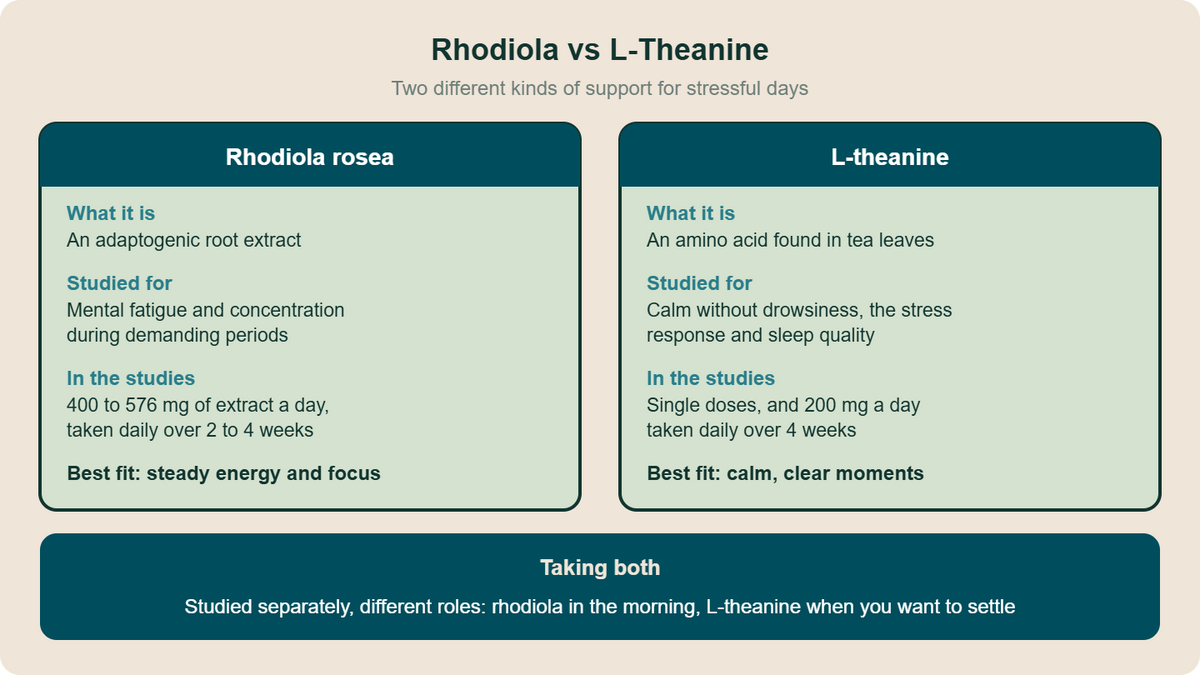
Rhodiola and L-theanine support you under stress in different ways. Rhodiola is an adaptogenic root studied for mental fatigue and concentration in stressful periods, usually taken daily for several weeks, while L-theanine is an amino acid from tea leaves studied for calm without drowsiness and for the body's response to a stressful task. Many people take both, since one supports steady energy and the other supports a relaxed, clear state.
Key Takeaways
- Rhodiola rosea is a root extract studied for mental fatigue and concentration under stress; in 60 adults with stress-related fatigue, 576 mg a day for 28 days lowered burnout scale scores and improved attention measures compared with placebo (Olsson et al., 2009).
- L-theanine is an amino acid found in tea; in 12 adults doing a stressful mental arithmetic task, it lowered the rise in heart rate and in a saliva stress marker compared with placebo (Kimura et al., 2007).
- In 30 healthy adults, 200 mg of L-theanine a day for 4 weeks improved sleep quality items compared with placebo, and no adverse events were apparent (Hidese et al., 2019).
- The simple split: rhodiola for steady energy and focus through demanding weeks, L-theanine for calm, clear moments and a relaxed evening.
- They have been studied separately and work in different ways, which is why many people pair them, often rhodiola in the morning and L-theanine when they want to settle.

Featured in this article
Clarity CapsulesRhodiola rosea extract 150 mg per 2-capsule serving, with lion's mane, bacopa, maca, epimedium and huperzine A, for daily focus and mental clarity.
Shop Clarity CapsulesThird-party tested ingredients. Vegan capsules, made in the USA.
Rhodiola vs L-Theanine: The Main Differences
Rhodiola rosea is a plant from cold, mountainous regions, and its root extract is called an adaptogen, meaning it is used to support the body's ability to handle physical and mental strain. L-theanine is an amino acid found naturally in tea leaves, best known for a relaxed but alert state.
| Rhodiola rosea | L-theanine | |
|---|---|---|
| What it is | An adaptogenic root extract | An amino acid found in tea leaves |
| What research has focused on | Mental fatigue, concentration and stress symptoms during demanding periods | Calm without drowsiness, the body's response to a stressful task, and sleep quality |
| Amounts in the studies here | 400 to 576 mg of extract a day | 200 mg a day; a review pointed to 200 to 400 mg a day |
| How it was studied | Daily use over 2 to 4 weeks | Single doses during a stressful task, and daily use over 4 weeks |
| Best fit | Steady energy and focus through long, demanding weeks | Calm, clear moments and a relaxed evening |
| Side effects reported | Dizziness, headache, trouble sleeping, dry mouth or extra saliva | No adverse events apparent in a 4-week trial |
For the full background on each one, see our rhodiola rosea ingredient page and our L-theanine ingredient page.
What Rhodiola Research Shows
Rhodiola trials tend to look at people under real pressure and measure fatigue, concentration and stress symptoms after a few weeks of daily use:
- In a randomized, placebo-controlled trial of 60 adults aged 20 to 55 with stress-related fatigue, 576 mg of a standardized rhodiola extract a day for 28 days improved burnout scale scores and several attention measures compared with placebo, and changed the cortisol response on waking. No serious side effects linked to the extract were reported (Olsson et al., 2009).
- In a double-blind crossover study of 56 young, healthy physicians working night shifts, one tablet of a standardized extract a day improved a combined score of memory, calculation, concentration and reaction tests during the first two-week period, with no side effects reported (Darbinyan et al., 2000).
- In an open study of 101 adults aged 30 to 60 with life-stress symptoms, 200 mg of extract twice a day for 4 weeks was followed by steady improvements in stress symptoms, fatigue, mood and concentration, as described in a 2022 review of rhodiola clinical trials (Stojcheva and Quintela, 2022).
The common thread is support for mental stamina when demands are high. Our guides to rhodiola benefits and rhodiola for focus go deeper on each area.
What L-Theanine Research Shows
L-theanine research looks more at calm, the body's stress signals and sleep:
- In a double-blind study of 12 adults given a mental arithmetic task, L-theanine lowered the rise in heart rate and in salivary immunoglobulin A, a saliva marker of stress, compared with placebo. Heart rate variability results pointed to a calmer stress response in the nervous system (Kimura et al., 2007).
- In a randomized, placebo-controlled crossover trial of 30 healthy adults aged 20 to 69, 200 mg a day for 4 weeks improved sleep items such as time to fall asleep and sleep disturbance compared with placebo. Stress-related symptom scores and verbal fluency also improved from the start of the L-theanine period, and no adverse events were apparent (Hidese et al., 2019).
- A 2020 systematic review of 9 randomized controlled trials looked at L-theanine and stress, and the authors pointed to 200 to 400 mg a day for people in stressful conditions (Williams et al., 2020).
See L-theanine benefits for the wider research, and L-theanine dosage for the amounts each study used.
Rhodiola vs L-Theanine for Stress
The two fit different kinds of stress. If stress leaves you drained and foggy after weeks of pressure, rhodiola is the closer match. If stress shows up as a busy mind or trouble settling down, L-theanine is the closer match.
- Choose rhodiola if you want steady energy and focus through long workdays, study periods or busy seasons.
- Choose L-theanine if you want to feel calm and clear without feeling sleepy, or want to wind down in the evening.
For the wider picture, see our stress, mood and nervous system guide.
Can You Take Rhodiola and L-Theanine Together?
Yes, many people do. The two have been studied separately and work in different ways: rhodiola for mental stamina under strain, L-theanine for a relaxed, clear state. That makes them a natural pair rather than two versions of the same thing.
A common routine is rhodiola in the morning, since it is studied for daytime energy and trouble sleeping is one of its listed side effects, and L-theanine later in the day or whenever you want to settle. If you drink coffee, our guide to L-theanine and caffeine explains why the two are often paired.
How to Take Them
- Follow your label. Use the serving on each product.
- Take rhodiola early. A morning dose keeps it away from bedtime.
- Give rhodiola a few weeks. Its trials measured results after 2 to 4 weeks of daily use.
- Use L-theanine when you choose. It has been studied as a single dose and as a daily habit.
Safety and Side Effects
The US National Center for Complementary and Integrative Health describes rhodiola as possibly safe for up to 12 weeks, with side effects that may include dizziness, headache, trouble sleeping and either dry mouth or extra saliva. It also notes reported interactions between rhodiola and losartan, a blood pressure medicine (NCCIH, 2025). Talk to your doctor before taking rhodiola if you take blood pressure medicine or any other prescription medicine.
L-theanine has a gentle record in studies: in the 4-week trial, no adverse events were apparent and no one dropped out (Hidese et al., 2019). See L-theanine side effects for more. For both, check with your clinician first if you are pregnant or breastfeeding or take prescription medicine, and stop if something does not feel right.
Where Our Clarity Capsules and Theanine Nasal Spray Fit
Our Clarity Capsules include rhodiola rosea extract 150 mg in every 2-capsule serving, alongside lion's mane 8:1 fruiting body extract 250 mg, epimedium extract 200 mg, maca root extract 200 mg, bacopa monnieri extract 200 mg and huperzine A 200 mcg, with ginger extract in vegan capsules. The suggested use is 2 capsules daily, preferably in the morning on an empty stomach, or as recommended by your healthcare practitioner. It is made with third-party tested ingredients.
Our Theanine Nasal Spray gives 36 mg of L-theanine in every 2-spray serving, with alkaline water as the only other ingredient. The label serving is two sprays, used as needed. It is absorbed through the lining of the nose instead of being swallowed like a capsule, so some of each dose skips digestion, and it is made with third-party tested ingredients. Its product page notes that it can be used alongside Clarity.

Featured in this article
Theanine Nasal Spray36 mg of L-theanine per 2-spray serving, with alkaline water as the only other ingredient.
Shop Theanine Nasal SprayThird-party tested ingredients. Made in the USA.
Frequently Asked Questions
Is rhodiola or L-theanine better for stress?
It depends on how stress shows up for you. Rhodiola fits stress that leaves you drained and foggy, since its trials measured fatigue and concentration under sustained strain. L-theanine fits a busy mind or tension, since its studies measured calm and the body's response to a stressful task. Many people use both.
Can you take rhodiola and L-theanine together?
Yes. They have been studied separately and work in different ways, so they complement each other. A common routine is rhodiola in the morning and L-theanine later in the day or whenever you want to settle. Check with your doctor first if you take prescription medicine, especially blood pressure medicine.
What is the difference between rhodiola and L-theanine?
Rhodiola is an adaptogenic root extract studied for mental stamina, fatigue and concentration during demanding periods, over weeks of daily use. L-theanine is an amino acid from tea leaves, studied for a relaxed but alert state, the body's stress signals and sleep quality.
Is rhodiola or L-theanine better for focus?
Rhodiola is the closer match for focus during long, tiring stretches: in night-shift physicians and in adults with stress-related fatigue, it improved concentration and attention tests. L-theanine supports focus by helping you stay calm and clear, and in a 4-week trial verbal fluency scores improved from the start of the L-theanine period.
Which is better for sleep, rhodiola or L-theanine?
L-theanine. In a 4-week trial of 200 mg a day, sleep items such as time to fall asleep and sleep disturbance improved compared with placebo. Rhodiola is better kept for the morning, because trouble sleeping is one of its listed side effects.
When should you take rhodiola and L-theanine?
Take rhodiola in the morning so it stays away from bedtime; our Clarity Capsules suggest 2 capsules daily, preferably in the morning on an empty stomach. L-theanine can be taken at the times you choose, such as a busy afternoon or the evening. Follow the label on your product.
How long do rhodiola and L-theanine take to work?
Rhodiola trials measured results after 2 to 4 weeks of daily use, so give it a few weeks of steady use. L-theanine has been studied both as a single dose given around a stressful task and as a daily habit over 4 weeks, so it suits everyday use and the moments you choose.
What are the side effects of rhodiola and L-theanine?
Rhodiola side effects may include dizziness, headache, trouble sleeping and dry mouth or extra saliva, and interactions with the blood pressure medicine losartan have been reported. L-theanine has a gentle record, with no adverse events apparent in a 4-week trial. Talk to your doctor if you are pregnant, breastfeeding or take medication.
Sources
- Olsson EM, von Schéele B, Panossian AG. A randomised, double-blind, placebo-controlled, parallel-group study of the standardised extract SHR-5 of the roots of Rhodiola rosea in the treatment of subjects with stress-related fatigue. Planta Medica, 2009. https://pubmed.ncbi.nlm.nih.gov/19016404/
- Darbinyan V, Kteyan A, Panossian A, et al. Rhodiola rosea in stress induced fatigue: a double blind cross-over study of a standardized extract SHR-5 with a repeated low-dose regimen on the mental performance of healthy physicians during night duty. Phytomedicine, 2000. https://pubmed.ncbi.nlm.nih.gov/11081987/
- Stojcheva EI, Quintela JC. The effectiveness of Rhodiola rosea L. preparations in alleviating various aspects of life-stress symptoms and stress-induced conditions: encouraging clinical evidence. Molecules, 2022. https://pubmed.ncbi.nlm.nih.gov/35745023/
- Kimura K, Ozeki M, Juneja LR, Ohira H. L-Theanine reduces psychological and physiological stress responses. Biological Psychology, 2007. https://pubmed.ncbi.nlm.nih.gov/16930802/
- Hidese S, Ogawa S, Ota M, et al. Effects of L-theanine administration on stress-related symptoms and cognitive functions in healthy adults: a randomized controlled trial. Nutrients, 2019. https://pubmed.ncbi.nlm.nih.gov/31623400/
- Williams JL, Everett JM, D'Cunha NM, et al. The effects of green tea amino acid L-theanine consumption on the ability to manage stress and anxiety levels: a systematic review. Plant Foods for Human Nutrition, 2020. https://pubmed.ncbi.nlm.nih.gov/31758301/
- National Center for Complementary and Integrative Health. Rhodiola: Usefulness and Safety. Updated April 2025. https://www.nccih.nih.gov/health/rhodiola
These statements have not been evaluated by the Food and Drug Administration. This content is for education and is not medical advice. Our products are not intended to diagnose, treat, cure or prevent any disease. Talk with a healthcare provider before starting a new supplement if you are pregnant, breastfeeding or taking medication.


Leave a comment
All comments are moderated before being published.
This site is protected by hCaptcha and the hCaptcha Privacy Policy and Terms of Service apply.