
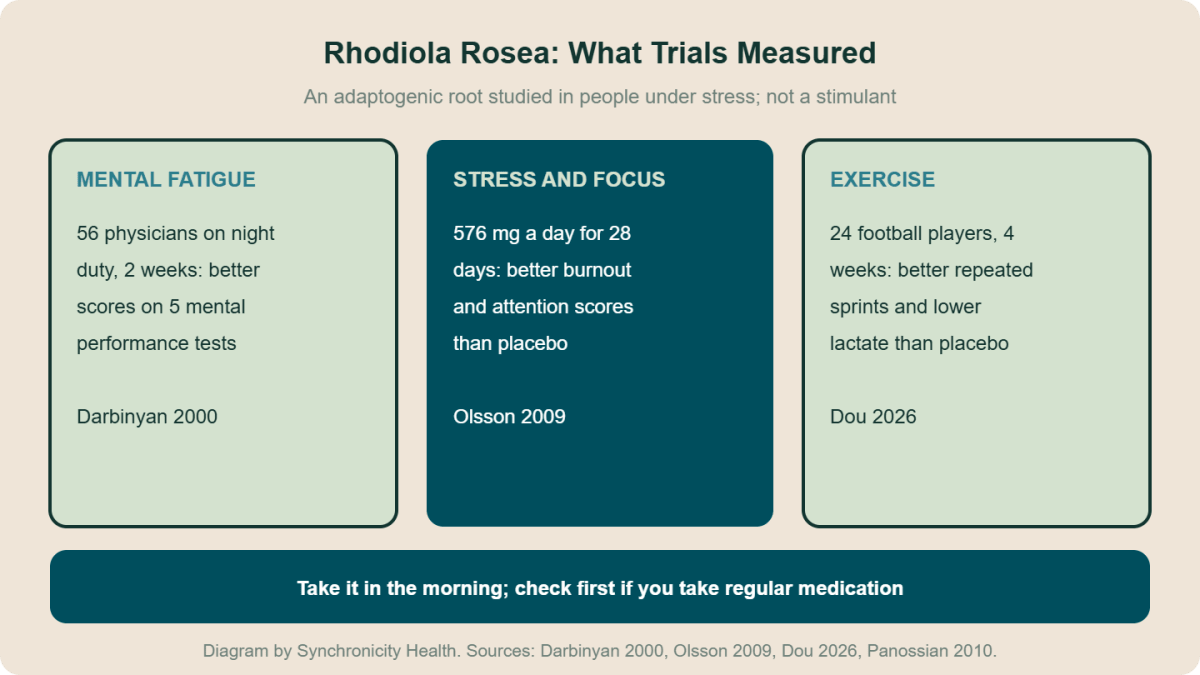
Rhodiola rosea is an adaptogenic root, and the benefits measured in placebo-controlled trials are less mental fatigue under stress in night-shift physicians, students and cadets, better concentration in adults with stress-related fatigue, and better repeated-sprint performance in football players.
This guide covers what rhodiola is, what each trial measured, the amounts used, how to take it, safety and where our Clarity Capsules fit. It is educational, not medical advice.
Key Takeaways
- Rhodiola rosea, also called golden root, grows in cold, high regions; about 140 compounds have been found in its roots, including rosavins and salidroside (Panossian et al., 2010).
- In 56 healthy physicians on night duty, a low daily dose of standardized extract improved mental performance tests over 2 weeks (Darbinyan et al., 2000).
- In 161 cadets, a single dose before a demanding test raised an anti-fatigue index compared with placebo (Shevtsov et al., 2003).
- In adults with stress-related fatigue, 576 mg a day for 28 days improved burnout scores and attention compared with placebo (Olsson et al., 2009).
- Rhodiola is not a stimulant, but take it in the morning; check with a clinician first if you take regular medication.

Featured in this article
Clarity CapsulesLion's mane, bacopa, rhodiola, maca, epimedium and huperzine A in a two-capsule morning serving.
Shop Clarity CapsulesThird-party tested ingredients. Caffeine-free.
What Is Rhodiola Rosea?
Rhodiola rosea is a flowering plant that grows in cold, high-altitude regions of Europe, Asia and North America, which is where its other names, golden root, arctic root and rosenroot, come from. It is classed as an adaptogen, a plant used to help the body handle physical and mental stress, and it has a long traditional use against fatigue.
About 140 compounds have been isolated from its roots and rhizome (Panossian et al., 2010). The two groups most studied are the rosavins, which are characteristic of rhodiola rosea, and salidroside. Extracts used in research are usually standardized to at least 3 percent rosavins and about 1 percent salidroside. Our rhodiola rosea ingredient guide covers the basics.
Rhodiola Benefits: What Research Has Measured
| Who was studied | Amount and length | What was found |
|---|---|---|
| 56 healthy physicians on night duty | One low-dose tablet a day, 2 weeks, crossover | Better scores on 5 mental performance tests |
| Students during exams | Low daily dose, 20 days | Better physical fitness, mental fatigue and well-being scores |
| 161 cadets aged 19 to 21 | Single dose of 2 or 3 capsules | Higher anti-fatigue index than placebo |
| 60 adults with stress-related fatigue | 576 mg a day, 28 days | Better burnout and attention scores; lower cortisol response on waking |
| 24 competitive football players | 4 weeks | Better intermittent running and mean sprint time; lower lactate |
Mental Fatigue Under Stress
Most rhodiola trials used a standardized extract called SHR-5 and looked at people under pressure. In a double-blind crossover study, 56 young, healthy physicians took one low-dose tablet a day or placebo for 2 weeks while working night shifts. Scores on 5 tests of mental performance, including short-term memory, calculation, concentration and speed of perception, improved significantly in the first 2-week period, and no side effects were reported (Darbinyan et al., 2000).
In students taking it for 20 days during an exam period, physical fitness, mental fatigue and well-being scores were better than on placebo (Spasov et al., 2000). And in 161 cadets aged 19 to 21, a single dose before a test of mental work under fatigue gave a higher anti-fatigue index than placebo, with no difference between the two doses tried (Shevtsov et al., 2003).
Stress, Burnout and Focus
In a 28-day placebo-controlled trial, 60 adults aged 20 to 55 who met criteria for stress-related fatigue took 576 mg a day of SHR-5 extract or placebo. Both groups improved, but the rhodiola group did better than placebo on a burnout scale and on several measures of attention, and their cortisol response to waking changed compared with placebo. No serious side effects were linked to the extract (Olsson et al., 2009). Results in this group may not apply to everyone.
Concentration under pressure is the reason many people try rhodiola. Our guide to rhodiola for focus looks at that use in detail, and our guide to the best supplements for focus and concentration compares it with other options.
Exercise and Endurance
In a 4-week double-blind trial, 24 male competitive football players took rhodiola or placebo. On rhodiola, performance on an intermittent running test improved and was better than placebo, mean repeated-sprint time was better than placebo, blood lactate after sprinting was lower, and decision accuracy under fatigue was higher. The authors read these results as better performance maintenance rather than more top speed (Dou et al., 2026). For other non-stimulant options for training, see our guide to energy without the crash.
How Much Rhodiola to Take
Trials used standardized root extracts rather than raw powder or tea. Amounts ranged from low daily doses in the night-shift and exam studies to 576 mg a day in the stress-related fatigue trial, and studies of stress and cognition most often used about 200 to 400 mg a day. Rhodiola is usually taken in the morning or early afternoon, because some people find it mildly energizing. Many people use it for 6 to 12 weeks during demanding periods. If you use a product, follow its label.
Why Standardized Extracts Matter
Rhodiola rosea is the species studied in these trials, and rosavins are characteristic of it. Look for a label that names Rhodiola rosea and, ideally, states its rosavin and salidroside content. For how rhodiola compares with other adaptogens, read benefits of adaptogens. If you are choosing between two popular adaptogens, our guide to rhodiola vs ashwagandha compares them side by side. For mood and stress, our guide to rhodiola vs saffron compares the two and covers taking them together.
Rhodiola Side Effects and Safety
In the trials above, rhodiola was well tolerated, with no side effects reported in the night-shift study and no serious side effects linked to it in the 28-day trial (Darbinyan et al., 2000; Olsson et al., 2009). Reported side effects are usually mild: dizziness, dry mouth, mild stomach upset, or feeling either slightly over-energized or unexpectedly calm.
- Medicines. Rhodiola can affect liver enzymes that process some drugs. Ask first if you take blood pressure, blood sugar, immune-suppressing, antidepressant or sedative medication.
- Bipolar disorder or autoimmune conditions. Talk with your clinician before using it.
- Pregnancy, breastfeeding and under 18. Not recommended without medical advice.
- Timing. Avoid late-evening doses if it keeps you up.
Where Our Clarity Capsules Fit
Our Clarity Capsules are a caffeine-free daily focus formula. Each 2-capsule serving contains 150 mg of rhodiola rosea extract alongside lion's mane, bacopa, maca, epimedium and huperzine A, made with third-party tested ingredients. Take two capsules in the morning, with or without food; each bottle holds 30 servings.
The label does not state rosavin or salidroside content, so its amount is not directly comparable with the SHR-5 trials above; take it as directed. Questions are answered on the Clarity FAQ. To read about two other ingredients in the formula, see our guides to bacopa monnieri benefits and maca root benefits.
Featured in this article
Clarity CapsulesLion's mane, bacopa, rhodiola, maca, epimedium and huperzine A in a two-capsule morning serving.
Shop Clarity CapsulesThird-party tested ingredients. Caffeine-free.
Frequently Asked Questions
What is rhodiola good for?
In placebo-controlled trials, rhodiola reduced mental fatigue under stress in physicians, students and cadets, improved burnout and attention scores in adults with stress-related fatigue, and improved repeated-sprint performance in football players.
What does rhodiola do to the brain?
Research suggests rhodiola acts on the stress hormone system, including cortisol, and on heat shock proteins that help cells handle stress. In people, trials measured concentration and mental performance under fatigue.
Is rhodiola a stimulant?
No, it contains no caffeine. Some people find it mildly energizing, which is why it is taken in the morning.
How long does rhodiola take to work?
Some trials measured effects after a single dose; others ran for 2 to 4 weeks of daily use.
When should I take rhodiola?
In the morning or early afternoon. Avoid late-evening doses if they interfere with sleep.
Can I take rhodiola every day?
Trials gave it daily for up to 4 weeks, and many people use it for 6 to 12 weeks during demanding periods. Check with a clinician first if you take regular medication.
Who should not take rhodiola?
People who are pregnant or breastfeeding, under 18, have bipolar disorder or an autoimmune condition, or take blood pressure, blood sugar, immune-suppressing, antidepressant or sedative medication should talk with a clinician first.
What is the difference between rhodiola and rhodiola rosea?
Rhodiola is a group of plants; Rhodiola rosea is the species used in the trials above and the one that contains rosavins.
How much rhodiola is in Clarity Capsules?
Each 2-capsule serving contains 150 mg of rhodiola rosea extract, along with lion's mane, bacopa, maca, epimedium and huperzine A.
Sources
- Panossian A, et al. Rosenroot (Rhodiola rosea): traditional use, chemical composition, pharmacology and clinical efficacy. Phytomedicine, 2010. https://pubmed.ncbi.nlm.nih.gov/20378318/
- Darbinyan V, et al. Rhodiola rosea in stress induced fatigue: a double blind cross-over study of a standardized extract SHR-5 with a repeated low-dose regimen on the mental performance of healthy physicians during night duty. Phytomedicine, 2000. https://pubmed.ncbi.nlm.nih.gov/11081987/
- Spasov AA, et al. A double-blind, placebo-controlled pilot study of the stimulating and adaptogenic effect of Rhodiola rosea SHR-5 extract on the fatigue of students caused by stress during an examination period with a repeated low-dose regimen. Phytomedicine, 2000. https://pubmed.ncbi.nlm.nih.gov/10839209/
- Shevtsov VA, et al. A randomized trial of two different doses of a SHR-5 Rhodiola rosea extract versus placebo and control of capacity for mental work. Phytomedicine, 2003. https://pubmed.ncbi.nlm.nih.gov/12725561/
- Olsson EM, et al. A randomised, double-blind, placebo-controlled, parallel-group study of the standardised extract SHR-5 of the roots of Rhodiola rosea in the treatment of subjects with stress-related fatigue. Planta Medica, 2009. https://pubmed.ncbi.nlm.nih.gov/19016404/
- Dou Y, et al. Effects of Rhodiola rosea on physical and decision-making performance in football players: a randomised controlled trial. Nutrients, 2026. https://pubmed.ncbi.nlm.nih.gov/41829897/
These statements have not been evaluated by the Food and Drug Administration. This content is for education and is not medical advice. Our products are not intended to diagnose, treat, cure or prevent any disease. Talk with a healthcare provider before starting a new supplement if you are pregnant, breastfeeding or taking medication.


Leave a comment
All comments are moderated before being published.
This site is protected by hCaptcha and the hCaptcha Privacy Policy and Terms of Service apply.