
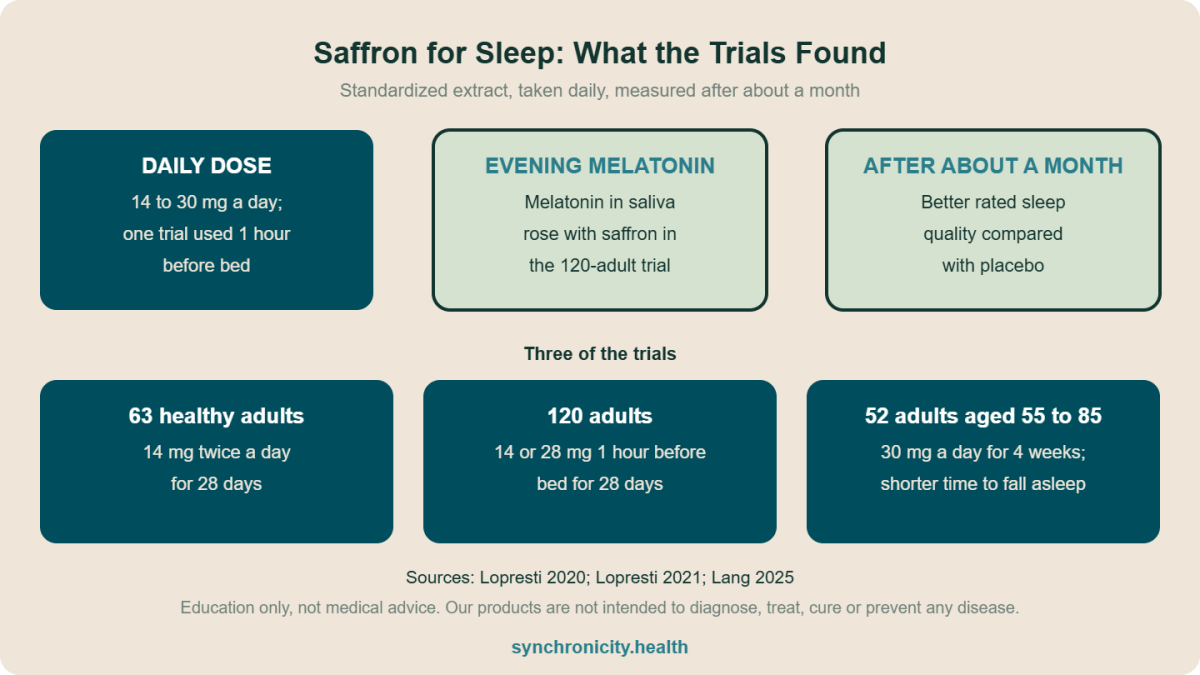
Saffron extract has been tested for sleep in several placebo-controlled trials, and the results are encouraging. In adults who were unhappy with their sleep, 14 to 30 mg a day of a standardized saffron extract for 4 to 6 weeks improved how well people rated their sleep, and in one trial evening melatonin levels rose. Several trials gave it in the evening, one of them 1 hour before bed, and people tolerated it well.
Key Takeaways
- In 63 healthy adults with self-reported poor sleep, 14 mg of saffron extract twice a day for 28 days improved sleep questionnaire scores and sleep diary quality ratings compared with placebo (Lopresti et al., 2020).
- In 120 adults with unsatisfying sleep, 14 mg or 28 mg taken 1 hour before bed for 28 days improved sleep quality ratings and mood on waking, and both doses worked about equally well (Lopresti et al., 2021).
- In that same trial, evening melatonin in saliva rose with saffron.
- In a pilot trial of 52 older adults aged 55 to 85, 30 mg a day for 4 weeks improved sleep quality and shortened the time to fall asleep measured with a sleep tracker (Lang et al., 2025).
- Saffron was generally well tolerated across 102 clinical trials (Hasheminasab et al., 2026).

Featured in this article
Saffron Mood and Calm CapsulesSaffron extract 28 mg with L-theanine 200 mg per serving in the planned formula, for a steadier mood and a calmer day.
Join the WaitlistComing soon. Third-party tested ingredients.
Does Saffron Help You Sleep? What the Trials Found
Saffron's sleep research comes from randomized, double-blind, placebo-controlled trials of standardized extracts. Here are the main ones:
| Trial | Who | Amount and length | What improved with saffron |
|---|---|---|---|
| Lopresti 2020 | 63 healthy adults aged 18 to 70 with self-reported poor sleep | 14 mg twice a day, 28 days | Sleep questionnaire scores, restorative sleep scores and sleep diary quality, compared with placebo |
| Lopresti 2021 | 120 adults with unsatisfying sleep | 14 mg or 28 mg 1 hour before bed, 28 days | Sleep quality ratings, mood on waking and sleep symptom scores, compared with placebo |
| Pachikian 2021 | 66 adults aged 25 to 70 with mild to moderate sleep complaints | 15.5 mg each evening, 6 weeks | Time in bed measured by a wrist tracker, ease of getting to sleep, and sleep quality, time to fall asleep and sleep duration scores |
| Lang 2025 (pilot) | 52 older adults aged 55 to 85 with self-reported sleep complaints | 30 mg a day, 4 weeks | Rated sleep quality and sleep efficiency, and a shorter time to fall asleep on a brain-wave sleep tracker |
Sources for the table: Lopresti et al., 2020; Lopresti et al., 2021; Pachikian et al., 2021; Lang et al., 2025.
The pattern is consistent: people who took saffron rated their sleep as better after about a month. Not every measure moved in every trial. In the 120-person trial, several other questionnaire and sleep diary measures were similar to placebo, and the authors note that most results were self-rated and that longer trials would help. The newer pilot adds a measured result, a shorter time to fall asleep on a brain-wave tracker, which is a welcome step.
How Saffron May Support Sleep
Two findings hint at how saffron fits into the evening:
- Melatonin: in the 120-person trial, evening melatonin measured in saliva rose with saffron, while evening cortisol did not change (Lopresti et al., 2021). It is one clue to how saffron fits into the evening, though it does not show exactly how saffron works.
- Mood on waking: the same trial found better mood ratings after waking, which fits saffron's wider research on mood.
Our guide to saffron supplement benefits covers the mood research, and our saffron extract ingredient page covers the compounds behind it.
Saffron for Sleep Dosage
| Amount in the trials | How it was taken |
|---|---|
| 14 mg | Once, 1 hour before bed |
| 15.5 mg | Once, each evening |
| 28 mg | Either 14 mg twice a day, or 28 mg 1 hour before bed |
| 30 mg | Daily |
Because 14 mg and 28 mg worked about equally well for sleep in the 120-person trial, there is no need to go higher than the label. Across 102 trials of saffron, most used 15 to 30 mg a day (Hasheminasab et al., 2026).
Choosing a saffron supplement for sleep
- A standardized extract with the milligrams per serving on the label, in the 14 to 30 mg range used in the trials.
- Stated marker compounds, such as crocins and safranal; one trial's 15.5 mg dose supplied 0.9 mg of crocins and 0.7 mg of safranal (Pachikian et al., 2021).
- Third-party tested ingredients.
When to Take Saffron Before Bed
The sleep trials point to the evening. The 120-person trial gave saffron 1 hour before bed, and the 6-week trial gave one capsule each evening. All the trials measured daily use over 4 to 6 weeks, so a steady routine matters more than any single night.
The most common saffron side effect is mild stomach upset, which was minor and short-lived in most cases (Hasheminasab et al., 2026), so taking it with an evening snack can help. If you take prescription medicine or are pregnant or breastfeeding, check with your clinician first.
Saffron Tea for Sleep
The sleep trials used measured capsules, not tea, so a cup of saffron tea does not give a known dose. In a lab study, the color compounds called crocins came out best in water at about 60 °C (140 °F) after 20 minutes, while the aroma compound safranal was barely present in plain water (Criado-Navarro et al., 2024). A warm cup can still be a pleasant part of winding down; for more options, see drinks that help you sleep.
Pairing Saffron With Other Sleep Ingredients
Saffron sits well alongside other melatonin-free ingredients:
- L-theanine: in a 4-week trial of 30 healthy adults, 200 mg before sleep each night improved sleep scores (Hidese et al., 2019). See L-theanine for sleep.
- Tart cherry, glycine and magnesium: each has its own sleep research; see tart cherry for sleep, which also covers how it pairs with magnesium and glycine.
For a wider look, our guides to sleep supplements without melatonin and natural sleep supplements that don't cause grogginess compare the options, and our sleep health guide covers the habits that matter most.
Where Our Saffron Capsules and Sleep Powder Fit
Our Saffron Mood and Calm Capsules pair saffron extract 28 mg with L-theanine 200 mg per serving in the planned formula. The 28 mg of saffron matches an amount used in the sleep trials above, and the 200 mg of L-theanine matches the bedtime L-theanine trial. They are coming soon: join the waitlist on the product page to hear when they launch, and no payment is taken now.
Our Melatonin-Free Sleep Powder is also coming soon. It combines tart cherry, 3 g of glycine, 200 mg of magnesium from two gentle forms, myo-inositol and apigenin in water, taken 30 to 60 minutes before bed, with no added melatonin, no 5-HTP and no added sugar or sweeteners. Join the waitlist to hear when it launches.
Saffron's benefits build with consistent daily use. Months 1 to 2 can bring early changes, and 3 months and beyond is where the full benefit builds.

Featured in this article
Melatonin-Free Sleep PowderTart cherry powder and tart cherry extract with glycine, magnesium and apigenin in an unsweetened drink that helps you wind down at night, with no added melatonin.
Join the WaitlistComing soon. Third-party tested ingredients.
Frequently Asked Questions
Does saffron help you sleep?
In placebo-controlled trials, adults who took 14 to 30 mg a day of saffron extract for 4 to 6 weeks rated their sleep quality as better than those on placebo.
Should I take saffron before bed?
The evening fits the research. One trial gave saffron 1 hour before bed and another gave it each evening, with daily use over 4 to 6 weeks.
How much saffron should I take for sleep?
The sleep trials used 14 to 30 mg a day of a standardized extract, and 14 mg and 28 mg worked about equally well in one trial. Follow your product label.
Is saffron extract good for sleep?
Yes, in studies. Standardized extracts improved rated sleep quality in adults with poor sleep, and in one trial evening melatonin in saliva rose.
Does saffron tea help you sleep?
The trials used capsules of extract, so the effect of tea is not known. A warm cup can still be part of a calm evening routine.
What is the best saffron supplement for sleep?
Look for a standardized extract with the milligrams on the label in the 14 to 30 mg range used in trials, stated marker compounds and third-party tested ingredients.
How long does saffron take to work for sleep?
The trials measured changes after 4 to 6 weeks of daily use, so give it at least a month, and longer for the full benefit.
Can I take saffron and L-theanine for sleep?
Yes, many people pair them. Both have sleep data with evening or bedtime use, and they are different kinds of ingredients.
Sources
- Lopresti AL, Smith SJ, Metse AP, Drummond PD. Effects of saffron on sleep quality in healthy adults with self-reported poor sleep: a randomized, double-blind, placebo-controlled trial. Journal of Clinical Sleep Medicine, 2020. https://pubmed.ncbi.nlm.nih.gov/32056539/
- Lopresti AL, Smith SJ, Drummond PD. An investigation into an evening intake of a saffron extract (affron) on sleep quality, cortisol, and melatonin concentrations in adults with poor sleep: a randomised, double-blind, placebo-controlled, multi-dose study. Sleep Medicine, 2021. https://pubmed.ncbi.nlm.nih.gov/34438361/
- Pachikian BD, Copine S, Suchareau M, Deldicque L. Effects of saffron extract on sleep quality: a randomized double-blind controlled clinical trial. Nutrients, 2021. https://pubmed.ncbi.nlm.nih.gov/33925432/
- Lang L, et al. A standardised saffron extract improves subjective and objective sleep quality in healthy older adults with sleep complaints: results from the gut-sleep-brain axis randomised, double-blind, placebo-controlled pilot study. Food and Function, 2025. https://pubmed.ncbi.nlm.nih.gov/40762630/
- Hasheminasab FS, Hajimonfarednejad M, Najibi SM, Hashempur MH. Adverse events of saffron (Crocus sativus L.): systematic review of current evidence. Health Science Reports, 2026. https://pubmed.ncbi.nlm.nih.gov/42057871/
- Criado-Navarro I, Ledesma-Escobar CA, Pérez-Juan P, Priego-Capote F. Distribution of main bioactive compounds from saffron species as a function of infusion temperature and time in an oil/water system. Molecules, 2024. https://pubmed.ncbi.nlm.nih.gov/38999032/
- Hidese S, et al. Effects of L-theanine administration on stress-related symptoms and cognitive functions in healthy adults: a randomized controlled trial. Nutrients, 2019. https://pubmed.ncbi.nlm.nih.gov/31623400/
These statements have not been evaluated by the Food and Drug Administration. This content is for education and is not medical advice. Our products are not intended to diagnose, treat, cure or prevent any disease. Talk with a healthcare provider before starting a new supplement if you are pregnant, breastfeeding or taking medication.

Leave a comment
All comments are moderated before being published.
This site is protected by hCaptcha and the hCaptcha Privacy Policy and Terms of Service apply.