
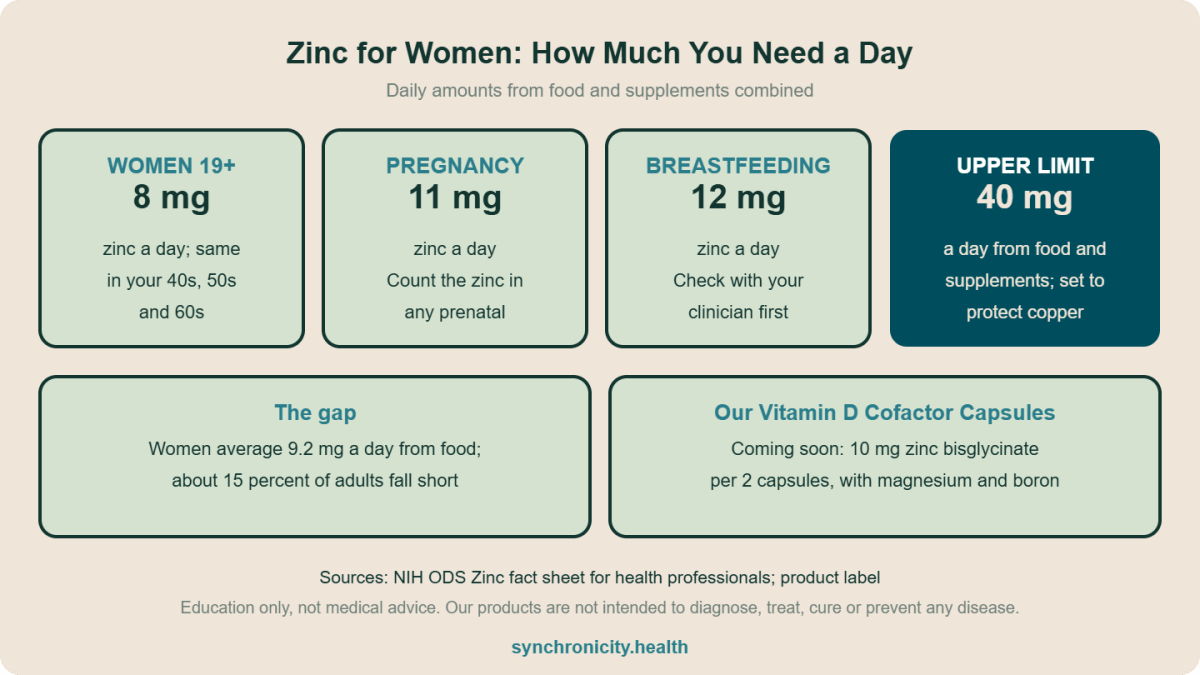
Adult women need 8 mg of zinc a day, rising to 11 mg during pregnancy and 12 mg while breastfeeding, and the upper limit is 40 mg a day from food and supplements combined. Women in the United States average about 9.2 mg a day from food, close to the target with little room to spare. Zinc supports normal immune function, protein and DNA building, wound repair and the sense of taste, and the daily amount stays the same through your 40s, 50s and beyond.
Key Takeaways
- Women 19 and older need 8 mg of zinc a day, 11 mg in pregnancy and 12 mg while breastfeeding; the upper limit for all adults is 40 mg a day from all sources (NIH ODS: Zinc).
- Women average 9.2 mg a day from food and 12.6 mg when supplements are counted, and about 15 percent of US adults take in less than the average requirement.
- A woman's body holds about 1.5 g of zinc, compared with about 2.5 g in men, and most of it sits in muscle and bone.
- Older adults are one of the groups most likely to have marginal intakes, which makes your 50s and 60s a good time to check your total.
- In a study of 12 women, zinc bisglycinate raised blood zinc 43.4 percent more than gluconate (Gandia et al., 2007).

Featured in this article
Vitamin D Cofactor CapsulesMagnesium 100 mg, zinc 10 mg and boron 3 mg per 2 capsules, all as glycinates, made to pair with vitamin D3.
Join the WaitlistComing soon. Third-party tested ingredients.
What Zinc Does for Women
Zinc is an essential mineral, which means your body cannot make it and needs a steady supply from food or supplements. It is required for the work of hundreds of enzymes, and it plays a role in immune function, protein and DNA synthesis, wound repair, and cell signaling and division. It is also involved in the sense of taste, and low zinc can dull both taste and smell (NIH ODS: Zinc).
Women carry less zinc than men: about 1.5 g in total compared with about 2.5 g, with most of it stored in skeletal muscle and bone. A steady daily intake keeps it topped up. For more on daily amounts, see our zinc per day guide, and for the form we use, our zinc bisglycinate ingredient page.
How Much Zinc Per Day for a Woman
These are the official daily amounts for adult women, from food and supplements combined (NIH ODS: Zinc):
| Life stage | Zinc RDA a day | Upper limit a day |
|---|---|---|
| Women 19 and older | 8 mg | 40 mg |
| Pregnancy, 19 and older | 11 mg | 40 mg |
| Breastfeeding, 19 and older | 12 mg | 40 mg |
| Men 19 and older, for comparison | 11 mg | 40 mg |
The RDA does not change after 19, so a woman of 45, 55 or 70 has the same 8 mg target. The upper limit is a ceiling for all sources combined, not a goal, and it was set based on zinc's effect on copper status.
On average, women get 9.2 mg a day from food and 12.6 mg once supplements are counted. Those averages hide a spread: about 15 percent of US adults take in less than the Estimated Average Requirement, and 11 percent of pregnant women fall below it (NIH ODS: Zinc).
Zinc for Women Over 40, 50 and 60
Your 40s
The target is still 8 mg. What often changes in this decade is the diet, often with more plant-based meals. Legumes and whole grains contain phytates, which bind zinc and lower how much you absorb, so women who eat mostly plants usually have lower zinc intakes and blood levels, and they might benefit from a supplement (NIH ODS: Zinc).
Your 50s
Zinc needs stay at 8 mg, but this is the decade when many women build a fuller supplement routine. The calcium target rises from 1,000 mg to 1,200 mg a day at 51 (NIH ODS: Calcium), and vitamin D, vitamin K2 and minerals such as magnesium and zinc often join the plan. That makes it the right time to add up zinc from every label, including a multivitamin, so the total stays well under 40 mg. Our guide to vitamin D for women covers the vitamin D side.
Your 60s and beyond
The NIH Office of Dietary Supplements notes that older adults are among the groups who might have marginal zinc intakes, and that low zinc in older adults can slow wound repair (NIH ODS: Zinc). In a randomized trial, 31 nursing home residents aged 65 and older who started with low blood zinc took 30 mg of zinc or a placebo every day for 3 months. Zinc raised blood zinc by 16 percent more than placebo and increased the number of T cells, a key type of immune cell (Barnett et al., 2016). It was a small study in a group that began low, and not everyone reached a normal level, but it shows zinc status can shift over a few months.
Zinc Benefits for Women: What Studies Measured
- Immune support: zinc plays a role in normal immune function, and the trial above found more T cells in older adults who started low.
- Skin and wound repair: zinc is needed for wound repair, and low zinc in older adults can slow it.
- Taste and smell: zinc is involved in taste, and low zinc can dull taste and smell.
- Mood: in a 10-week pilot study, 30 young women took a multivitamin with or without 7 mg of zinc. Women in the zinc group had higher blood zinc and better scores on a standard mood questionnaire, while the multivitamin-only group showed no such change (Sawada and Yokoi, 2010). It was a small, early study.
Our immune system guide covers the other nutrients that support normal immune function.
Food First: Where Women Get Zinc
Shellfish and red meat are the richest sources. These amounts come from the NIH food table (NIH ODS: Zinc):
| Food and serving | Zinc |
|---|---|
| Oysters, Eastern, farmed, raw, 3 oz | 32 mg |
| Beef, bottom sirloin, roasted, 3 oz | 3.8 mg |
| Blue crab, cooked, 3 oz | 3.2 mg |
| Oats, cooked, 1 cup | 2.3 mg |
| Pumpkin seeds, roasted, 1 oz | 2.2 mg |
| Cheddar cheese, 1.5 oz | 1.5 mg |
| Lentils, boiled, half cup | 1.3 mg |
| Greek yogurt, plain, 6 oz | 1.0 mg |
A day with oatmeal, a yogurt, a handful of pumpkin seeds and a serving of lentils adds up to roughly 6.8 mg, so a woman who rarely eats meat or shellfish can come in under 8 mg without noticing. Our guide to foods high in zinc has the full list and a vegan sample day.
Choosing a Zinc Supplement
- Read the elemental amount: the Supplement Facts panel lists the zinc itself, not the weight of the whole compound, so 10 mg of zinc as bisglycinate counts as 10 mg.
- Form matters a little: absorption is about 61 percent for zinc citrate and gluconate in young adults and 50 percent for zinc oxide (NIH ODS: Zinc). In a crossover study of 12 healthy women given a single 15 mg dose, zinc bisglycinate raised blood zinc 43.4 percent more than gluconate and was well tolerated (Gandia et al., 2007). See zinc picolinate vs bisglycinate vs gluconate for the full comparison.
- Space it from iron supplements: taking 25 mg or more of iron at the same time as zinc can lower zinc absorption. Iron in fortified foods does not interfere much.
- Pairing with magnesium is fine: the interaction with magnesium was seen only at 142 mg of zinc a day. See magnesium and zinc together.
Is Zinc Safe for Women?
Most people tolerate zinc well at everyday amounts, and food rarely supplies too much. High intakes can cause nausea, dizziness, headaches, stomach upset and loss of appetite, and 50 mg or more a day for weeks can interfere with copper absorption and reduce immune function (NIH ODS: Zinc). Staying under the 40 mg upper limit from all sources keeps you clear of both. If zinc upsets your stomach, take it with a meal.
If you are pregnant or breastfeeding, count the zinc in any prenatal vitamin and talk with your clinician before adding more. If you take prescription medicine, check with your clinician first too.
Where Our Vitamin D Cofactor Capsules Fit
Our Vitamin D Cofactor Capsules are coming soon. Each 2-capsule serving gives 10 mg of zinc and 100 mg of magnesium as bisglycinate, plus 3 mg of boron as glycinate, made with third-party tested ingredients and designed to pair with our Vitamin D3 + K2 Drops. Added to the 9.2 mg a woman gets from food on average, 10 mg of zinc lands well under the 40 mg limit. You can join the waitlist on the product page. For why these minerals are grouped with vitamin D, see vitamin D cofactors.
Benefits build with consistent daily use: months 1 to 2 can bring early changes, and 3 months and beyond is where the full benefit builds.

Featured in this article
Vitamin D3 + K2 DropsVegan vitamin D3 from lichen with vitamin K2 as MK-4 and MK-7 in an MCT oil base, one drop a day with a meal.
Shop Vitamin D3 + K2 DropsThird-party tested ingredients. Vegan, gluten free, non-GMO.
Frequently Asked Questions
How much zinc per day should a woman take?
Adult women need 8 mg a day from food and supplements combined, 11 mg in pregnancy and 12 mg while breastfeeding. The upper limit is 40 mg a day from all sources.
What is the zinc RDA for women?
The RDA is 8 mg a day for women 19 and older. Men need 11 mg.
How much zinc should a woman over 50 take?
The same 8 mg a day. Older adults are more likely to have marginal intakes, so it is worth adding up what you get from food and every supplement label.
Is zinc good for women over 40?
Zinc supports normal immune function, wound repair and taste at every age. The target stays at 8 mg in your 40s, and women eating mostly plant foods may need extra attention because phytates lower absorption.
What are the benefits of zinc for women?
Zinc is needed for hundreds of enzymes and supports immune function, protein and DNA building, wound repair and taste. A small pilot in young women also linked 7 mg of added zinc with better mood scores.
Can a woman take zinc every day?
Yes. Daily intake is how the RDA is set. Keep your total from food and supplements under 40 mg a day.
Is 50 mg of zinc too much for a woman?
It is above the 40 mg upper limit. Taking 50 mg or more a day for weeks can interfere with copper absorption, so stay under 40 mg unless a clinician advises otherwise.
Can I take zinc and iron together?
Iron supplements of 25 mg or more taken at the same time can lower zinc absorption, so take them at different times of day. Iron in fortified foods does not interfere much.
Sources
- National Institutes of Health, Office of Dietary Supplements. Zinc: Fact Sheet for Health Professionals. https://ods.od.nih.gov/factsheets/Zinc-HealthProfessional/
- National Institutes of Health, Office of Dietary Supplements. Calcium: Fact Sheet for Health Professionals. https://ods.od.nih.gov/factsheets/Calcium-HealthProfessional/
- Barnett JB, et al. Effect of zinc supplementation on serum zinc concentration and T cell proliferation in nursing home elderly: a randomized, double-blind, placebo-controlled trial. American Journal of Clinical Nutrition, 2016. https://pubmed.ncbi.nlm.nih.gov/26817502/
- Sawada T, Yokoi K. Effect of zinc supplementation on mood states in young women: a pilot study. European Journal of Clinical Nutrition, 2010. https://pubmed.ncbi.nlm.nih.gov/20087376/
- Gandia P, et al. A bioavailability study comparing two oral formulations containing zinc (Zn bis-glycinate vs. Zn gluconate) after a single administration to twelve healthy female volunteers. International Journal for Vitamin and Nutrition Research, 2007. https://pubmed.ncbi.nlm.nih.gov/18271278/
These statements have not been evaluated by the Food and Drug Administration. This content is for education and is not medical advice. Our products are not intended to diagnose, treat, cure or prevent any disease. Talk with a healthcare provider before starting a new supplement if you are pregnant, breastfeeding or taking medication.

Leave a comment
All comments are moderated before being published.
This site is protected by hCaptcha and the hCaptcha Privacy Policy and Terms of Service apply.