
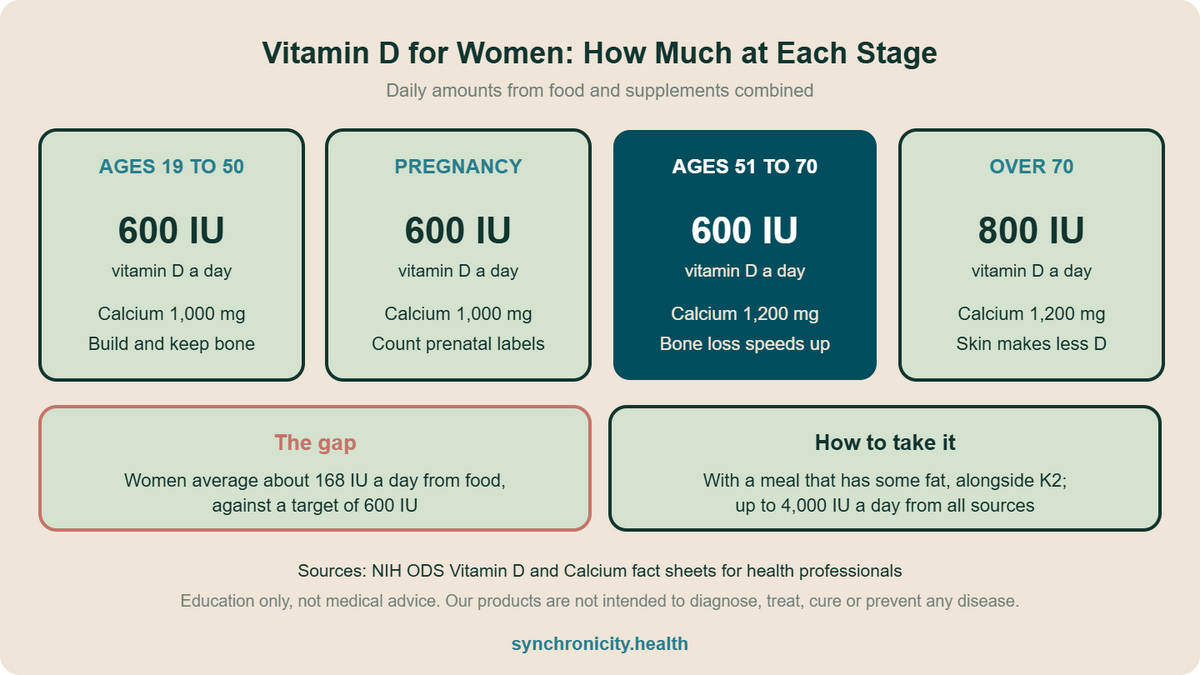
Most women need 600 IU (15 mcg) of vitamin D a day from food and supplements combined, rising to 800 IU (20 mcg) after age 70, and the amount stays at 600 IU during pregnancy and breastfeeding. Yet women in the United States average only about 168 IU a day from food, so many rely on sunlight or a supplement to close the gap. Vitamin D is needed to absorb calcium, which matters more than ever after menopause, when bone loss speeds up.
Key Takeaways
- Adult women need 600 IU (15 mcg) a day, 800 IU (20 mcg) after 70, and 600 IU in pregnancy and while breastfeeding. The upper limit for all adults is 4,000 IU (100 mcg) a day (NIH ODS: Vitamin D).
- Food alone rarely gets there: women average about 168 IU (4.2 mcg) a day from foods and drinks.
- Vitamin D helps the body absorb calcium and supports bones, muscles and normal immune function.
- After menopause, women lose about 1 percent of bone mineral density a year, and the calcium target rises from 1,000 to 1,200 mg a day at 51 (NIH ODS: Calcium).
- Take vitamin D with a meal that has some fat, count every source, and pair it with vitamin K2 and enough magnesium.

Featured in this article
Vitamin D3 + K2 DropsVegan vitamin D3 from lichen with vitamin K2 as MK-4 and MK-7 in an MCT oil base, one drop a day with a meal.
Shop Vitamin D3 + K2 DropsThird-party tested ingredients. Vegan, gluten free, non-GMO.
Why Vitamin D Matters for Women
Vitamin D is a fat-soluble vitamin that your skin makes from sunlight and that you can also get from a few foods and supplements. Its best known job is helping the gut absorb calcium, the mineral that builds and keeps bone. Vitamin D also plays a role in normal muscle, nerve and immune function (NIH ODS: Vitamin D).
For women, the bone side of that story carries extra weight. Bone is built and kept up throughout life, and after menopause lower estrogen means the body absorbs less calcium, loses more in urine and breaks down more bone. That is why the calcium target goes up at 51 (NIH ODS: Calcium), and why vitamin D, the nutrient that lets you absorb that calcium, deserves a place in the plan. For how the two work together, see our guide to vitamin D3 and K2.
How Much Vitamin D Women Need by Life Stage
These are the official daily amounts for women, from food and supplements combined (NIH ODS: Vitamin D; NIH ODS: Calcium):
| Life stage | Vitamin D a day | Calcium a day |
|---|---|---|
| Ages 19 to 50 | 600 IU (15 mcg) | 1,000 mg |
| Pregnancy and breastfeeding | 600 IU (15 mcg) | 1,000 mg |
| Ages 51 to 70 | 600 IU (15 mcg) | 1,200 mg |
| Over 70 | 800 IU (20 mcg) | 1,200 mg |
| Upper limit, all adults | 4,000 IU (100 mcg) | 2,500 mg to 50; 2,000 mg from 51 |
The upper limit is the most you can take each day from all sources combined without a likely risk of harm, not a target. Many supplements, including ours, give 2,000 IU a day, which sits well within it. Our vitamin D3 supplement guide compares common doses.
Why Many Women Fall Short
Few foods contain much vitamin D. In national survey data, women averaged 168 IU (4.2 mcg) a day from foods and drinks, against a target of 600 IU, and men averaged 204 IU (NIH ODS: Vitamin D). Here is what the richest foods provide:
| Food | Vitamin D |
|---|---|
| Trout, farmed, cooked, 3 oz | 645 IU |
| Salmon, sockeye, cooked, 3 oz | 570 IU |
| White mushrooms exposed to UV light, half cup | 366 IU |
| Milk, 2 percent, fortified, 1 cup | 120 IU |
| Egg, 1 large, scrambled | 44 IU |
Unless you eat oily fish most days, food alone is unlikely to reach 600 IU. Our guide to foods high in vitamin D has the full list.
Women who may need extra attention
- Older women: the skin makes less vitamin D with age, and older adults tend to spend more time indoors.
- Limited sun: working indoors, living far from the equator, or covering most of the skin when outdoors.
- Darker skin: more melanin means the skin makes less vitamin D from the same sunlight.
- A BMI of 30 or more: blood levels tend to run lower, and more vitamin D may be needed to reach the same level.
- Trouble absorbing fat: some digestive conditions and weight loss surgery reduce how much vitamin D you absorb.
These groups come from the NIH Office of Dietary Supplements (NIH ODS: Vitamin D). If one fits you, a blood test is the simplest way to know where you stand.
Vitamin D Through Each Stage of Life
Your 20s to 40s
These are the years when you build and keep up bone for later. Aim for 600 IU of vitamin D and 1,000 mg of calcium a day, with most of the calcium from food. Regular movement, especially strength training, works alongside both; our guide to creatine for women covers strength training support.
Pregnancy and breastfeeding
The vitamin D target does not change: 600 IU a day, with the same 4,000 IU upper limit. Most prenatal vitamins already contain vitamin D, so add up every label before adding another product, and talk with your healthcare provider before starting any new supplement while pregnant or breastfeeding.
Perimenopause and menopause
As estrogen falls, the body absorbs less calcium, loses more in urine and breaks down more bone. After menopause women lose about 1 percent of bone mineral density a year, so the calcium target rises to 1,200 mg a day at 51 (NIH ODS: Calcium). Vitamin D stays at 600 IU until 70, but it is the nutrient that lets you absorb that extra calcium, so this is a good time to check your intake and your blood level.
After 70
The vitamin D target rises to 800 IU (20 mcg) a day because the skin makes less and time outdoors often drops. Calcium stays at 1,200 mg.
Vitamin K2 and Magnesium: The Partners
- Vitamin K2: vitamin D raises how much calcium you absorb, and vitamin K2 activates osteocalcin, the protein that binds calcium into bone. See vitamin K2: MK-4 vs MK-7 for the two forms.
- Magnesium: the enzymes that turn vitamin D into its active form need magnesium. Our guide to vitamin D and magnesium explains how to take them together.
- The full picture: boron and zinc also play supporting roles; see vitamin D cofactors.
How to Take Vitamin D
- With a meal that has some fat: vitamin D is fat-soluble, so a meal with eggs, yogurt, nuts, olive oil or fish helps you absorb it.
- At the same time every day: pick the meal you never skip.
- Count every source: multivitamins, prenatal vitamins and fortified foods all add up toward the 4,000 IU upper limit.
- Test if you want certainty: a blood level of 20 ng/mL or more is adequate for most people, and levels above 50 ng/mL are higher than needed (NIH ODS: Vitamin D). Recheck about 3 months after you start or change a dose.
- Pick the form you will use: drops and pills both work; see vitamin D drops vs pills, and our vegan vitamin D3 guide if you avoid animal ingredients.
Our vitamin D3 ingredient guide covers the basics, and our immune system guide covers daily immune support.
Where Our Vitamin D3 + K2 Drops Fit
Our Vitamin D3 + K2 Drops put both partners in one drop: 2,000 IU (50 mcg) of vegan vitamin D3 from lichen and 300 mcg of vitamin K2 as MK-7 200 mcg and MK-4 100 mcg, in MCT oil from coconut. Take one drop a day with a meal. Each bottle holds about 180 drops, about 6 months at one drop a day. If you also want the minerals that help vitamin D work, our Vitamin D Cofactor Capsules are coming soon.
Featured in this article
Vitamin D3 + K2 DropsVegan vitamin D3 from lichen with vitamin K2 as MK-4 and MK-7 in an MCT oil base, one drop a day with a meal.
Shop Vitamin D3 + K2 DropsThird-party tested ingredients. Vegan, gluten free, non-GMO.
More vitamin D guides: vitamin D side effects, the best time to take vitamin D, vitamin D and calcium and vitamin D in winter.
Frequently Asked Questions
How much vitamin D should a woman take a day?
The official target is 600 IU (15 mcg) a day for women up to 70 and 800 IU (20 mcg) after 70, from food and supplements combined. The upper limit is 4,000 IU a day.
Is 2,000 IU of vitamin D a day safe for women?
For healthy adult women, yes. 2,000 IU is half the 4,000 IU upper limit. Add up any other supplements and fortified foods so your total stays under the limit.
Do women need more vitamin D after menopause?
The vitamin D target stays at 600 IU until 70, then rises to 800 IU. What rises at 51 is the calcium target, to 1,200 mg, and vitamin D is what lets you absorb that calcium.
How much vitamin D do you need during pregnancy?
600 IU (15 mcg) a day, the same as other adult women. Most prenatal vitamins contain vitamin D, so check the label and talk with your healthcare provider before adding more.
What does vitamin D do for women?
It helps the body absorb calcium and supports bones, muscles and normal immune function. The bone role matters most after menopause, when bone loss speeds up.
Should women take vitamin D with K2?
Many do. Vitamin D raises calcium absorption and vitamin K2 activates osteocalcin, which binds calcium into bone. Both are fat-soluble, so one meal suits both.
Can women get enough vitamin D from the sun?
Some can in summer, but sunscreen, clothing, darker skin, age, time indoors and winter sunlight far from the equator all cut how much the skin makes. Many women need food or a supplement as well.
What is the best time of day for women to take vitamin D?
Any time, as long as it is with a meal that has some fat and you take it at the same time each day.
Sources
- National Institutes of Health, Office of Dietary Supplements. Vitamin D: Fact Sheet for Health Professionals. https://ods.od.nih.gov/factsheets/VitaminD-HealthProfessional/
- National Institutes of Health, Office of Dietary Supplements. Calcium: Fact Sheet for Health Professionals. https://ods.od.nih.gov/factsheets/Calcium-HealthProfessional/
These statements have not been evaluated by the Food and Drug Administration. This content is for education and is not medical advice. Our products are not intended to diagnose, treat, cure or prevent any disease. Talk with a healthcare provider before starting a new supplement if you are pregnant, breastfeeding or taking medication.

Leave a comment
All comments are moderated before being published.
This site is protected by hCaptcha and the hCaptcha Privacy Policy and Terms of Service apply.