
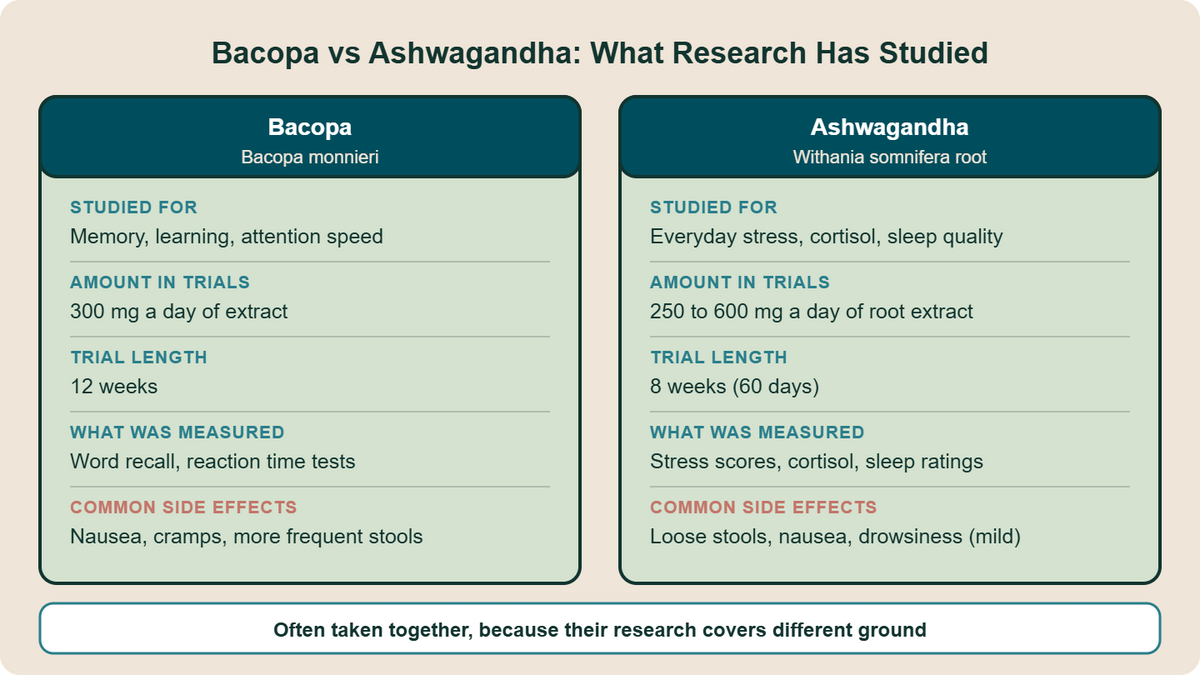
Bacopa and ashwagandha are both traditional Indian herbs, but research has studied them for different things. Bacopa is studied mainly for memory, learning and attention, in trials that ran about 12 weeks, while ashwagandha is studied mainly for everyday stress, cortisol and sleep quality, in trials that ran about 8 weeks. Because their roles overlap so little, many people take them together. Here is how they compare, how to take them and what to watch for.
Key Takeaways
- Bacopa (Bacopa monnieri) has been studied mainly for memory: in 98 healthy adults over 55, 300 mg a day for 12 weeks improved verbal learning and delayed word recall compared with placebo (Morgan and Stevens, 2010).
- A pooled analysis of 9 placebo-controlled trials with 518 participants found bacopa extract shortened Trail B times and choice reaction times, two measures of attention speed (Kongkeaw et al., 2014).
- Ashwagandha root extract has been studied mainly for everyday stress: in 64 adults with a history of chronic stress, 300 mg twice a day for 60 days lowered stress scale scores and serum cortisol compared with placebo (Chandrasekhar et al., 2012).
- A review of 5 trials in 400 adults found a small but significant benefit of ashwagandha on overall sleep, larger at 600 mg a day or more and with 8 weeks of use or longer (Cheah et al., 2021).
- Bacopa and ashwagandha can be taken together. Side effects for both are mostly mild stomach complaints, and ashwagandha might affect thyroid function and interact with some medicines (NIH Office of Dietary Supplements).

Featured in this article
Clarity CapsulesBacopa monnieri extract 200 mg with lion's mane, rhodiola, maca, epimedium and huperzine A in every 2-capsule serving, for daily focus and memory support.
Shop Clarity CapsulesThird-party tested ingredients. Vegan capsules, made in the USA.
Bacopa vs Ashwagandha at a Glance
Both herbs come from the Indian tradition of Ayurveda, and neither is a stimulant. The clearest difference is what human trials have measured.
| Bacopa | Ashwagandha | |
|---|---|---|
| Main research focus | Memory, learning and attention speed | Everyday stress, cortisol and sleep quality |
| Amounts used in trials | 300 mg a day of extract | 250 to 600 mg a day of root extract |
| Trial length | 12 weeks | 8 weeks (60 days) |
| What was measured | Word recall, verbal learning, reaction time and attention tests | Stress scale scores, serum cortisol and sleep ratings |
| Most common side effects | Stomach complaints such as nausea, cramps and more frequent stools | Loose stools, nausea, drowsiness, usually mild |
| Where you find it in our range | Clarity Capsules, 200 mg per serving | Forage, 100 mg per serving |
What Bacopa Is Studied For
Bacopa monnieri is a creeping plant that grows in wet ground, and its extract is studied mainly for memory.
In a 12-week trial in 98 healthy adults over 55, 300 mg of bacopa a day improved verbal learning and delayed word recall compared with placebo (Morgan and Stevens, 2010). In a second 12-week trial, 54 adults aged 65 and older took 300 mg of a standardized extract a day; delayed word recall and scores on a Stroop task, a test of attention, improved compared with placebo (Calabrese et al., 2008).
Looking across studies, a meta-analysis pooled 9 randomized, placebo-controlled trials with 518 participants. Bacopa shortened Trail B times, a test of attention and switching between tasks, and choice reaction times (Kongkeaw et al., 2014).
For a deeper look at the herb itself, see our bacopa monnieri ingredient page and our guide to bacopa benefits. If you are weighing bacopa against a mushroom, bacopa vs lion's mane compares the two. If you are weighing it against an amino acid from tea instead, bacopa vs L-theanine covers memory, calm focus and taking both.
What Ashwagandha Is Studied For
Ashwagandha (Withania somnifera) is a shrub whose root is used as an adaptogen, a herb taken to support the body's response to everyday stress.
In a 60-day trial in 64 adults with a history of chronic stress, 300 mg of root extract twice a day lowered scores on every stress scale used, and serum cortisol, compared with placebo. Side effects were mild and similar in both groups (Chandrasekhar et al., 2012). In an 8-week trial in 60 stressed adults, both 250 mg and 600 mg a day of root extract lowered Perceived Stress Scale scores and serum cortisol, and sleep quality improved compared with placebo (Salve et al., 2019).
For sleep, a review of 5 randomized trials in 400 adults found a small but significant benefit on overall sleep. The effect was larger at 600 mg a day or more and with 8 weeks of use or longer (Cheah et al., 2021).
Our ashwagandha root extract page and ashwagandha benefits guide cover the herb in more detail, and rhodiola vs ashwagandha compares it with another adaptogen.
Bacopa or Ashwagandha: Choosing by Your Goal
The simplest way to choose is to match the herb to the result you care about most:
- Memory and learning. Bacopa is the one studied for word recall, learning new material and attention speed.
- Everyday stress. Ashwagandha is the one studied for stress ratings and cortisol in stressed adults.
- Sleep quality. Ashwagandha has the sleep research, with larger effects at higher amounts and longer use.
- Focus on busy days. Both can fit: bacopa for the attention side, ashwagandha for the stress that can get in the way of focus.
For more ways to support a clear head, see our hub on cognitive health and mental clarity.
Taking Bacopa and Ashwagandha Together
Bacopa and ashwagandha are often paired because their research covers different ground: one for memory and attention, the other for stress and sleep. The trials above studied each herb on its own.
If you would like to take both, a sensible approach is to start one at a time for a week or two, so you know how each one suits you before you combine them. Ashwagandha can cause drowsiness in some people (NIH Office of Dietary Supplements), so notice how you feel before driving or other tasks that need full attention.
In our range, bacopa is in Clarity Capsules, which give Bacopa monnieri extract 200 mg alongside lion's mane 8:1 fruiting body extract 250 mg, epimedium extract 200 mg, maca root extract 200 mg, rhodiola rosea extract 150 mg and huperzine A 200 mcg per 2-capsule serving. Ashwagandha is in Forage, which gives ashwagandha root extract 100 mg and Himalayan shilajit extract 100 mg with seven 8:1 mushroom fruiting body extracts per 2-capsule serving. Both are made with third-party tested ingredients in vegan capsules.
How to Take Them
- Follow the label. Clarity Capsules: 2 capsules daily, preferably in the morning on an empty stomach. Forage: 2 capsules daily, taken in the morning with or without food.
- Take them every day. Trials gave both herbs daily, and results were measured after 8 to 12 weeks.
- Track one thing for each. A weekly word list or reading recall check for bacopa, and a simple stress and sleep rating for ashwagandha, tell you more than how a single day feels.
Safety and Side Effects
Bacopa
In a 12-week trial in adults aged 65 and older, bacopa was well tolerated, and the side effects reported were mostly stomach upset (Calabrese et al., 2008). In the trial in adults over 55, bacopa caused more stomach side effects than placebo, namely more frequent stools, abdominal cramps and nausea (Morgan and Stevens, 2010).
Ashwagandha
Common side effects such as loose stools, nausea and drowsiness are usually mild. There are a few reports of more serious effects on the liver, and ashwagandha might affect thyroid function. It might also interact with some medicines, including medicines for diabetes, blood pressure medicines, immunosuppressants, sedatives and thyroid hormone medicines. Some experts advise against ashwagandha during pregnancy (NIH Office of Dietary Supplements). Our guide to ashwagandha side effects covers who should avoid it.
When to check with your doctor
Talk with your doctor before taking either herb if you are pregnant or breastfeeding, if you take prescription medicine, or if you have a liver or thyroid condition. Clarity Capsules also contain huperzine A, so share the full ingredient list with your doctor or pharmacist.

Featured in this article
ForageAshwagandha root extract 100 mg and Himalayan shilajit extract 100 mg with seven 8:1 mushroom fruiting body extracts in every 2-capsule serving.
Shop ForageThird-party tested ingredients. Vegan capsules, made in the USA.
Frequently Asked Questions
Is bacopa or ashwagandha better?
Neither is better overall, because research has studied them for different goals: bacopa for memory, learning and attention, ashwagandha for stress, cortisol and sleep. Choose bacopa if memory and learning matter most to you, ashwagandha if everyday stress and sleep matter most, or take both if you want support in both areas.
What is the difference between ashwagandha and bacopa?
Ashwagandha is a shrub whose root is used as an adaptogen, and it is studied mainly for everyday stress, cortisol and sleep quality. Bacopa is a creeping wetland herb studied mainly for memory, verbal learning and attention speed. Neither is a stimulant.
Can you take bacopa and ashwagandha together?
Yes, many people take bacopa and ashwagandha together because their research covers different ground. Starting one at a time for a week or two helps you see how each suits you. Ashwagandha can cause drowsiness in some people and can interact with some medicines, so talk with your doctor first if you take prescription medicine or are pregnant.
Is bacopa or ashwagandha better for focus?
Bacopa is the one studied directly for attention: a pooled analysis of 9 trials found faster Trail B times and choice reaction times with bacopa extract. Ashwagandha research centers on stress and sleep, which can also shape how well you focus during a busy day.
Is bacopa or ashwagandha better for stress?
Ashwagandha is the herb studied most for everyday stress. In a 60-day trial in adults with a history of chronic stress, 300 mg of root extract twice a day lowered stress scale scores and serum cortisol compared with placebo. Bacopa research focuses mainly on memory and learning.
How long do bacopa and ashwagandha take to work?
Bacopa trials measured memory and attention after 12 weeks. Ashwagandha trials measured stress and cortisol after 8 weeks, and a sleep review found larger effects with 8 weeks of use or longer. How soon you notice anything varies from person to person.
Should you take bacopa and ashwagandha in the morning or at night?
Follow the label of the product you use. Clarity Capsules suggest 2 capsules in the morning, preferably on an empty stomach, and Forage suggests 2 capsules in the morning with or without food. Ashwagandha can cause drowsiness in some people, so notice how it affects you before driving.
What are the side effects of bacopa and ashwagandha?
For bacopa, trials reported mostly stomach complaints such as nausea, abdominal cramps and more frequent stools. For ashwagandha, common side effects such as loose stools, nausea and drowsiness are usually mild, with a few reports of liver effects and possible effects on thyroid function. Talk with your doctor if you take medicine for diabetes, blood pressure or your thyroid.
Sources
- Morgan A, Stevens J. Does Bacopa monnieri improve memory performance in older persons? Results of a randomized, placebo-controlled, double-blind trial. Journal of Alternative and Complementary Medicine, 2010. https://pubmed.ncbi.nlm.nih.gov/20590480/
- Calabrese C, Gregory WL, Leo M, Kraemer D, Bone K, Oken B. Effects of a standardized Bacopa monnieri extract on cognitive performance, anxiety, and depression in the elderly: a randomized, double-blind, placebo-controlled trial. Journal of Alternative and Complementary Medicine, 2008. https://pubmed.ncbi.nlm.nih.gov/18611150/
- Kongkeaw C, Dilokthornsakul P, Thanarangsarit P, Limpeanchob N, Norman Scholfield C. Meta-analysis of randomized controlled trials on cognitive effects of Bacopa monnieri extract. Journal of Ethnopharmacology, 2014. https://pubmed.ncbi.nlm.nih.gov/24252493/
- Chandrasekhar K, Kapoor J, Anishetty S. A prospective, randomized double-blind, placebo-controlled study of safety and efficacy of a high-concentration full-spectrum extract of ashwagandha root in reducing stress and anxiety in adults. Indian Journal of Psychological Medicine, 2012. https://pubmed.ncbi.nlm.nih.gov/23439798/
- Salve J, Pate S, Debnath K, Langade D. Adaptogenic and anxiolytic effects of ashwagandha root extract in healthy adults: a double-blind, randomized, placebo-controlled clinical study. Cureus, 2019. https://pubmed.ncbi.nlm.nih.gov/32021735/
- Cheah KL, Norhayati MN, Husniati Yaacob L, Abdul Rahman R. Effect of Ashwagandha (Withania somnifera) extract on sleep: a systematic review and meta-analysis. PLoS One, 2021. https://pubmed.ncbi.nlm.nih.gov/34559859/
- NIH Office of Dietary Supplements. Ashwagandha: Is it helpful for stress, anxiety, or sleep? Health Professional Fact Sheet, updated 2025. https://ods.od.nih.gov/factsheets/Ashwagandha-HealthProfessional/
These statements have not been evaluated by the Food and Drug Administration. This content is for education and is not medical advice. Our products are not intended to diagnose, treat, cure or prevent any disease. Talk with a healthcare provider before starting a new supplement if you are pregnant, breastfeeding or taking medication.


Leave a comment
All comments are moderated before being published.
This site is protected by hCaptcha and the hCaptcha Privacy Policy and Terms of Service apply.