
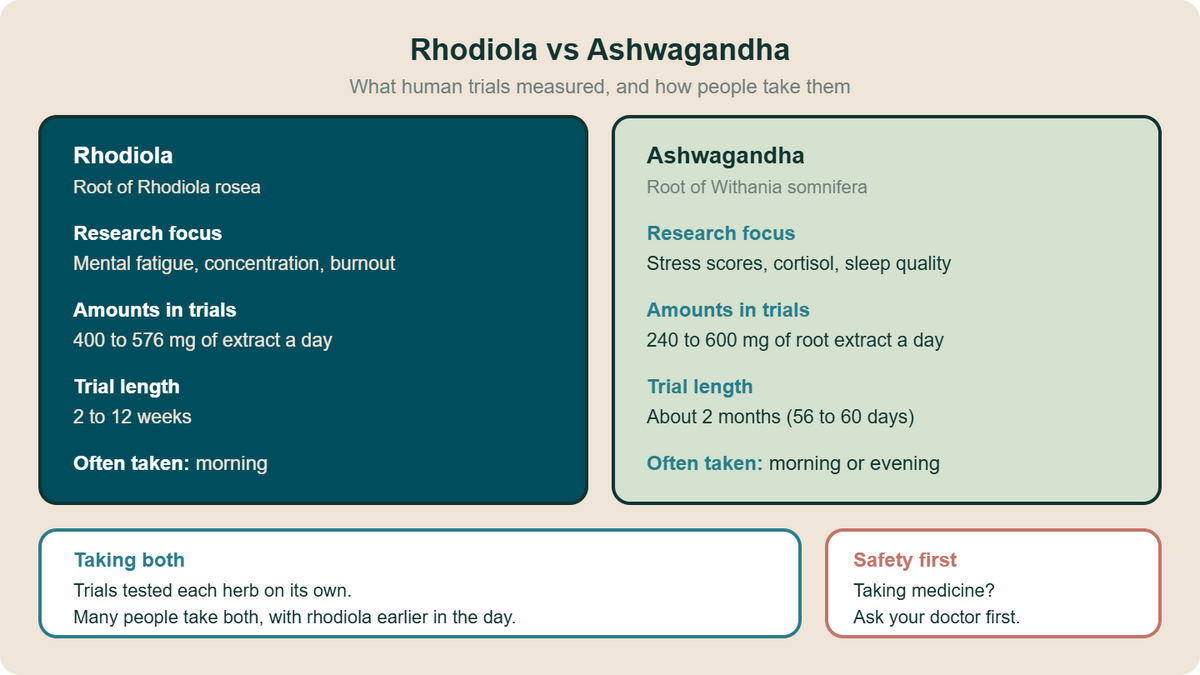
Rhodiola and ashwagandha are both adaptogens, but research has studied them for different jobs. Rhodiola trials have mostly looked at mental fatigue and concentration under stress, while ashwagandha trials have mostly measured stress scores, cortisol and sleep quality. Here is how they compare for stress and energy, how the studied amounts differ, and whether you can take rhodiola and ashwagandha together.
Key Takeaways
- Rhodiola is a root from cold, high-altitude regions; in 60 adults with stress-related fatigue, 576 mg a day for 28 days improved burnout scores and several attention measures compared with placebo (Olsson et al., 2009).
- Ashwagandha is the root of Withania somnifera; in 64 adults with a history of chronic stress, 300 mg twice a day for 60 days lowered stress scale scores and serum cortisol compared with placebo (Chandrasekhar et al., 2012).
- For daytime energy and mental stamina, rhodiola has the more direct research. For stress scores and sleep quality, ashwagandha's placebo-controlled trials measure those outcomes directly.
- Published trials tested each herb on its own. Many people take both because their research covers different needs, with rhodiola earlier in the day.
- Both are usually well tolerated in studies lasting up to about 12 weeks. Ashwagandha has a few case reports of liver and thyroid effects, so check with your doctor first if you take medicine.

Featured in this article
Clarity Capsules150 mg of rhodiola rosea extract with lion's mane, bacopa, maca, epimedium and huperzine A in every 2-capsule serving.
Shop Clarity CapsulesThird-party tested ingredients. Vegan capsules, made in the USA.
Rhodiola vs Ashwagandha at a Glance
Both herbs are called adaptogens, plants studied for how they support the body's response to stress. They differ in where they come from, what trials measured and the amounts used.
| Feature | Rhodiola | Ashwagandha |
|---|---|---|
| What it is | Root of Rhodiola rosea, also called golden root or arctic root | Root of Withania somnifera |
| Main research focus | Mental fatigue, concentration and burnout scores under stress | Perceived stress scores, cortisol and sleep quality |
| Amounts in the trials below | 400 to 576 mg of extract a day, where an amount was stated | 240 to 600 mg of root extract a day |
| Trial length | 2 to 12 weeks | About 2 months (56 to 60 days) |
| Common side effects reported | Dizziness, headache, trouble sleeping, dry mouth | Loose stools, nausea, drowsiness |
| Time of day people often choose | Morning | Morning or evening |
| In our products | Clarity Capsules, 150 mg per serving | Forage, 100 mg per serving |
Rhodiola grows in cold regions and at high altitudes in Europe, Asia and North America (NCCIH, 2025). For more on each plant, see our rhodiola rosea ingredient page and our ashwagandha root extract page.
Rhodiola vs Ashwagandha for Stress
Both herbs have been studied in stressed adults, but the trials asked different questions.
What ashwagandha trials measured
Ashwagandha research has focused on how stressed people rate their stress and on cortisol, the main stress hormone. In 64 adults with a history of chronic stress, 300 mg of root extract twice a day for 60 days lowered scores on every stress scale used, and lowered serum cortisol, compared with placebo. Side effects were mild and similar in both groups (Chandrasekhar et al., 2012).
In 60 stressed adults, 250 mg or 600 mg a day of root extract for 8 weeks lowered perceived stress scores and serum cortisol at both amounts, and sleep quality improved compared with placebo (Salve et al., 2019). In another 60 stressed but otherwise healthy adults, 240 mg a day for 60 days lowered morning cortisol more than placebo did (Lopresti et al., 2019).
What rhodiola trials measured
Rhodiola research has looked more at how stress wears people down: tiredness, burnout and focus. In 60 adults aged 20 to 55 with stress-related fatigue, 576 mg a day of a standardized rhodiola extract for 28 days improved burnout scores and several attention measures compared with placebo, and the cortisol response on waking differed between the groups (Olsson et al., 2009). In an open-label study of 118 adults with burnout symptoms, 400 mg a day for 12 weeks was followed by improvement in most stress and burnout measures (Kasper and Dienel, 2017).
Put simply: if your main goal is stress support, ashwagandha's placebo-controlled trials measure exactly that. If stress shows up for you as mental tiredness and trouble concentrating, rhodiola's research fits that picture more closely. Our guide to supplements and cortisol covers other options.
Rhodiola vs Ashwagandha for Energy
For daytime energy, rhodiola's trials are the closer match. In 56 healthy young doctors working night shifts, one low-dose tablet of rhodiola extract a day for two weeks improved a fatigue index built from tests of memory, calculation, concentration and reaction speed, compared with placebo (Darbinyan et al., 2000). In the 28-day trial in adults with stress-related fatigue, the authors described the main effect as an anti-fatigue effect, particularly on concentration (Olsson et al., 2009).
Ashwagandha relates to energy through a different route. Its trials measured stress scores, cortisol and sleep quality, and good sleep is the base that daytime energy is built on. For more, see rhodiola benefits and rhodiola for focus.
What About Sleep?
Sleep is where ashwagandha stands apart. A 2021 pooled analysis described by the NIH Office of Dietary Supplements found a small but significant improvement in sleep compared with placebo at 250 to 600 mg a day of root extract over 6 to 12 weeks, with larger benefits at 600 mg a day and with at least 8 weeks of use (NIH Office of Dietary Supplements, 2025). Rhodiola is generally taken for daytime support, and trouble sleeping is among its reported side effects, so it is usually taken earlier in the day (NCCIH, 2025).
Can You Take Rhodiola and Ashwagandha Together?
Many people pair them. The published trials above tested each herb on its own, so there are no combined trial results to report. People combine them because their research covers different needs: rhodiola for mental stamina during the day and ashwagandha for stress and sleep quality. A common approach is to take rhodiola in the morning and to take ashwagandha either in the morning or in the evening, since drowsiness is one of its common side effects.
- Add one at a time. Start with one herb and add the other later, so you can tell how each one suits you.
- Track what matters to you. A weekly rating of stress, energy and sleep tells you more than how a single day feels.
- Check your medicines first. Both herbs have reported medicine interactions, listed in the safety section below.
Choosing Between Them
- Choose rhodiola if you want daytime support for mental energy, focus and stamina on demanding days.
- Choose ashwagandha if your priority is support for a healthy stress response and sleep quality.
- Consider both if you want daytime focus support plus stress and sleep support, taken at different times of day.
For a wider look at herbs and nutrients studied for stress, see our stress, mood and nervous system balance hub.
Safety and Side Effects
Rhodiola
Rhodiola is described as possibly safe for up to 12 weeks. Reported side effects include dizziness, headache, trouble sleeping and either dry mouth or extra saliva. Little is known about its safety during pregnancy or breastfeeding, and an interaction with losartan, a blood pressure medicine, has been reported (NCCIH, 2025).
Ashwagandha
Ashwagandha appears to be well tolerated for up to about 3 months. Common side effects such as loose stools, nausea and drowsiness are usually mild. There are a few case reports of liver injury and of thyroid effects, some experts advise against use during pregnancy, and it might not be safe for men with prostate cancer or during breastfeeding. It might interact with medicines for diabetes, blood pressure and thyroid conditions, with immunosuppressants and with sedatives (NIH Office of Dietary Supplements, 2025). Our guide to ashwagandha side effects covers each of these in detail.
Talk to your doctor before taking either herb if you are pregnant or breastfeeding, take prescription medicine, or have a liver or thyroid condition.
Where Our Products Fit
Our Clarity Capsules are a daily focus blend with 150 mg of rhodiola rosea extract in every 2-capsule serving, alongside lion's mane 8:1 fruiting body extract 250 mg, bacopa monnieri extract 200 mg, maca root extract 200 mg, epimedium extract 200 mg and huperzine A 200 mcg, with ginger extract in vegan capsules. The suggested use is 2 capsules daily, preferably in the morning on an empty stomach.
Our Forage blend includes 100 mg of ashwagandha root extract per 2-capsule serving, together with seven 8:1 mushroom fruiting body extracts and Himalayan shilajit extract 100 mg, with ginger extract in vegan capsules. The suggested use is two capsules daily, taken in the morning with or without food. Both are made with third-party tested ingredients. For more on the herb itself, see ashwagandha benefits.

Featured in this article
ForageSeven 8:1 mushroom fruiting body extracts plus 100 mg of ashwagandha root extract and 100 mg of Himalayan shilajit in every 2-capsule serving.
Shop ForageThird-party tested ingredients. Vegan capsules, made in the USA.
Frequently Asked Questions
Is rhodiola or ashwagandha better for stress?
It depends on how stress shows up for you. Ashwagandha's placebo-controlled trials measured perceived stress and cortisol, with lower scores at 240 to 600 mg a day over about 2 months. Rhodiola trials focused on stress-related fatigue and burnout, with better burnout and attention scores at 576 mg a day over 28 days. Choose ashwagandha for stress itself and rhodiola for the tired, foggy side of stress.
Is rhodiola or ashwagandha better for energy?
Rhodiola has the more direct research for daytime energy. In doctors working night shifts, a daily rhodiola tablet for two weeks improved scores on tests of memory, concentration and reaction speed compared with placebo. Ashwagandha trials measured stress scores, cortisol and sleep quality, and good sleep is the base that daytime energy is built on.
Can you take rhodiola and ashwagandha together?
Many people take both, because their research covers different needs. The published trials tested each herb on its own, so there are no combined trial results to report. A common approach is rhodiola in the morning and ashwagandha in the morning or evening. Add one at a time so you can tell how each suits you, and check with your doctor first if you take prescription medicine.
Which is better for sleep, rhodiola or ashwagandha?
Ashwagandha. A pooled analysis of trials found a small but significant improvement in sleep compared with placebo at 250 to 600 mg a day of root extract, with larger benefits at 600 mg a day and after at least 8 weeks. Rhodiola is taken for daytime support, and trouble sleeping is one of its reported side effects, so most people take it earlier in the day.
Should I take rhodiola in the morning and ashwagandha at night?
That is a common pattern. Rhodiola is generally taken in the morning because it is used for daytime focus and stamina and can affect sleep in some people. Ashwagandha can be taken in the morning or the evening; because drowsiness is one of its common side effects, some people prefer it later in the day. Follow the directions on the product label you use.
Which is better for focus, rhodiola or ashwagandha?
Rhodiola. In 60 adults with stress-related fatigue, 576 mg a day for 28 days improved several attention measures compared with placebo, and the authors described an anti-fatigue effect, particularly on concentration. Ashwagandha research centers on stress scores, cortisol and sleep quality. Our Clarity Capsules pair rhodiola with bacopa and lion's mane in one daily focus blend.
Who should not take rhodiola or ashwagandha?
Talk to your doctor first if you are pregnant or breastfeeding or take prescription medicine. Rhodiola has a reported interaction with losartan, a blood pressure medicine. Ashwagandha might interact with medicines for diabetes, blood pressure and thyroid conditions, with immunosuppressants and with sedatives, and it has a few case reports of liver and thyroid effects. It might not be safe for men with prostate cancer.
How long do rhodiola and ashwagandha take to work?
The trials measured results after set periods of daily use: 2 to 12 weeks for rhodiola and about 2 months for ashwagandha, with larger sleep benefits for ashwagandha after at least 8 weeks. Plan on taking either herb every day for several weeks, and track your stress, energy and sleep once a week to judge how it suits you.
Sources
- Olsson EM, von Schéele B, Panossian AG. A randomised, double-blind, placebo-controlled, parallel-group study of the standardised extract SHR-5 of the roots of Rhodiola rosea in the treatment of subjects with stress-related fatigue. Planta Medica, 2009. https://pubmed.ncbi.nlm.nih.gov/19016404/
- Darbinyan V, Kteyan A, Panossian A, Gabrielian E, Wikman G, Wagner H. Rhodiola rosea in stress induced fatigue: a double blind cross-over study of a standardized extract SHR-5 with a repeated low-dose regimen on the mental performance of healthy physicians during night duty. Phytomedicine, 2000. https://pubmed.ncbi.nlm.nih.gov/11081987/
- Kasper S, Dienel A. Multicenter, open-label, exploratory clinical trial with Rhodiola rosea extract in patients suffering from burnout symptoms. Neuropsychiatric Disease and Treatment, 2017. https://pubmed.ncbi.nlm.nih.gov/28367055/
- Chandrasekhar K, Kapoor J, Anishetty S. A prospective, randomized double-blind, placebo-controlled study of safety and efficacy of a high-concentration full-spectrum extract of ashwagandha root in reducing stress and anxiety in adults. Indian Journal of Psychological Medicine, 2012. https://pubmed.ncbi.nlm.nih.gov/23439798/
- Salve J, Pate S, Debnath K, Langade D. Adaptogenic and anxiolytic effects of ashwagandha root extract in healthy adults: a double-blind, randomized, placebo-controlled clinical study. Cureus, 2019. https://pubmed.ncbi.nlm.nih.gov/32021735/
- Lopresti AL, Smith SJ, Malvi H, Kodgule R. An investigation into the stress-relieving and pharmacological actions of an ashwagandha (Withania somnifera) extract: a randomized, double-blind, placebo-controlled study. Medicine, 2019. https://pubmed.ncbi.nlm.nih.gov/31517876/
- NIH Office of Dietary Supplements. Ashwagandha: Is it helpful for stress, anxiety, or sleep? Health Professional Fact Sheet, 2025. https://ods.od.nih.gov/factsheets/Ashwagandha-HealthProfessional/
- National Center for Complementary and Integrative Health. Rhodiola: Usefulness and Safety, 2025. https://www.nccih.nih.gov/health/rhodiola
These statements have not been evaluated by the Food and Drug Administration. This content is for education and is not medical advice. Our products are not intended to diagnose, treat, cure or prevent any disease. Talk with a healthcare provider before starting a new supplement if you are pregnant, breastfeeding or taking medication.


Leave a comment
All comments are moderated before being published.
This site is protected by hCaptcha and the hCaptcha Privacy Policy and Terms of Service apply.