
Does NAD+ nasal spray need refrigeration?

NAD+ nasal spray needs refrigeration only when the product’s storage instructions require it; the ingredient name alone does not establish a refrigeration rule. For nad nasal spray storage in 2026, follow the bottle’s stated conditions, including any instructions that change after opening. Refrigerating a bottle after improper storage does not establish that its quality has been restored.

Featured in this article
NAD+ Nasal SpraySupports cellular energy, focus and healthy aging. A needle-free alternative to NAD+ IV.
Shop NAD+ Nasal SprayThird-party tested ingredients. Vegan, non-GMO, made in the USA.
- NAD nasal spray storage follows the specific bottle’s instructions, not a universal refrigeration rule.
- Synchronicity NAD+ Nasal Spray should be assessed using its own storage directions, not another product’s label.
- Keep refrigeration, shelf life, and after-opening instructions separate when checking a nasal spray.
- After a storage mistake, ask the manufacturer before using the bottle; appearance cannot confirm potency.
Does NAD+ nasal spray need refrigeration?
Refrigerate NAD+ nasal spray when its label requires refrigeration. If the label specifies room-temperature storage, follow that instruction instead. If the directions are unclear, ask the manufacturer to confirm the conditions for your exact bottle before choosing a storage location.
For NAD+ Nasal Spray, check the bottle and accompanying instructions together. A general ingredient guide cannot replace product-specific storage directions, and instructions for a different brand do not establish how to store yours.
Use this comparison to interpret the directions you find. These are storage scenarios, not specifications for a particular formula.
| Storage option | Best for | Practical advantage | Limitation |
|---|---|---|---|
| Refrigerated storage | A bottle explicitly labeled for refrigeration | Matches the stated cold-storage requirement | Does not authorize freezing or establish acceptable time outside the refrigerator |
| Room-temperature storage | A bottle explicitly labeled for room-temperature storage | Avoids adding an unnecessary refrigeration routine | Still requires attention to any stated heat, light, or humidity restrictions |
| Storage after clarification | A bottle with unclear or conflicting instructions | Gives you an answer tied to the actual product | Requires confirmation before you settle on a routine |
The key distinction is between required, permitted, and unconfirmed refrigeration. Those words are not interchangeable. A refrigerator being available does not make it the right storage location for every nasal spray.
Why this matters
Storage is part of using a nasal spray as directed, not a separate housekeeping detail. Your bottle’s formula, packaging, and handling instructions matter more than a general claim that NAD+ is sensitive or that cold storage is always better.
In 2026, think of an ingredient explanation and a storage instruction as different kinds of information. An explanation of NAD+ biology does not establish the shelf life of a bottled nasal formulation. Likewise, a statement about product benefits does not tell you what happens after that bottle sits in a warm bag.
For you, the useful question is narrow: What conditions apply to this bottle, before and after opening? Get that answer before planning daily use, travel, or where to keep it at home.
How to check your bottle’s storage instructions
Start with the physical bottle and any instructions supplied with it. Keep the packaging until you have checked whether it contains details that are not printed on the bottle itself.
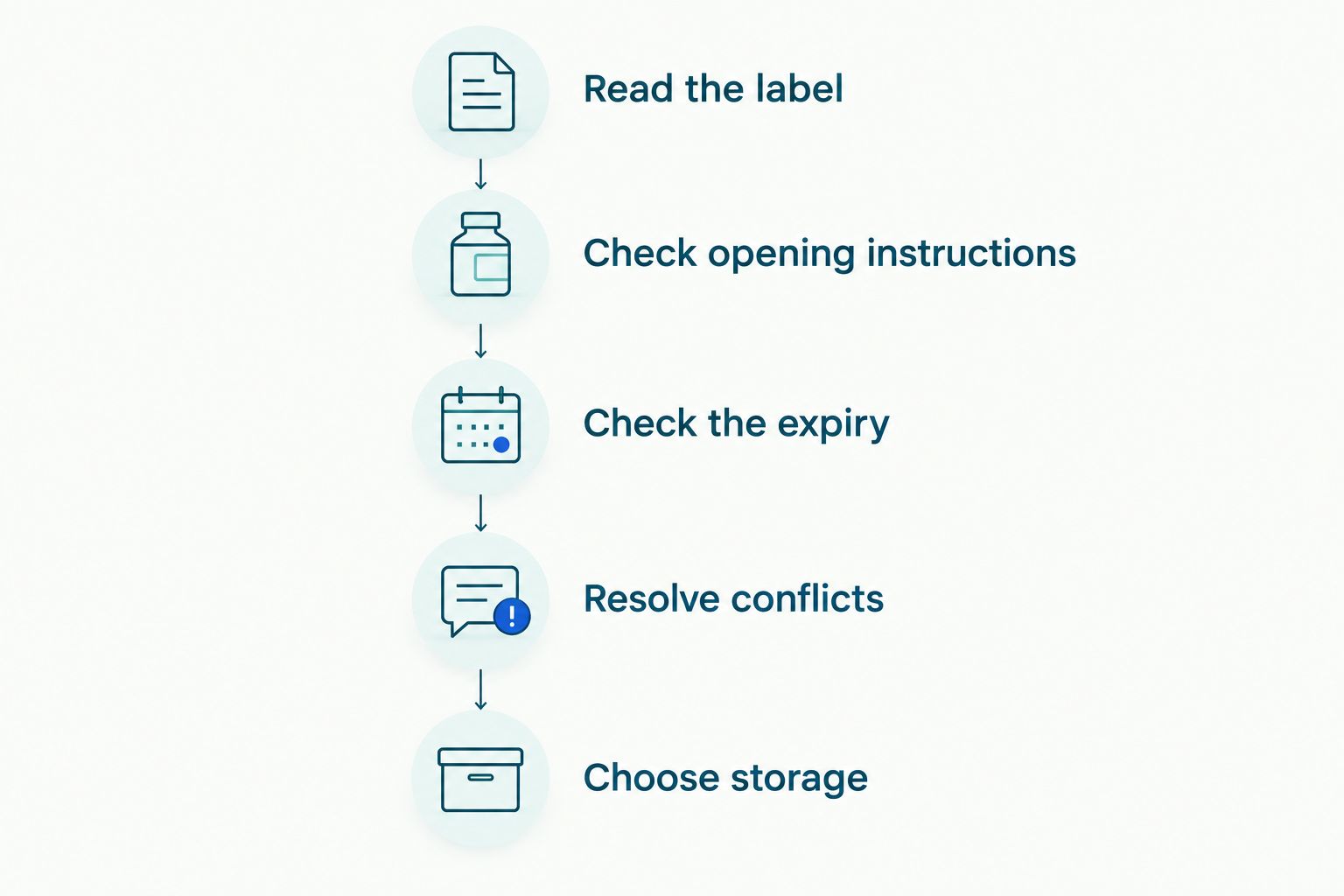
- Read the label. Look for an explicit refrigeration instruction or another stated storage condition. Do not infer one from the ingredient list.
- Check opening instructions. Find out whether opening changes the storage conditions or introduces a separate discard instruction.
- Check the expiry. Read the expiration date alongside any after-opening directions. Do not assume they describe the same deadline.
- Resolve conflicts. If the bottle, packaging, and online information disagree, ask the manufacturer which directions apply to your bottle.
- Choose storage. Select a location that meets the confirmed instructions and lets you keep the bottle protected between uses.
Write down the answer if the manufacturer supplies clarification. Save the response with your purchase information so you do not have to reconstruct it later.
This check also avoids a common mix-up: using the directions for another product you already own. Even when bottles look similar or share an ingredient, read each label independently. A familiar routine is useful only when it matches the current product’s instructions.
Refrigerated storage: follow the stated conditions
If your bottle says to refrigerate it, follow any temperature limits and handling directions supplied with that instruction. Do not replace a stated condition with a guess about what feels cold enough.
Refrigeration is not permission to freeze. If the bottle has been frozen, ask the manufacturer whether it remains suitable for use. Thawing it and finding that the pump still works does not establish that the formulation is unchanged.
Keep the instructions accessible to anyone else who handles the bottle. This matters when a household member puts it away, when you travel, or when you move it between storage locations. The goal is consistent handling, not merely placing it in a refrigerator occasionally.
Avoid inventing a preparation routine around refrigeration. Do not warm, shake, or otherwise alter the bottle unless the product’s instructions call for that step. Storage directions and directions for administering the spray should be read together.
Room-temperature storage: follow the label, not the weather
If the label directs room-temperature storage, follow any conditions that accompany that wording. Room temperature is not a reason to leave a bottle in direct sunlight, beside a heat source, or in another location outside its stated limits.
Choose a storage location based on the conditions the bottle requires rather than where you remember to use it. Convenience matters, but a windowsill, vehicle, gym bag, and indoor cupboard do not provide interchangeable environments.
For your 2026 routine, separate storage from reminders. You can use a reminder to retrieve the bottle without keeping it beside a sunny desk at all times or carrying it all day. This approach keeps the routine practical without assuming portability is evidence of storage suitability.
Do not add refrigeration because another NAD+ product recommends it. First confirm whether refrigeration is required, allowed, or discouraged for the formulation you actually have.
Why NAD+ nasal spray storage instructions vary
There is no sound basis for applying one bottle’s directions to every NAD+ nasal spray. Product-specific instructions account for more than the name of the active ingredient.
When comparing instructions, check these factors rather than guessing which formulation is more stable:
- The complete formula. A product containing NAD+ alone and a product listing additional ingredients require their own directions; a shared ingredient does not make the formulas identical.
- The dosage form. Instructions for a capsule do not establish conditions for a liquid nasal spray.
- The bottle and pump. Follow the handling instructions for the supplied container rather than transferring the liquid into another bottle.
- Opening status. Check whether the manufacturer distinguishes unopened storage from storage during use.
- The labeled expiry. Apply the date and any associated conditions to the bottle you have, not to a replacement you plan to buy later.
These factors tell you what to verify. They do not supply a temperature, an acceptable heat exposure, or an after-opening deadline on their own.
A specific storage claim needs specific support. Ask for the manufacturer’s directions for the finished product rather than accepting a general explanation about NAD+ chemistry as the answer.
What should you do if NAD+ nasal spray was left out?
If a bottle that requires refrigeration was left out, check its instructions and contact the manufacturer before using it. Do not assume that returning it to the refrigerator resolves the question. If a Synchronicity order arrived warm, leaking or damaged, tell us through our Guarantee and Order Help Form.
Give the manufacturer useful details: the product name, whether it was opened, the batch information, where it was kept, and how long it was outside its specified conditions. If you know the temperature, include it; if you do not, describe the setting without inventing a measurement.
A bottle left on an indoor counter presents a different question from one left in direct sunlight or a vehicle. Neither setting establishes an automatic keep-or-discard answer without reference to the product’s directions.
Do not rely on a normal appearance, smell, or spray pattern to confirm potency or microbiological quality. Visible changes are a reason to stop and seek guidance, but the absence of visible changes is not proof that a storage excursion was harmless.
Can you travel with NAD+ nasal spray?
You can plan travel around the bottle’s confirmed storage requirements, but a travel bag does not override them. Check how you will maintain the required conditions during transit and at your destination before packing.
If refrigeration is required, ask the manufacturer about transport conditions and acceptable interruptions. Do not assume that any insulated pouch provides suitable storage, and avoid direct contact with frozen cooling materials unless the product’s transport instructions permit it.
If room-temperature storage is specified, still account for heat exposure during the journey. Keep the original label available, and check the current carrier and destination requirements separately from the product’s storage directions.
Does refrigeration extend NAD+ nasal spray’s shelf life?
Refrigeration does not authorize you to extend the printed expiration date or an after-opening limit. Follow the stated deadline unless the manufacturer provides instructions that specifically apply to your bottle.
Keep an opening record when the label gives an after-opening deadline. That record helps you follow the instruction; it does not create a new shelf-life estimate.
Do not confuse a bottle that has not been used often with a bottle that is still within its permitted use period. The number of sprays remaining is not a substitute for checking the date and storage history.
What storage tells you, and what it does not
Synchronicity’s NAD+ Nasal Spray is for adults comparing NAD+ products, not a substitute for individualized medical advice. Synchronicity sells nasal sprays and capsule supplements; assess each product’s directions and evidence separately rather than assuming the range is interchangeable.
When reading evidence in 2026, distinguish human studies of oral ingredients from studies of nasal delivery.
For third-party testing, check what was measured and whether stability under particular storage conditions was assessed. Look for information relevant to the question you are asking.
If you take medication, are pregnant or breastfeeding, or have a health condition, discuss the specific product and its full ingredient list with a qualified clinician before use. Stop using a spray that causes irritation and seek advice rather than changing the dose to work around symptoms.
Our NAD+ nasal spray FAQ answers common questions about how and when to use the spray.
Sources
- Covarrubias AJ, et al. NAD+ metabolism and its roles in cellular processes during ageing. Nat Rev Mol Cell Biol. 2021. PubMed 33353981
- Freeberg KA, et al. Dietary Supplementation With NAD+-Boosting Compounds in Humans: Current Knowledge and Future Directions. J Gerontol A Biol Sci Med Sci. 2023. PubMed 37068054
- Ulusoy S, et al. Mechanisms and solutions for nasal drug delivery: a narrative review. Eur Rev Med Pharmacol Sci. 2022. PubMed 36524914
- Wolfe KD, et al. Long-Term Stability of Nicotinamide Cofactors in Common Aqueous Buffers: Implications for Cell-Free Biocatalysis. Molecules. 2024. PubMed 39598842
Featured in this article
NAD+ Nasal SpraySupports cellular energy, focus and healthy aging. A needle-free alternative to NAD+ IV.
Shop NAD+ Nasal SprayThird-party tested ingredients. Vegan, non-GMO, made in the USA.
FAQ
Does NAD+ nasal spray always need to be refrigerated?
No universal refrigeration rule follows from the NAD+ ingredient name. Follow the specific bottle’s storage instructions and ask the manufacturer if they are unclear.
Should I refrigerate Synchronicity NAD+ Nasal Spray?
Use the storage instructions supplied with Synchronicity NAD+ Nasal Spray to decide whether refrigeration is required. If the bottle and accompanying directions are unclear or conflict, confirm the conditions with the manufacturer.
Can I put NAD+ nasal spray in the freezer?
Do not freeze NAD+ nasal spray unless its instructions explicitly permit freezing. Refrigeration and freezing are different conditions; ask the manufacturer about a bottle that has already frozen.
Is NAD+ nasal spray still usable after being left out overnight?
The bottle’s instructions and the details of the exposure determine the next step, not the word overnight alone. Contact the manufacturer with the storage setting, duration, opening status, and batch information before using it.
Does a normal-looking nasal spray mean it is still good?
No, normal appearance does not confirm potency or microbiological quality. A clear liquid and a functioning pump cannot establish that improper storage had no effect.
Does keeping NAD+ nasal spray cold extend its expiration date?
Cold storage does not authorize extending the labeled expiration date or an after-opening deadline. Follow the bottle’s stated conditions and dates.
Can I follow capsule storage directions for a NAD+ nasal spray?
No, capsule storage directions do not establish how to store a nasal spray. Use instructions for the specific finished product and delivery form.
One last thing
Keep the label information, not just the bottle. Photograph the storage directions, expiration date, and batch information while they are easy to read. If you later have a storage question, those details help the manufacturer address the bottle you actually own.
The practical rule for 2026 is simple: confirm the conditions, follow them consistently, and ask before using a bottle with an uncertain storage history. Colder is not a substitute for clearer instructions.
Related reading: traveling with NAD+ nasal spray.