
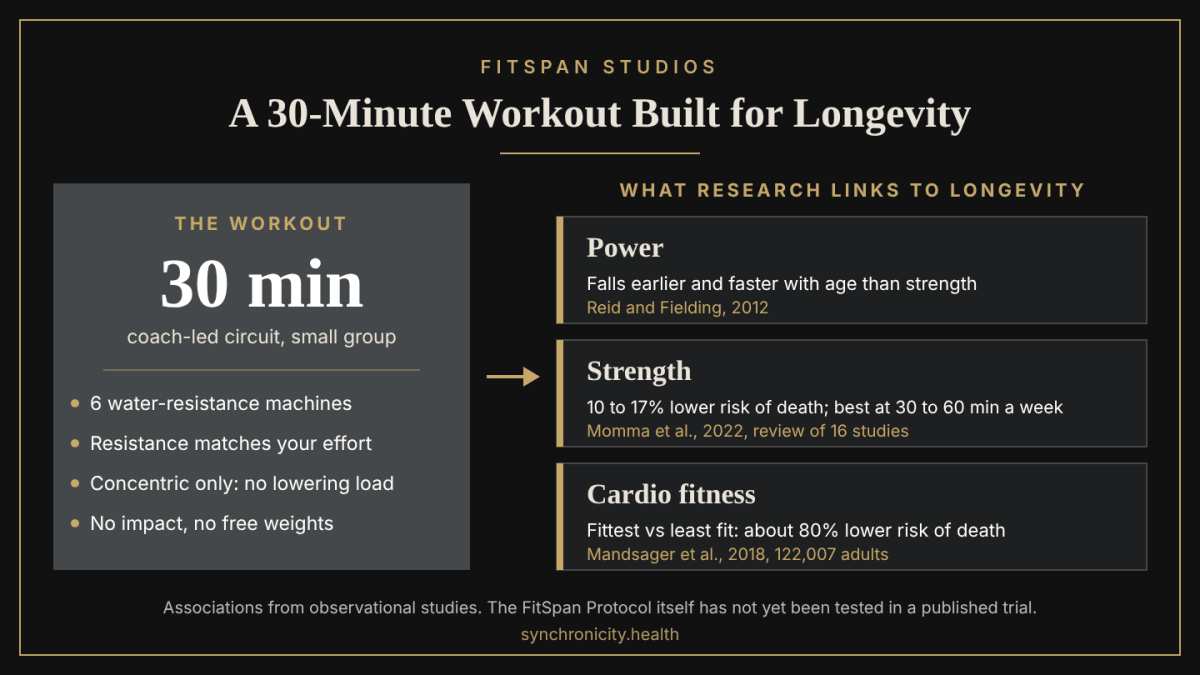
FitSpan Studios is a fitness franchise built around a 30-minute, no-impact circuit on water-resistance machines. The machines resist you only as you push or pull, with no load on the lowering phase, and the workout is designed around functional power, heart rate and staying injury free as you age. Below we explain how the workout runs and what research says about the longevity ideas behind it.
Key Takeaways
- A FitSpan session is a coach-led, 30-minute circuit on six water-resistance machines, with no jumping and no free weights (FitSpan Studios).
- Water resistance only pushes back as hard as you push, and only while you push or pull, so the work is concentric only. Unaccustomed eccentric (lowering) work is known to cause next-day muscle soreness (Hody et al., 2019).
- Muscle power, the ability to produce force quickly, falls earlier and faster with age than strength does (Reid and Fielding, 2012).
- In a review of 16 studies, muscle-strengthening activity was linked to a 10 to 17% lower risk of death from any cause, with the largest benefit at about 30 to 60 minutes a week (Momma et al., 2022).
What Is FitSpan Studios?
FitSpan is a boutique fitness studio and franchise. Its studio is in Medford, Oregon, and the company is now franchising nationwide. The name comes from its goal: to extend your "fitspan," the years you stay strong, mobile and able to do the things you enjoy, not just your lifespan.
The idea started with a setback. At 45, founder David Berger set out to get back in shape after years of neglect and hurt his shoulder lifting a free weight. That showed him how often an injury ends someone's fitness routine. He then worked with Andy Baxter, a medical exercise specialist who had spent his career training older adults, to build a group workout with no impact and as little injury risk as they could design. The result is what FitSpan calls the FitSpan Protocol.
FitSpan sums up the approach in three lines: "Resistance without impact. Intensity without injury. Strength without soreness."
How the FitSpan Workout Works
Each session is a coach-led, 30-minute circuit in a small group. Members rotate through six machines, each built around water-resistance tanks. FitSpan describes them this way:
| Station | What it works | Main goal |
|---|---|---|
| No Impact Cardio Climber | Abs, glutes and thighs, with opposite arm and leg movement | Heart rate and coordination |
| Ski Erg | Core, back and arms, both sides at once | Functional power and heart rate |
| No Impact Cardio Rower | Back, arms and chest | Smooth, steady load and heart rate |
| Bidirectional Crank | Core and arms | Functional speed and heart rate |
| Squat Press | Legs, glutes and shoulders | Lower body strength with no lowering load |
| Lift | Arms, legs and core | Functional strength and heart rate |
Three design choices set it apart from a typical gym circuit:
- Water resistance that matches your effort. The harder you push or pull, the more the water pushes back. A beginner and a fit member can use the same machine at their own level, without changing plates or pins.
- Concentric only. The machines resist you only while a muscle shortens to push or pull. There is no load to control on the way back, the lowering (eccentric) phase.
- Closed chain and functional. Most movements keep your hands or feet in contact with the machine, and each is meant to carry over to daily life, such as getting up from a chair without help.
The Science of Concentric-Only Training
Every repetition in a normal lift has two halves. The concentric half is the lift itself, when the muscle shortens. The eccentric half is the lowering, when the muscle lengthens under load. Unaccustomed eccentric work is known to cause muscle damage and delayed-onset muscle soreness, the stiffness you feel a day or two after a hard session (Hody et al., 2019). Taking the eccentric load away is how FitSpan aims for "strength without soreness."
Does concentric-only training still build muscle? A 2017 review of randomized trials compared the two halves of the lift directly. Muscle growth averaged 10.0% with eccentric training and 6.8% with concentric training, a difference that was not statistically significant, and the authors concluded both are effective for building muscle (Schoenfeld et al., 2017). The same review suggests eccentric work has its own value, so the trade-off is less soreness and lower injury risk in exchange for some of the extra growth eccentric training may add.
Why Power Matters More With Age
Strength is how much force you can produce. Power is how fast you can produce it, which is what you need to catch yourself after a trip, climb stairs briskly or get out of a low chair. Muscle power declines earlier and more steeply with age than muscle strength, and peak power has emerged as an important predictor of functional limits in older adults (Reid and Fielding, 2012).
That is why FitSpan built its protocol around what it calls power endurance: moving with speed and force, repeatedly, across a circuit. Research supports training power in later life. A 2022 review of 20 randomized trials with 566 older adults (average age 70) found that power training, which moves the load as fast as possible on the lifting phase, produced a modest improvement in physical function compared with traditional slower strength training. The authors rated the certainty of the evidence as low and called for larger, higher-quality trials (Balachandran et al., 2022).
Strength, Fitness and Longevity
FitSpan's longevity focus rests on a well-studied link between fitness and lifespan. Three large studies show how strong that link is:
- Strength training time. A 2022 review of 16 cohort studies found muscle-strengthening activities were associated with a 10 to 17% lower risk of death from any cause. The largest reduction, about 10 to 20%, came at roughly 30 to 60 minutes a week, and doing both strength and aerobic activity was also linked to lower risk than doing neither (Momma et al., 2022).
- Grip strength. In 139,691 adults in the PURE study, each 5 kg drop in grip strength was linked to a 16% higher risk of death from any cause over a median of 4 years (Leong et al., 2015).
- Cardiorespiratory fitness. In 122,007 adults who had a treadmill test, the fittest group had about 80% lower risk of death over the following years than the least fit group, and the researchers saw no upper limit to the benefit (Mandsager et al., 2018).
These are associations from observational studies. They show that stronger, fitter people tend to live longer, not that any one workout adds years. They are still the reason so many longevity experts put strength and fitness first.
Mitochondria and Mixed Training
FitSpan says its workout raises your heart rate while building the mitochondrial density of muscle, meaning more of the cell's energy factories, rather than bulk. Research on training type helps explain why the mix matters. In a 12-week trial in younger and older adults, high-intensity interval training, resistance training and combined training all improved insulin sensitivity and lean mass, but only interval and combined training improved aerobic capacity and the energy output of muscle mitochondria. Interval training also reversed many age-related differences in mitochondrial proteins in the older group (Robinson et al., 2017).
A FitSpan session mixes heart-rate work with resistance, which puts it closer to combined training than to strength training alone. No study has measured mitochondria in FitSpan members, though, so read the mitochondria claim as a reasonable idea rather than a tested result. For more on how cells make energy, see our cellular energy and mitochondrial health guide and our guide to NAD+ and exercise performance.
Who the FitSpan Workout Suits
Because there is no impact and no lowering load, the workout is aimed at people who want hard training without the joint stress or soreness of free weights:
- Adults in midlife and beyond who want to keep strength, power and fitness as they age.
- People coming back to exercise after time off, or who have stopped before because of soreness or injury.
- Busy people who want strength and cardio in one 30-minute session.
If you are new to exercise, have a heart condition, are recovering from an injury or are pregnant, check with your clinician before starting any new program.
Supporting Your Training
Exercise does the heavy lifting for healthy aging, and daily habits help you keep showing up for it. Two of our products fit naturally beside a training routine:
- Creatine Monohydrate. Our Creatine Monohydrate has 5 g in every scoop and is coming soon. Creatine is one of the most studied supplements alongside strength training; our guides to creatine benefits and when to take creatine, and our creatine ingredient guide, cover what the research shows.
- NAD+ Nasal Spray. NAD+ is a molecule every cell uses to turn food into energy. Our NAD+ Nasal Spray is absorbed through the lining of the nose, so some of each dose skips digestion. Our guide on how to increase NAD+ naturally explains where exercise fits.
For the bigger picture on aging research, see our guide on turning anti-aging science into healthspan.
Frequently Asked Questions
What is FitSpan Studios?
FitSpan is a boutique fitness studio and franchise built around a 30-minute, coach-led, no-impact circuit on water-resistance machines. Its studio is in Medford, Oregon.
How long is a FitSpan workout?
Each session is 30 minutes, moving through six water-resistance stations that mix strength, power and heart-rate work.
What does concentric only mean?
The machines resist you only while a muscle shortens to push or pull. There is no load on the lowering (eccentric) phase, which is the phase linked to next-day muscle soreness.
Can you build muscle without the lowering phase?
Yes. A review of randomized trials found concentric and eccentric training both increased muscle size. Eccentric training produced somewhat more growth on average, but the difference was not statistically significant.
Is FitSpan good for older adults?
It was designed with a medical exercise specialist who had worked with older adults, and it uses no impact and no lowering load. Research shows muscle power declines faster than strength with age, which is the quality FitSpan trains. Check with your clinician before starting any new program.
How much strength training do you need for longevity?
In a review of 16 cohort studies, the largest drop in risk of death was seen at about 30 to 60 minutes of muscle-strengthening activity a week, and doing strength and aerobic activity together was also linked to lower risk.
Has the FitSpan Protocol been studied?
Not yet as a complete program in a published trial. The principles it uses, power training, strength training and combined strength and cardio, have each been studied, as the sections above show.
Where is FitSpan located?
FitSpan's studio is in Medford, Oregon, and the company is franchising nationwide. Visit the FitSpan Studios website for locations and membership options.
Sources
- Balachandran AT, Steele J, Angielczyk D, et al. Comparison of power training vs traditional strength training on physical function in older adults: a systematic review and meta-analysis. JAMA Network Open, 2022. https://pubmed.ncbi.nlm.nih.gov/35544136/
- Hody S, Croisier JL, Bury T, Rogister B, Leprince P. Eccentric muscle contractions: risks and benefits. Frontiers in Physiology, 2019. https://pubmed.ncbi.nlm.nih.gov/31130877/
- Leong DP, Teo KK, Rangarajan S, et al. Prognostic value of grip strength: findings from the Prospective Urban Rural Epidemiology (PURE) study. Lancet, 2015. https://pubmed.ncbi.nlm.nih.gov/25982160/
- Mandsager K, Harb S, Cremer P, Phelan D, Nissen SE, Jaber W. Association of cardiorespiratory fitness with long-term mortality among adults undergoing exercise treadmill testing. JAMA Network Open, 2018. https://pubmed.ncbi.nlm.nih.gov/30646252/
- Momma H, Kawakami R, Honda T, Sawada SS. Muscle-strengthening activities are associated with lower risk and mortality in major non-communicable diseases: a systematic review and meta-analysis of cohort studies. British Journal of Sports Medicine, 2022. https://pubmed.ncbi.nlm.nih.gov/35228201/
- Reid KF, Fielding RA. Skeletal muscle power: a critical determinant of physical functioning in older adults. Exercise and Sport Sciences Reviews, 2012. https://pubmed.ncbi.nlm.nih.gov/22016147/
- Robinson MM, Dasari S, Konopka AR, et al. Enhanced protein translation underlies improved metabolic and physical adaptations to different exercise training modes in young and old humans. Cell Metabolism, 2017. https://pubmed.ncbi.nlm.nih.gov/28273480/
- Schoenfeld BJ, Ogborn DI, Vigotsky AD, Franchi MV, Krieger JW. Hypertrophic effects of concentric vs. eccentric muscle actions: a systematic review and meta-analysis. Journal of Strength and Conditioning Research, 2017. https://pubmed.ncbi.nlm.nih.gov/28486337/
- FitSpan Studios. Home, About, Science, Protocol and Workout pages, read October 31, 2026. https://www.fitspanstudios.com/

Leave a comment
All comments are moderated before being published.
This site is protected by hCaptcha and the hCaptcha Privacy Policy and Terms of Service apply.