
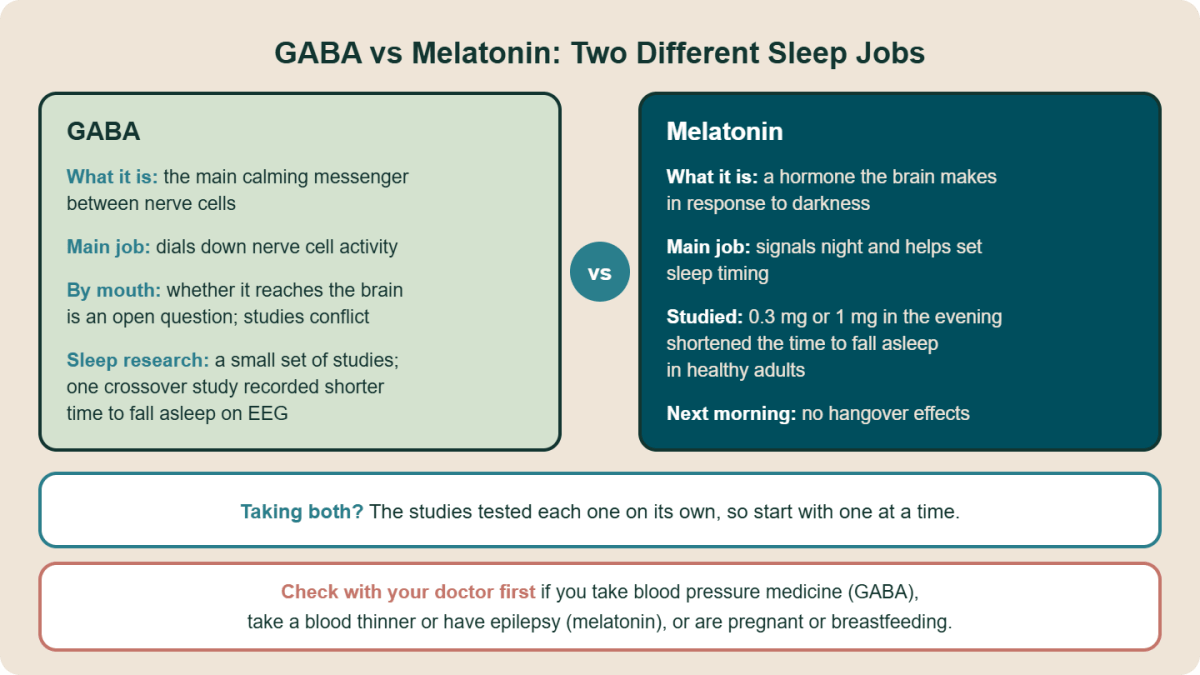
GABA vs melatonin comes down to two different jobs: melatonin is the hormone that tells your body when it is time to sleep, and evening doses as low as 0.3 mg shortened the time to fall asleep in a sleep lab study of healthy adults. GABA is the brain's main calming messenger, but whether GABA taken by mouth reaches the brain is still an open question, and its sleep research is a smaller set of studies. Here is how they compare, what the studies measured, and whether you can take GABA and melatonin together.
Key Takeaways
- Melatonin is a hormone your brain makes in response to darkness, and it helps set your sleep timing (NCCIH, 2024). GABA is the main inhibitory, or calming, messenger in the human cortex (Boonstra et al., 2015).
- In healthy adult volunteers, 0.3 mg or 1 mg of melatonin taken in the evening shortened the time to fall asleep on sleep lab recordings, with no next-morning hangover effects (Zhdanova et al., 1995).
- Whether GABA taken by mouth crosses into the brain is unsettled: the studies on that question conflict (Boonstra et al., 2015).
- In one placebo-controlled crossover study, oral GABA shortened the time to fall asleep and lengthened non-REM sleep on EEG (Yamatsu et al., 2016); a 2020 review of 14 human studies asked for more sleep research (Hepsomali et al., 2020).
- Both are well tolerated in short-term use. GABA can briefly lower blood pressure, and melatonin calls for medical supervision if you take a blood thinner or have epilepsy.
- The studies here tested each one on its own, so if you want both, start with one at a time.

Featured in this article
Melatonin Nasal Spray200 mcg of melatonin with 17 mg of L-theanine per 2-spray serving, 30 servings per bottle, for a calmer wind down before bed.
Shop Melatonin Nasal SprayThird-party tested ingredients. Made in the USA.
GABA vs Melatonin: The Main Difference
The two work at different levels. Melatonin is a timing signal. Your brain releases it as darkness falls, and it tells the rest of your body that night has arrived (NCCIH, 2024). GABA (gamma-aminobutyric acid) is a messenger nerve cells use to quiet each other's activity, and it is the main inhibitory messenger in the human cortex (Boonstra et al., 2015).
| GABA | Melatonin | |
|---|---|---|
| What it is | An amino acid that works as a calming messenger between nerve cells | A hormone the brain makes in response to darkness |
| Main job | Dials down nerve cell activity | Signals that it is night and helps set sleep timing |
| Reaching the brain when taken by mouth | An open question; studies conflict | Raises blood melatonin to night-time levels at low doses |
| Sleep research in people | A small set of studies; one crossover study recorded shorter time to fall asleep | A sleep lab study in healthy adults found shorter time to fall asleep at 0.3 mg and 1 mg |
| Amounts studied | About 120 mg a day in 12-week studies; much larger amounts for a few days | 0.3 mg and 1 mg in the evening |
| Mild side effects reported | Throat burning, headache, drowsiness, a short-lived drop in blood pressure | Headache, dizziness, nausea, sleepiness |
| Check with your doctor first if | You take blood pressure medicine, or are pregnant or breastfeeding | You take a blood thinner, have epilepsy, or are pregnant or breastfeeding |
For a deeper look at the hormone itself, see our melatonin ingredient page.
What Melatonin Research Shows
A classic sleep lab study gave healthy adult volunteers 0.3 mg or 1 mg of melatonin, or a placebo, at 6, 8 or 9 in the evening. Sleep recordings showed that either dose, at any of the three times, shortened the time it took to fall asleep and to reach stage 2 sleep. Melatonin did not suppress REM sleep or delay it, and next-morning tests of mood and performance showed no hangover effects (Zhdanova et al., 1995).
More is not better: amounts well under 1 mg were enough to change sleep timing in those volunteers. Research also suggests melatonin may help with jet lag, when your body clock is out of step with local time (NCCIH, 2024).
Our full melatonin for sleep guide covers amounts and timing in more depth.
What GABA Research Shows
Because GABA has long been thought unable to pass from the blood into the brain, scientists have asked whether oral GABA reaches its target at all. A 2015 review found the studies on that point conflicting and called for research that measures brain GABA directly after people take it. The authors also suggested any effects could work indirectly, through the nerves of the gut (Boonstra et al., 2015).
On sleep itself, a randomized, single-blind, placebo-controlled crossover study measured sleep with EEG after oral GABA. GABA shortened the time to fall asleep and increased total non-REM sleep time. Blood GABA peaked 30 minutes after it was taken and then declined (Yamatsu et al., 2016).
A 2020 systematic review gathered 14 placebo-controlled human studies of oral GABA on stress and sleep. The authors called for more studies, particularly on sleep (Hepsomali et al., 2020). If calm is your main goal, our guide to GABA vs L-theanine compares GABA with another calming amino acid.
GABA or Melatonin for Sleep: Which Fits You?
The better choice depends on what keeps you up.
- Your body clock feels off. Late nights, travel or a shifting schedule are timing problems, and timing is melatonin's job. Low amounts are the place to start.
- Your mind feels busy at bedtime. GABA is often chosen for winding down. L-theanine is another option many people pair with melatonin; our guide to melatonin and L-theanine explains that pairing.
- You prefer to avoid melatonin. Glycine, magnesium and tart cherry are common melatonin-free choices. See sleep supplements without melatonin.
Good sleep habits help whichever you choose: dim lights in the evening, a cool bedroom and a steady bedtime. Our sleep health guide covers the basics.
Can You Take GABA and Melatonin Together?
The two act at different points: timing for melatonin, nerve cell activity for GABA. The studies above tested each one on its own, so there is no combined trial to point to for amounts. A sensible approach is to start with one, see how you sleep for a week or two, and only then add the other at the low end of its label amount.
Both can leave you drowsy, so take them only when you are ready for bed and do not drive afterward. Check labels so you do not double up on melatonin. For how melatonin compares with another popular sleep option, see 5-HTP vs melatonin.
GABA and Melatonin Safety
Melatonin. Short-term use of melatonin appears to be safe for most people. Side effects reported in short-term studies were mild, such as headache, dizziness, nausea and sleepiness. People with epilepsy or on blood thinners should use it only under medical supervision, and anyone pregnant or breastfeeding should talk with a healthcare provider first. Parents should talk with a healthcare provider before giving melatonin to a child (NCCIH, 2024). Our guide to melatonin side effects covers grogginess and dreams.
GABA. A United States Pharmacopeia safety review found no serious adverse events linked to GABA in clinical studies, which used up to 18 g a day for 4 days and about 120 mg a day for 12 weeks. Some people had a short-lived, moderate drop in blood pressure of under 10 percent, and mild effects included throat burning, headache and drowsiness. The reviewers advised caution in pregnancy and breastfeeding, and noted that GABA could add to the effect of blood pressure medicines (Oketch-Rabah et al., 2021).
Talk with your doctor before trying either one if you take blood pressure medicine, a blood thinner, or any medicine that makes you sleepy.
Where Our Sleep Products Fit
Our Melatonin Nasal Spray gives 200 mcg (0.2 mg) of melatonin and 17 mg of L-theanine in every 2-spray serving, with alkaline water as the only other ingredient. That amount is in keeping with research finding that doses well under 1 mg can change sleep timing, paired with L-theanine for a calmer wind down. Use one spray in each nostril as part of your bedtime routine and follow the label directions. It is absorbed through the lining of the nose instead of being swallowed like a capsule, so some of each dose skips digestion, and it is made with third-party tested ingredients.
If you would rather skip melatonin, our Melatonin-Free Sleep Powder is coming soon: glycine 3,000 mg, tart cherry 2,500 mg, magnesium 200 mg, myo-inositol 2,000 mg and apigenin 50 mg per scoop, with no added melatonin and no 5-HTP. Join the waitlist on the product page to hear when it launches.

Featured in this article
Melatonin-Free Sleep PowderGlycine 3 g, tart cherry, magnesium, myo-inositol and apigenin in one scoop, with no added melatonin, to help you wind down at night.
Join the WaitlistComing soon. Third-party tested ingredients.
Frequently Asked Questions
Is GABA or melatonin better for sleep?
They do different jobs. Melatonin is the hormone that signals night and helps set sleep timing, and low evening doses shortened the time to fall asleep in a sleep lab study of healthy adults. GABA is the brain's main calming messenger, with a smaller set of sleep studies. If your sleep timing feels off, melatonin is the more studied choice; for a busy mind, GABA or L-theanine are common options.
What is the difference between GABA and melatonin?
Melatonin is a hormone your brain releases in response to darkness, telling your body that night has arrived. GABA is an amino acid that nerve cells use to quiet each other's activity. As supplements, melatonin raises blood levels to night-time levels at low doses, while whether oral GABA reaches the brain is still being studied.
Can you take GABA and melatonin together?
Some people do, and the two act at different points. The studies covered here tested each one on its own, so start with one, give it a week or two, and add the other at the low end of its label amount if you want to. Both can cause drowsiness, so take them only at bedtime, and check with your doctor first if you take any medicine.
Does GABA make you sleepy?
Drowsiness is one of the mild effects people have reported with GABA, and one placebo-controlled crossover study found that oral GABA shortened the time to fall asleep on EEG. Reviews describe GABA supplements mainly in terms of a calming effect. How you respond can vary from person to person.
Does GABA cross the blood-brain barrier?
This is still an open question. GABA has long been thought unable to pass from the blood into the brain, but the studies on this point conflict. A 2015 review called for research that measures brain GABA directly after people take it, and suggested GABA might also act indirectly through the nerves of the gut.
When should I take melatonin or GABA?
Take either one as part of your wind-down routine and follow your label directions. In the sleep lab study, melatonin was given in the evening. How soon you notice anything varies from person to person. Keep lights dim and screens away in the last hour so your own melatonin can rise too.
Are GABA and melatonin safe to take every night?
Short-term use of melatonin appears to be safe for most people, with mild side effects such as headache or sleepiness. A safety review of GABA found no serious adverse events in clinical studies of up to 12 weeks. For months of nightly use, stay at your label amount and tell your doctor, especially if you take blood pressure medicine or a blood thinner.
Sources
- National Center for Complementary and Integrative Health. Melatonin: What You Need To Know. NIH, updated May 2024. https://www.nccih.nih.gov/health/melatonin-what-you-need-to-know
- Boonstra E, de Kleijn R, Colzato LS, Alkemade A, Forstmann BU, Nieuwenhuis S. Neurotransmitters as food supplements: the effects of GABA on brain and behavior. Frontiers in Psychology, 2015. https://doi.org/10.3389/fpsyg.2015.01520
- Zhdanova IV, Wurtman RJ, Lynch HJ, et al. Sleep-inducing effects of low doses of melatonin ingested in the evening. Clinical Pharmacology and Therapeutics, 1995. https://pubmed.ncbi.nlm.nih.gov/7768078/
- Yamatsu A, Yamashita Y, Pandharipande T, Maru I, Kim M. Effect of oral gamma-aminobutyric acid (GABA) administration on sleep and its absorption in humans. Food Science and Biotechnology, 2016. https://doi.org/10.1007/s10068-016-0076-9
- Hepsomali P, Groeger JA, Nishihira J, Scholey A. Effects of oral gamma-aminobutyric acid (GABA) administration on stress and sleep in humans: a systematic review. Frontiers in Neuroscience, 2020. https://pubmed.ncbi.nlm.nih.gov/33041752/
- Oketch-Rabah HA, Madden EF, Roe AL, Betz JM. United States Pharmacopeia (USP) safety review of gamma-aminobutyric acid (GABA). Nutrients, 2021. https://doi.org/10.3390/nu13082742
These statements have not been evaluated by the Food and Drug Administration. This content is for education and is not medical advice. Our products are not intended to diagnose, treat, cure or prevent any disease. Talk with a healthcare provider before starting a new supplement if you are pregnant, breastfeeding or taking medication.


Leave a comment
All comments are moderated before being published.
This site is protected by hCaptcha and the hCaptcha Privacy Policy and Terms of Service apply.