
Glycine and GABA are both calming, or inhibitory, messengers in the nervous system, but as sleep supplements they are studied very differently. Glycine is usually taken as 3 g before bed, and in healthy adults whose sleep was cut short it was followed by less fatigue and faster reaction times the next day. Oral GABA trials have used far smaller amounts, and researchers are still working out whether GABA you swallow reaches the brain. Here is how glycine vs GABA compares for sleep, and what to know about taking both.
Key Takeaways
- Glycine is an amino acid your body makes; in the brain it works in both calming signals, through glycine receptors, and activating signals, through NMDA receptors (Bannai and Kawai, 2012).
- In healthy men whose time in bed was cut by 25 percent, 3 g of glycine 30 minutes before bed was followed by less fatigue after the first night and faster reaction times on a vigilance test (Bannai et al., 2012).
- GABA is the main inhibitory messenger in the human cortex, and whether oral GABA crosses the blood brain barrier in people is still an open question (Boonstra et al., 2015).
- Oral GABA sleep trials used about 100 to 300 mg of GABA made by fermentation, and a 2020 review of 14 trials called for more research before firm conclusions (Hepsomali et al., 2020).
- The two have been studied separately, and the main safety note for GABA is a short, moderate drop in blood pressure in some people (Oketch-Rabah et al., 2021).

Featured in this article
Melatonin-Free Sleep Powder3,000 mg of glycine per scoop with tart cherry, magnesium, myo-inositol and apigenin, and no added melatonin, to help you wind down at night.
Join the WaitlistComing soon. Third-party tested ingredients.
Glycine vs GABA: The Main Differences
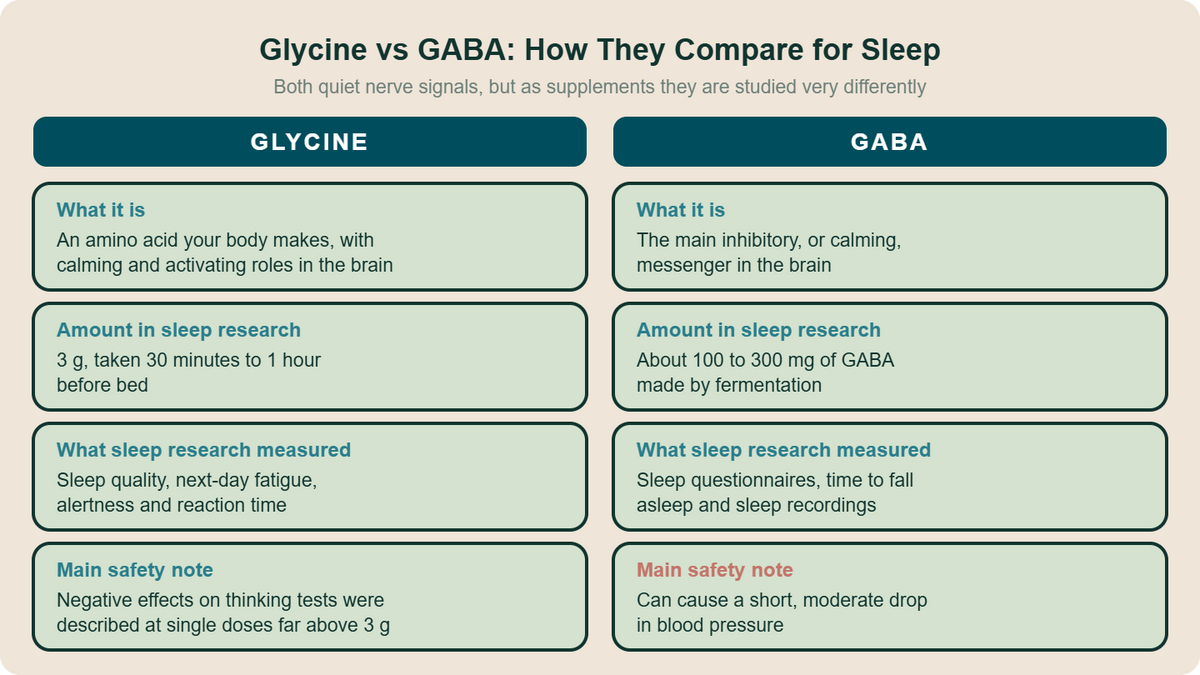
Both quiet nerve signals in the body, but as supplements they differ in what they are, how much research uses and what it has measured.
| Glycine | GABA | |
|---|---|---|
| What it is | An amino acid your body makes, with calming and activating roles in the brain | The main inhibitory, or calming, messenger in the brain |
| Amount in sleep research | 3 g, taken 30 minutes to 1 hour before bed | About 100 to 300 mg of GABA made by fermentation |
| What sleep research measured | Sleep quality, next-day fatigue, alertness and reaction time | Sleep questionnaires, time to fall asleep and sleep recordings taken during the night |
| Reaching the brain | In rats, oral glycine raised glycine in the fluid around the brain | Still debated; no human data yet show it crosses the blood brain barrier |
| Main safety note | Negative effects on thinking tests were described at single doses far above 3 g | Can cause a short, moderate drop in blood pressure |
For a full profile of the amino acid, see our glycine ingredient page.
What Glycine Is and How It Relates to Sleep
Glycine is a non-essential amino acid, which means your body makes it on its own. In the brain it plays two roles: it carries inhibitory, or calming, signals through glycine receptors, and it helps excitatory signals through NMDA receptors (Bannai and Kawai, 2012).
The leading idea about glycine and sleep involves body temperature. In rats, oral glycine raised glycine levels in the blood and in the fluid around the brain, increased blood flow to the skin and lowered core body temperature. Core temperature normally falls at sleep onset, and the authors suggest this cooling may help explain glycine's link with sleep (Bannai and Kawai, 2012). This pathway comes from animal work.
Glycine does not appear to work by raising melatonin. In rats, it did not change blood melatonin or two core clock genes in the brain's master clock, the suprachiasmatic nucleus (Bannai et al., 2012). That makes it a common choice among sleep supplements without melatonin. Our guide to glycine for sleep goes deeper on dosage and timing.
What GABA Is and the Blood Brain Barrier Question
GABA (gamma-aminobutyric acid) is the main inhibitory neurotransmitter in the human cortex, and GABA supplements are widely available (Boonstra et al., 2015). Trials have used GABA made by fermentation and GABA found in foods such as rice (Hepsomali et al., 2020).
The big question is whether GABA you swallow gets into the brain. The blood brain barrier is a tight lining around the brain's blood vessels that controls what passes through, and studies on GABA crossing it disagree. A 2015 review concluded that no definite answer is possible yet for people, and proposed that oral GABA might act indirectly through the nerves of the gut (Boonstra et al., 2015). A 2020 review noted that blood GABA rose 30 minutes after it was taken by mouth, but found no human data yet showing it crosses into the brain (Hepsomali et al., 2020).
Our guide to GABA vs L-theanine compares GABA with another calming amino acid.
Glycine vs GABA for Sleep: What the Research Shows
Glycine
In a randomized crossover trial, healthy men had their time in bed cut by 25 percent for three nights. They took 3 g of glycine or a placebo 30 minutes before bed. With glycine, fatigue was lower the day after the first night, and reaction times on a psychomotor vigilance test were faster on the first and third days. Seven men were analyzed (Bannai et al., 2012).
A 2024 systematic review of glycine in adults found that 3 g a day, taken 30 minutes to 1 hour before bed for 2 to 4 days, improved sleep quality and alertness and eased daytime fatigue in healthy people across three small studies (Soh et al., 2024).
GABA
The 2020 review gathered 14 placebo-controlled human trials of oral GABA on stress and sleep. Sleep trials used about 100 to 300 mg of GABA made by fermentation and measured sleep questionnaires, time to fall asleep and brain wave recordings taken during the night. The reviewers concluded that GABA may have benefits for stress and sleep, and that the small, varied studies mean more research is needed (Hepsomali et al., 2020).
Taking Glycine and GABA Together
Research so far has studied glycine and GABA one at a time, so there is no tested amount for the pair. If you choose to take both, keep each at its label amount and talk to your doctor first if you take blood pressure medicine, sleep medicine, sedatives or any other prescription medicine.
Magnesium glycinate carries some glycine, but well below 3 g; see glycine vs magnesium glycinate and magnesium glycinate for sleep.
How to Take Them
- Glycine: the amount in human sleep research is 3 g, taken 30 minutes to 1 hour before bed.
- GABA: sleep trials used about 100 to 300 mg of GABA made by fermentation; follow your product's label.
- Timing: both were taken in the evening in sleep research.
- Habits still count: a dim, cool room and a steady bedtime help too. Our sleep health guide covers the basics.
Safety and Who Should Check First
Glycine. The negative effects the 2024 review described, on sensorimotor gating (how the brain filters incoming signals) and thinking tests, came from single doses far above 3 g, such as 0.8 g per kg of body weight, about 56 g for a 70 kg adult (Soh et al., 2024).
GABA. A United States Pharmacopeia safety review found no serious adverse events in clinical studies, with intakes studied up to 18 g a day for 4 days and 120 mg a day for 12 weeks. Some people had a short, moderate drop in blood pressure, so GABA taken with blood pressure medicines might raise the risk of blood pressure falling too low. No studies were available in pregnancy or breastfeeding, and the reviewers advise caution there (Oketch-Rabah et al., 2021).
Talk to your doctor before taking either one if you are pregnant or breastfeeding, take blood pressure medicine, blood thinners such as warfarin, sleep medicine or sedatives, or have kidney disease or another medical condition.
Where Our Sleep Products Fit
We do not make a GABA product. Our Melatonin-Free Sleep Powder is built around the 3 g glycine amount from the research. Each 9.5 g scoop has glycine 3,000 mg, tart cherry 2,500 mg, magnesium 200 mg (from magnesium bisglycinate and magnesium glycerophosphate), myo-inositol 2,000 mg and apigenin 50 mg from chamomile flower. It has no added melatonin, no 5-HTP and no added sugar or sweeteners, and it is made with third-party tested ingredients.
The powder is coming soon: join the waitlist on the product page to hear when it launches. The planned directions are 1 scoop in 8 oz of water 30 to 60 minutes before bed, no more than 1 scoop a day. It is not for pregnant or nursing women or anyone under 18. It may cause drowsiness, so do not drive after use or combine it with alcohol, and avoid it if you are allergic to chamomile, ragweed, chrysanthemums, marigolds or daisies.
If you would like sleep support available today, our Melatonin Nasal Spray pairs 200 mcg of melatonin with 17 mg of L-theanine in every 2-spray serving, with alkaline water as the only other ingredient. It is designed to support your natural sleep timing and a calmer wind down before bed, and it is absorbed through the lining of the nose instead of being swallowed like a capsule, so some of each dose skips digestion. Use it before your intended bedtime, as the label directs.

Featured in this article
Melatonin Nasal Spray200 mcg of melatonin with 17 mg of L-theanine per 2-spray serving, to support your natural sleep timing and a calmer wind down.
Shop Melatonin Nasal SprayThird-party tested ingredients. Made in the USA.
Frequently Asked Questions
Is glycine or GABA better for sleep?
They are studied differently. Glycine research centers on 3 g before bed, and in healthy adults it was followed by better sleep quality and alertness and less daytime fatigue in small studies. Oral GABA sleep trials used about 100 to 300 mg, and a 2020 review called for more research before firm conclusions.
Can you take glycine and GABA together for sleep?
They have been studied separately, so there is no tested amount for the pair. If you choose to combine them, keep each at its label amount and take them in the evening. Talk to your doctor first if you take blood pressure medicine, sleep medicine, sedatives or any other prescription medicine.
Is glycine the same as GABA?
No. Glycine is an amino acid your body makes, with both calming and activating roles in the brain. GABA is the brain's main calming messenger. As supplements they are taken in very different amounts: about 3 g of glycine compared with milligrams of GABA.
Does oral GABA reach the brain?
That is still being worked out. GABA was long thought unable to cross the blood brain barrier, and studies on the question disagree. A 2020 review found that blood GABA rose 30 minutes after it was taken by mouth, but no human data yet show it crosses into the brain.
How much glycine should I take for sleep?
Human sleep research used 3 g (3,000 mg) taken 30 minutes to 1 hour before bed. That is the amount in one scoop of our Melatonin-Free Sleep Powder, which is coming soon. Follow your product's label, and check with your doctor first if you are pregnant, breastfeeding or take any medication.
Will glycine make me groggy the next morning?
In the sleep restriction trial, 3 g of glycine before bed was followed by less fatigue the day after the first night, not more, and faster reaction times on a vigilance test. Everyone responds differently, so take sleep blends at night and not before driving.
Sources
- Bannai M, Kawai N. New therapeutic strategy for amino acid medicine: glycine improves the quality of sleep. Journal of Pharmacological Sciences, 2012. https://doi.org/10.1254/jphs.11R04FM
- Bannai M, Kawai N, Ono K, Nakahara K, Murakami N. The effects of glycine on subjective daytime performance in partially sleep-restricted healthy volunteers. Frontiers in Neurology, 2012. https://doi.org/10.3389/fneur.2012.00061
- Soh J, Raventhiran S, Lee JH, et al. The effect of glycine administration on the characteristics of physiological systems in human adults: a systematic review. GeroScience, 2024. https://doi.org/10.1007/s11357-023-00970-8
- Boonstra E, de Kleijn R, Colzato LS, Alkemade A, Forstmann BU, Nieuwenhuis S. Neurotransmitters as food supplements: the effects of GABA on brain and behavior. Frontiers in Psychology, 2015. https://doi.org/10.3389/fpsyg.2015.01520
- Hepsomali P, Groeger JA, Nishihira J, Scholey A. Effects of oral gamma-aminobutyric acid (GABA) administration on stress and sleep in humans: a systematic review. Frontiers in Neuroscience, 2020. https://doi.org/10.3389/fnins.2020.00923
- Oketch-Rabah HA, Madden EF, Roe AL, Betz JM. United States Pharmacopeia (USP) safety review of gamma-aminobutyric acid (GABA). Nutrients, 2021. https://doi.org/10.3390/nu13082742
These statements have not been evaluated by the Food and Drug Administration. This content is for education and is not medical advice. Our products are not intended to diagnose, treat, cure or prevent any disease. Talk with a healthcare provider before starting a new supplement if you are pregnant, breastfeeding or taking medication.

Leave a comment
All comments are moderated before being published.
This site is protected by hCaptcha and the hCaptcha Privacy Policy and Terms of Service apply.