
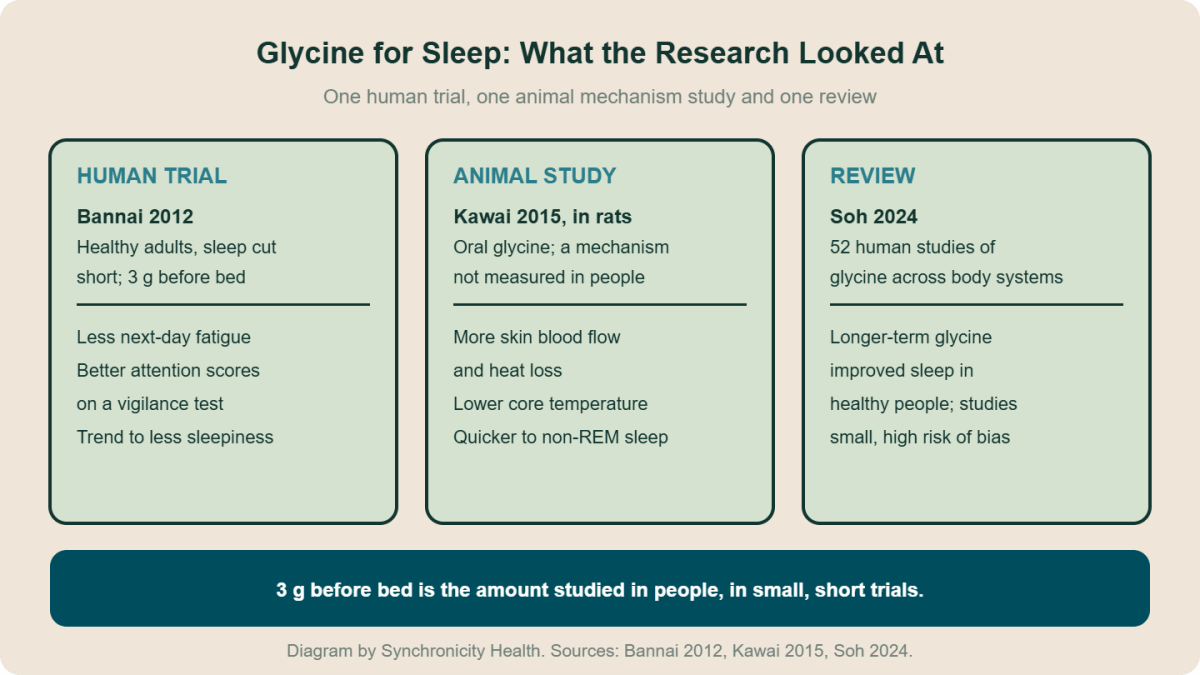
Glycine for sleep has a small but genuine body of human research: in a study of healthy adults whose sleep was cut short, 3 g of glycine taken before bed was followed by less next-day fatigue and better scores on an attention test. Below we cover what the studies measured, the body temperature idea behind it, dosage, timing, side effects, magnesium glycinate and myo-inositol.
Key Takeaways
- Glycine is the smallest amino acid. Your body makes it, and you also get it from protein foods.
- In a sleep-restricted study of healthy volunteers, 3 g of glycine before bed was followed by less fatigue, a tendency toward less sleepiness and better psychomotor vigilance the next day (Bannai et al., 2012).
- A 2024 systematic review found that longer-term glycine improved sleep in healthy people, while noting those studies were small with a high risk of bias (Soh et al., 2024).
- In rats, glycine increased skin blood flow, lowered core body temperature and increased non-REM sleep.
- The usual approach is 3 g taken 30 to 60 minutes before bed.
- Magnesium bisglycinate carries glycine, but at typical magnesium amounts the glycine is well below 3 g.

Featured in this article
Melatonin-Free Sleep Powder3,000 mg glycine and 2,000 mg myo-inositol per scoop, with tart cherry, magnesium and apigenin. No added melatonin.
Join the WaitlistComing soon. Third-party tested ingredients.
What Is Glycine?
Glycine is an amino acid, and the simplest one in structure. Your body makes it on its own, and it's also part of the protein you eat, with collagen and gelatin being especially rich sources.
Glycine also has a second life as a signaling molecule in the nervous system. It works at NMDA receptors in the brain, and that is exactly where animal research on glycine and sleep points, as you'll see below.
What the Research on Glycine and Sleep Shows
The key human study is a sleep-restriction trial. Healthy volunteers had their sleep restricted by 25 percent for three nights and took 3 g of glycine before bedtime. Glycine reduced fatigue, showed a tendency toward less sleepiness, and improved performance on a psychomotor vigilance test, a computer task that measures how quickly and consistently you react (Bannai et al., 2012).
The same paper included rat experiments. Glycine did not change plasma melatonin or the core clock genes Bmal1 and Per2 in the suprachiasmatic nucleus, the brain's master clock. It did increase two signaling peptides there, arginine vasopressin and vasoactive intestinal polypeptide, during the light period. The authors suggested glycine may influence circadian signaling indirectly (Bannai et al., 2012). That point matters if you are looking at sleep supplements without melatonin: glycine does not appear to work by raising melatonin.
Stepping back, a 2024 systematic review looked at glycine across eleven body systems in adults, covering 18 studies in healthy populations and 34 in people with health conditions. The nervous system showed the most positive effects. The authors reported that longer-term glycine improved sleep in healthy populations, and they were direct about the limits: those studies had small sample sizes and a high risk of bias (Soh et al., 2024). Larger trials would sharpen the picture.
| Study | Who or what was studied | What was measured |
|---|---|---|
| Bannai et al., 2012 | Healthy adults with sleep cut by 25% for three nights; 3 g glycine before bed. Plus rats. | Less fatigue, a tendency toward less sleepiness, better psychomotor vigilance. In rats, no change in melatonin. |
| Kawai et al., 2015 | Rats given glycine by mouth and directly into the brain | More skin blood flow and heat loss, lower core temperature, more non-REM sleep, faster entry into non-REM sleep |
| Soh et al., 2024 | Systematic review of 52 human studies across eleven body systems | Longer-term glycine improved sleep in healthy people; studies were small with a high risk of bias |
Glycine does more than support sleep; its roles in glutathione and creatine are covered in glycine benefits. If you are deciding between glycine and GABA, our guide to glycine vs GABA compares how each has been studied for sleep.
How Glycine May Work: Body Temperature
The leading explanation for glycine's effect on sleep involves body temperature, specifically moving heat out through the skin so the body's core cools down.
In rats, glycine given by mouth or directly into the brain increased blood flow to the skin of the feet in a dose-dependent way, which led to heat loss and a simultaneous decrease in core temperature. Oral glycine also increased non-REM sleep and shortened the time it took to reach non-REM sleep. These effects depended on NMDA receptors in the suprachiasmatic nucleus: blocking those receptors stopped the blood flow increase, and removing the suprachiasmatic nucleus abolished both the sleep and temperature effects. The researchers concluded that glycine appears to promote sleep through widening of blood vessels near the skin, acting on NMDA receptors in that brain region (Kawai et al., 2015).
One caveat: this comes from animal work. It is a proposed pathway, not something measured in the human glycine trial above. For practical, non-supplement steps, see our guide on how to fall asleep fast.
Glycine Dosage and Timing
The human glycine study used 3 g taken before bedtime (Bannai et al., 2012), so 3 g is the sensible amount to start with and the one to compare products against.
- How much: 3 g (3,000 mg).
- When: in the evening, roughly 30 to 60 minutes before bed, so it's in your system as you wind down.
- How often: nightly use is how most people take it. Notice how you feel over a couple of weeks.
Building a full evening routine? See natural sleep supplements that don't cause grogginess.
Glycine Side Effects and Safety
Glycine is a normal part of the protein in everyday food. Even so, a few sensible points apply to any evening supplement:
- The sleep studies were short and small, so there is limited long-term data at this specific dose and timing (Soh et al., 2024).
- If you're pregnant or nursing, under 18, or take any medication, check with your healthcare provider first.
- Sleep-focused blends can cause drowsiness. Take them at night, not before driving, and avoid combining them with alcohol.
Glycine in Magnesium Glycinate
If you already take magnesium glycinate, you're getting some glycine. Magnesium bisglycinate is magnesium bound to two glycine molecules, which is where the name comes from.
The catch is the amount. At the magnesium levels found in a typical serving, the glycine that comes along is well below the 3 g used in the glycine sleep research. The two are related but not interchangeable. For more, see magnesium glycinate for sleep and magnesium bisglycinate vs glycinate. Our sleep powder uses two magnesium forms, bisglycinate and magnesium glycerophosphate, alongside a full 3,000 mg dose of glycine.
Myo-Inositol for Sleep
Myo-inositol is the main form of inositol, a compound your body makes on its own and also gets from food.
Most myo-inositol research has focused on areas other than sleep. One randomized, double-blind, placebo-controlled trial did measure it: 60 pregnant women in Iran took a powder with 2,000 mg myo-inositol and folic acid, or folic acid alone, for 10 weeks. The myo-inositol group had better scores on the Pittsburgh Sleep Quality Index, a standard sleep questionnaire, including subjective sleep quality and sleep duration (Mashayekh-Amiri, 2022). That study was small and in one group of people, and our powder is not for pregnant or nursing women, so the results may not apply to everyone.
That is why we think of myo-inositol as a supporting ingredient rather than the lead. Our powder includes 2,000 mg myo-inositol alongside 3,000 mg glycine, so the glycine dose matches the research while myo-inositol plays a complementary role. For another nighttime drink, see the sleepy girl mocktail.
Our myo-inositol guide covers what it is, its food sources, the amounts used in studies and its side effects. For more on inositol at night, see our guide to inositol for sleep; for the glycine math and taking both, see glycine vs magnesium glycinate.
Glycine Alongside Other Sleep Ingredients
Here's how glycine compares with ingredients it's often paired with:
| Ingredient | What it is | Learn more |
|---|---|---|
| Glycine | An amino acid; research centers on 3 g before bed | This guide |
| Tart cherry | A sour cherry studied for sleep; naturally contains trace melatonin | Tart cherry for sleep |
| Apigenin | A plant compound found in chamomile | Apigenin guide |
| Magnesium | An essential mineral; glycinate and glycerophosphate are common forms | Apigenin vs magnesium vs melatonin |
| Melatonin | A hormone that signals night to the body | Melatonin guide |
For the bigger picture on why rest matters, start with our hub on sleep health and quality rest. If you are wondering how long to keep taking glycine or another sleep aid, see Sleep Supplements: How Long You Should Really Use Them.
For tart cherry beyond sleep, including exercise recovery studies, see tart cherry juice benefits. For tart cherry paired with magnesium, see our guide to tart cherry and magnesium.
Where Our Products Fit
Our Melatonin-Free Sleep Powder is built around the glycine dose from the research. Each 9.5 g scoop has 3,000 mg glycine and 2,000 mg myo-inositol, plus 2,000 mg tart cherry (Prunus cerasus) fruit powder, 500 mg tart cherry fruit extract, 200 mg magnesium (100 mg from magnesium bisglycinate and 100 mg from magnesium glycerophosphate) and 50 mg apigenin from chamomile flower. It's an unsweetened tart cherry drink with no added sugar or sweeteners and no added melatonin. It's designed to support restful sleep and help you wind down at night.
Mix 1 scoop in 8 oz of water 30 to 60 minutes before bed, no more than 1 scoop a day. It's not for pregnant or nursing women or anyone under 18. Ask a healthcare provider first if you take medication, especially blood thinners such as warfarin, sedatives or prescription sleep medicines. It may cause drowsiness, so avoid alcohol with it, and skip it if you're allergic to chamomile, ragweed, chrysanthemums, marigolds or daisies. The powder is coming soon at $59 for 30 servings, and you can join the waitlist now.
If you'd rather not drink anything close to bedtime, our Theanine Nasal Spray is a different format: 36 mg of L-theanine per serving (one spray in each nostril), absorbed through the lining of the nose. Read more in our L-theanine for sleep guide.
Featured in this article
Melatonin-Free Sleep PowderAn unsweetened tart cherry drink that helps you wind down at night, built around the 3 g glycine dose from the research.
Join the WaitlistComing soon. Third-party tested ingredients.
Frequently Asked Questions
Does glycine actually help with sleep?
Human research is small but consistent. In sleep-restricted healthy adults, 3 g of glycine before bed was followed by less fatigue and better vigilance the next day (Bannai et al., 2012), and a 2024 review found longer-term glycine improved sleep in healthy people, while noting the studies were small (Soh et al., 2024).
How much glycine should I take for sleep?
The human research used 3 g (3,000 mg). That's the amount in one scoop of our sleep powder.
When should I take glycine for sleep?
Before bed. The study gave it before bedtime, and taking it 30 to 60 minutes ahead gives it time to settle in as you wind down.
Will glycine make me groggy the next morning?
In the sleep-restriction study, people reported less fatigue the next day, not more, and they performed better on a vigilance test (Bannai et al., 2012). Everyone responds differently, so see how you feel.
Is glycine the same as magnesium glycinate?
No. Magnesium glycinate is magnesium bound to glycine, so it carries some glycine, but at typical magnesium amounts it's far less than the 3 g used in glycine sleep research.
Does glycine raise melatonin?
In rats, glycine did not change plasma melatonin levels (Bannai et al., 2012). The leading explanation involves body temperature instead.
Does myo-inositol help you sleep?
Only a small number of human studies have measured sleep with myo-inositol. In one trial in pregnant women, 2,000 mg a day for 10 weeks was followed by better sleep questionnaire scores than placebo, though that group may not reflect everyone. In our powder it plays a supporting role at 2,000 mg, alongside the 3,000 mg glycine dose that matches the glycine research.
Does the sleep powder contain melatonin?
There's no added melatonin. Tart cherries naturally contain trace amounts, which is why we say no added melatonin rather than none at all. Curious which foods carry it? See foods with melatonin.
Sources
- Bannai M, Kawai N, Ono K, Nakahara K, Murakami N. The effects of glycine on subjective daytime performance in partially sleep-restricted healthy volunteers. Front Neurol. 2012;3:61. PMID 22529837
- Kawai N, Sakai N, Okuro M, et al. The sleep-promoting and hypothermic effects of glycine are mediated by NMDA receptors in the suprachiasmatic nucleus. Neuropsychopharmacology. 2015;40(6):1405-1416. PMID 25533534
- Soh J, Raventhiran S, Lee JH, et al. The effect of glycine administration on the characteristics of physiological systems in human adults: a systematic review. GeroScience. 2024;46(1):219-239. PMID 37851316
- Mashayekh-Amiri S, Delavar MA, Bakouei F, Faramarzi M, Esmaeilzadeh S. The impact of myo-inositol supplementation on sleep quality in pregnant women: a randomized, double-blind, placebo-controlled study. J Matern Fetal Neonatal Med. 2022;35(18):3415-3423. PMID 32933356
Our products are not intended to diagnose, treat, cure or prevent any disease. This article is for education only and is not medical advice.

Leave a comment
All comments are moderated before being published.
This site is protected by hCaptcha and the hCaptcha Privacy Policy and Terms of Service apply.