
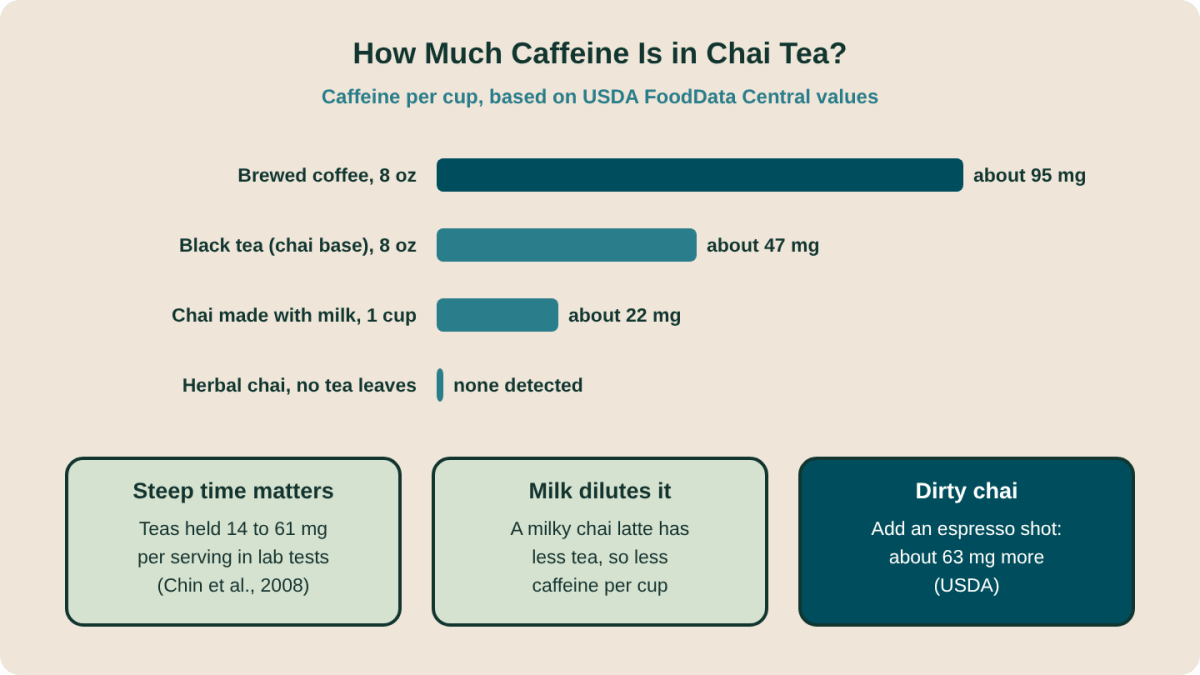
A cup of chai tea usually has about 20 to 50 mg of caffeine, roughly a quarter to a half of a cup of coffee. Chai is black tea brewed with spices, and brewed black tea has about 47 mg per 8 oz (USDA FoodData Central). Chai made with milk has less per cup, about 22 mg, because the milk takes the place of some of the tea (USDA FoodData Central). Brewed coffee has about 95 mg per 8 oz (USDA FoodData Central). This guide covers chai by type, chai lattes, decaf and how to brew a lighter cup.
It is educational, not medical advice.
Key Takeaways
- Chai is black tea: its caffeine comes from the tea leaves, and brewed black tea has about 47 mg per 8 oz (USDA FoodData Central).
- With milk, less per cup: USDA lists tea with milk, which includes masala chai and chai tea lattes, at about 22 mg per 1 cup serving (USDA FoodData Central).
- Coffee has about twice as much: brewed coffee has about 95 mg per 8 oz (USDA FoodData Central).
- Brewing matters: in lab tests, teas held 14 to 61 mg per serving, and longer steeping raised the caffeine (Chin et al., 2008).
- Herbal chai is caffeine-free: herbal teas had no caffeine detected in the same tests (Chin et al., 2008).

Featured in this article
Theanine Nasal Spray36 mg of L-theanine per serving, caffeine-free, to pair with your coffee or tea.
Shop Theanine Nasal SprayThird-party tested ingredients. Vegan, non-GMO, made in the USA.

Caffeine in Chai Tea at a Glance
| Drink | Caffeine | Source |
|---|---|---|
| Brewed black tea (the base of chai), 8 oz | about 47 mg | USDA |
| Tea with milk, such as masala chai or a chai latte, 1 cup | about 22 mg | USDA |
| Black tea, 12 oz | 71 mg | FDA |
| Brewed coffee, 8 oz | about 95 mg | USDA |
| Herbal chai (no tea leaves) | none detected in herbal teas | Chin et al., 2008 |
The 8 oz figures are calculated from USDA values of 20 mg of caffeine per 100 g of brewed black tea (USDA FoodData Central) and 40 mg per 100 g of brewed coffee (USDA FoodData Central). The tea with milk figure uses the USDA value of 9 mg per 100 g and its 240 g cup (USDA FoodData Central). The 12 oz figure is an FDA typical amount (FDA).
What Is Chai Tea?
In much of the world, chai simply means tea. In the US, "chai" usually means masala chai: black tea brewed with spices such as cardamom, cinnamon, ginger and cloves, often with milk and sugar. USDA groups Indian masala chai, spiced milk tea and chai tea lattes under tea with milk, and lists spiced black tea bags as brewed black tea (USDA FoodData Central; USDA FoodData Central). The spices themselves do not add caffeine; the tea leaves do.
How Much Caffeine Is in a Cup of Chai?
It depends on how much tea goes in and how much milk. Brewed black tea has about 20 mg of caffeine per 100 g, or about 47 mg in an 8 oz cup (USDA FoodData Central). A chai made half with milk will have less tea in the same cup, which is why USDA lists tea with milk at about 9 mg per 100 g, or about 22 mg per 1 cup serving (USDA FoodData Central). A larger 12 oz mug of black tea has about 71 mg (FDA).
Steeping time also moves the number. When researchers brewed 20 tea products, white, green and black teas ranged from 14 to 61 mg per 6 or 8 oz serving, and caffeine went up with longer steeping (Chin et al., 2008). Since longer steeping raised the caffeine in those tests, a chai simmered for a long time, as many home recipes do, is likely to be stronger than a quick tea bag. Our guide to caffeine in black tea covers cup sizes and brewing in more detail. For another tea leaf, our guide to how much caffeine is in oolong tea gives amounts per cup and compares it with coffee.
Chai Lattes, Concentrates and Tea Bags
- Chai tea bags: a spiced black tea bag brewed in water is close to black tea, about 47 mg per 8 oz (USDA FoodData Central; USDA FoodData Central).
- Chai lattes: made with chai concentrate or tea plus a lot of milk, so the tea, and the caffeine, is spread through a bigger drink; USDA puts tea with milk at about 22 mg per cup (USDA FoodData Central).
- Coffee shop chai: restaurants and coffee shops are not required to tell you how much caffeine their drinks contain, so the FDA suggests asking (FDA). Larger sizes and extra tea shots raise the total.
- Dirty chai: a chai latte with a shot of espresso added. One espresso shot has about 63 mg of caffeine (USDA FoodData Central), so a dirty chai can land close to a cup of coffee.
- Herbal or rooibos chai: blends made without tea leaves; herbal teas had no caffeine detected in lab tests (Chin et al., 2008).
Chai vs Coffee
An 8 oz cup of brewed black tea, the base of chai, has about half the caffeine of the same cup of brewed coffee: about 47 mg against about 95 mg (USDA FoodData Central; USDA FoodData Central). A 12 oz cup of regular brewed coffee typically has 113 to 247 mg, against 71 mg for black tea (FDA). So switching one coffee a day for a chai is one of the easier ways to cut back without dropping caffeine completely. For the wider comparison, see tea vs coffee, and for other lower caffeine swaps, coffee alternatives.
L-Theanine in Chai
Because chai is made from tea, it carries L-theanine, an amino acid from the tea plant. In a placebo-controlled study, 50 mg of caffeine with 100 mg of L-theanine improved speed and accuracy on an attention switching task and reduced distraction in a memory task (Owen et al., 2008). That pairing is one reason tea drinks often feel gentler than coffee. Read more in L-theanine and caffeine.
How to Make Chai With Less Caffeine
- Steep for less time: shorter steeping gave less caffeine in lab tests (Chin et al., 2008).
- Use more milk: a milky chai has less tea per cup (USDA FoodData Central).
- Choose decaf tea: decaffeinated teas held less than 12 mg per serving (Chin et al., 2008).
- Try an herbal chai: spice blends with rooibos or other herbs instead of tea leaves; herbal teas had no caffeine detected (Chin et al., 2008).
- Skip the espresso shot: a dirty chai adds about 63 mg per shot (USDA FoodData Central).
How Much Chai Is Too Much?
For most adults, the FDA cites 400 mg of caffeine a day as an amount not generally associated with negative effects, while noting that sensitivity varies and that people who are pregnant, trying to become pregnant or breastfeeding should ask their health care provider (FDA). At about 47 mg per 8 oz of black tea (USDA FoodData Central), several cups of chai fit well inside that for most people, but the total from all your drinks is what counts. See how much caffeine is too much for the signs to watch for.
That 400 mg figure is backed by a large systematic review, which concluded that up to 400 mg of caffeine a day is not associated with overt adverse effects in healthy adults (Wikoff et al., 2017).
Where Our Products Fit
Theanine Nasal Spray gives 36 mg of L-theanine per serving and is caffeine-free, for anyone who likes the idea of tea's theanine alongside their usual drink. The Energy Stack combines NAD+ Nasal Spray, Forage and Methyl B-12 Nasal Spray in one daily energy routine. Read more on our L-theanine ingredient page and the Non-Stimulant Energy and Focus hub.

Featured in this article
Energy StackNAD+ Nasal Spray, Forage and Methyl B-12 Nasal Spray together in one daily energy routine.
Shop Energy StackThird-party tested ingredients.
Frequently Asked Questions
Does chai tea have caffeine?
Yes, unless it is an herbal blend. Chai is made with black tea, which has about 47 mg per 8 oz (USDA FoodData Central).
How much caffeine is in a chai latte?
A chai latte is mostly milk, so the caffeine is lower per cup; USDA lists tea with milk, including chai tea lattes, at about 22 mg per 1 cup serving (USDA FoodData Central). Ask the shop for its own figure (FDA).
Does chai have more caffeine than coffee?
No. Brewed black tea has about 47 mg per 8 oz and brewed coffee about 95 mg (USDA FoodData Central; USDA FoodData Central).
Does chai have more caffeine than green tea?
Usually, because chai is made with black tea; black tea averages more caffeine than green tea, though individual teas overlap (FDA; Chin et al., 2008).
How much caffeine is in a dirty chai?
A chai latte plus one espresso shot, which adds about 63 mg (USDA FoodData Central).
Is there caffeine-free chai?
Yes. Decaf chai uses decaffeinated tea, which held less than 12 mg per serving in tests, and herbal chai is made from herbal teas, which had none detected (Chin et al., 2008).
Can I drink chai at night?
Regular chai has caffeine (USDA FoodData Central), so an herbal or decaf chai is the easier evening choice. See how long caffeine lasts.
Do the spices in chai have caffeine?
No. The caffeine in chai comes from the black tea; USDA lists spiced black tea with brewed black tea (USDA FoodData Central).
Sources
- Chin JM, Merves ML, Goldberger BA, Sampson-Cone A, Cone EJ. Caffeine content of brewed teas. J Anal Toxicol. 2008. PubMed 19007524
- Owen GN, Parnell H, De Bruin EA, Rycroft JA. The combined effects of L-theanine and caffeine on cognitive performance and mood. Nutr Neurosci. 2008. PubMed 18681988
- U.S. Food and Drug Administration. Spilling the Beans: How Much Caffeine Is Too Much? FDA
- U.S. Department of Agriculture. FoodData Central: Beverages, tea, black, brewed, prepared with tap water (FDC 173227); Tea, hot, with milk (FDC 2710506); Tea, hot, leaf, black (FDC 2710488); Beverages, coffee, brewed, prepared with tap water (FDC 171890); Beverages, coffee, brewed, espresso, restaurant-prepared (FDC 171891). FoodData Central
- Wikoff D, Welsh BT, Henderson R, Brorby GP, Britt J, Myers E, et al. Systematic review of the potential adverse effects of caffeine consumption in healthy adults, pregnant women, adolescents, and children. Food Chem Toxicol. 2017;109(Pt 1):585-648. PubMed 28438661
Our products are not intended to diagnose, treat, cure or prevent any disease. This article is for education only and is not medical advice.


Leave a comment
All comments are moderated before being published.
This site is protected by hCaptcha and the hCaptcha Privacy Policy and Terms of Service apply.