
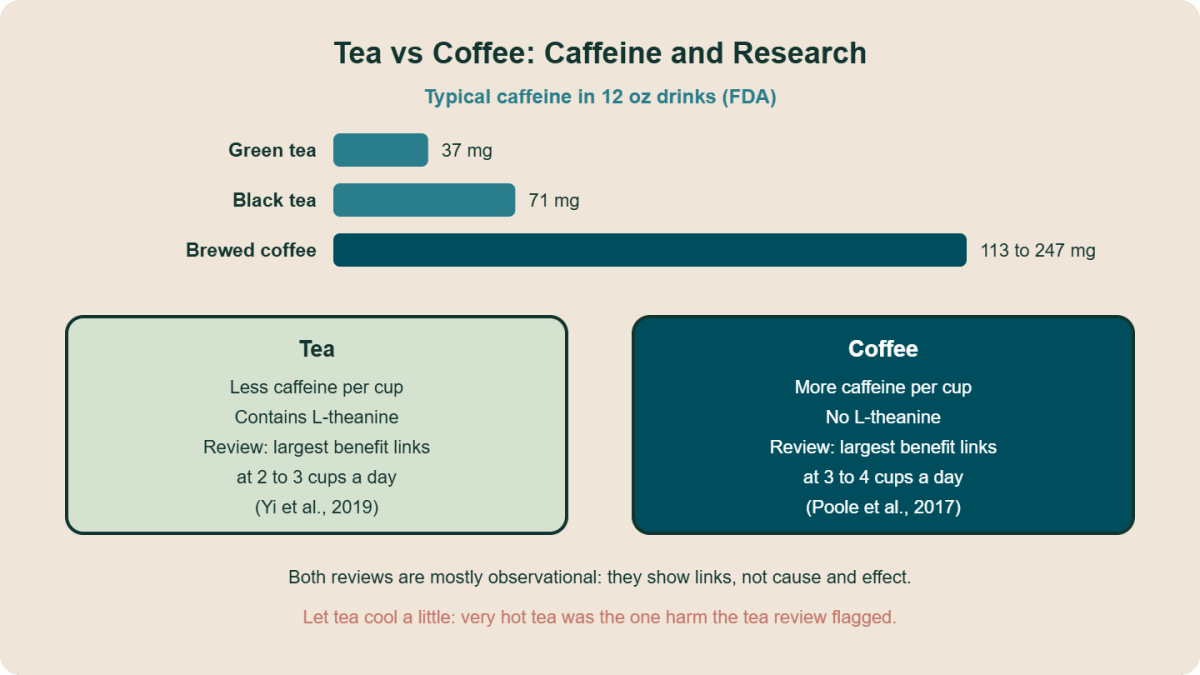
Coffee has more caffeine than tea, often two to three times as much per cup, while tea brings L-theanine and a gentler dose. In 12-ounce servings the FDA lists 113 to 247 mg of caffeine for brewed coffee, 71 mg for black tea and 37 mg for green tea (FDA). Large reviews of observational research link both drinks with more benefit than harm at usual intakes (Poole et al., 2017; Yi et al., 2019). The better choice depends on how much caffeine suits you. This guide compares caffeine, effects, research and how to choose.
It is educational, not medical advice.
Key Takeaways
- Caffeine per 12 oz: coffee 113 to 247 mg, black tea 71 mg, green tea 37 mg (FDA).
- Tea varies: brewed white, green and black teas held 14 to 61 mg per 6 or 8 ounce serving, and steeping time changed the caffeine (Chin et al., 2008).
- L-theanine: tea naturally contains L-theanine, and caffeine with L-theanine improved attention switching in a study (Owen et al., 2008).
- Coffee research: the largest risk reductions in an umbrella review were seen at three to four cups a day (Poole et al., 2017).
- Tea research: the largest reductions were seen at two to three cups a day, with very hot tea the exception (Yi et al., 2019).

Featured in this article
Theanine Nasal Spray36 mg of L-theanine per serving, caffeine-free, to pair with your coffee or tea.
Shop Theanine Nasal SprayThird-party tested ingredients. Vegan, non-GMO, made in the USA.

Tea vs Coffee: Caffeine Compared
| Drink | Caffeine per 12 oz (FDA) | Caffeine per 8 oz (USDA, calculated) |
|---|---|---|
| Green tea | 37 mg | about 28 mg |
| Black tea | 71 mg | about 47 mg |
| Brewed coffee | 113 to 247 mg | about 95 mg |
The FDA figures are typical amounts for 12 ounces (FDA). The 8-ounce figures are calculated from USDA values of 12 mg per 100 g for brewed green tea (USDA FoodData Central), 20 mg for brewed black tea (USDA FoodData Central) and 40 mg for brewed coffee (USDA FoodData Central). Brand, strength and steeping time all change the real number: in lab tests, steep time affected the caffeine in tea, and most teas held less caffeine per serving than brewed coffee (Chin et al., 2008).
How They Feel Different
The smaller caffeine dose in tea is the biggest difference: one cup of black tea is closer to half a coffee. Tea also contains L-theanine, an amino acid found in the tea plant. In a placebo-controlled study, 50 mg of caffeine with 100 mg of L-theanine improved speed and accuracy on an attention switching task and reduced distraction in a memory task (Owen et al., 2008). That pairing is one reason many people describe tea as a calmer lift. Our guide to L-theanine and caffeine goes deeper.
What Research Shows for Each
Coffee: an umbrella review of 201 meta-analyses of observational research and 17 of interventional research found coffee was more often associated with benefit than harm across a range of health outcomes, with the largest relative risk reduction at three to four cups a day, including a 17% lower risk of death from any cause compared with none (Poole et al., 2017).
Tea: an umbrella review of 96 meta-analyses found tea showed greater benefit than harm, with the largest reductions at two to three cups a day, including lower risk of death from any cause. It flagged one harm: drinking tea hotter than about 55 to 60 degrees Celsius was associated with cancers of the esophagus and stomach, so let it cool a little (Yi et al., 2019).
Both reviews are built mostly on observational studies, which show links rather than cause and effect, and the tea review noted that randomized trials are still needed to confirm them (Yi et al., 2019).
For more detail on single drinks, see how much caffeine is in black tea, green tea vs black tea and how much caffeine is in espresso, and if you are replacing energy drinks, our list of energy drink alternatives.
Green Tea vs Coffee
Green tea has the least caffeine of the common choices, 37 mg in 12 ounces against 113 to 247 mg for brewed coffee (FDA), and it carries catechins such as EGCG. Matcha, a powdered green tea, is stronger because you drink the whole leaf; our guide to matcha vs coffee compares it in detail, and green tea extract and EGCG covers the catechins.
Tea, Coffee and Sleep
Caffeine from either drink can affect sleep if you have it late. Because tea has less per cup, an afternoon tea is a smaller load than an afternoon coffee, but several cups add up. Herbal teas had no caffeine detected in lab tests (Chin et al., 2008), which makes them an easy evening choice. Our guide to how long caffeine lasts explains timing.
Two popular in-between options are chai, a spiced black tea covered in caffeine in chai tea, and mate, compared in yerba mate vs coffee. If you stay with coffee, read the best time to drink coffee and coffee on an empty stomach.
Kombucha is another tea-based drink, with less caffeine per glass than either tea or coffee; see does kombucha have caffeine.
Which Should You Choose?
- Choose coffee: if you want a stronger lift and you sleep well with an early cutoff.
- Choose tea: if coffee makes you jittery, or you want to spread a smaller dose through the day.
- Use both: a morning coffee and an afternoon green tea keeps your total lower than two coffees.
- Keep count: the FDA cites 400 mg a day as an amount not generally linked to negative effects for most adults (FDA). See how much caffeine is too much.
If you are cutting back on coffee, our list of coffee alternatives has more swaps.
Where Our Products Fit
Theanine Nasal Spray gives 36 mg of L-theanine per serving and is caffeine-free, so coffee drinkers who like the idea of tea's theanine can pair it with their usual cup. The Energy Stack combines NAD+ Nasal Spray, Forage and Methyl B-12 Nasal Spray in one daily energy routine. Read more on our L-theanine ingredient page and the Non-Stimulant Energy and Focus hub. For a cocoa based cup instead, our Mushroom Cacao is a mushroom hot chocolate with 500 mg each of lion's mane and cordyceps per serving.

Featured in this article
Energy StackNAD+ Nasal Spray, Forage and Methyl B-12 Nasal Spray together in one daily energy routine.
Shop Energy StackThird-party tested ingredients.
Frequently Asked Questions
Does tea have more caffeine than coffee?
No. In 12 ounces, black tea has about 71 mg and green tea 37 mg, against 113 to 247 mg for brewed coffee (FDA).
Is tea healthier than coffee?
Neither clearly wins. Umbrella reviews link both with more benefit than harm at usual intakes, coffee at three to four cups a day and tea at two to three (Poole et al., 2017; Yi et al., 2019).
Is green tea better than coffee?
Green tea has much less caffeine, 37 mg in 12 ounces (FDA), so it suits people who want a gentler lift. Coffee suits those who want more.
Can I replace coffee with tea?
Yes. Black tea is the closest swap in caffeine; expect about a third to two thirds of a coffee's caffeine per cup based on FDA figures (FDA).
Which is better for focus, tea or coffee?
Coffee gives more caffeine. Tea gives less with L-theanine, and the caffeine and L-theanine pairing improved attention switching in a study (Owen et al., 2008).
How many cups of tea equal one cup of coffee?
About two to three cups of black tea match the caffeine in one 8-ounce brewed coffee, based on USDA values (USDA FoodData Central; USDA FoodData Central).
Does steeping time change the caffeine in tea?
Yes. Steep time affected caffeine levels in lab tests of brewed teas (Chin et al., 2008).
Is it OK to drink tea and coffee on the same day?
Yes, as long as your total caffeine stays within a level that suits you; the FDA cites 400 mg a day for most adults (FDA).
Sources
- U.S. Food and Drug Administration. Spilling the Beans: How Much Caffeine Is Too Much? FDA
- Chin JM, Merves ML, Goldberger BA, Sampson-Cone A, Cone EJ. Caffeine content of brewed teas. J Anal Toxicol. 2008. PubMed 19007524
- Poole R, Kennedy OJ, Roderick P, et al. Coffee consumption and health: umbrella review of meta-analyses of multiple health outcomes. BMJ. 2017. PubMed 29167102
- Yi M, Wu X, Zhuang W, et al. Tea consumption and health outcomes: umbrella review of meta-analyses of observational studies in humans. Mol Nutr Food Res. 2019. PubMed 31216091
- Owen GN, Parnell H, De Bruin EA, Rycroft JA. The combined effects of L-theanine and caffeine on cognitive performance and mood. Nutr Neurosci. 2008. PubMed 18681988
- U.S. Department of Agriculture. FoodData Central: Beverages, tea, green, brewed, regular (FDC 171917); Beverages, tea, black, brewed, prepared with tap water (FDC 173227); Beverages, coffee, brewed, prepared with tap water (FDC 171890). FoodData Central
Our products are not intended to diagnose, treat, cure or prevent any disease. This article is for education only and is not medical advice.


Leave a comment
All comments are moderated before being published.
This site is protected by hCaptcha and the hCaptcha Privacy Policy and Terms of Service apply.