
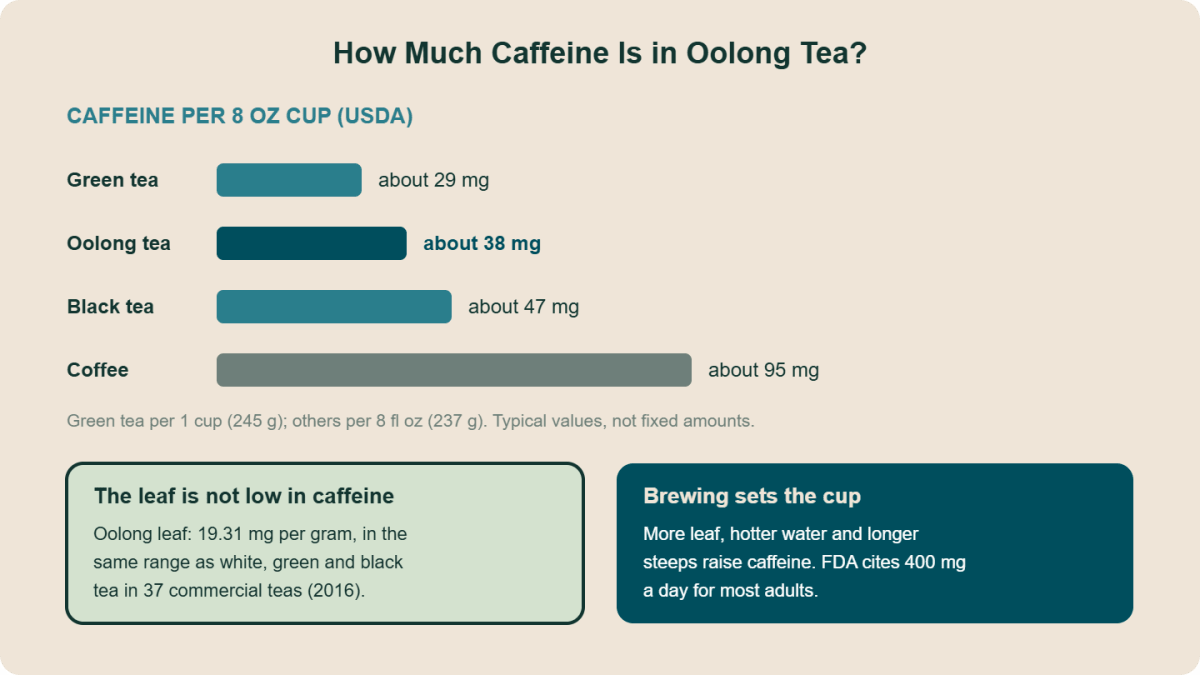
A cup of oolong tea has about 38 mg of caffeine per 8 oz, less than black tea and well under half a cup of coffee. USDA lists brewed oolong at 16 mg of caffeine per 100 g (USDA FoodData Central), against about 47 mg for brewed black tea and about 95 mg for brewed coffee in the same 8 oz cup (USDA FoodData Central; USDA FoodData Central). The real number in your cup depends on how much leaf you use, how hot the water is and how long it steeps. This guide covers oolong caffeine by cup size, how it compares with green tea, black tea and coffee, and how to brew a stronger or gentler cup.
It is educational, not medical advice.
Key Takeaways
- About 38 mg per 8 oz cup: USDA lists brewed oolong at 16 mg of caffeine per 100 g (USDA FoodData Central).
- Between green and black tea: USDA puts a cup of brewed green tea at about 29 mg and an 8 oz cup of brewed black tea at about 47 mg (USDA FoodData Central; USDA FoodData Central).
- The leaf is not low in caffeine: in 37 commercial teas, oolong leaf held 19.31 mg of caffeine per gram, in the same range as white, green and black tea (Boros et al., 2016).
- Brewing decides the cup: longer brewing raised caffeine in every tea type tested in a 2025 lab study (Ayakdaş and Ağagündüz, 2025).
- Fits easily in a day: the FDA cites 400 mg of caffeine a day as an amount not generally associated with negative effects for most adults (FDA).

Featured in this article
Theanine Nasal Spray36 mg of L-theanine per serving, caffeine-free, to pair with your coffee or tea.
Shop Theanine Nasal SprayThird-party tested ingredients. Vegan, non-GMO, made in the USA.

Oolong Tea Caffeine at a Glance
| Drink | Caffeine | Source |
|---|---|---|
| Oolong tea, 6 oz | about 28 mg | USDA |
| Oolong tea, 8 oz | about 38 mg | USDA |
| Oolong tea, 12 oz | about 57 mg | USDA |
| Oolong tea, 16 oz | about 76 mg | USDA |
| Brewed green tea, 1 cup | about 29 mg | USDA |
| Brewed black tea, 8 oz | about 47 mg | USDA |
| Brewed coffee, 8 oz | about 95 mg | USDA |
The oolong figures are calculated from the USDA value of 16 mg of caffeine per 100 g of brewed oolong (USDA FoodData Central), using the cup weights USDA gives for brewed black tea: 178 g for 6 fl oz and 237 g for 8 fl oz (USDA FoodData Central). The green tea figure uses USDA's 12 mg per 100 g and its 245 g cup (USDA FoodData Central), and the coffee figure 40 mg per 100 g (USDA FoodData Central). Read every number as a typical cup, not a fixed amount.
What Is Oolong Tea?
Oolong comes from the same tea plant as green, white and black tea. What sets it apart is processing: the leaves are partly oxidized, so oolong sits between green tea, which is barely oxidized, and black tea, which is fully oxidized. Lightly oxidized oolongs taste floral and close to green tea, while dark, roasted oolongs taste toasty and closer to black tea. Because all of these teas come from one plant, all of them carry caffeine and L-theanine.
How Much Caffeine Is in a Cup of Oolong?
Using the USDA value of 16 mg per 100 g (USDA FoodData Central):
- 6 oz teacup: about 28 mg
- 8 oz cup: about 38 mg
- 12 oz mug: about 57 mg
- 16 oz travel mug or bottle: about 76 mg
Lab studies show how wide the real range is. In a 2025 study of six tea types brewed at two temperatures and three steeping times, the average for oolong was about 4 mg per 200 mL, the lowest of the six, and longer brewing raised caffeine in the teas tested, with yellow tea reaching about 53 mg per 200 mL at 10 minutes (Ayakdaş and Ağagündüz, 2025). A quick, cool steep with little leaf gives a light cup; plenty of leaf and a long, hot steep gives a cup closer to black tea.
Is Oolong Lower in Caffeine Than Other Teas?
Not in the leaf itself. When researchers measured 37 commercial white, green, oolong, black and pu-erh teas, the oolong leaves averaged 19.31 mg of caffeine per gram, against 16.79 for white, 16.28 for green and 17.73 for black tea, and they concluded that caffeine content could not tell the tea types apart (Boros et al., 2016). A larger study of 1,398 tea samples from 17 Chinese provinces found average contents of 27 mg per gram for oolong up to 43 mg per gram for yellow tea, and reported that caffeine passed into the water almost completely under its brewing method (Yong et al., 2022).
So oolong's middle position in a cup comes mostly from how it is usually brewed, not from a low caffeine leaf. Many oolongs are rolled into tight balls that open slowly, so a short first steep pulls out less than a long one.
Oolong vs Green Tea vs Black Tea vs Coffee
By USDA's typical values, a cup of brewed green tea has about 29 mg, oolong about 38 mg, black tea about 47 mg and coffee about 95 mg (USDA FoodData Central; USDA FoodData Central; USDA FoodData Central; USDA FoodData Central). Lab tests of brewed teas found that most contain less caffeine per serving than brewed coffee, with steep time changing the result (Chin et al., 2008).
For the other teas, see caffeine in black tea and green tea vs black tea. For the bigger picture, tea vs coffee compares effects as well as caffeine, and caffeine in chai tea covers the spiced black tea version.
What Changes the Caffeine in Your Cup
- Steeping time: longer brewing raised caffeine in the teas tested (Ayakdaş and Ağagündüz, 2025; Chin et al., 2008).
- Water temperature: the 2025 study brewed at 80 °C and 100 °C and found brewing conditions changed caffeine levels (Ayakdaş and Ağagündüz, 2025). Oolong is often brewed just below boiling.
- How much leaf: more leaf in the same water means more caffeine. At the 27 mg per gram average from the large survey, 2 g of oolong leaf holds about 54 mg (Yong et al., 2022).
- Repeated short steeps: in the traditional style of brewing, the same leaves are steeped several times for a short time each. Each small cup is light, but the caffeine across all of them adds up.
- Tea bag or loose leaf: the 2025 study also found the serving form changed the result (Ayakdaş and Ağagündüz, 2025). Bags hold small broken pieces that release faster.
- Cup size: a 16 oz bottle of the same oolong carries twice the caffeine of an 8 oz cup (USDA FoodData Central).
Caffeine and L-Theanine in Oolong
Tea leaves carry L-theanine, an amino acid from the tea plant, alongside their caffeine. In the 37 commercial teas, oolong leaves averaged 6.09 mg of L-theanine per gram, close to white and green tea (Boros et al., 2016). In a placebo-controlled study, 50 mg of caffeine with 100 mg of L-theanine improved speed and accuracy on an attention switching task and reduced distraction in a memory task (Owen et al., 2008). That caffeine amount is close to a 12 oz mug of oolong. Read more in L-theanine and caffeine.
Oolong Tea Before Bed
Oolong still has caffeine, so an evening cup can matter if you are sensitive. In one placebo-controlled crossover study, 12 men drank oolong tea with 100 mg of caffeine at breakfast and lunch for 14 days, and sleep recordings on day 14 showed no change in sleep architecture; the authors note that caffeine's acute effects, such as interference with sleep, fade over 1 to 4 days of regular use (Zhang et al., 2020). That study used morning and midday cups, not evening ones. If you drink oolong later in the day, a lighter brew or an earlier last cup is the simple fix. Our guide to how long caffeine lasts explains the timing.
How to Brew Oolong With More or Less Caffeine
- For a gentler cup: use less leaf, cooler water and a shorter steep, and stop after one or two short infusions (Ayakdaş and Ağagündüz, 2025).
- For a stronger cup: use more leaf, near boiling water and a longer steep (Chin et al., 2008).
- Count the whole pot: when you steep the same leaves several times, add the cups together rather than counting one.
- Watch bottled oolong: ready to drink bottles are often 16 oz or more, so read the label for the caffeine amount when one is given.
How Much Oolong Tea Is Too Much?
For most adults, the FDA cites 400 mg of caffeine a day as an amount not generally associated with negative effects, and suggests talking with a health care provider if you are pregnant, trying to become pregnant, breastfeeding, or have a condition or medication that affects caffeine (FDA). At about 38 mg per 8 oz cup (USDA FoodData Central), several cups of oolong fit under that line, but count coffee, soda and other teas too. Our guide to how much caffeine is too much lists the signs to watch for, and caffeine crash covers the afternoon dip.
Where Our Products Fit
Theanine Nasal Spray gives 36 mg of L-theanine per serving and is caffeine-free, for anyone who likes the idea of tea's theanine alongside their usual drink. The Energy Stack combines NAD+ Nasal Spray, Forage and Methyl B-12 Nasal Spray in one daily energy routine. Read more on our L-theanine ingredient page and the Non-Stimulant Energy and Focus hub.

Featured in this article
Energy StackNAD+ Nasal Spray, Forage and Methyl B-12 Nasal Spray together in one daily energy routine.
Shop Energy StackThird-party tested ingredients.
Frequently Asked Questions
Does oolong tea have caffeine?
Yes. USDA lists brewed oolong at 16 mg of caffeine per 100 g, or about 38 mg in an 8 oz cup (USDA FoodData Central).
Does oolong tea have more caffeine than green tea?
A little more by USDA's typical values: about 38 mg per 8 oz for oolong against about 29 mg per cup for green tea (USDA FoodData Central; USDA FoodData Central). How you brew each one can easily reverse that.
Does oolong tea have more caffeine than black tea?
Usually less in the cup. Brewed black tea has about 47 mg per 8 oz against about 38 mg for oolong (USDA FoodData Central; USDA FoodData Central), though the leaves themselves hold similar amounts (Boros et al., 2016).
How does oolong caffeine compare with coffee?
An 8 oz cup of oolong has about 38 mg and an 8 oz cup of brewed coffee about 95 mg, so oolong has well under half (USDA FoodData Central; USDA FoodData Central).
Is there decaf oolong tea?
Decaffeinated teas exist, and lab tests found decaf teas still had small amounts, under 12 mg per serving (Chin et al., 2008). Check the label for oolong specifically.
Will oolong tea keep me awake?
It can if you are sensitive, since a mug has about as much caffeine as a small cup of black tea. A lighter brew or an earlier last cup helps. See how long caffeine lasts.
How many cups of oolong can I drink a day?
For caffeine alone, several 8 oz cups fit under the 400 mg a day the FDA cites for most adults (FDA), as long as you count your other caffeine too.
Does the second steep of oolong have less caffeine?
The large survey reported that caffeine passed into the water almost completely under its brewing method (Yong et al., 2022), so whatever one short steep leaves behind can come out in the next. Rolled oolongs open slowly, which is one reason later steeps can still be strong.
Sources
- U.S. Department of Agriculture. FoodData Central: Beverages, tea, Oolong, brewed (FDC 174120); Beverages, tea, green, brewed, regular (FDC 171917); Beverages, tea, black, brewed, prepared with tap water (FDC 173227); Beverages, coffee, brewed, prepared with tap water (FDC 171890). FoodData Central
- Ayakdaş G, Ağagündüz D. Determination of L-Theanine and Caffeine Contents in Tea Infusions with Different Fermentation Degrees and Brewing Conditions Using the Chromatographic Method. Foods. 2025. DOI
- Boros K, Jedlinszki N, Csupor D. Theanine and Caffeine Content of Infusions Prepared from Commercial Tea Samples. Pharmacogn Mag. 2016. DOI
- Yong L, Song Y, Xiao X, et al. Quantitative probabilistic assessment of caffeine intake from tea in Chinese adult consumers based on nationwide caffeine content determination and tea consumption survey. Food Chem Toxicol. 2022. DOI
- Chin JM, Merves ML, Goldberger BA, Sampson-Cone A, Cone EJ. Caffeine content of brewed teas. J Anal Toxicol. 2008. PubMed 19007524
- Zhang S, Takano J, Murayama N, et al. Subacute Ingestion of Caffeine and Oolong Tea Increases Fat Oxidation without Affecting Energy Expenditure and Sleep Architecture: A Randomized, Placebo-Controlled, Double-Blinded Cross-Over Trial. Nutrients. 2020. DOI
- Owen GN, Parnell H, De Bruin EA, Rycroft JA. The combined effects of L-theanine and caffeine on cognitive performance and mood. Nutr Neurosci. 2008. PubMed 18681988
- U.S. Food and Drug Administration. Spilling the Beans: How Much Caffeine Is Too Much? FDA
Our products are not intended to diagnose, treat, cure or prevent any disease. This article is for education only and is not medical advice.

Leave a comment
All comments are moderated before being published.
This site is protected by hCaptcha and the hCaptcha Privacy Policy and Terms of Service apply.