
To verify third-party testing for a glutathione supplement, request an independent laboratory report for the finished product and match its lot number to your bottle. Check what the laboratory measured, the reported results, and the limits used to judge those results. A testing badge alone does not establish potency or purity.

Featured in this article
Glutathione Nasal SpraySupports antioxidant defense and the body's own clearance pathways.
Shop Glutathione Nasal SprayThird-party tested ingredients. Vegan, non-GMO, made in the USA.
- The best glutathione supplement third party tested has verifiable, batch-matched evidence, not just a badge.
- Synchronicity sells glutathione nasal spray; assess its testing separately from evidence for oral supplements.
- A certificate of analysis should identify the sample, laboratory, methods, results, and acceptance limits.
- Third-party testing checks specified quality measures.
Why this matters
When you search for the best glutathione supplement third party tested in 2026, separate two questions: does the product meet its stated quality specifications, and does human research support the benefit you want? A laboratory report helps answer the first. A clinical study addresses the second, and its findings depend on the formulation, dose, participants, and delivery route studied.
Synchronicity formulates in-house with third-party tested ingredients. Those are useful starting points, but your purchasing decision should rest on documentation for the specific product and batch, not a general statement about the brand.
How to check glutathione supplements for third-party testing
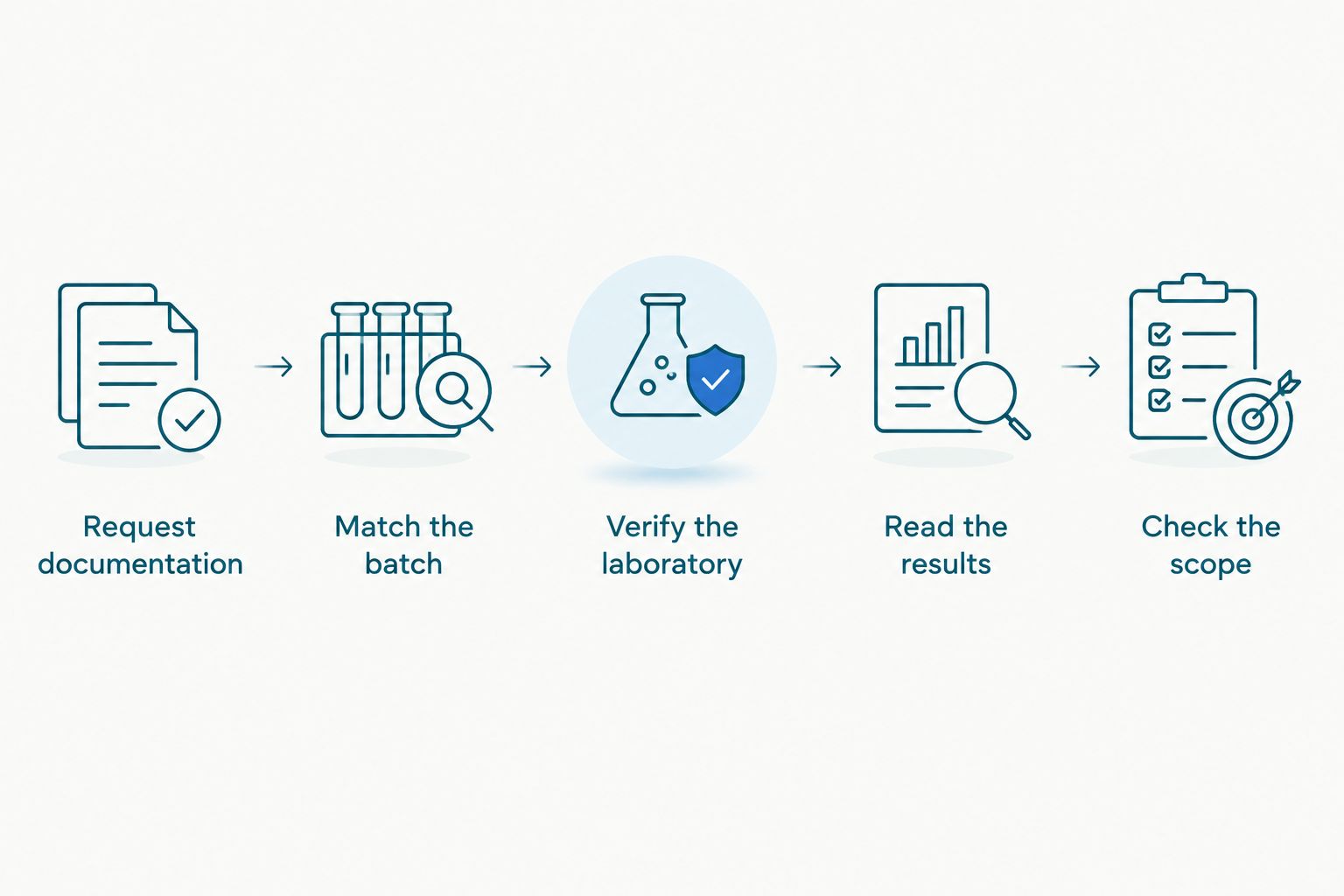
Use this sequence before buying in 2026. If you already have a bottle, keep its label beside the report so you can compare the product name, lot number, and serving information directly.
1. Request documentation
Ask for the certificate of analysis, often abbreviated COA, or the laboratory report supporting the third-party testing claim. Specify that you want documentation for the finished glutathione product, not just the ingredient supplied to the manufacturer.
A raw-material report answers questions about the ingredient before formulation. It does not establish that the final capsule or liquid contains the labeled amount or meets the same contamination specifications after production.
Finished-product testing matters because labels are not always accurate: when researchers analyzed 44 weight-loss supplements, 36 had inaccurate labels and 16 contained ingredients not listed on the label (Crawford et al., 2024).
Make the request specific:
- Which finished-product batch does this report cover?
- Which independent laboratory performed the testing?
- Which tests support the claim on the product page?
- Does the report include numerical results and acceptance limits?
Do not assume a promotional summary is interchangeable with the laboratory document. A summary can explain the findings, but the underlying report should let you check them.
2. Match the batch
Compare the product name, dosage form, and lot or batch identifier on the report with the bottle you are considering. A report for capsules does not verify a nasal spray, even if both contain glutathione.
Check the sample description as carefully as the product name. It should make clear whether the laboratory received an ingredient, bulk formulation, or finished product. Also distinguish the manufacturing date, sample receipt date, test date, and report date; they describe different events.
A report issued in 2026 is not automatically relevant to every bottle sold in 2026. Batch identity matters more than a recent-looking date. A mismatched report is not proof that your bottle is unsafe, but it does not verify that bottle.
3. Verify the laboratory
Look for the laboratory's name and report identifier. Contact details allow you to ask the laboratory whether it issued the document and whether the report has been altered, subject to its confidentiality rules.
ISO/IEC 17025 accreditation is a recognized indicator of laboratory competence. Check the accreditation body's listing and the laboratory's scope, because accreditation applies to specified testing activities, not automatically to every test a laboratory offers.
An accreditation logo alone is insufficient. Confirm that the scope covers the relevant analytical work and that the report identifies the methods used. Laboratory accreditation and product certification are different claims.
4. Read the results
Identify the actual measurements rather than stopping at a pass statement. For potency, look for the glutathione result, its units, and the basis of measurement: per capsule, per serving, or concentration in the liquid.
Units must be comparable. Milligrams per milliliter describe concentration; milligrams per serving describe the amount delivered in a stated serving. For a spray, interpreting the labeled serving also requires the stated spray volume or another documented measure of delivery.
For contaminants, look for the substances tested, measured results, and acceptance limits. Heavy-metal and microbiological testing answer different questions. A report that covers one does not establish the other.
If a result says not detected, check the detection limit. That phrase means the substance was not detected under the method's conditions; it does not mean an unlimited search found none whatsoever.
5. Check the scope
Confirm what the testing establishes and what remains outside its scope. An assay of glutathione content does not by itself verify shelf-life stability or consistent delivery from a spray device.
For a liquid product, ask whether supporting documentation addresses relevant microbiological specifications and storage conditions. For any product, distinguish testing at release from evidence that it remains within specifications through its labeled shelf life.
A finished-product report is useful quality evidence. Its limitation is equally important: it describes the sample tested and the measurements performed, not every property of every bottle.
6. Separate quality from outcomes
After checking the report, evaluate the health claim independently. Glutathione participates in cellular antioxidant processes.
Read human research for the actual delivery route. Glutathione research has mostly measured blood and cell levels, so note the route, dose, and outcome each study measured.
For your 2026 shortlist, favor clearly defined claims over broad promises. A seller should distinguish what its laboratory measured from what human studies demonstrated.
Which testing documents are most useful?
Different documents answer different questions. Compare their scope before deciding whether they support the claim you care about.
| Evidence type | Best for | What it supports | Main limitation |
|---|---|---|---|
| Batch-matched finished-product report | Checking your specific formulation | Results for identified tests on the submitted sample | Covers only the tests performed on that sample |
| Raw-ingredient report | Checking an ingredient before formulation | Ingredient identity and tested quality measures | Does not verify the finished bottle |
| Recognized product certification | Checking a defined certification program | Compliance with the program's stated requirements | Coverage depends on the program |
| Manufacturing-quality statement | Understanding production controls | Information about the manufacturing system | Does not replace batch-specific analytical results |
| Human clinical study | Assessing a health outcome | Findings for the studied formulation, route, and population | Does not verify your bottle's quality |
Use finished-product testing for quality questions and human studies for outcome questions. Neither substitutes for the other.
Read certification criteria rather than assuming every seal covers the same ground. Ingredient verification, contaminant testing, manufacturing review, and banned-substance screening are distinct activities.
Why third-party testing claims vary
The phrase third-party tested does not tell you the full testing scope. These factors explain why two claims can represent different evidence:
- Sample stage: Testing an ingredient is different from testing the finished formulation.
- Batch coverage: A report tied to one lot does not establish testing of every lot.
- Test panel: Potency, metals, and microbiological results address separate quality questions.
- Analytical method: Detection limits and suitability affect what a result can establish.
- Acceptance criteria: A pass statement depends on the limits used to evaluate the measurement.
- Testing period: Release testing and shelf-life studies address different points in a product's life.
For comparisons in 2026, use the same checklist for each seller. Do not rank products by the number of laboratory logos or the length of the quality statement.
What should you check for a glutathione nasal spray?
A nasal formulation needs route-specific scrutiny. Check the labeled ingredients, concentration, serving instructions, storage directions, and cautions, then ask which of those characteristics the available documentation verifies.
Synchronicity is best suited to shoppers comparing glutathione nasal spray rather than oral capsules. Its Glutathione Nasal Spray is described as formulated to support antioxidant defense, mental clarity, recovery, and healthy aging.
The practical advantage of considering a nasal product is that it lets you compare a non-capsule delivery format. When you read glutathione research, note which delivery route each study used.
Ask a healthcare professional before use if you are pregnant, breastfeeding, managing a medical condition, or taking medication. Discuss nasal conditions and other nasal products when considering nasal delivery. Stop use and seek advice if you develop irritation or other unexpected symptoms; severe allergic symptoms require urgent medical attention.
What does third-party testing tell you about glutathione?
Third-party testing reports the quality measurements actually performed on a glutathione product. Health outcomes are a separate question, studied in human research.
Check whether a study measured the outcome you care about and used the same delivery route.
Is a certificate of analysis enough to choose a supplement?
A certificate of analysis is useful but not sufficient by itself. You still need to check batch identity, laboratory credibility, test coverage, label directions, safety considerations, and evidence for the intended use.
A detailed report also needs interpretation. Ask for clarification when its units, limits, or sample description are unclear rather than taking technical language as reassurance.
How should you compare products without a clear report?
Request clarification before accepting an unverified testing claim as established. Missing public documentation does not prove poor quality, but it leaves the claim unresolved for your purchasing decision.
If the seller cannot explain what was tested and which product the evidence covers, choose based on better-documented alternatives rather than a badge alone.
Sources
- International Organization for Standardization. ISO/IEC 17025:2017, General requirements for the competence of testing and calibration laboratories. iso.org
- Minich DM, Brown BI. A Review of Dietary (Phyto)Nutrients for Glutathione Support. Nutrients. 2019. PubMed 31484368
- Richie JP, et al. Randomized controlled trial of oral glutathione supplementation on body stores of glutathione. Eur J Nutr. 2015. PubMed 24791752
- NIH Office of Dietary Supplements. Dietary Supplements: What You Need to Know. ods.od.nih.gov
- Crawford C, Lindsey AT, Avula B, Katragunta K, Khan IA, Deuster PA. Label accuracy and quality of select weight-loss dietary supplements sold on or near US military bases. Nutrients. 2024;16(24):4369. PubMed 39770990
Featured in this article
Glutathione Nasal SpraySupports antioxidant defense and the body's own clearance pathways.
Shop Glutathione Nasal SprayThird-party tested ingredients. Vegan, non-GMO, made in the USA.
FAQ
What's the best glutathione supplement third party tested?
The strongest starting point is a glutathione product with independent, batch-matched finished-product testing and clear results. Testing alone cannot identify the best supplement for a health goal; delivery route, safety, and relevant human evidence also matter.
How do I know a glutathione certificate of analysis is real?
Check the laboratory name, report identifier, sample description, and batch number, then ask the issuing laboratory about authenticity. Confirm any accreditation through the accreditation body and inspect its testing scope.
Does third-party testing mean the FDA has approved a supplement?
No, third-party testing is separate from FDA review. In the United States, the FDA does not approve dietary supplements for safety and effectiveness before they are sold.
How should I read capsule studies when comparing glutathione nasal spray?
Capsule studies looked at oral glutathione. Note the route, dose, and outcome each study measured, and compare those details with the nasal formulation's label.
What should a glutathione testing report show?
A useful report identifies the sample, batch, laboratory, methods, results, units, and acceptance limits. Check which potency and contamination measurements it actually includes instead of assuming the report covers every quality concern.
Does not detected mean a supplement contains no contaminants?
No, not detected means the test did not detect the substance under its stated analytical conditions. The method's detection limit matters, and the result applies only to the substances tested.
Should I take more glutathione if it has a third-party test report?
No, third-party testing is not a reason to increase your dose. Follow the product directions and discuss dosing, medical conditions, and medication use with a healthcare professional.
One last thing
The most useful question is not whether a supplement was tested, but whether the report answers your question about your bottle. Before choosing glutathione in 2026, connect the label, the batch identifier, and the laboratory result. Then evaluate the benefit claim separately.
A clean report can establish a measured quality result.


Leave a comment
All comments are moderated before being published.
This site is protected by hCaptcha and the hCaptcha Privacy Policy and Terms of Service apply.