
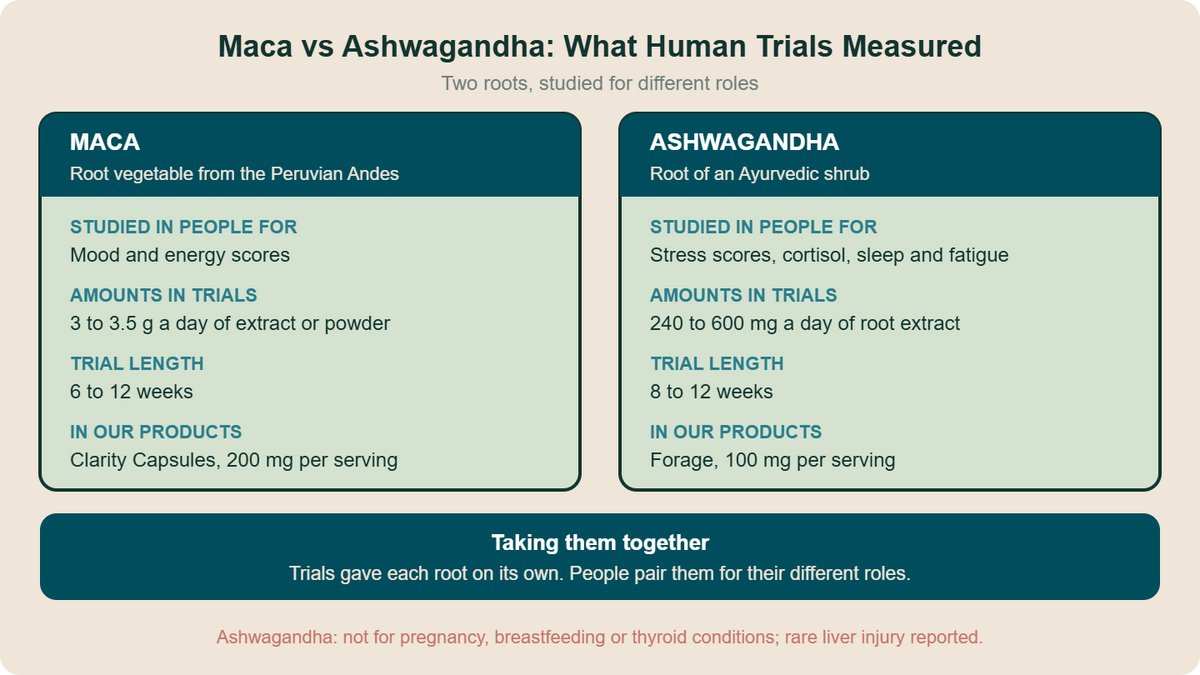
Maca and ashwagandha are both roots, but they have been studied for different things. In human trials, maca was studied for mood and energy scores, while ashwagandha was studied for stress scores, cortisol, sleep and fatigue. Here is how maca vs ashwagandha compares for energy and stress, what the trials used, and how to take maca and ashwagandha together.
Key Takeaways
- Maca is a root from the Andes of Peru. In 175 adults, 3 g a day of red or black maca extract for 12 weeks improved mood and energy scores, with larger mood and energy effects for red maca (Gonzales-Arimborgo et al., 2016).
- Ashwagandha is a root used in Ayurveda. In 64 adults with a history of chronic stress, 300 mg of root extract twice a day for 60 days lowered stress scale scores and serum cortisol compared with placebo (Chandrasekhar et al., 2012).
- For energy, both have human data: maca for energy scores, and ashwagandha for fatigue scores, which fell more than with placebo over 12 weeks in adults aged 40 to 75 (Smith et al., 2023).
- Trials gave each root on its own. People pair them because they were studied for different roles: maca for mood and energy, ashwagandha for stress and sleep.
- Ashwagandha is not for pregnancy, breastfeeding or thyroid conditions, and rare liver injury has been reported, so check with your doctor if you take prescription medicine (LiverTox).

Featured in this article
Clarity Capsules200 mg of maca root extract per 2-capsule serving, with lion's mane, bacopa, rhodiola, epimedium and huperzine A.
Shop Clarity CapsulesThird-party tested ingredients. Vegan capsules, made in the USA.
Maca vs Ashwagandha at a Glance
Maca (Lepidium meyenii) is a root vegetable grown high in the Andes of Peru. Ashwagandha (Withania somnifera) is the root of a shrub used in Ayurveda, the traditional medicine of India, and is often called an adaptogen. Neither one is a stimulant.
| Maca | Ashwagandha | |
|---|---|---|
| What it is | Root vegetable from the Peruvian Andes | Root of an Ayurvedic shrub |
| Studied in people for | Mood and energy scores | Stress scores, cortisol, sleep and fatigue |
| Amounts in trials | 3 to 3.5 g a day of extract or powder | 240 to 600 mg a day of root extract |
| Trial length | 6 to 12 weeks | 8 to 12 weeks |
| Main cautions | Well tolerated in a 12-week trial; ask your doctor if pregnant or on medication | Drowsiness, stomach upset, rare liver injury; avoid in pregnancy and with thyroid conditions |
| In our products | Clarity Capsules, 200 mg per serving | Forage, 100 mg per serving |
For more on each root, see our maca root extract and ashwagandha root extract ingredient pages.
Maca vs Ashwagandha for Energy
Maca trials asked people to rate their energy directly. Ashwagandha trials more often measured fatigue and stress.
What the maca trials measured
The largest maca trial enrolled 175 adults living at low or high altitude in Peru. They took 3 g a day of spray-dried red maca extract, black maca extract or placebo for 12 weeks. Both maca extracts improved mood, energy and health status scores, the effects on mood and energy were larger with red maca, and both extracts were well tolerated (Gonzales-Arimborgo et al., 2016). If you are choosing a color, our guide to black vs red vs yellow maca walks through the differences.
What the ashwagandha trials measured
In a 12-week trial, 120 adults aged 40 to 75 who reported stress and fatigue took 200 mg of ashwagandha root extract twice a day or placebo. Fatigue scores fell more in the ashwagandha group than in the placebo group, and no serious side effects were reported (Smith et al., 2023).
Put simply: maca fits daytime mood and energy support, and ashwagandha fits low energy that comes with stress. For more daytime options, see supplements for energy without the crash.
Stress, Mood and Sleep: What the Trials Show
| Trial | Who and how much | What changed |
|---|---|---|
| Maca: Brooks et al., 2008 | 14 postmenopausal women; 3.5 g a day of maca powder for 6 weeks, crossover with placebo | Lower psychological symptom scores than with placebo; hormone levels measured did not change |
| Ashwagandha: Chandrasekhar et al., 2012 | 64 adults with a history of chronic stress; 300 mg twice a day for 60 days | Lower scores on all stress scales and lower serum cortisol than placebo |
| Ashwagandha: Salve et al., 2019 | 60 stressed healthy adults (58 completed); 250 or 600 mg a day for 8 weeks | Lower perceived stress scores and serum cortisol at both amounts; better sleep quality than placebo |
| Ashwagandha: Lopresti et al., 2019 | 60 stressed healthy adults; 240 mg a day for 60 days | Morning cortisol fell more than with placebo; no adverse events reported |
In the maca crossover trial, psychological symptom scores fell without any change in the hormone levels the researchers measured (Brooks et al., 2008). The ashwagandha stress trials point the same way: lower stress scores and lower cortisol, the body's main stress hormone (Salve et al., 2019; Lopresti et al., 2019).
For sleep, a review that pooled five placebo-controlled trials with 400 adults found a small but significant effect of ashwagandha on overall sleep, with larger effects at 600 mg a day or more and after 8 weeks or longer. Ashwagandha also improved mental alertness on rising (Cheah et al., 2021). Our ashwagandha benefits and maca benefits guides cover each root in more depth.
Can You Take Maca and Ashwagandha Together?
Many people do. The trials above gave each root on its own, so the reason to pair them comes from their different roles: maca was studied for mood and energy scores, and ashwagandha for stress, cortisol and sleep. Together they cover both the energy side and the stress side of a busy week.
- Start one at a time. Begin with one root for a week or two before adding the other, so you can tell how each one suits you.
- Give it weeks, not days. The trials ran 6 to 12 weeks, so judge the pair after a steady routine of daily use.
- Watch for drowsiness. Ashwagandha can cause drowsiness in some people, so notice how you feel in the first days, especially if you also take anything that makes you sleepy.
How to Take Them
Our Clarity Capsules give 200 mg of maca root extract in every 2-capsule serving, along with lion's mane, epimedium, bacopa, rhodiola and huperzine A, in vegan capsules. The suggested use is 2 capsules daily, preferably in the morning on an empty stomach.
Our Forage blend gives 100 mg of ashwagandha root extract in every 2-capsule serving, along with seven 8:1 mushroom fruiting body extracts and Himalayan shilajit, in vegan capsules. The suggested use is two capsules daily, taken in the morning with or without food.
Both are morning products, so they fit one routine. Both also contain lion's mane, so if you take them together you get lion's mane from each. Both are made with third-party tested ingredients. For the wider picture of stress and mood, see our stress, mood and nervous system balance hub.
Safety: Who Should Talk to a Doctor First
Maca
In the 12-week trial of 175 adults, both red and black maca extracts at 3 g a day were well tolerated (Gonzales-Arimborgo et al., 2016). If you are pregnant, breastfeeding or take prescription medicine, ask your doctor before you start.
Ashwagandha
Ashwagandha may be safe for short-term use of up to about 3 months. Some people get drowsiness, stomach upset, diarrhea or vomiting. Avoid it if you are pregnant or breastfeeding, if you have a thyroid condition, or before surgery, and people with hormone-sensitive prostate cancer are advised to avoid it. Talk to your doctor if you take medicine for diabetes, blood pressure, thyroid hormone, seizures, sedatives or immunosuppressants (NCCIH).
Liver injury linked to ashwagandha is rare. In reported cases it appeared 2 to 12 weeks after starting and usually settled within 1 to 4 months of stopping. Stop and call your doctor if you notice yellowing of the skin or eyes, dark urine or itching (LiverTox). Our full guide to ashwagandha side effects has more detail.

Featured in this article
Forage100 mg of ashwagandha root extract per 2-capsule serving, with seven 8:1 mushroom fruiting body extracts and Himalayan shilajit.
Shop ForageThird-party tested ingredients. Vegan capsules, made in the USA.
Frequently Asked Questions
Is maca or ashwagandha better for energy?
It depends on what drains your energy. Maca was studied for energy directly: in a 12-week trial, 3 g a day of red or black maca extract improved energy and mood scores. Ashwagandha was studied for fatigue and stress: fatigue scores fell more than with placebo over 12 weeks. If stress is behind your low energy, ashwagandha fits; for daytime mood and energy, maca fits.
Can you take maca and ashwagandha together?
Yes, many people take maca and ashwagandha together. Trials studied each root on its own, and people pair them because of their different roles: maca for mood and energy scores, ashwagandha for stress, cortisol and sleep. Start one at a time, give the pair several weeks, and check with your doctor first if you are pregnant, have a thyroid condition or take medication.
What is the difference between maca and ashwagandha?
Maca is a root vegetable from the Andes of Peru. Ashwagandha is the root of an Ayurvedic shrub known as an adaptogen. Maca trials used 3 to 3.5 g a day and looked at mood and energy, while ashwagandha trials used 240 to 600 mg of extract and looked at stress, cortisol and sleep.
Should I take maca and ashwagandha in the morning or at night?
Follow the label of the product you use. Our Clarity Capsules, which contain maca, are suggested for the morning, preferably on an empty stomach. Our Forage blend, which contains ashwagandha, is suggested for the morning with or without food. That means both fit one morning routine. Ashwagandha can cause drowsiness in some people, so notice how you feel in the first days.
How long do maca and ashwagandha take to work?
Plan on weeks of daily use. Maca trials measured mood and energy after 6 to 12 weeks. Ashwagandha trials measured stress, cortisol and fatigue after 8 to 12 weeks, and a sleep review found larger effects after 8 weeks or more. Track your energy, stress and sleep once a week.
Which maca color is best for energy?
In the 12-week trial of 175 adults, both red and black maca extracts improved mood and energy scores, and the effects on mood and energy were larger with red maca. Our guide to black, red and yellow maca compares the three in more detail.
Who should not take ashwagandha?
Avoid ashwagandha if you are pregnant or breastfeeding, have a thyroid condition or are about to have surgery. Talk to your doctor first if you take prescription medicine, including thyroid hormone or sedatives. Rare liver injury has been reported, so stop and call your doctor if you notice yellow skin or eyes or dark urine.
Sources
- Gonzales-Arimborgo C, Yupanqui I, Montero E, et al. Acceptability, Safety, and Efficacy of Oral Administration of Extracts of Black or Red Maca (Lepidium meyenii) in Adult Human Subjects: A Randomized, Double-Blind, Placebo-Controlled Study. Pharmaceuticals (Basel), 2016. https://pubmed.ncbi.nlm.nih.gov/27548190/
- Brooks NA, Wilcox G, Walker KZ, Ashton JF, Cox MB, Stojanovska L. Beneficial effects of Lepidium meyenii (Maca) on psychological symptoms and measures of sexual dysfunction in postmenopausal women are not related to estrogen or androgen content. Menopause, 2008. https://pubmed.ncbi.nlm.nih.gov/18784609/
- Chandrasekhar K, Kapoor J, Anishetty S. A prospective, randomized double-blind, placebo-controlled study of safety and efficacy of a high-concentration full-spectrum extract of ashwagandha root in reducing stress and anxiety in adults. Indian Journal of Psychological Medicine, 2012. https://pubmed.ncbi.nlm.nih.gov/23439798/
- Salve J, Pate S, Debnath K, Langade D. Adaptogenic and Anxiolytic Effects of Ashwagandha Root Extract in Healthy Adults: A Double-blind, Randomized, Placebo-controlled Clinical Study. Cureus, 2019. https://pubmed.ncbi.nlm.nih.gov/32021735/
- Lopresti AL, Smith SJ, Malvi H, Kodgule R. An investigation into the stress-relieving and pharmacological actions of an ashwagandha (Withania somnifera) extract: A randomized, double-blind, placebo-controlled study. Medicine (Baltimore), 2019. https://pubmed.ncbi.nlm.nih.gov/31517876/
- Smith SJ, Lopresti AL, Fairchild TJ. Exploring the efficacy and safety of a novel standardized ashwagandha (Withania somnifera) root extract (Witholytin) in adults experiencing high stress and fatigue in a randomized, double-blind, placebo-controlled trial. Journal of Psychopharmacology, 2023. https://pubmed.ncbi.nlm.nih.gov/37740662/
- Cheah KL, Norhayati MN, Husniati Yaacob L, Abdul Rahman R. Effect of Ashwagandha (Withania somnifera) extract on sleep: A systematic review and meta-analysis. PLoS One, 2021. https://pubmed.ncbi.nlm.nih.gov/34559859/
- National Center for Complementary and Integrative Health. Ashwagandha. https://www.nccih.nih.gov/health/ashwagandha
- LiverTox: Clinical and Research Information on Drug-Induced Liver Injury. Ashwagandha. National Institute of Diabetes and Digestive and Kidney Diseases. https://www.ncbi.nlm.nih.gov/books/NBK548536/
These statements have not been evaluated by the Food and Drug Administration. This content is for education and is not medical advice. Our products are not intended to diagnose, treat, cure or prevent any disease. Talk with a healthcare provider before starting a new supplement if you are pregnant, breastfeeding or taking medication.


Leave a comment
All comments are moderated before being published.
This site is protected by hCaptcha and the hCaptcha Privacy Policy and Terms of Service apply.