
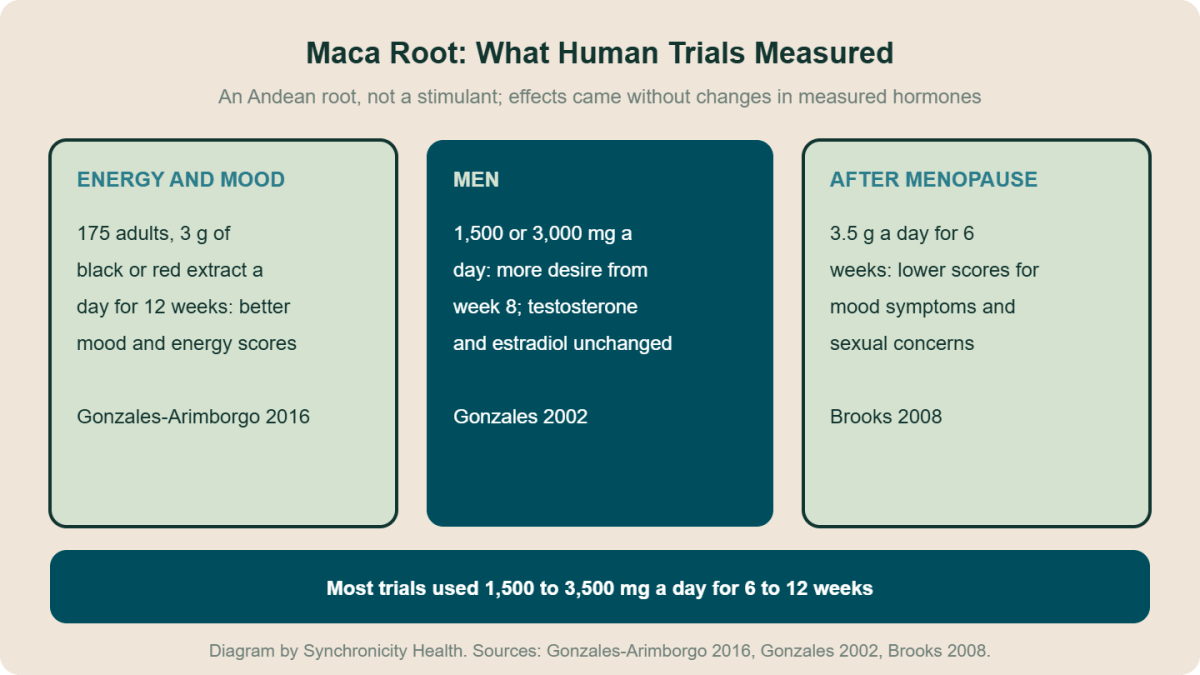
Maca is an Andean root vegetable, and the benefits measured in human trials are energy and mood, sexual desire in men and women, quality of life, and sperm quality in a small pilot, all without changes in testosterone or estrogen levels.
This guide covers what maca is, what each trial measured, the amounts used, the forms you can buy, side effects and where our Clarity Capsules fit. It is educational, not medical advice.
Key Takeaways
- Maca (Lepidium meyenii) is a cruciferous root grown between 4,000 and 4,500 meters in the central Andes of Peru, where it has been cultivated for more than 2,000 years (Gonzales, 2012).
- In a 12-week trial in 175 adults, 3 g a day of black or red maca extract improved mood, energy and quality of life scores compared with placebo (Gonzales-Arimborgo et al., 2016).
- In healthy men aged 21 to 56, 1,500 or 3,000 mg a day improved self-rated sexual desire from week 8, with no change in testosterone or estradiol (Gonzales et al., 2002).
- In women after menopause, 3.5 g a day for 6 weeks lowered scores for mood symptoms and sexual concerns, with no change in hormone levels (Brooks et al., 2008).
- Maca is not a stimulant and contains no caffeine; trials gave it daily for 2 to 12 weeks.

Featured in this article
Clarity CapsulesLion's mane, bacopa, rhodiola, maca, epimedium and huperzine A in a two-capsule morning serving.
Shop Clarity CapsulesThird-party tested ingredients. Caffeine-free.
What Is Maca Root?
Maca is a hardy plant in the same family as broccoli, kale and radishes. The part people eat is the swollen root, called the hypocotyl, which grows high in the Peruvian Andes. In the highlands, maca is traditionally boiled before eating, and people avoid eating it fresh (Gonzales, 2012).
Dried maca is about 13 to 16 percent protein and rich in essential amino acids, and fresh maca has high amounts of iron and calcium (Gonzales, 2012). It also contains plant compounds called macamides, macaenes and glucosinolates. In lab tests, the most active macamides blocked FAAH, the human enzyme that breaks down the endocannabinoid anandamide (Wu et al., 2013). That finding comes from enzyme tests, not people.
Maca grows in several colors, mainly yellow, black and red, and the colors carry different amounts of these compounds. Our guide to black vs red vs yellow maca compares them in detail, and our maca root extract ingredient guide covers the basics. If you are interested in anandamide itself, our anandamide supplement provides it alongside PEA, OEA and L-theanine in each 2-capsule serving to support a steady mood.
Maca Benefits: What Research Has Measured
| Benefit studied | Who and how long | What was found |
|---|---|---|
| Energy and mood | 175 adults, 3 g extract a day, 12 weeks | Better mood, energy and quality of life scores than placebo |
| Sexual desire in men | Men aged 21 to 56, 1,500 or 3,000 mg a day, 12 weeks | Desire improved from week 8; testosterone and estradiol unchanged |
| Women after menopause | 14 women, 3.5 g a day, 6 weeks, crossover | Lower scores for mood symptoms and sexual concerns; hormones unchanged |
| Exercise | 8 trained male cyclists, 14 days, crossover | Faster 40 km time trial than at the start; higher desire scores than placebo |
| Sperm quality | 20 healthy men aged 20 to 40, 1.75 g a day, 12 weeks | Sperm concentration and motility trended upward; hormones unchanged |
Energy and Mood
The largest maca trial gave 175 adults living at low or high altitude 3 g a day of black maca extract, red maca extract or placebo for 12 weeks. Both maca extracts improved mood, energy and health-related quality of life scores compared with placebo, and red maca did best for mood and energy (Gonzales-Arimborgo et al., 2016). People at low altitude reported more energy from week 2. Because maca contains no caffeine, it is a common pick for people looking for energy without the crash. If you are deciding between maca and ashwagandha, our guide to maca vs ashwagandha compares them for energy and stress.
Libido and Sexual Desire in Men
In a 12-week placebo-controlled trial, healthy men aged 21 to 56 took 1,500 mg or 3,000 mg a day of gelatinized maca or placebo. Self-rated sexual desire improved from week 8. Testosterone and estradiol levels did not differ from placebo, and the effect on desire was independent of mood and anxiety scores (Gonzales et al., 2002).
A systematic review of placebo-controlled trials on sexual function found two trials in healthy people, one in men and one in women after menopause, that reported positive effects on sexual desire or sexual concerns (Shin et al., 2010). Maca is often paired with horny goat weed; our horny goat weed guide covers that pairing, and our guide to supplements to support testosterone covers the hormone side.
Maca for Women After Menopause
In a randomized, double-blind crossover trial, 14 women after menopause took 3.5 g a day of powdered maca for 6 weeks and placebo for 6 weeks. On a standard menopause symptom scale, scores for psychological symptoms, such as anxiety and low mood, and for sexual concerns fell compared with both the start and placebo. Estradiol, FSH, LH and SHBG did not change (Brooks et al., 2008). The authors called the findings preliminary.
Exercise and Endurance
In a small crossover study, 8 trained male cyclists took maca extract or placebo for 14 days each. On maca, their 40 km time trial times improved compared with their starting times, though not compared with placebo, and their self-rated sexual desire improved compared with both (Stone et al., 2009).
Sperm Quality
In a 12-week double-blind pilot, 20 healthy men aged 20 to 40 took 1.75 g a day of milled maca root or placebo. Sperm concentration and motility showed rising trends compared with placebo, while hormone levels did not change significantly (Melnikovova et al., 2015). Animal studies of black maca point the same way, as our maca color guide explains.
Hormones
Maca is often described as a hormone booster, but in trials in men and in women after menopause, its effects on desire and mood came without changes in testosterone, estradiol or other measured hormones (Gonzales et al., 2002; Brooks et al., 2008). Maca contains no hormones.
How Much Maca to Take
Most human trials gave 1,500 to 3,500 mg of maca a day for 6 to 12 weeks, as powder or extract. Give it several weeks: energy was reported from week 2 and desire from week 8 in the trials above.
| Trial | Form and amount | Length |
|---|---|---|
| Adults, energy and mood | Black or red maca extract, 3 g a day | 12 weeks |
| Men, sexual desire | Gelatinized maca, 1,500 or 3,000 mg a day | 12 weeks |
| Women after menopause | Powdered maca, 3.5 g a day | 6 weeks |
| Men, sperm quality | Milled maca root, 1.75 g a day | 12 weeks |
Maca Powder, Gelatinized Maca and Extract
- Raw maca powder is dried, ground root that has not been cooked. Traditionally, maca is boiled before eating rather than eaten fresh.
- Gelatinized maca is cooked under moist heat and pressure so its starch breaks down, which is meant to make it easier to digest (Meissner et al., 2006). The trial in men used this form.
- Maca extract concentrates the root into a smaller serving. The 175-adult trial used spray-dried extracts.
Capsules keep the amount consistent day to day, which matters because the trials gave maca daily for weeks. Some people prefer not to take maca close to bedtime until they know how they respond.
Maca Side Effects and Safety
Maca has been eaten as a food in the Andes for centuries. In the 175-adult trial, black and red maca extracts were well tolerated for 12 weeks with no serious side effects (Gonzales-Arimborgo et al., 2016). Reported side effects include stomach upset or bloating, headache and trouble falling asleep if taken late in the day. Taking it with food or choosing a gelatinized form may help.
- Pregnancy and breastfeeding. Safety data are limited, so check with your healthcare provider first.
- Hormone-sensitive conditions. Even though trials found no hormone changes, talk with your clinician before using maca if you have a hormone-sensitive condition or use hormone therapy.
- Thyroid. Maca is a cruciferous plant, so anyone with a thyroid condition or on thyroid medication should review it with their clinician.
- Medicines. Ask first if you take blood thinners, blood pressure medication or antidepressants.
Where Our Clarity Capsules Fit
Our Clarity Capsules are a caffeine-free daily focus formula. Each 2-capsule serving contains 200 mg of maca root extract alongside lion's mane, epimedium, bacopa, rhodiola and huperzine A, made with third-party tested ingredients. Take two capsules in the morning, with or without food; each bottle holds 30 servings.
Clarity provides maca extract as one part of a broader formula, so take it as directed on the label. Questions are answered on the Clarity FAQ. To learn about another ingredient in the formula, see our guide to bacopa monnieri benefits, and for maca's place among adaptogens, read benefits of adaptogens. Our non-stimulant energy and focus guide brings the topic together.
Featured in this article
Clarity CapsulesLion's mane, bacopa, rhodiola, maca, epimedium and huperzine A in a two-capsule morning serving.
Shop Clarity CapsulesThird-party tested ingredients. Caffeine-free.
Frequently Asked Questions
What is maca root good for?
In human trials, maca improved self-rated energy, mood and quality of life, sexual desire in men, and mood and sexual concern scores in women after menopause. A small pilot also saw rising trends in sperm concentration and motility.
What does maca do for men?
In healthy men, 1,500 or 3,000 mg a day improved self-rated sexual desire from week 8 without changing testosterone. In a pilot in 20 men, sperm concentration and motility trended upward over 12 weeks.
What does maca do for women?
In women after menopause, 3.5 g a day for 6 weeks lowered scores for mood symptoms and sexual concerns, with no change in estradiol or other hormones. Women were also included in the 175-adult energy and mood trial.
Does maca increase testosterone?
Not in the human trials. Its effects on desire came without changes in testosterone or estradiol.
How long does maca take to work?
In the trials, more energy was reported from week 2 and more sexual desire from week 8. Take it daily for several weeks.
Is maca a stimulant?
No. Maca contains no caffeine, and it is often grouped with adaptogens rather than stimulants.
Which color of maca is best?
In the one trial that compared them in people, red maca did best for mood and energy and both black and red improved quality of life. Our guide to black vs red vs yellow maca covers the differences.
Is it safe to take maca every day?
Trials gave maca daily for up to 12 weeks with no serious side effects. Check with your clinician first if you are pregnant, breastfeeding, have a thyroid or hormone-sensitive condition, or take medication.
How much maca is in Clarity Capsules?
Each 2-capsule serving of Clarity Capsules contains 200 mg of maca root extract, along with lion's mane, epimedium, bacopa, rhodiola and huperzine A.
Sources
- Gonzales GF. Ethnobiology and ethnopharmacology of Lepidium meyenii (maca), a plant from the Peruvian highlands. Evidence-Based Complementary and Alternative Medicine, 2012. https://pubmed.ncbi.nlm.nih.gov/21977053/
- Gonzales-Arimborgo C, et al. Acceptability, safety, and efficacy of oral administration of extracts of black or red maca (Lepidium meyenii) in adult human subjects: a randomized, double-blind, placebo-controlled study. Pharmaceuticals, 2016. https://pubmed.ncbi.nlm.nih.gov/27548190/
- Gonzales GF, et al. Effect of Lepidium meyenii (maca) on sexual desire and its absent relationship with serum testosterone levels in adult healthy men. Andrologia, 2002. https://pubmed.ncbi.nlm.nih.gov/12472620/
- Brooks NA, et al. Beneficial effects of Lepidium meyenii (maca) on psychological symptoms and measures of sexual dysfunction in postmenopausal women are not related to estrogen or androgen content. Menopause, 2008. https://pubmed.ncbi.nlm.nih.gov/18784609/
- Stone M, et al. A pilot investigation into the effect of maca supplementation on physical activity and sexual desire in sportsmen. Journal of Ethnopharmacology, 2009. https://pubmed.ncbi.nlm.nih.gov/19781622/
- Melnikovova I, et al. Effect of Lepidium meyenii Walp. on semen parameters and serum hormone levels in healthy adult men: a double-blind, randomized, placebo-controlled pilot study. Evidence-Based Complementary and Alternative Medicine, 2015. https://pubmed.ncbi.nlm.nih.gov/26421049/
- Shin BC, et al. Maca (L. meyenii) for improving sexual function: a systematic review. BMC Complementary and Alternative Medicine, 2010. https://pubmed.ncbi.nlm.nih.gov/20691074/
- Wu H, et al. Macamides and their synthetic analogs: evaluation of in vitro FAAH inhibition. Bioorganic and Medicinal Chemistry, 2013. https://pubmed.ncbi.nlm.nih.gov/23891163/
- Meissner HO, et al. Short and long-term physiological responses of male and female rats to two dietary levels of pre-gelatinized maca (Lepidium peruvianum Chacon). International Journal of Biomedical Science, 2006. https://pubmed.ncbi.nlm.nih.gov/23674962/
These statements have not been evaluated by the Food and Drug Administration. This content is for education and is not medical advice. Our products are not intended to diagnose, treat, cure or prevent any disease. Talk with a healthcare provider before starting a new supplement if you are pregnant, breastfeeding or taking medication.


Leave a comment
All comments are moderated before being published.
This site is protected by hCaptcha and the hCaptcha Privacy Policy and Terms of Service apply.