
Melatonin works the same basic way for women as for men: it is the hormone your brain makes in the dark to tell your body it is night. For women over 40, 50 and 60, the useful points are about dose and timing. Small amounts taken shortly before bed are what studies in adults over 50 used, a 0.3 mg dose brought low nighttime melatonin back to normal levels, and short-term use appears safe for most people.
Key Takeaways
- Your brain makes melatonin in response to darkness, and it helps set your 24-hour body clock; light at night can block it (NCCIH).
- In a lab study of 28 women and 28 men aged 18 to 30, women had a higher nightly melatonin rise and their body clock ran earlier relative to their sleep (Cain et al., 2010).
- In a study of adults over 50, 0.3 mg of melatonin 30 minutes before bed raised nighttime melatonin to normal levels, while 3 mg kept levels high into the daytime (Zhdanova et al., 2001).
- Short-term use appears safe for most people, and the side effects reported are mild, such as headache, dizziness, nausea and sleepiness (NCCIH).
- Melatonin may stay active longer in older people, which is one more reason to favor small doses as the years go by.

Featured in this article
Melatonin Nasal Spray200 mcg of melatonin with L-theanine per serving, for your bedtime routine.
Shop Melatonin Nasal SprayThird-party tested ingredients. Vegan, non-GMO, made in the USA.
How Melatonin Works for Women
Melatonin is a hormone made in the brain in response to darkness. It helps set your circadian rhythm, the internal clock that runs on roughly a 24-hour cycle, and it supports sleep. Light at night can block its production, which is why screens and bright rooms late in the evening matter (NCCIH). Supplemental melatonin is a copy of that same signal, so it works on timing: it tells your body that night has started.
There are a few differences between women and men. In a carefully controlled lab study, researchers paired 28 women and 28 men aged 18 to 30 by their usual wake time. Women had a higher melatonin amplitude, meaning a bigger nightly rise, and their melatonin and body temperature rhythms peaked earlier relative to their sleep. Both groups went to bed at the same clock time, so for women, sleep fell at a later point on their internal clock (Cain et al., 2010). In plain terms, many women's body clocks run a little early, which makes the timing of light, bedtime and any melatonin worth getting right. Our guide to fixing your sleep schedule covers the habits side.
Melatonin After 40, 50 and 60
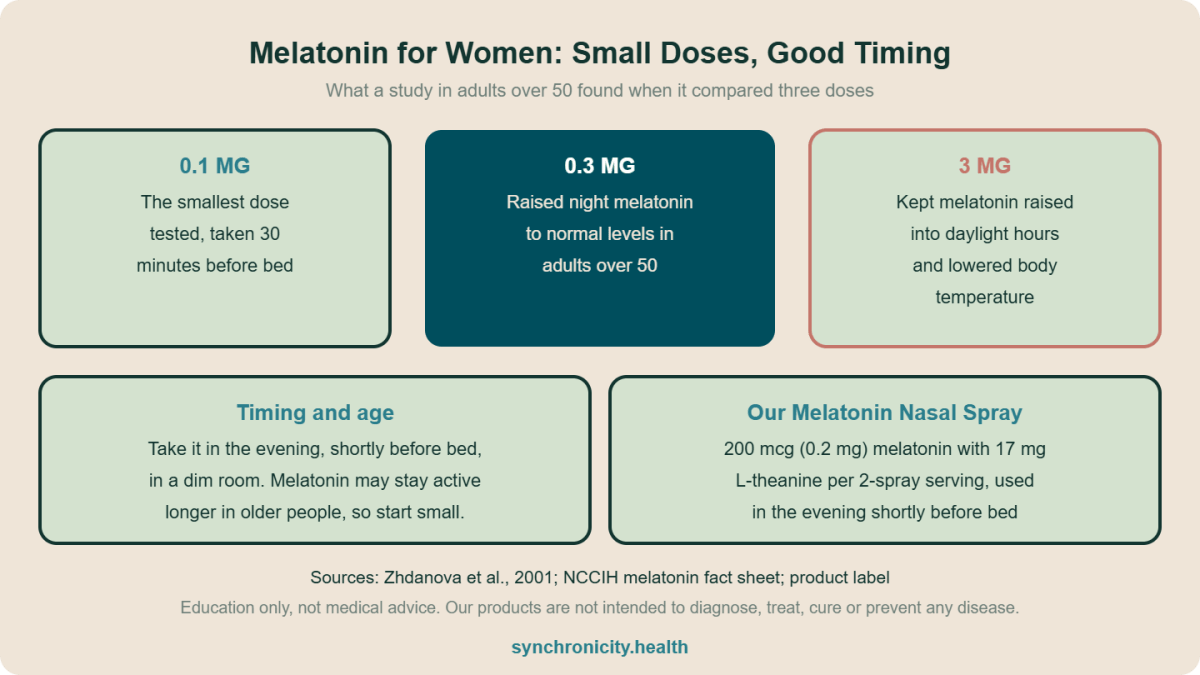
The most useful age data comes from a study of 30 adults over 50. Half slept well and half had poor sleep measured in the lab. Both groups had low nighttime melatonin levels, including the good sleepers. Each person tried a placebo and three doses, 0.1 mg, 0.3 mg and 3 mg, taken 30 minutes before bed for a week at a time (Zhdanova et al., 2001):
| Dose tested | What the study found |
|---|---|
| 0.1 mg | Improved sleep in the poor sleepers |
| 0.3 mg | Raised nighttime melatonin to normal levels and improved sleep efficiency in the poor sleepers, mainly in the middle of the night |
| 3 mg | Also improved sleep, but kept melatonin raised into daylight hours and lowered body temperature |
The good sleepers' sleep did not change at any dose, and the poor sleepers were a small group, so this is an early result in that group rather than a promise. The clear lesson is about dose: a small amount matched the body's own nighttime level, while ten times more spilled over into the next day.
That fits a second point from the National Institutes of Health: melatonin may remain active longer in older people and can cause daytime drowsiness (NCCIH). So whether you are in your 40s, 50s or 60s, the same rule applies, and it matters more each decade: start small.
How Much Melatonin Should a Woman Take?
There is no separate dose for women. The amounts studied in adults over 50 ranged from 0.1 mg to 3 mg, and the lowest doses did the most targeted job. Label accuracy is another reason to choose carefully: a 2017 test of 31 melatonin supplements found that for most, the amount inside did not match the label (NCCIH).
A practical approach:
- Start with a low amount, in the 0.1 to 0.3 mg range used in the study above.
- Take it at the same time each night.
- If you feel groggy the next morning, the dose is likely too high or taken too late.
Our melatonin dosage guide covers amounts in more detail, and how long melatonin lasts explains next-day grogginess.
When to Take Melatonin
Melatonin works on timing, so when you take it matters as much as how much. The study in adults over 50 used 30 minutes before bed. In a 4-week trial of 307 people whose body clocks ran late, taking melatonin 1 hour before the desired bedtime, together with a set bedtime, helped them fall asleep an average of 34 minutes earlier (NCCIH). For most women, the evening, shortly before bed, in a dim room, is the simple rule.
Why Is Melatonin Only for Over 55 in Some Countries?
If you have seen melatonin described as only for people over 55, that does not reflect the rules in the United States, where melatonin is sold over the counter as a supplement. In several other countries, melatonin is regulated more strictly and is available only with a prescription (NCCIH), so rules, including any age limits, vary by country. Nothing in how melatonin works switches on at 55; the age research above simply favors smaller doses as you get older.
Is Melatonin Safe for Women?
Short-term use of melatonin appears safe for most people. A 2015 review reported only mild side effects: headache, dizziness, nausea and sleepiness (NCCIH). Keeping the dose small and taking it at bedtime helps avoid next-day sleepiness. Our melatonin side effects guide goes deeper.
Check with your clinician first if you are pregnant or breastfeeding, if you take prescription medicine, or if you are going through menopause and take medication. If you plan to use melatonin nightly for months, that is also worth a conversation with your clinician.
If You Prefer to Skip Melatonin
Some women would rather not take a hormone at all, or want something for nights when melatonin is not the right fit. Our guide to sleep supplements without melatonin covers the options. Our Melatonin-Free Sleep Powder is coming soon: tart cherry, 3 g of glycine, 200 mg of magnesium from two gentle forms, myo-inositol and apigenin, stirred into water 30 to 60 minutes before bed, with no added melatonin, no 5-HTP and no added sugar or sweeteners. You can join the waitlist on its page.
Where Our Melatonin Nasal Spray Fits
Our Melatonin Nasal Spray gives 200 mcg (0.2 mg) of melatonin with 17 mg of L-theanine in every 2-spray serving, in alkaline water. That sits within the low range used in the study of adults over 50. Use it in the evening shortly before bed. It is absorbed through the lining of the nose, so some of each dose skips digestion, and it is made with third-party tested ingredients. Our guide to melatonin and L-theanine explains why the two are paired, and our melatonin ingredient page and sleep health guide cover the basics.

Featured in this article
Melatonin-Free Sleep PowderTart cherry powder and tart cherry extract with glycine, magnesium and apigenin in an unsweetened drink that helps you wind down at night, with no added melatonin.
Join the WaitlistComing soon. Third-party tested ingredients.
Frequently Asked Questions
Is melatonin good for women over 50?
Many women over 50 use it at bedtime. In a study of adults over 50, a small 0.3 mg dose raised nighttime melatonin to normal levels, while a 3 mg dose kept levels high into the daytime, so start small.
How much melatonin should a woman over 50 take?
The study in adults over 50 tested 0.1 mg, 0.3 mg and 3 mg, and the lower doses matched the body's own nighttime level. Starting in the 0.1 to 0.3 mg range is a sensible approach.
Is melatonin OK for women over 40?
Short-term use appears safe for most adults, with mild side effects such as headache or sleepiness. Check with your clinician first if you take prescription medicine.
Can women over 60 take melatonin?
Yes, but keep the dose small. Melatonin may stay active longer in older people and can cause daytime drowsiness, so low amounts taken at bedtime are the better fit.
Does melatonin decrease with age?
In the study of adults over 50, both good and poor sleepers had low nighttime melatonin levels, and a 0.3 mg dose brought them back to normal.
Why is melatonin only for over 55?
That is not a US rule: in the United States, melatonin is sold over the counter. Several other countries regulate melatonin more strictly and make it available only with a prescription, so rules vary by country.
When should a woman take melatonin?
In the evening, shortly before bed. Studies used 30 minutes to 1 hour before bedtime, and a dim room helps, since light at night can block melatonin.
Can I take melatonin every night?
Short-term nightly use appears safe for most people. If you plan to use it every night for months, talk it over with your clinician.
Sources
- National Center for Complementary and Integrative Health (NIH). Melatonin: What You Need To Know. Updated May 2024. https://www.nccih.nih.gov/health/melatonin-what-you-need-to-know
- Cain SW, et al. Sex differences in phase angle of entrainment and melatonin amplitude in humans. Journal of Biological Rhythms, 2010. https://pubmed.ncbi.nlm.nih.gov/20679498/
- Zhdanova IV, et al. Melatonin treatment for age-related insomnia. Journal of Clinical Endocrinology and Metabolism, 2001. https://pubmed.ncbi.nlm.nih.gov/11600532/
These statements have not been evaluated by the Food and Drug Administration. This content is for education and is not medical advice. Our products are not intended to diagnose, treat, cure or prevent any disease. Talk with a healthcare provider before starting a new supplement if you are pregnant, breastfeeding or taking medication.


Leave a comment
All comments are moderated before being published.
This site is protected by hCaptcha and the hCaptcha Privacy Policy and Terms of Service apply.