
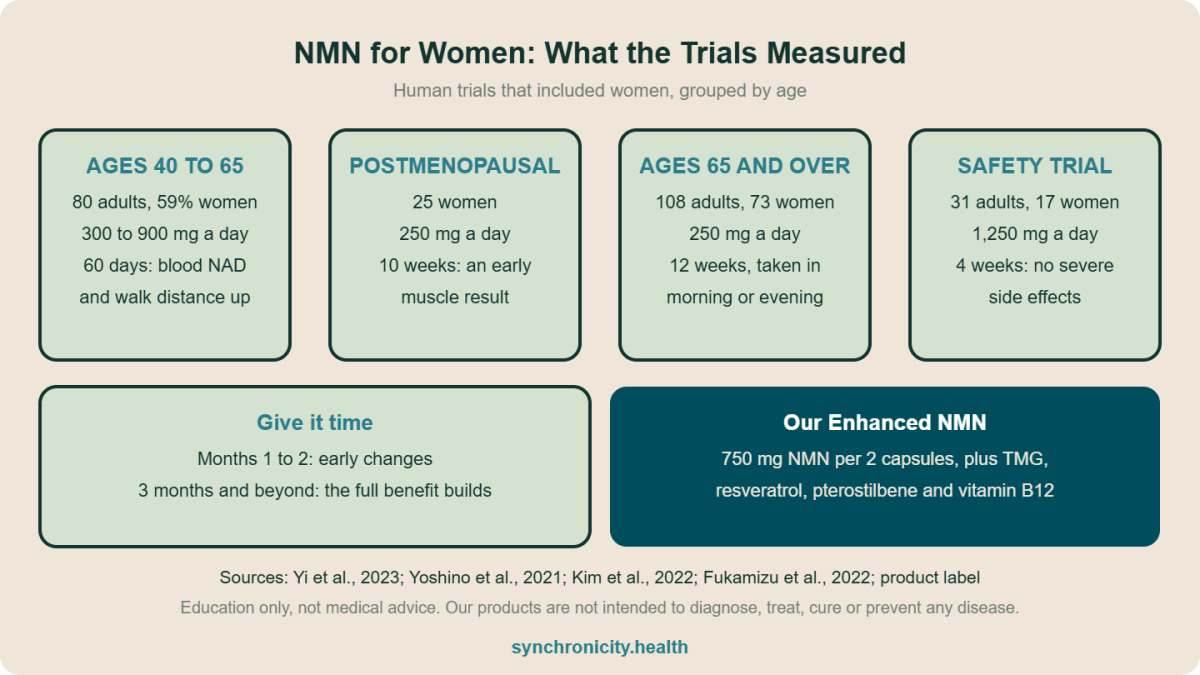
NMN for women is studied for healthy aging, energy at the cellular level and physical function, and several human trials have included women in their 40s, 50s and beyond. The best known is a 2021 trial in which postmenopausal women took 250 mg of NMN a day for 10 weeks, and other trials with mostly female groups used 250 to 900 mg a day for 2 to 3 months. Here is what each study measured, who took part and how women use NMN day to day.
Key Takeaways
- NMN is a building block your cells use to make NAD+, a molecule that cells rely on to turn food into usable energy.
- In a 10-week trial, 25 postmenopausal women took 250 mg of NMN or a placebo daily; muscle measures improved in the NMN group in this small, early trial (Yoshino et al., 2021).
- In 80 adults aged 40 to 65 (59 percent women), 300, 600 or 900 mg a day for 60 days raised blood NAD and walking distance on a six-minute walk test (Yi et al., 2023).
- In 108 adults aged 65 and over, 73 of them women, 250 mg a day for 12 weeks was studied in the morning and in the evening (Kim et al., 2022).
- Most people tolerate NMN well; a 4-week safety trial at 1,250 mg a day, with 17 women among 31 adults, found no severe side effects (Fukamizu et al., 2022).

Featured in this article
Enhanced NMN750 mg of NMN plus resveratrol and pterostilbene per serving, in a daily capsule.
Shop Enhanced NMNThird-party tested ingredients. Vegan, non-GMO, made in the USA.
What NMN Does in a Woman's Body
NMN (nicotinamide mononucleotide) is one step away from NAD+, a molecule found in every cell. NAD+ helps the enzymes that turn food into energy and keep cells in good repair. Your body makes NMN on its own from forms of vitamin B3, and taking NMN gives cells extra raw material for NAD+. Our guide to why NAD+ declines with age explains why this matters more as the years go on.
The way NMN works is the same in women and men. What differs is who took part in each study. Some NMN trials enrolled only men, such as a 2022 trial in which healthy older men took 250 mg a day for 6 or 12 weeks and raised their blood NAD+ (Igarashi et al., 2022). Others were mostly or entirely women, and this guide focuses on those. For the bigger picture on NAD+ by sex, see NAD+ benefits for women and men.
NMN Trials That Included Women
| Trial | Who took part | Daily NMN and length | What was measured |
|---|---|---|---|
| Liao et al., 2021 | 48 amateur runners aged 27 to 50, 8 of them women | 300, 600 or 1,200 mg for 6 weeks | Aerobic capacity during exercise testing |
| Yi et al., 2023 | 80 healthy adults aged 40 to 65, 59 percent women | 300, 600 or 900 mg for 60 days | Blood NAD, six-minute walk, a well-being survey |
| Yoshino et al., 2021 | 25 postmenopausal women with overweight or obesity and prediabetes | 250 mg for 10 weeks | Muscle and liver measures |
| Kim et al., 2022 | 108 adults aged 65 and over, 73 of them women | 250 mg for 12 weeks, morning or evening | Sleep quality, daytime drowsiness, leg function |
| Fukamizu et al., 2022 | 31 healthy adults aged 20 to 65, 17 of them women | 1,250 mg for 4 weeks | Safety: side effects, blood work, vital signs |
None of these trials was designed to compare women with men head to head, so the honest way to read them is by age group and goal rather than by sex.
The 2021 NMN Trial in Postmenopausal Women
The study most people mean when they search for NMN for women was published in the journal Science in 2021. Twenty-five postmenopausal women with overweight or obesity and prediabetes were randomly assigned to 250 mg of NMN once a day (13 women) or a placebo (12 women) for 10 weeks (Yoshino et al., 2021).
The researchers measured how muscle handles fuel, and that measure improved in the NMN group but not with placebo. NMN also switched on genes linked to muscle remodeling. Other measures, including liver measures, did not change (NIDDK).
It was a small, short trial in one specific group of women, and the lead researcher said it was too early to make recommendations from it. It is an early result in that group, useful mainly because it shows NMN studied directly in women after menopause.
NMN for Women Over 40
The largest trial in this age range enrolled 80 healthy adults aged 40 to 65, and 59 percent of them were women. They took a placebo or 300, 600 or 900 mg of NMN once a day for 60 days (Yi et al., 2023).
- Blood NAD: rose in every NMN group at day 30 and day 60, with the highest levels at 600 and 900 mg.
- Six-minute walk: distance improved more than with placebo at all three amounts.
- Well-being survey: scores on the SF-36, a standard questionnaire on physical and mental well-being, improved more than with placebo in the NMN groups (except 300 mg at day 30).
- Safety: the researchers found no safety concerns in lab tests or reported side effects at any amount.
For active women, a 6-week trial in amateur runners aged 27 to 50 (8 women and 40 men) found that 600 and 1,200 mg a day improved measures of aerobic capacity during exercise testing compared with placebo, alongside a regular training plan (Liao et al., 2021). The group was mostly men, so read it as a supporting result for women. For strength, see our guide to creatine for women.
NMN for Women Over 50 and Over 60
The postmenopausal trial above covers women in their 50s and beyond. For women over 60, the most useful study is a 12-week trial in Japan with 108 adults aged 65 and over, 73 of them women. Each person took 250 mg of NMN or a placebo once a day, either in the morning or in the evening (Kim et al., 2022).
The group taking NMN in the evening showed the largest improvements in daytime drowsiness and in a five-times sit-to-stand test, a simple measure of leg strength. Some measures improved in the placebo groups as well, and the authors said diet was not controlled, so this is an early result. No side effects from NMN were reported.
Over 50, many women also look at vitamin D for bones and muscles. Our guide to vitamin D for women covers the amounts recommended at each life stage.
NMN and Menopause: What the Research Covers
People often search for NMN for menopause because of the 2021 trial. In that study, menopause described who took part; the researchers measured muscle and liver, not menopause itself. So the fair way to put it is that NMN has been studied in women after menopause for muscle and healthy aging, and we do not make claims about menopause, hormones or estrogen.
If you are going through menopause and take medication, talk with your clinician before adding NMN. The same goes if you are pregnant or breastfeeding: check with a clinician first.
How Much NMN Women Take, and When
The trials that included women used 250 to 1,250 mg a day. The two most common amounts were 250 mg, used in the postmenopausal and over-65 trials, and 300 to 900 mg, used in the 40 to 65 trial. The one trial that compared timing found its largest effects with evening use, while most people take NMN in the morning as part of their routine. Our NMN dosage guide covers every amount studied.
Is NMN safe for women?
Most people tolerate NMN well. In a 4-week safety trial, 31 healthy adults aged 20 to 65, 17 of them women, took 1,250 mg a day or a placebo; there were no severe side effects, and blood counts and vital signs stayed within normal ranges (Fukamizu et al., 2022). The 60-day trial found no safety concerns at up to 900 mg a day. Talk with your clinician first if you take prescription medicine, are pregnant or breastfeeding.
Give it time
Benefits build with consistent daily use: months 1 to 2 can bring early changes, and 3 months and beyond is where the full benefit builds.
Where Our Enhanced NMN Fits
Our Enhanced NMN gives 750 mg of NMN in every 2-capsule serving, within the range used in the trials above. Each serving also has 200 mg of trimethylglycine (TMG), 200 mg of resveratrol, 100 mg of pterostilbene and 750 mcg of vitamin B12 as methylcobalamin, with ginger extract in vegan capsules, made with third-party tested ingredients. Take 2 capsules in the morning, with or without food, every day. See NMN and TMG and NMN supplement benefits for more.
Many women pair it with our Vitamin D3 + K2 Drops: vegan vitamin D3 from lichen with vitamin K2 as MK-4 and MK-7, 1 drop a day with a meal that has some fat. Anyone on warfarin or another blood thinner should talk with their clinician first. For more on NMN itself, see our NMN ingredient page and our guide to cellular energy and mitochondrial health.
Featured in this article
Enhanced NMN750 mg of NMN plus resveratrol and pterostilbene per serving, in a daily capsule.
Shop Enhanced NMNThird-party tested ingredients. Vegan, non-GMO, made in the USA.
Frequently Asked Questions
Is NMN good for women?
NMN helps cells make NAD+, which they use for energy, and several trials that included many women found higher blood NAD and better scores on walking and well-being tests. Most women tolerate it well.
What are the benefits of NMN for women over 50?
Trials in women after menopause and in adults over 65, mostly women, measured muscle, leg function and daytime drowsiness, with early positive results at 250 mg a day over 10 to 12 weeks.
Is NMN good for women over 40?
The main trial in adults aged 40 to 65, 59 percent of them women, found higher blood NAD and a longer six-minute walk after 60 days at 300 to 900 mg a day.
Does NMN help with menopause?
NMN has been studied in postmenopausal women for muscle and healthy aging, but those trials did not measure menopause itself, so we make no menopause claims. If you are going through menopause and take medication, check with your clinician first.
How much NMN should a woman take?
Trials that included women used 250 to 1,250 mg a day. Our Enhanced NMN gives 750 mg in 2 capsules taken in the morning.
When should women take NMN?
Once a day works. One trial in adults over 65 saw its largest effects with evening use, while most people take NMN in the morning with their routine.
Is NMN safe for women to take every day?
Daily use is how NMN was studied, and a 4-week trial at 1,250 mg a day found no severe side effects. Check with a clinician first if you are pregnant, breastfeeding or take prescription medicine.
Sources
- Yoshino M, Yoshino J, Kayser BD, et al. Nicotinamide mononucleotide increases muscle insulin sensitivity in prediabetic women. Science, 2021. https://pubmed.ncbi.nlm.nih.gov/33888596/
- National Institute of Diabetes and Digestive and Kidney Diseases. Treatment may improve muscle insulin sensitivity in postmenopausal women. Research update, 2021. https://www.niddk.nih.gov/news/archive/2021/treatment-may-improve-muscle-insulin-sensitivity-in-postmenopausal-women
- Yi L, Maier AB, Tao R, et al. The efficacy and safety of beta-nicotinamide mononucleotide (NMN) supplementation in healthy middle-aged adults. GeroScience, 2023. https://pubmed.ncbi.nlm.nih.gov/36482258/
- Kim M, Seol J, Sato T, et al. Effect of 12-week intake of nicotinamide mononucleotide on sleep quality, fatigue, and physical performance in older Japanese adults: a randomized, double-blind placebo-controlled study. Nutrients, 2022. https://pubmed.ncbi.nlm.nih.gov/35215405/
- Liao B, Zhao Y, Wang D, et al. Nicotinamide mononucleotide supplementation enhances aerobic capacity in amateur runners: a randomized, double-blind study. Journal of the International Society of Sports Nutrition, 2021. https://pubmed.ncbi.nlm.nih.gov/34238308/
- Igarashi M, Nakagawa-Nagahama Y, Miura M, et al. Chronic nicotinamide mononucleotide supplementation elevates blood nicotinamide adenine dinucleotide levels and alters muscle function in healthy older men. npj Aging, 2022. https://pubmed.ncbi.nlm.nih.gov/35927255/
- Fukamizu Y, Uchida Y, Shigekawa A, et al. Safety evaluation of beta-nicotinamide mononucleotide oral administration in healthy adult men and women. Scientific Reports, 2022. https://pubmed.ncbi.nlm.nih.gov/36002548/
These statements have not been evaluated by the Food and Drug Administration. This content is for education and is not medical advice. Our products are not intended to diagnose, treat, cure or prevent any disease. Talk with a healthcare provider before starting a new supplement if you are pregnant, breastfeeding or taking medication.


Leave a comment
All comments are moderated before being published.
This site is protected by hCaptcha and the hCaptcha Privacy Policy and Terms of Service apply.