
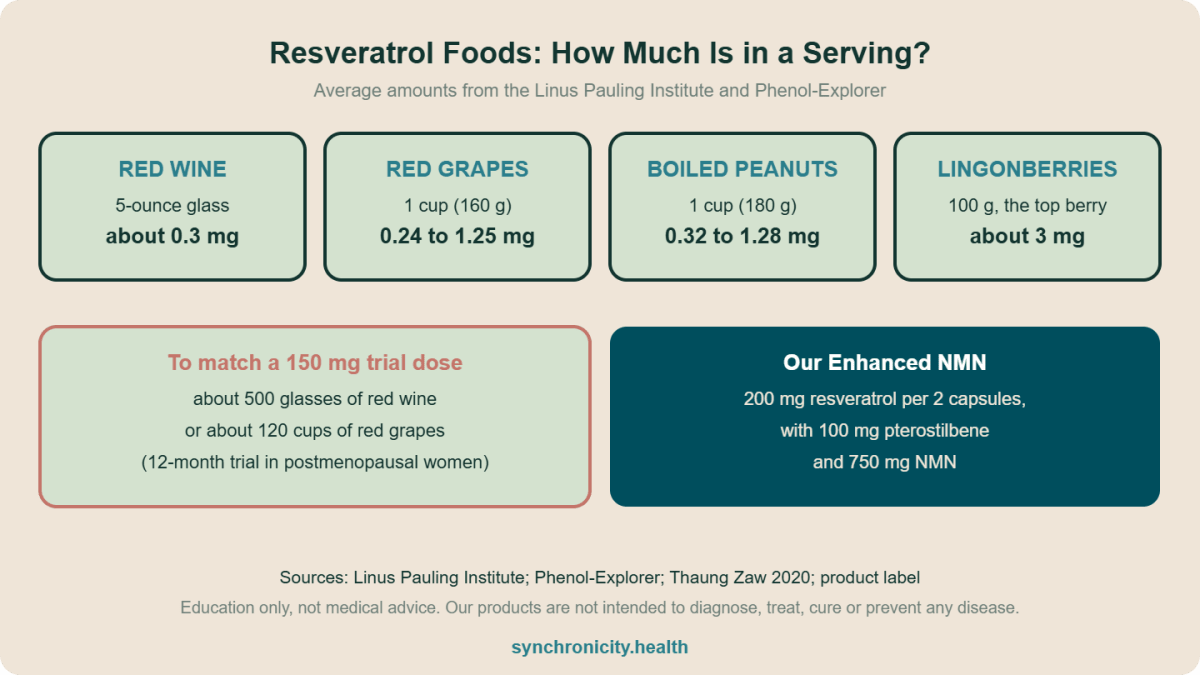
The main resveratrol foods are red grapes, red wine, peanuts, some berries such as lingonberries and cranberries, pistachios and cocoa, but each gives you well under 2 mg a serving. A 5-ounce glass of red wine holds about 0.3 mg on average, and a cup of red grapes 0.24 to 1.25 mg. Human trials have used 150 to 500 mg a day, which is why studied amounts come from supplements rather than food.
Key Takeaways
- Red wines average about 1.9 mg of resveratrol per liter, or roughly 0.3 mg in a 5-ounce glass; Pinot Noir averages the most, at about 0.5 mg a glass (Linus Pauling Institute).
- A cup of red grapes holds 0.24 to 1.25 mg, and a cup of boiled peanuts 0.32 to 1.28 mg (Linus Pauling Institute).
- Among measured foods, lingonberries rank highest at about 3 mg per 100 g, followed by European cranberries and red currants (Phenol-Explorer).
- Matching the 150 mg a day used in a 12-month trial would take about 500 glasses of red wine (Thaung Zaw et al., 2020).
- Most US resveratrol supplements are made from Japanese knotweed root, not from grapes or wine (Linus Pauling Institute).

Featured in this article
Enhanced NMN750 mg of NMN plus resveratrol and pterostilbene per serving, in a daily capsule.
Shop Enhanced NMNThird-party tested ingredients. Vegan, non-GMO, made in the USA.
Why Resveratrol Levels in Food Vary So Much
Resveratrol is a stilbene, a type of polyphenol that plants make when they are stressed, injured, exposed to UV light or attacked by fungi. The amount in any food can vary considerably, so the Linus Pauling Institute says published values should be treated as approximate (Linus Pauling Institute).
The numbers below come from two careful sources: the Linus Pauling Institute at Oregon State University and Phenol-Explorer, a research database that pools published food analyses. For what resveratrol does once you take it, see our guide to NMN and resveratrol and our resveratrol ingredient page.
Foods High in Resveratrol
Phenol-Explorer lists these average amounts per 100 g of food (about 3.5 ounces):
| Food | Resveratrol per 100 g |
|---|---|
| Lingonberries, raw | 3.00 mg |
| European cranberries | 1.92 mg |
| Red currants, raw | 1.57 mg |
| Bilberries, raw | 0.67 mg |
| Strawberries, raw | 0.35 mg |
| Black grapes | 0.15 mg |
| Pistachios, shelled | 0.11 mg |
| Peanuts | 0.08 mg |
| Dark chocolate | 0.04 mg |
| Green grapes | 0.02 mg |
Source: Phenol-Explorer. Berries lead the list, and dark-skinned grapes hold several times more than green ones. Even the top food, lingonberries, gives about 3 mg per 100 g.
How Much Resveratrol Is in a Glass of Red Wine?
About 0.3 mg in a 5-ounce glass, on average. Red wines from around the world average 1.9 mg per liter, though single bottles have measured as high as 14.3 mg per liter. The Linus Pauling Institute lists average amounts by grape (Linus Pauling Institute):
| Red wine | Average per liter | Per 5-ounce glass |
|---|---|---|
| Pinot Noir | 3.6 mg | 0.5 mg |
| Merlot | 2.8 mg | 0.4 mg |
| Zweigelt | 1.9 mg | 0.3 mg |
| Shiraz | 1.8 mg | 0.3 mg |
| Cabernet Sauvignon | 1.7 mg | 0.2 mg |
Rosé and white wines carry less: Phenol-Explorer lists 0.27 mg per 100 ml for red wine, 0.12 mg for rosé and 0.04 mg for white (Phenol-Explorer).
Red wine is not a practical way to get resveratrol. The Linus Pauling Institute notes there is no convincing evidence that the amounts in one or two glasses produce the effects seen in trials, and that pregnant women should not use wine as a resveratrol source (Linus Pauling Institute).
How Much Resveratrol Is in Grapes?
A cup of red grapes (160 g) holds 0.24 to 1.25 mg of resveratrol (Linus Pauling Institute). Dark grapes beat green ones: Phenol-Explorer lists 0.15 mg per 100 g for black grapes and 0.02 mg for green (Phenol-Explorer). Whole grapes are a better everyday choice than wine.
Peanuts, Pistachios and Cocoa
How peanuts are prepared matters. A cup of raw peanuts holds 0.01 to 0.26 mg, a cup of boiled peanuts 0.32 to 1.28 mg, and a cup of peanut butter 0.04 to 0.13 mg (Linus Pauling Institute). Shelled pistachios come in at 0.11 mg per 100 g and dark chocolate at 0.04 mg (Phenol-Explorer).
The Linus Pauling Institute also lists cocoa among resveratrol foods, in small amounts. If cocoa is already part of your day, our Mushroom Cacao is a mushroom hot chocolate made with cocoa, cacao and a high polyphenol, high theobromine cocoa extract, plus 500 mg each of lion's mane and cordyceps 8:1 fruiting body extracts per serving, at 15 calories and 0 g sugar. Its cocoa brings polyphenols and theobromine; it is not a measured source of resveratrol. For more food-first guides, see glutathione foods, urolithin A foods and how to increase NAD+ naturally.
Resveratrol From Food vs a Supplement
The longest human trials gave postmenopausal women 75 mg twice a day, 150 mg in total, for 12 months, and saw better overall cognitive performance compared with placebo (Thaung Zaw et al., 2020). Here is what 150 mg looks like in food, using the averages above:
| Food | Amount to reach 150 mg |
|---|---|
| Red wine at 0.3 mg a glass | About 500 glasses |
| Pinot Noir at 0.5 mg a glass | About 300 glasses |
| Red grapes at 1.25 mg a cup (high end) | About 120 cups |
| Lingonberries at 3 mg per 100 g | About 5 kg (11 pounds) |
None of this makes resveratrol foods a poor choice. Berries, grapes and nuts are worth eating for many reasons, and they add small amounts of resveratrol to your day. If you want the amounts studied in trials, though, a supplement is the only realistic route, and most US supplements use an extract of Japanese knotweed root (Linus Pauling Institute). Pterostilbene, a close relative, is often taken with it; see pterostilbene vs resveratrol, and for the wider picture, our cellular energy hub. For another polyphenol often taken alongside resveratrol, see our guide to resveratrol and quercetin.
Where Our Enhanced NMN Fits
Our Enhanced NMN gives you 200 mg of resveratrol in every 2 capsules, alongside 750 mg of NMN, 100 mg of pterostilbene, 200 mg of trimethylglycine (TMG) and 750 mcg of vitamin B12 as methylcobalamin, with ginger extract and vegan capsules. It is made with third-party tested ingredients. Take 2 capsules in the morning, with or without food.
Benefits build with consistent daily use. Months 1 to 2 can bring early changes, and 3 months and beyond is where the full benefit builds, so keep the berries and grapes on your plate and take the capsules every day.
Featured in this article
Enhanced NMN750 mg of NMN plus resveratrol and pterostilbene per serving, in a daily capsule.
Shop Enhanced NMNThird-party tested ingredients. Vegan, non-GMO, made in the USA.
Frequently Asked Questions
How much resveratrol is in a glass of red wine?
About 0.3 mg in a 5-ounce glass on average, and about 0.5 mg for Pinot Noir, the highest average of the varieties listed.
How much resveratrol is in red wine per liter?
Red wines average about 1.9 mg per liter, with single wines measured as high as 14.3 mg per liter.
How much resveratrol is in grapes?
A cup of red grapes holds 0.24 to 1.25 mg. Black grapes average 0.15 mg per 100 g and green grapes 0.02 mg.
How much resveratrol is in red grapes compared with red wine?
A cup of red grapes can match or beat an average 5-ounce glass of red wine, at 0.24 to 1.25 mg against about 0.3 mg.
What foods are high in resveratrol?
Lingonberries, European cranberries, red currants, bilberries, strawberries, red and black grapes, boiled peanuts, pistachios and dark chocolate are the main measured sources.
Can you get enough resveratrol from food?
Not at trial amounts. Studies used 150 to 500 mg a day, while a serving of food gives you well under 2 mg.
Does white wine have resveratrol?
Very little. Phenol-Explorer lists 0.04 mg per 100 ml for white wine, against 0.27 mg for red.
Where does resveratrol in supplements come from?
Most US supplements use an extract of Japanese knotweed root, also called Polygonum cuspidatum.
Sources
- Linus Pauling Institute Micronutrient Information Center. Resveratrol. Oregon State University. https://lpi.oregonstate.edu/mic/dietary-factors/phytochemicals/resveratrol
- Neveu V, et al. Phenol-Explorer: an online comprehensive database on polyphenol contents in foods. Resveratrol entry. http://phenol-explorer.eu/contents/polyphenol/592
- Thaung Zaw JJ, Howe PRC, Wong RHX. Sustained cerebrovascular and cognitive benefits of resveratrol in postmenopausal women. Nutrients, 2020. https://www.mdpi.com/2072-6643/12/3/828
These statements have not been evaluated by the Food and Drug Administration. This content is for education and is not medical advice. Our products are not intended to diagnose, treat, cure or prevent any disease. Talk with a healthcare provider before starting a new supplement if you are pregnant, breastfeeding or taking medication.


Leave a comment
All comments are moderated before being published.
This site is protected by hCaptcha and the hCaptcha Privacy Policy and Terms of Service apply.